
The Perils of Global State and Poorly Scoped Variables
Description
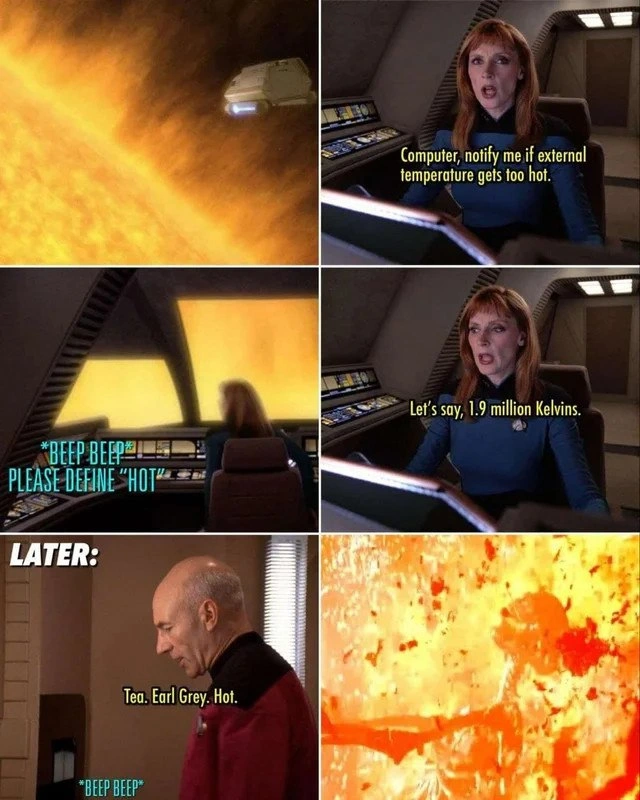
This is a six-panel meme using screenshots from the TV series 'Star Trek: The Next Generation' to illustrate a classic programming bug. In the first panels, Dr. Crusher, piloting a shuttle near a star, asks the computer to notify her if the external temperature gets 'too hot,' specifying a threshold of 1.9 million Kelvins after the computer asks for a definition. The third row, labeled 'LATER:', shows Captain Picard ordering his customary 'Tea. Earl Grey. Hot.' from the replicator. Immediately after he says 'Hot,' a beep is heard, and the final panel shows a fiery explosion, implying Crusher's shuttle was destroyed. The joke is a perfect allegory for a critical software bug caused by global state or a poorly scoped variable. The 'hot' alert threshold, set in one specific, high-stakes context (starship safety), was triggered by a completely unrelated, low-stakes command in another part of the system (making tea). It hilariously demonstrates the dangers of namespace pollution and why context is king in software architecture

Comments
9Comment deleted
This is a textbook case of a critical bug report: 'Setting replicator to 'hot' triggers stellar proximity alert. Steps to reproduce: 1. Fly into a star. 2. Order tea. Expected result: A nice beverage. Actual result: Rapid, unscheduled disassembly.'
Refactor reminder: namespacing config keys isn’t over-engineering - it’s the difference between HullMonitor setting HOT=1.9e6 and BeverageService filing a Sev-0 titled “Earl Grey - Corona Edition.”
This is basically every production incident where someone forgot to namespace their variables and the intern's test config overwrote the CEO's personal preferences in the global state manager
Nobody defined 'hot' as a scoped constant, so the tea brewer and the hull-temperature alarm shared the same global - classic naming collision with a fatal blast radius
This perfectly captures why production monitoring alerts need proper context and scope. Setting a temperature threshold at 1.9 million Kelvin is technically correct for solar proximity warnings, but when your monitoring system lacks semantic understanding and treats all 'hot' keywords equally, you end up with alert fatigue from the replicator. It's the distributed systems equivalent of setting your disk space alert at 99.9% and wondering why the log rotation job keeps paging you at 3 AM - technically functioning as specified, catastrophically useless in practice
The replicator's YAML lacked units - 'hot' defaulted to photosphere temp, prod meltdown ensues
Strongly type your units: otherwise “Earl Grey, hot” evaluates to 1.9e6 K and the beverage service pages the warp-core on-call
Hot tip: never share enums across services - SRE set HOT=1.9e6 K and the coffee machine achieved fusion
reminds me of Dilbert's first episode. "It's not something something space oddisey, it's 2001, A space odissey" Comment deleted