Skip to content
DevMeme
4425 of 7435
When you learn devs really copy StackOverflow code, fish disbelief ensues
DevCommunities Post #4847, on Sep 7, 2022 in TG

When you learn devs really copy StackOverflow code, fish disbelief ensues

Why is this DevCommunities meme funny?

Level 1: Everybody Does It

Imagine you’re in class and you always thought the smartest kids do all their homework without any help. Then one day, you find out those kids are actually peeking at an answer book or Googling answers when they’re stuck. You’d be surprised, right? You might even laugh and say, “Wait, you guys actually copy answers? I thought that was just a joke!” This meme is like that, but for computer programmers. It’s funny because the character in the picture just realized something unexpected: even the “grown-up” programmers sometimes copy bits of code from the internet to get their work done. It’s a lighthearted way of saying, “Don’t be shocked – everybody does it!” The humor comes from that surprised feeling when you learn that getting help (like using a recipe or an answer key) is totally common, even for the experts.

Level 2: From Joke to Reality

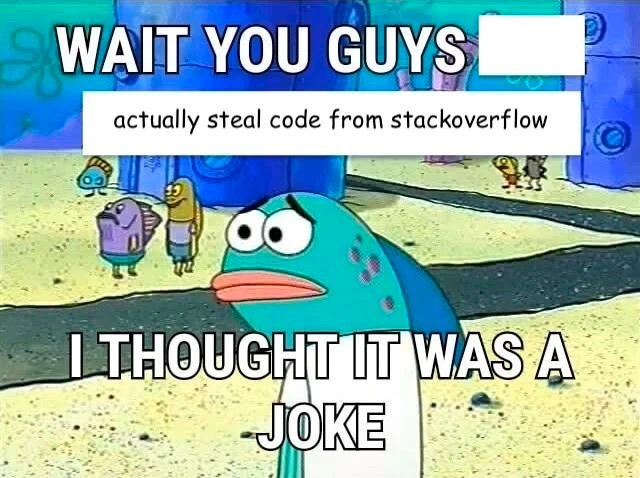
This meme is all about a surprised discovery in the developer world. The top text says “WAIT YOU GUYS…” and the bottom exclaims “I THOUGHT IT WAS A JOKE,” with a phrase about stealing code from Stack Overflow in the middle. Stack Overflow is a famous Q&A website where programmers ask questions and get answers (often including handy code snippets) from the community. It’s basically a huge forum of coding knowledge. CopyPasteCoding (also called copy-paste programming) refers to when someone literally copies code from an outside source (like an answer on Stack Overflow) and pastes it into their own project. Developers often joke about doing this because it’s a quick way to solve problems — you search for your error or task, find a snippet that fits, and boom, you drop it into your code. The meme’s text is formatted like a search bar query (“actually steal code from stackoverflow”), which emphasizes the shock: the character is so astonished that they’re essentially searching for confirmation, as if saying, “Wait, do people seriously do this?!”.

Why is this funny or surprising? In learning settings (like coding bootcamps or college), there’s a big emphasis on writing your own code and truly understanding it. Copying someone else’s code verbatim can feel like “cheating” or at least not learning. So a newer developer might think that all the jokes about engineers copy-pasting from Stack Overflow are just exaggerated humor. The punchline “I thought it was a joke” is literally the character expressing that they never took those memes seriously—until now. The fish’s shocked face from SpongeBob SquarePants represents that newbie developer who just found out that copying code from the internet is extremely common in real life development. It’s a very relatable humor moment because almost every programmer has done a quick Google search for an example or solution. In fact, knowing how to effectively search for solutions is considered a valuable skill. Experienced devs often reassure juniors that you’re not expected to memorize every library function or algorithm — instead, you should know how to find answers (often on Stack Overflow or official docs).

However, the meme also hints at concerns about code quality and learning. Copying code without understanding it can lead to problems. For instance, the code might not exactly fit your situation, or it could be outdated or have bugs. If a developer just pastes it and moves on, they might introduce a bug or security issue unknowingly. There’s even a playful term, “StackOverflow driven development,” for when a codebase is basically built by stringing together solutions found online. That’s why a lot of mentors advise: it’s okay to use code from Stack Overflow, but make sure you read it, test it, and understand it. The meme exaggerates the scenario to make us laugh — picturing someone literally saying, “Wait, you guys actually steal code from StackOverflow? I thought it was a joke” out loud. It’s funny because it’s both true and not true: True, many of us copy snippets; not true, we don’t consider it “stealing” in a bad way so much as sharing knowledge. In developer communities, reusing code is normal (that’s why we have open-source!). But for someone new, discovering this feels like finding out a secret. They’re half-amazed and half-concerned, which is exactly the mix of feelings the big-eyed SpongeBob fish conveys.

Level 3: Copy-Paste Culture Shock

The meme captures a dev community rite of passage: discovering that Stack Overflow-driven development is very real. The shocked fish from SpongeBob’s Bikini Bottom represents a junior developer’s wide-eyed realization that experienced colleagues literally copy code from Stack Overflow. This isn’t a rare confession—it’s practically an open secret in programming circles. The top text styled like a search bar (“actually steal code from stackoverflow”) is a tongue-in-cheek detail: it’s as if the bewildered dev is Googling whether this practice is actually happening. The surprised fish character with bulging eyes embodies that “Wait… seriously?!” moment familiar to anyone who’s had their assumptions in tech flipped upside-down.

Behind the humor lies a commentary on learning habits and code quality. In theory, developers strive to write clean, original code and thoroughly understand what they build. In practice, tight deadlines and the vast expanse of programming knowledge mean that even senior engineers turn to Stack Overflow as a quick reference. Why reinvent the wheel when a solution — often a code snippet vetted by hundreds of upvotes — is one search away? This pragmatic approach leads to what some jokingly call “CopyPasteProgramming” or Stack Overflow dependency. It’s so pervasive that one could jokingly imagine adding import StackOverflow at the top of a Python script as a standard library. The meme’s punchline “I thought it was a joke” resonates because newcomers often hear quips about devs copy-pasting code, assuming it’s hyperbole — until they catch a teammate literally doing it. The shock_realization is both funny and a bit unsettling: if pro coders are borrowing solutions, what does that mean for originality and expertise?

From a seasoned developer’s perspective, this scenario is relatable humor with a pinch of dark truth. Yes, we search error messages and copy answers during crunch time (who hasn’t grabbed a nifty StackOverflow one-liner to fix a nagging bug at 3 AM?). But there’s a code quality trade-off. Blindly pasting code can inject unknown bugs or stylistic inconsistencies into a codebase. One famous cautionary tale: a security bug from a copied Stack Overflow snippet replicated across dozens of projects because so many devs copied the same flawed code. Stealing code from StackOverflow without understanding is like copying someone’s homework – you might get the answer, but you won’t learn the material (and if the answer was wrong, everyone’s in trouble). Experienced devs know to use these snippets as a starting point: test them, refactor variable names, ensure the solution actually fits the problem context. The humor is that, despite these risks, just about everyone in software has done it. The copy_paste_confession vibe of the meme pokes fun at this collective guilty habit. It’s a shared secret among developers: the real skill isn’t knowing everything, it’s knowing how to quickly find and adapt answers from the community.

The irony runs deeper when you consider the ideals versus reality. In school, “copying” is cheating, but in the real-world dev community, reusing code is often smart and efficient. After all, sites like Stack Overflow exist exactly to share knowledge and snippets. The DevCommunities culture encourages learning from each other – the Q&A format is built on the idea that solving a problem once can help countless others. It’s a form of collaborative learning. Yet, the meme highlights a potential stackoverflow_dependency_issue: over-reliance on copying answers can become a crutch. New developers might skip truly learning in favor of quick fixes, leading to shallow understanding. This is the “I thought it was a joke” shock: realizing how much day-to-day development relies on Google searches and community answers, rather than some encyclopedic brain archive of code. The humor has a self-deprecating edge for senior devs too – we laugh because we’ve all pasted something we didn’t fully write. It’s funny and a tad humbling: even the pros lean on collective knowledge. In the technicolor streets of Bikini Bottom (or any open-plan office), the scenario plays out every day. The meme cleverly uses a SpongebobMeme to underscore a real software engineering insight: StackOverflow is as much a tool in our toolbox as our IDE. And the shocked fish? That’s each of us, the first time we caught ourselves copying code and realized “Wait, everybody does this?!”.

Description

A single-frame Spongebob Squarepants reaction meme shows a blue-green, spotted fish standing on a sandy Bikini Bottom street, eyes wide and mouth slightly open in shock. Large white uppercase text across the top says “WAIT YOU GUYS”, followed by a white search-bar style strip that reads “actually steal code from stackoverflow” in smaller black type. Bold white uppercase lettering at the bottom exclaims “I THOUGHT IT WAS A JOKE”. The startled expression visualizes the moment a developer discovers that colleagues literally copy-paste snippets from Stack Overflow, poking fun at pervasive community reliance and the potential impact on learning habits and code quality

Comments

14
Anonymous ★ Top Pick Our SBOM review got awkward when I had to list “Stack Overflow Accepted Answer #1234567 (circa 2012)” as our largest third-party dependency - apparently copy-paste accrues legal debt too
  1. Anonymous ★ Top Pick

    Our SBOM review got awkward when I had to list “Stack Overflow Accepted Answer #1234567 (circa 2012)” as our largest third-party dependency - apparently copy-paste accrues legal debt too

  2. Anonymous

    The moment you realize that 'Stack Overflow Driven Development' isn't just a meme but an actual architectural pattern, and that half of production code is essentially crowd-sourced solutions held together by upvotes and the desperate hope that the accepted answer from 2012 still works with your current framework version

  3. Anonymous

    The real senior move isn't admitting you copy from Stack Overflow - it's knowing which answers are from 2012 and need three dependency upgrades, two security patches, and a complete architectural rethink before they'll even compile in your modern stack

  4. Anonymous

    The real joke: that SO copy-paste outlives your greenfield rewrite in prod

  5. Anonymous

    In our org, Stack Overflow is a transitive dependency with no semver, murky CC BY-SA licensing, and APIs that deprecate faster than our incident postmortems

  6. Anonymous

    SO-DD in action: ship the accepted answer to prod, then treat the comment thread as your only documentation and transitive SBOM entry

  7. Deleted Account 3y

    From the questions too baby

  8. @s2504s 3y

    That's true 💁‍♂

  9. @s2504s 3y

    ctrl+c; ctrl+v

    1. @Saeid025 3y

      ctrl+c, ctrl+c, ctrl+c, ctrl+c ... ctrl+v

      1. @affirvega 3y

        copy seven times, paste one time

        1. @SamsonovAnton 3y

          That would be counter-productive. Better do quite the opposite — paste each snippet at least 7 times — to increase your LoC count and thus get paid more for using the code you did not even write! 🤑 Be copy-positive!

          1. @affirvega 3y

            Bbbbut what it Ctrl c didn't work the first time? Then you'd be paying previous loc

            1. @SamsonovAnton 3y

              Then that would form a solid foundation for future bug-fixes! 😎

Use J and K for navigation