Calling the SSL cat: a punny 'httpspspsps' joke for web security devs
Why is this Security meme funny?
Level 1: Nerdy Cat Call
Think of it this way: it’s funny because a very serious thing is being used in a very silly way. Imagine if your teacher always uses a big important word in class, and then one day you hear them use that word to call their cat. It would sound really goofy! In this meme, a technical term (basically the thing that makes websites secure, kind of like a secret padlock on the internet) is combined with the "pspsps" sound people use to call cats. It’s an unexpected mix. Calling a cat is usually casual and playful, not high-tech. So hearing those two worlds collide – a nerdy web phrase and a kitty-catching sound – makes people giggle. In short, it’s funny because it’s like using a secret web safety code as a cat’s name and call. It’s just so absurd that you can’t help but smile at it.
Level 2: Secure S & Silly Sounds
Let’s break down the joke in plain terms. SSL stands for Secure Sockets Layer. It’s a technology used to secure internet connections by encrypting data between two computers (for example, your browser and a web server). Nowadays, SSL’s job is carried on by TLS (Transport Layer Security), which is like SSL’s updated version. But many people still just say “SSL” when talking about this kind of web security.
Now, HTTP stands for HyperText Transfer Protocol. It’s the basic protocol for the web – essentially how your browser requests pages and how servers send them. When you add an S and make it HTTPS, it means HTTP Secure. HTTPS is just HTTP combined with SSL/TLS encryption. In practice, when a site uses HTTPS, your browser shows a little padlock icon 🔒 in the address bar, indicating the connection is secure. All data sent over HTTPS is scrambled (encrypted) so that no one can read it if they intercept it. This is important for things like passwords, credit card numbers, or any personal info – you don’t want those flying around in plain text.
If you’re new to web development, setting up HTTPS is one of those early milestones. For example, you might use a service like Let’s Encrypt to get an SSL certificate for your website. That certificate is like a digital ID card for your site, helping browsers verify it’s really your site and not an impostor. You then configure your web server to use this certificate and its private key. Once it’s all set up, your site’s URL will start with https:// and users will see the padlock, meaning their connection to you is safely encrypted.
On the other side of this meme, we have the “pspsps” sound. If you’ve ever tried calling a cat, you might have used or heard this sound. People often go “pspsps” (it sounds like a soft, repetitive pss-pss-pss) to attract cats. It’s almost universal – even a cat that ignores everything might perk up if you make that sound. It’s basically the feline version of saying “here, kitty kitty,” using a whispery, enticing noise that cats respond to.
So the meme asks: “How do you call the cat named SSL?” The answer given is httpspspsps. This answer literally mashes together “https” and “pspsps”. You can think of it like: https + pspsps = httpspspsps. Imagine saying “HTTPS” (the secure web address prefix) and immediately following it with “pspsps” (the kitty-calling sound). It’s a playful pun that mixes a cybersecurity term with a cat noise.
Why is this funny to developers? Because it combines two very different things we deal with. On one hand, we work with serious web development and security stuff like HTTPS and SSL – making sure websites are safe and data is protected. On the other hand, many of us are pet lovers or at least enjoy a good pet joke. The idea of using a dry tech term as if it’s part of a cat-call is unexpected. It’s like if a doctor used a medical term to call their dog – it would sound silly, right? Here a serious computer word becomes part of a funny animal sound, and that surprise makes us laugh.
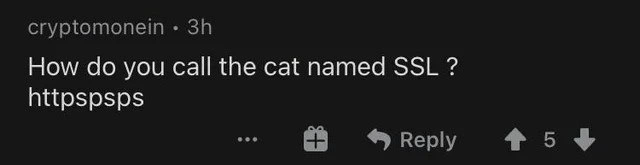
The image is a screenshot of a Reddit comment (dark background with light text, showing the username cryptomonein, the comment text, and icons for upvote/downvote and reply). Reddit is a popular online forum, and there’s a community (subreddit) called r/ProgrammerHumor where developers share jokes and memes like this. The small number “5” next to the up-arrow means 5 people upvoted the comment, signaling they found it clever. In developer circles, this kind of joke is pretty common – mixing a bit of tech lingo with everyday life. Once you know what HTTPS means and you’ve heard the classic “pspsps” for calling cats, you can appreciate the mash-up. It’s a fun example of how even technical folks like to be playful by blending their work terms with their personal life (and love of cats!).
Level 3: Padlocks & Pawprints
To an experienced developer, this meme is a perfect blend of security geekiness and lighthearted humor. We spend so much time ensuring the little padlock icon appears in browsers – configuring SSL certificates, renewing them every year, dealing with odd TLS version bugs – that seeing a padlock (symbol of web security) metaphorically linked with a pawprint (symbol of a mischievous cat wandering in) is both funny and oddly relatable.
The question “How do you call the cat named SSL?” immediately taps into our daily jargon. SSL has been the colloquial term for web encryption for decades, even though technically we’ve moved on to TLS. (Yes, some pedantic engineers might yowl that it should technically be a “TLS cat” now – but "TLSpspsps" just doesn’t have the same ring to it.) By using the name SSL, the joke leans on nostalgia and common parlance. Seasoned devs remember the era of manually installing SSL certs, triple-checking openssl commands, and crossing fingers that the chain of trust was correctly set up. The mention of “SSL” alone can bring back both pride (when things finally work) and trauma (that one time a certificate expired and woke everyone up at 3 AM).
The punchline httpspspsps is where the real crux lies. It takes the ultra-familiar prefix https:// (which we toil to enable on our sites for WebDev and Security best practices) and fuses it with the universal sound for beckoning a cat: “pspsps”. The humor comes from that mash-up: it’s as if a very serious piece of tech lingo suddenly grew whiskers and a tail. Every web developer knows adding that “S” is serious business – flipping your site from HTTP (open, vulnerable) to HTTPS (secure, trusted). We battle mixed-content warnings, HSTS preload lists, and infinite redirect loops when enforcing HTTPS. So when someone uses https in a purely silly context (calling an imaginary cat), it’s a breath of fresh air. It’s like seeing your stern, high-security office guard making baby talk to a stray kitty. The contrast is golden.
There’s also an inside joke here about how ingrained these terms are in our lives. Many of us have joked about naming our pets “Docker” or “GitHub” – naming a cat SSL fits that tradition of tech humor. The meme format (a Reddit comment screenshot in dark mode, naturally – because every coder loves a dark theme) adds to the authenticity. You can almost hear the chuckles in the comment thread. The small upvote count (5 points) tells us this was a niche gem; it’s not a mainstream hit, but for those who get it, it hits the spot.
And of course, the broader developer culture aspect: we developers love cats. The internet and DeveloperHumor have had a long romance with felines. From the classic "Keyboard Cat" video to countless CatMemes, cats are practically the unofficial mascot of internet culture. Mixing cats with code is a recipe for smiles. This meme leverages that affectionate cat-calling pspsps sound (something even non-devs do to charm a kitty) and sneakily slips in a tech twist. It humanizes the often dry topic of encryption. Instead of talking about certificate pinning or TLS 1.3 vs 1.2, we’re momentarily imagining an SSL cat coming running when called with a humorous incantation of protocols and purrs.
In real engineering life, dealing with SSL/TLS can be frustrating – misconfigured certs, outdated encryption suites, the dreaded "SSL handshake error". Those are the unglamorous pawprints all over our on-call rotations. But jokes like this help turn that frustration into a shared laugh. It’s a reminder that behind every strict security policy or DevOps checklist (“Enable HTTPS” is on all of them), there are humans who enjoy a bit of silliness. The next time you’re wrestling with a tricky TLS config or renewing a cert at midnight, you might recall httpspspsps and crack a grin. After all, even the most hardened backend engineer can’t resist picturing a cat responding to a URL with an adorable meow.
Level 4: The Purr-fect Handshake
At this deepest level, the meme’s humor taps into the complexity behind that single letter S in HTTPS. When you see https:// at the start of a URL (that extra S after "http"), a sophisticated cryptographic handshake is happening. This handshake uses advanced public-key cryptography (for example, RSA or Diffie–Hellman key exchange) to establish a secure channel:
- The client (your browser) and the server exchange "Hello" messages and agree on encryption methods (the cipher suite).
- The server presents its SSL/TLS certificate (an X.509 digital certificate) issued by a trusted Certificate Authority. This certificate contains the server’s public key and domain name, essentially proving its identity (like showing ID).
- The client verifies the certificate’s authenticity and validity (checking the CA’s digital signature and ensuring the cert hasn’t expired or been tampered with).
- Using the server’s public key, the client encrypts a random secret (the "premaster secret") and sends it to the server. Only the server’s private key can decrypt this secret.
- Both sides use that shared secret to derive the same symmetric session key, which will encrypt all further communication.
In simpler terms, that extra “S” in HTTPS triggers a full-blown TLS handshake – a mini-ceremony of math and trust. Once it’s done, all data between the browser and server is encrypted (so eavesdroppers just see gibberish). This is what SSL (more correctly, its modern successor TLS) provides: confidentiality, integrity, and authenticity for web traffic.
Now, the meme slyly personifies “SSL” as a cat and makes us “call” it with httpspspsps. In doing so, it mashes up an internet cornerstone (the HTTPS secure protocol) with a playful cat-calling sound “pspsps”. For those in the know, it’s a delightful contrast: the deadly serious world of encryption (where forgetting to renew a certificate can literally bring down a production site) meets the carefree charm of CatMemes. Underneath the joke, there’s an appreciation: every developer who sets up WebSecurity features knows that little “s” is backed by heavy-duty math and meticulous protocols. Seeing it used as part of a cat’s name and summoning call is absurdly charming. It’s as if all the complexities of Networking and cryptography – usually discussed in terms of ciphers, key exchanges, and protocols – get distilled into a single, silly noise.
In essence, httpspspsps is two worlds colliding: HTTPS (the secure web protocol born from cryptographic breakthroughs) and “pspsps” (the universal sound to attract a feline). The result is a pun that resonates on a deeply nerdy level. It’s amusing to imagine that calling a cat might involve initiating an SSL handshake – perhaps presenting a "cat certificate" and doing a meow-based key exchange! The wordplay works because developers recognize how crucial HTTPS is; merging it with a meme-worthy cat call feels delightfully offbeat. It gently reminds those familiar with these systems that even our most robust security mechanisms can be lightheartedly anthropomorphized. And honestly, who can resist a good cat pun? Even the toughest cryptography concepts can take a backseat when someone says "https... pspsps."
Description
Dark-mode screenshot of a social media comment thread. In light gray serif text it reads: “cryptomonein • 3h” on the first line. The second line asks, “How do you call the cat named SSL ?” followed by a line break. The punchline on the third line is “httpspspsps”, cleverly merging “https” (secure HTTP) with the feline-summoning sound “pspsps”. Below the comment are small icons for gifting, replying, an up-arrow with “5”, and a down-arrow, indicating standard Reddit UI. The meme plays on developers’ familiarity with SSL/TLS and HTTPS, riffing on web security terminology while injecting classic cat-calling humor that resonates with software engineers
Comments
11Comment deleted
The SSL cat only comes after a mutual-TLS pawshake - otherwise your “httpspspsps” just gets a 204 No Content stare
The real question is whether the cat validates its own certificate or if you need to add it to your trust store - and good luck getting a CAT certificate authority to sign anything without knocking it off the desk first
This is the kind of joke that only lands if you've spent enough time debugging certificate chains at 2 AM. The beauty is in the layers: SSL/TLS securing HTTP to create HTTPS, then recursively applying the 'pspsps' cat-calling pattern. It's technically a protocol composition joke - and honestly, if your cat's name is SSL, you're probably also the person who names their servers after Star Trek characters and has strong opinions about Let's Encrypt vs. commercial CAs. The real question is: does the cat respond to port 443 only, or does it still listen on the deprecated 8443?
Pedant mode: it’s TLS - this cat has HSTS enabled and only negotiates pspsps over port 443 with modern ciphers
Self-signed PSPS? Cat rejects with 'NET::ERR_CERT_INVALID' and ghosts you
HTTPSpsps - cute; somewhere an infosec lead is muttering “it’s TLS, not SSL” while marketing files a ticket to “renew the SSL cat cert” at 4:55pm Friday
If you want to talk with him, call him wssssss Comment deleted
Обьясните тупому, плиз Comment deleted
ssl сертификат добавляет http буковку s, а кошек обычно зовут ксксккс или же пспспспспсппс и типа httpspspspsps Comment deleted
čščščš Comment deleted
asdf;iasriognpthuhnfgv;oidhnezl;iwerfng Comment deleted