Maintaining a legacy system from 2007
Why is this LegacySystems meme funny?
Level 1: The Secret Tin-Can Telephone
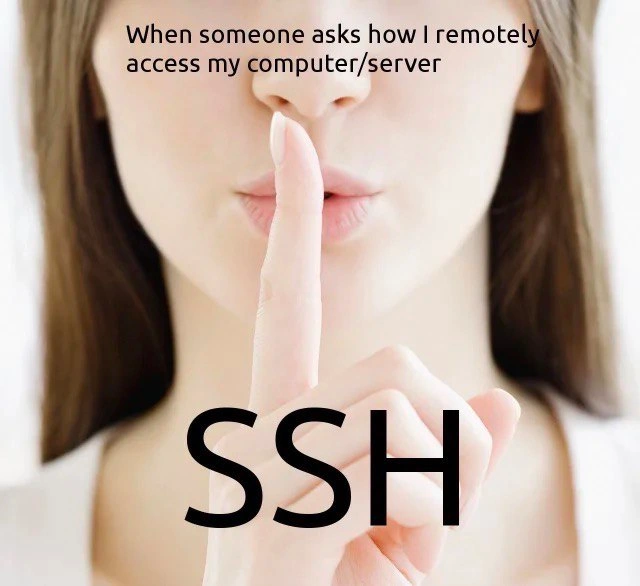
Imagine two kids with a tin-can telephone, except the string is magic: anyone who grabs it in the middle hears only gibberish, while the kids hear each other perfectly. That magic string is what grown-ups use to control faraway computers, and its name — SSH — happens to be spelled exactly like the sound you make when you put a finger to your lips: shhh. So when someone asks "how do you talk to your faraway computer?", the answer is both a real tool and a way of saying "it's a secret." One word, two meanings, and the lady in the picture gets to make the joke without saying anything at all.
Level 2: Secure Shell, Spelled Out
SSH stands for Secure Shell. It's a command-line tool and protocol that lets you open a terminal on another computer — across the room or across an ocean — with everything encrypted in transit. Type ssh [email protected], authenticate, and your keystrokes now execute on that remote machine. It listens on port 22 by default, and it's how developers manage cloud servers, copy files (scp, sftp), and tunnel traffic securely.
Early-career rites of passage cluster around it: generating your first key pair with ssh-keygen, pasting the public key (never the private one!) onto a server, the panic of locking yourself out by breaking sshd_config, and the small triumph of your first passwordless login. The joke works because the acronym is pronounced letter by letter, "ess-ess-aitch" — but it looks exactly like "shhh," the sound the stock-photo woman in the image is making with her finger to her lips. The protocol keeps secrets; the gesture keeps secrets; the pun writes itself.
Level 3: Port 22 and the Loud History of Quiet
The caption — "When someone asks how I remotely access my computer/server" — answered by a giant "SSH" under a finger pressed to lips, is a perfect homophone gag. But the senior-engineer chuckle has a darker harmonic: SSH became the universal answer precisely because everything before it was screaming. telnet, rlogin, and rsh shipped your password across the network in cleartext for decades; anyone with a packet sniffer on the path could read your login like a postcard. SSH won not through marketing but through sheer necessity, becoming the de facto control plane for Unix system administration, CI/CD deploy steps, and — wrapped inside Git's transport — half the world's git push operations.
The pun also lands because SSH is the rare tool sysadmins genuinely don't want to talk about. An exposed port 22 on the public internet collects brute-force login attempts within minutes — check auth.log on any cloud VM and witness the botnet chorus. Hence the rituals of the trade: disable password auth, disable root login, move the port (security theater, but quieter logs), fail2ban, bastion hosts, and the eternal corporate debate about whether SSH access to production should exist at all. The meme's smug minimalism mirrors the engineer's posture: the question has had one correct answer since the late nineties, and elaborating further is how you end up volunteering to maintain the jump box. Shhh indeed — half of operational security is just not advertising what's listening.
Level 4: Diffie, Hellman, and the Art of Whispering
There's a lovely irony in pairing SSH with a hushing gesture, because the protocol's entire reason for existing is whispering across a room full of eavesdroppers. When you type ssh user@host, a small cryptographic ballet begins. First, a key exchange — classically Diffie-Hellman, today usually its elliptic-curve cousin Curve25519 — lets two machines that have never met agree on a shared secret while an attacker watching every packet learns nothing. The math is the magic: it's computationally easy to mix the values together but infeasible to un-mix them (the discrete logarithm problem), so the secret is derived on both ends without ever being transmitted.
From that shared secret, SSH derives symmetric session keys for an authenticated cipher (think AES-GCM or ChaCha20-Poly1305), giving you confidentiality and integrity — an eavesdropper can't read the traffic, and a meddler can't silently alter it. Authentication rides on top: the server proves its identity with a host key (that's the fingerprint prompt everyone reflexively answers yes to, which is the protocol's one trust-on-first-use Achilles heel), and you prove yours, ideally with a public-key signature rather than a password. SSH-2, standardized after the original 1995 design by Tatu Ylönen showed its cracks, layers this into a transport protocol, an authentication protocol, and a connection protocol that can multiplex channels — which is why one connection can carry your shell, a port forward, and an scp all at once. The "shhh" isn't just a pun; it's a formally enforceable security property.
Description
A popular meme format featuring a skeleton waiting on a bench. The skeleton is labeled 'Me waiting for the build to finish'. In the background, a dusty, ancient computer with a CRT monitor is shown, also covered in cobwebs. The screen of the monitor shows a progress bar that is barely moving. The meme humorously depicts the pain of working with old, slow, and outdated legacy systems. For senior developers, this is a relatable experience, highlighting the frustrations of maintaining ancient codebases with slow build processes and ancient hardware
Comments
8Comment deleted
I'm not saying the legacy build system is old, but its dependencies are managed by a scribe on a stone tablet
Sure, we’ll automate everything with Terraform later; for now, my ~/.ssh/config still scales better than your entire remote-desktop strategy
The real security through obscurity is explaining to auditors why your SSH keys are still using RSA-2048 because changing them would mean updating 47 different CI/CD pipelines, 3 legacy systems that nobody remembers how to access, and that one critical server where the only person who knew the root password left in 2019
SSH is the right answer twice over: it's how you get in, and it's what you say when security asks if that port is still exposed to the internet
The beauty of SSH is that it's simultaneously the answer to 'How do I access my server?' and 'Should I tell anyone my private key passphrase?' - though for very different reasons. One connects you securely across networks; the other keeps your security team from having a collective aneurysm
SSHH: Multiplexing tunnels over a single connection, because who needs GUI overhead when tmux owns your remote empire?
SSH asks for quiet, until someone leaves PermitRootLogin yes and agent forwarding enabled on the jump host - then the SIEM shouts louder than the on-call channel
It isn't a secret - it's VPN -> bastion -> ssh -J into tmux; the only hush is about who left port 22 open