Skip to content
DevMeme
3157 of 7435
The Evolution of SSH Key Generation Sophistication
Security Post #3477, on Jul 30, 2021 in TG

The Evolution of SSH Key Generation Sophistication

Why is this Security meme funny?

Level 1: Casual vs Formal

Imagine you have a secret diary and you want to lock it so no one else can read it. You start with a simple lock – it does the job, kind of like the first panel where Pooh is just normal. Then you decide to use a bigger, stronger lock – now it’s much harder for anyone to break it open (that’s Pooh in a nice suit, a step up in fancy). Finally, you get a super high-tech magical lock that only you can open, no matter what – that’s the top-tier protection (Pooh with a top hat and monocle, super fancy!). The meme is joking that using more advanced security (like a better kind of key for your computer secrets) is like dressing up in a really fancy outfit. The fancier the outfit, the more impressive and secure it seems. So basically, it’s saying: using the newest, strongest key is like being the most dressed-up and prepared to keep your stuff safe – and it makes everyone smile because we picture a very proper, fancy Winnie-the-Pooh guarding our secrets.

Level 2: SSH Key Glow-Up

Let’s break down what’s actually happening in this meme, in case all these terms are new. It’s all about SSH keys and how we generate them using the command line. SSH (Secure Shell) is a protocol that lets you connect securely to another computer – for example, logging into a remote server or pushing code to GitHub. Instead of passwords, developers often use SSH key pairs (a private key you keep secret, and a public key you share) to log in without typing a password each time. The tool to create these keys is ssh-keygen, which you run in a CLI (Command Line Interface) like Terminal or PowerShell.

Now, ssh-keygen -t rsa is the simple command to create a key pair using the RSA algorithm. RSA has been a standard for decades – it’s reliable and was the default in many systems. If you run this, it asks a couple of questions (where to save the key, and an optional passphrase), and then produces two files, usually something like id_rsa (your private key) and id_rsa.pub (your public key). The -t rsa part just tells the program “use the RSA type”. If you don’t specify -t at all, many versions of ssh-keygen historically defaulted to RSA anyway. The meme’s first panel shows Pooh looking normal, labeled with this command. It implies this is the basic, no-frills way to do it – nothing fancy. It’s like the everyday version of an SSH key.

In the second panel, the command is ssh-keygen -t rsa -b 4096. Here, -b 4096 is an option to set the number of bits (the length of the key) to 4096. Think of “bits” as the size of the key or the size of the secret number inside. A larger number is harder for attackers to guess. By default, RSA keys are often 2048 bits, which is already very large (about 617 decimal digits!). By choosing 4096, we’re doubling the length, making a much bigger number. In simple terms, if a 2048-bit key was a needle in a haystack, a 4096-bit key is like a needle in a haystack the size of a planet. It’s just way harder to find. Pooh in a tuxedo corresponds to this command, meaning this is a more polished or security-conscious step. A developer who uses -b 4096 is being extra cautious or following best practices by not just accepting the minimum. This is similar to making a password longer – a longer, more complex password is tougher to crack. Here, a “longer” key (more bits) is tougher to crack than a shorter one.

Finally, the third panel has ssh-keygen -t ed25519. This is a different algorithm altogether: Ed25519. It’s a type of elliptic curve cryptography. You might notice there’s no -b option here – that’s because with Ed25519, you don’t choose the key size in bits; it’s built into the algorithm (it’s effectively using a 256-bit key based on the curve parameters). Despite the smaller number, Ed25519 is actually super strong because of the advanced math it uses. When you run this command, you end up with files like id_ed25519 and id_ed25519.pub. Many modern systems (and security-aware developers) prefer this type of key. Why? For one, the keys are smaller in size (so they’re quicker to transmit and take up less space) but just as secure as huge RSA keys. Also, the cryptographic operations (like creating a digital signature during authentication) are faster with Ed25519, meaning logging in with an Ed25519 key can be a bit quicker and uses less CPU, especially on low-power devices.

So, in summary, these three commands all achieve the same goal – making an SSH key pair – but with increasing levels of security strength and modernness:

  • RSA (default bits): good old reliable, but just the basics, nothing extra.
  • RSA (4096 bits): same algorithm, stronger lock on the door by using a bigger key size.
  • Ed25519: a newer type of lock altogether, that’s both strong and efficient – the current recommended method.

The meme uses the popular Winnie-the-Pooh format (often called Tuxedo Pooh meme) to visualize this. In internet memes, Winnie the Pooh is shown in increasing states of sophistication (from casual to wearing a tuxedo to wearing a top hat and monocle) to humorously rank things from plain to fancy. Here:

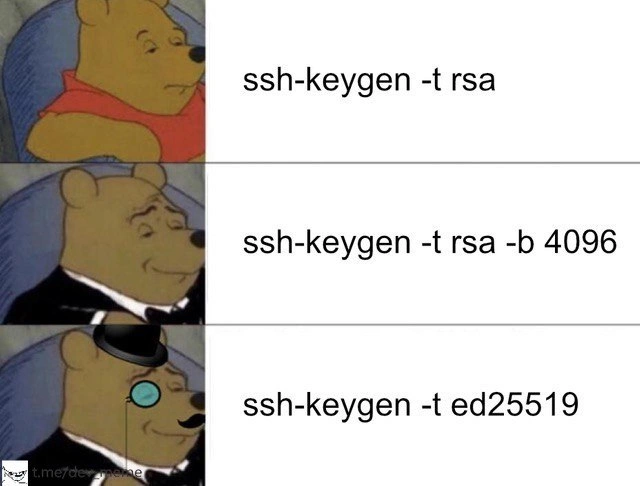
  • ssh-keygen -t rsa” is paired with casual Pooh (plain red shirt) – this is the plain, default choice.
  • ssh-keygen -t rsa -b 4096” is next to Pooh in a tuxedo – a step up in class, i.e., a more refined command because it’s a wiser security choice.
  • ssh-keygen -t ed25519” appears beside Pooh with a top hat and monocle – the ultimate fancy gentleman, implying this is the most refined, top-tier choice of the three.

The joke is essentially saying: generating an Ed25519 key is like being the classy aristocrat of the developer world, whereas just doing a default RSA is a bit pedestrian. Of course, in reality, any SSH key is a good thing for security (it’s much better than using no key or a weak password!). But among developers, there’s an inside joke here: using the most up-to-date cryptography (like Ed25519) is seen as something to be proud of. It shows you’re keeping up with security best practices. It’s a bit of a flex (slang for showing off).

For a newer developer, the takeaway is also educational: it implicitly suggests “hey, maybe use Ed25519 for your next key.” If you’ve never thought about it, you might have just run ssh-keygen and accepted RSA because that’s what older tutorials show. But nowadays, a quick Google or any recent guide will recommend Ed25519 as the better option for SSH keys. So the meme is both a joke and a gentle PSA. It’s funny because it exaggerates attitudes (nobody actually wears a monocle because they used a better key algorithm!), but it’s rooted in real tech knowledge: Ed25519 is indeed the more sophisticated choice for SSH keygen. The fancy Pooh just personifies the satisfaction one might feel using a cooler, modern tool.

Level 3: Keygen Couture

For seasoned developers and security-minded folks, this meme hits on the evolution of SSH key generation habits – and it’s painfully on point. The three panels essentially list CLI commands of increasing security fashion. In the first panel, we have the bare-bones ssh-keygen -t rsa, which is the most vanilla way to generate a key. This was the default for years: it creates an RSA key pair (by default 2048 bits) for public key authentication. Winnie-the-Pooh is shown in his normal red shirt looking indifferent – the message: “Just running the default RSA? Pretty basic, nothing to write home about.” This is the equivalent of wearing a T-shirt to a formal event in the security world. Many of us started exactly here: typing ssh-keygen, accepting the defaults, and ending up with an ~/.ssh/id_rsa.pub to paste on GitHub or a server. It works, it’s secure enough for most cases, but it’s basic. 🐻

In the second panel, Pooh has donned a tuxedo. The command has leveled up: ssh-keygen -t rsa -b 4096. Here a savvier developer is saying, “Sure, I still use RSA, but I make it strong.” The -b 4096 flag explicitly requests a 4096-bit key instead of the default 2048 bits, doubling the key length. This is a security best practice for those sticking with RSA: a larger key means an exponentially tougher time for any attacker trying to crack it. It’s like upgrading from a standard door lock to a deadbolt and a chain lock. As a result, Pooh in a tuxedo exudes more confidence and class – he’s doing the same thing (using RSA) but in a more refined way. In real life, an experienced dev in, say, 2015 might have insisted on 4096-bit RSA keys to future-proof their SSH access (“I know the default is 2048, but let’s crank it up to 4096 bits just to be safe”). The tuxedo Pooh expression captures that tiny bit of smugness: you feel like the 007 of DevOps stepping up your encryption game. It’s a humble flex on the CLI: adding one option (-b 4096) that says “I know what I’m doing, I care about security.”

Then we get to the final panel – Pooh is now wearing a top hat and monocle, radiating aristocratic smugness. The command shown is the ultra-modern ssh-keygen -t ed25519. To a seasoned engineer, this immediately reads as “I keep up with the times and use the best available tools.” Ed25519 is an elliptic curve algorithm, widely recommended as the new standard for SSH keys. Here, Pooh isn’t even bothering with RSA at all; he’s using a next-gen method. The developer elitism joke shines through: the monocle signals that this is the proper gentleman’s choice of key type. It’s as if Pooh is saying, “Pardon me, good sir, but I only generate Ed25519 keys these days.” This hits home for developers because around the late 2010s, there was a clear shift: guides, blogs, and security talks all started recommending Ed25519 over RSA for new keys. The reasons? As noted, Ed25519 keys are smaller, faster, and at least as secure as even huge RSA keys. So using Ed25519 became a sort of badge of honor among those in the know – a bit like using the latest framework or having an ultra-optimized dotfiles setup.

The humor is that something as mundane as an SSH key command becomes a status symbol. There’s definitely a “CLI flex” aspect here: imagine a group chat where someone asks how to set up SSH keys, and a dev replies, “Oh, don’t bother with RSA, just do ssh-keygen -t ed25519 – it’s what all the cool kids use now.” The meme exaggerates this attitude; Pooh’s expression in the final frame is almost snobbish. It playfully mocks the subtle smugness tech folks can have about using superior tech, even in something as routine as key generation. We’ve all seen a bit of gatekeeping or pride around using the “right” algorithms or tools. Using Ed25519 in 2021 is like being part of a crypto-conscious club. Conversely, if you’re caught still doing plain ssh-keygen -t rsa with default settings, a senior colleague might tease you for lagging behind the times. (It’s reminiscent of the gentle ribbing like, “Wait, you’re still on Python 2?” or “You deploy on a Friday? Bold move.”)

Another layer for the experienced audience is recalling how security practices evolve. Not long ago, RSA was the gold standard and 2048-bit keys were fine. But computing power grows and cryptographic research advances, so best practices shift – and suddenly using a 2048-bit RSA key feels quaint. The meme captures this timeline in a tongue-in-cheek way. Panel 1 (casual Pooh) is the old norm (RSA default), Panel 2 (tux Pooh) is the intermediate step (bigger RSA key as a stop-gap), and Panel 3 (monocled Pooh) is the current norm (embracing ECC). A senior dev reading this likely remembers when Ed25519 support was added to OpenSSH (~2014) and the slight geeky thrill of generating their first Ed25519 key pair. It was legitimately exciting – a mix of better security and feeling on the cutting edge. The meme dramatizes that feeling: by the time you’re using -t ed25519, you might as well be sipping encrypted Earl Grey from a fine china cup. ☕️

To give some context in code form, here’s how these commands look on the terminal (and how they level up in sophistication):

# Generating a default RSA key (Casual, old-school)
$ ssh-keygen -t rsa

# Generating an RSA key with a 4096-bit modulus (Formal upgrade)
$ ssh-keygen -t rsa -b 4096

# Generating a modern Ed25519 key (Top-hat fancy)
$ ssh-keygen -t ed25519

Each of these will prompt you for a file path and a passphrase, and then output a public/private key pair. The differences come later: the RSA keys (especially 4096-bit) will result in larger key files and a somewhat slower handshake when you actually use them to SSH, whereas the Ed25519 key will be small and lightning-fast. An experienced engineer gets the punchline: the monocle Pooh isn’t just about looking fancy – it is genuinely a smarter choice. The meme perfectly blends that truth with humor. It’s poking fun at our tendency to feel a bit self-satisfied when we follow best practices (“I’ve got a 4096-bit key, I’m practically unhackable!” or “I use Ed25519, obviously”). But it’s also practically informative: it’s like a cheeky reminder to everyone reading it on DevMeme that, hey, if you haven’t updated your SSH key habits yet, maybe it’s time to put on that top hat and join the Ed25519 club.

Level 4: Elliptic Elegance

At the highest level, this meme is riffing on cryptographic algorithms and the mathematics behind them. The commands shown – ssh-keygen -t rsa vs ssh-keygen -t ed25519 – hide vastly different internal mechanisms. RSA keys rely on the difficulty of factoring large prime numbers, a cornerstone of classic public-key cryptography since 1977. A default RSA key (often 2048 bits) lives in a world of modular arithmetic: your public key is basically a very large number derived from two random primes, and cracking it means trying to factor a number with hundreds of digits – practically infeasible with current computing. By specifying -b 4096, the RSA key gets 4096 bits long, dramatically increasing the key space (from ~$2^{2048}$ possibilities to ~$2^{4096}$) and thus the computational effort needed to break it. This is a brute-force defender’s approach: make the number so astronomically large that even the best algorithms (like the Number Field Sieve) gasp for breath. It’s effective, but also a bit like wielding a heavier and heavier hammer.

Now enter Ed25519, which represents the elegant curve-based cryptography that has become modern best practice. Instead of large primes, Ed25519 uses an elliptic curve over a finite field – specifically a Twisted Edwards curve called Curve25519 (hence the name). Under the hood, your key is a point on this curve defined by an equation (something like $x^2 + y^2 = 1 - d \cdot x^2 \cdot y^2$ over a prime field, with a carefully chosen constant d). The security of Ed25519 comes from the Discrete Logarithm Problem on elliptic curves: given a point multiplied by a huge secret number, it’s essentially impossible to reverse-engineer that secret (no efficient algorithm is known, unlike the progress in factoring). What’s magical is that Ed25519 achieves comparable stronger effective security with just 256-bit keys, thanks to the steeper math of curves. A 256-bit ECC key can resist attacks as well as RSA keys in the 3072-4096 bit range, but with far less computational bulk. It’s like replacing an old vault door (thick steel and heavy bolts) with a futuristic compact vault made of some unbreakable material – smaller size, yet just as (or more) impenetrable. In cryptographic terms, Ed25519 provides about a 128-bit security level, which is on par with or beyond 3072-bit RSA (~128-bit) and approaching 4096-bit RSA’s level. And it does this with graceful mathematical efficiency.

The joke’s “monocle and top hat” sophistication is merited: Ed25519 was designed in 2011 by a team led by cryptographer Daniel J. Bernstein as part of the modern elliptic curve family (EdDSA). It's carefully engineered for both security and speed – using lattice-free parameters, eliminating minor biases and side-channel leaks, and producing keys and signatures much faster than RSA. In practice, generating a new Ed25519 key is blazingly quick (often instant), whereas a 4096-bit RSA key can make you wait as it grinds through random prime generation. Ed25519 keys are also pleasantly compact – the public key is only 32 bytes – which is why your ~/.ssh/authorized_keys file stays slim even with many Ed25519 entries. This refined efficiency is why modern SSH implementations and security guidelines nudge users toward elliptic curve keys. In a sense, the meme humorously casts Ed25519 as “cryptographic high society.” The underlying math is genuinely more advanced and elegant, so using ssh-keygen -t ed25519 is like opting for the state-of-the-art cryptographic sophistication instead of brute-force tradition. The meme exaggerates it as an air of snooty superiority (hence Pooh’s monocle), but fundamentally it’s highlighting a real technical evolution: from a venerable, centuries-old number theory approach (RSA) to a sleek curve on the cutting edge of modern cryptography.

Description

This is a three-panel meme using the 'Tuxedo Winnie the Pooh' format to illustrate levels of sophistication in creating SSH keys. The first panel shows the standard, unimpressed Pooh next to the basic command 'ssh-keygen -t rsa'. The second panel features a more refined Pooh in a tuxedo, pleased with the more secure command 'ssh-keygen -t rsa -b 4096', which specifies a 4096-bit key. The final panel shows the most sophisticated Pooh, complete with a top hat, monocle, and mustache, endorsing the modern and highly secure command 'ssh-keygen -t ed25519'. A small watermark for 't.me/dev_meme' is visible in the bottom-left corner of the last panel. This meme is a classic gatekeeping joke for experienced developers, subtly ranking individuals based on their choice of cryptographic algorithms. It highlights the move from the older RSA standard to the more performant and secure elliptic-curve cryptography algorithm Ed25519 as a sign of deeper technical knowledge and adherence to current best practices
Comments

11
Anonymous ★ Top Pick Using a default RSA key is like putting a padlock on a bank vault. Using a 4096-bit key is a bigger padlock. Using Ed25519 is just hiring a ninja who lives in the shadows and questions the very existence of doors
  1. Anonymous ★ Top Pick

    Using a default RSA key is like putting a padlock on a bank vault. Using a 4096-bit key is a bigger padlock. Using Ed25519 is just hiring a ninja who lives in the shadows and questions the very existence of doors

  2. Anonymous

    Upgrading all keys to ed25519 feels delightfully modern - right up until the ancient Jenkins box on OpenSSH 6.0 refuses the handshake and you discover backward compatibility is the one cipher nobody can break

  3. Anonymous

    Meanwhile, the same engineer still has id_rsa from 2008 in ~/.ssh because "it works on all the legacy systems and I'm not updating 47 authorized_keys files across prod."

  4. Anonymous

    The real sophistication isn't just choosing Ed25519 for its superior security-to-key-size ratio and resistance to timing attacks - it's knowing that your infrastructure still has that one ancient server from 2008 that only supports RSA, forcing you to maintain both key types in your ~/.ssh directory like some kind of cryptographic hoarder

  5. Anonymous

    ed25519 is the obvious default - fast, small, and sane - until the FIPS-mode bastion running 2013-era OpenSSH says “no,” and you sheepishly regenerate RSA‑4096 like compliance never heard of curves

  6. Anonymous

    Ed25519: because 4096-bit RSA is just overcompensating when curves do it faster and sleeker

  7. Anonymous

    RSA‑4096 is the enterprise fix - throw more bits at it - while ed25519 is the staff engineer quietly cutting handshake CPU and calling it “just a dotfile tweak.”

  8. @pixelsex 4y

    ed pubkey so short, i can tattoo it on my dick!

    1. @gdfngue4ui3 4y

      Ahahaha

    2. @neopulsar 4y

      In QR code

    3. @ZgGPuo8dZef58K6hxxGVj3Z2 4y

      Fontsize 0 doesn't count /s

Use J and K for navigation