SQL: The Last Bastion of Acceptable Shouting
Why is this Databases meme funny?
Level 1: When It’s Okay to Shout
Imagine you’re usually very polite and use your inside voice all day. You know that shouting can seem rude or too aggressive, so you almost never shout when you talk to people. But now picture that you’re outside on a playground and your friend is on the other side – you might cup your hands and yell so they can hear you, right? That’s a moment when shouting is okay.
This meme is like saying programmers are very calm and use their normal voice (normal letters) most of the time, but when they talk to their database (a big electronic storage of information), they suddenly use their loud voice (ALL big letters!). In everyday life, writing in all big letters (like “PLEASE DO THIS!”) looks like you’re shouting. But in the special case of writing instructions for a database (SQL queries), using big letters for certain words is normal and helpful. So it’s funny because it’s an unexpected exception: the one time a usually quiet, precise developer “shouts” is when they’re writing these database commands. It’s as if the developer is saying, “I normally don’t shout, but if you ever see me shouting in text, it’s because I’m busy asking the database for something important!” That little surprise – comparing everyday shouting to the quirky habit of capitalizing SQL words – is what makes everyone smile.
Level 2: Caps Lock Convention
For newer developers, let’s break down what’s going on. SQL stands for Structured Query Language, a specialized language for talking to relational databases (think of databases like MySQL, PostgreSQL, or Oracle). An SQL query is basically a question or command you ask the database, like “Hey database, give me all users named Alice” or “Delete the old records”. SQL has specific keywords (also called reserved words) that have special meaning, such as:
- SELECT – to choose which columns of data to retrieve
- FROM – to specify which table to get the data from
- WHERE – to filter results based on conditions
Developers often write these keywords in ALL CAPS. Important note: SQL itself doesn’t require capital letters – SELECT and select will both work the same. The database isn’t case-sensitive about these commands. Writing them in uppercase is a style choice that many developers follow to make the query easier to read. It’s a bit like putting road signs in bright colors; the keywords stand out from the rest of the text. For example, compare these two queries:
-- Query with uppercase keywords (common style)
SELECT id, name
FROM users
WHERE active = 1;
-- Query with lowercase keywords (works the same, but less standard)
select id, name from users where active = 1;
Both queries do the exact same thing: they fetch the id and name of all users who are active. But many people find the first version clearer because the SQL commands (SELECT, FROM, WHERE) jump out at you. This is what we mean by the “caps lock convention” – hitting that Caps Lock (or Shift key) for keywords has become an unwritten rule in many teams and communities when writing SQL. In fact, if you look at documentation or textbooks, you’ll often see SQL statements written in uppercase for the commands. It’s a learned habit: you see it everywhere, so you start doing it too.
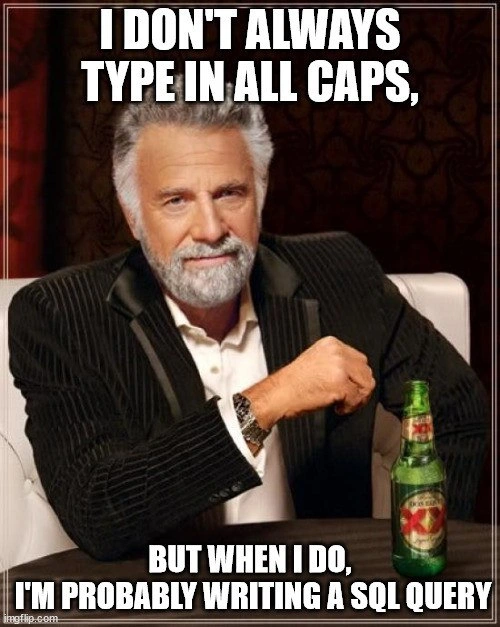
Now, the meme itself is using a popular template known in internet culture: The Most Interesting Man in the World. In those meme captions, the character (a distinguished-looking gentleman with a beer) says a phrase like, “I don’t always do X, but when I do, I do Y.” It’s meant to sound witty and tongue-in-cheek. In our case, the developer persona is saying: “I don’t always type in all caps, but when I do, I’m probably writing a SQL query.” This joke works because normally, typing in all caps is rare for developers – it’s like yelling in text form, something we avoid in emails or chats. The humor is that the one exception to that rule is when we’re writing those database queries with all the SELECTs and WHEREs. It’s poking fun at how programmers have this one weird habit: restraining the use of uppercase in general, then going wild with it in SQL.
For a junior dev, it’s a relatable rite of passage: the first time you write a query and find yourself holding the Shift key for half the words, you might pause and think, “Am I shouting at my database?” 😄 Don’t worry – you’re not being rude to the database (it’s indifferent to caps), but you are following a long-standing style tradition. The meme is a lighthearted way to acknowledge that tradition. It’s coding humor mixing a bit of internet meme culture with a genuine developer experience. Once you’ve written or read a few SQL queries, you’ll likely start doing this automatically, and then this joke really clicks: you realize, hey, the only time I aggressively hit Caps Lock is indeed when writing a query! And that shared realization is exactly what makes the meme funny for those in the know.
Level 3: SELECTive Shouting
In the realm of databases and query languages, this meme hits on a long-standing coding convention. It’s highlighting how developers rarely use ALL CAPS in code or communication – except when writing SQL queries. The image’s text parodies the famous Most Interesting Man meme: “I don’t always X, but when I do, I Y.” Here, the developer doesn’t always type in all caps, but when they do, it’s for a SQL query. This resonates with experienced devs because SQL (Structured Query Language) has a tradition of writing keywords like SELECT, FROM, WHERE, JOIN in uppercase. It’s as if the database only understands you when you “shout” these commands – of course that’s not true, but it’s a habit born from decades of style guides and readability choices.
Technically, SQL is case-insensitive for its keywords – the database engine doesn’t care if you write select or SELECT (both mean the same thing to the parser). So why do seasoned developers insist on the caps? It’s about human readability and a shared convention. By capitalizing reserved words (the commands of the SQL language), devs make query code easier to skim and understand. The SELECT stands out from the column names, the FROM pops against the table name. This is especially appreciated in complex queries with many clauses; uppercase keywords act like signposts for the structure of the query. Think of it as a gentle visual cue, not for the computer’s sake, but for the humans on the team. Many codebases and SQL style guides explicitly recommend this uppercase keyword convention. It’s a bit of a cultural norm in database humor and practice – so common that it’s become a RelatableDeveloperExperience tag in itself.
There’s an ironic twist that seasoned devs chuckle at: outside of SQL, typing in all caps is considered shouting (and is often discouraged for being unprofessional or hard to read). Yet here we are, drilling that Caps Lock key for every SELECT and WHERE. The meme exaggerates this irony by implying developers “save” their shouting for when it’s really needed – not for arguing on the internet or writing regular code, but for those precious moments of crafting an SQL query. The suave character in the image adds to the joke: he’s refined and restrained, much like a developer who normally writes code with calm CamelCase or snake_case. But just this once, he goes full ALL CAPS intensity to converse with the database. It’s funny because it’s true – even the most soft-spoken coders will yell (in text) when they write SELECT * FROM table;. We’ve all seen code where the only capitalized words are SQL keywords, almost like the code is literally shouting its database commands. This shared quirk in SQLQuery culture is what makes the meme instantly recognizable and chuckle-worthy for experienced devs.
Description
This meme utilizes the classic 'The Most Interesting Man in the World' format, featuring a dapper, gray-bearded man in a suit seated at a table with a bottle of Dos Equis beer. The image is overlaid with a punchline in two parts, using a bold, white, all-caps font. The top text reads, 'I DON'T ALWAYS TYPE IN ALL CAPS,'. The bottom text completes the phrase with, 'BUT WHEN I DO, I'M PROBABLY WRITING A SQL QUERY.' The humor is rooted in a long-standing, albeit informal, convention within the developer community to write SQL keywords (like SELECT, FROM, WHERE) in uppercase. This practice is done to improve readability by distinguishing the language's commands from the user-defined table and column names. For experienced developers, especially those with a background in database management or backend systems, this is an instantly recognizable and relatable habit from a bygone era of coding standards that still persists today
Comments
18Comment deleted
My linter auto-formats my SQL to lowercase. I change it back to uppercase. We've been locked in this passive-aggressive merge conflict for three years
We don’t uppercase SELECT for readability - we’re just yelling so the database can hear us over the ORM whispering 10,000 tiny queries in production
The real tragedy isn't typing SELECT * FROM users WHERE 1=1 in all caps - it's explaining to the junior why your 20-year-old stored procedures look like they're SHOUTING at the database while their ORM quietly whispers camelCase sweet nothings
The irony here cuts deep: we've spent decades arguing about camelCase vs snake_case, tabs vs spaces, and whether semicolons are necessary - yet somehow the entire industry collectively agreed that SQL keywords should be SHOUTED AT in ALL CAPS. It's the one coding convention where looking like you're angry-typing is actually considered professional. Meanwhile, your linter is configured to enforce lowercase everything else, creating a cognitive dissonance so profound that junior devs genuinely wonder if their Caps Lock key is possessed when writing their first JOIN statement
ORMs whisper in camelCase; grizzled DBAs make their subqueries SCREAM
SQL is case-insensitive, but on-call humans aren't - uppercasing SELECT is the only optimizer hint code review reliably accepts
ALL CAPS is how I tell the ORM to step aside - this SELECT is negotiating directly with the optimizer
or a meme Comment deleted
Even it's not required, I prefer to write SQL keywords in caps because readability Comment deleted
Well yeah, that's what people did before syntax highlighting. Many languages of that time period have that. JCL/COBOL, Fortran, flavours of BASIC… Comment deleted
For the sake of readability, I do the opposite thing: SQL keywords in lowercase, table & column names in uppercase. Comment deleted
Are not backticks enough to clearly distinguish table and field names from keywords? (You do use backticks, don't you?) Comment deleted
I don't, unless I need to do it for some names that collide with keywords. Well different letter cases are far more distinguishable from afar than words in backticks, don't you think? Comment deleted
I do everything in lowercase lol Comment deleted
Lel Comment deleted
i prefer camelcase for readability SeLeCt ToP 2 * FrOm CuStOmErS; Comment deleted
It’s wave case Comment deleted
yeah, thnx Comment deleted