Ignoring Jira's Sprint Scope Warning Like a True Titan
Why is this Agile meme funny?
Level 1: One More Chore
Imagine you and your friends made a plan to clean up a playground in one hour. You list out tasks: pick up trash, wipe the swings, and paint the bench. You all agree, “That’s what we’ll do in one hour, no more.” Now, 30 minutes in, a teacher comes by and says, “Oh, also pull out all the weeds in the field before you finish.” Uh oh! You already have your hands full with the original plan. One of your friends says, “But we already decided our tasks!” and the teacher just insists, “Do it anyway!” Now you have extra work, and you’re all stressed because it might make you miss your deadline. In this story, the one more chore is like adding a new task in the middle of a sprint. The plan was set (clean the playground), and then someone in charge threw in a big new job (pull the weeds) while you were in the middle of things. It’s funny in the meme because the boss is acting like a stubborn superhero villain saying “Just do it!” even though everyone knows it’s going to mess up the plan. It’s a silly way to show how grown-up work plans sometimes get upset by last-minute demands, leaving the team feeling just like kids who got an unexpected extra chore.
Level 2: Scope Creep 101
Let’s break down what’s happening in this meme in more straightforward terms. In Agile project management (especially the Scrum flavor of agile), work is planned in fixed intervals called sprints – usually 1 to 2 weeks long. At the start of a sprint, the team commits to a set of tasks or user stories (the sprint scope) that they believe they can complete in that time frame. This scope is ideally locked in. Why? Because keeping a stable list of tasks allows the team to focus and actually finish things, and it provides a baseline to measure how much work they can handle (their velocity) for future planning.
Now, scope creep is a term you’ll hear a lot in both ProjectManagementHumor and horror stories alike. Scope creep means new tasks or requirements keep creeping in after the plan is set. It’s like if you planned to build a simple treehouse, and mid-project someone says, “Actually, let’s add an underground swimming pool too.” In software, this often happens when stakeholders suddenly request additional features or when unexpected bugs must be fixed immediately. It’s considered an AgilePainPoints classic: it disrupts the team’s flow and can jeopardize achieving the sprint goals.
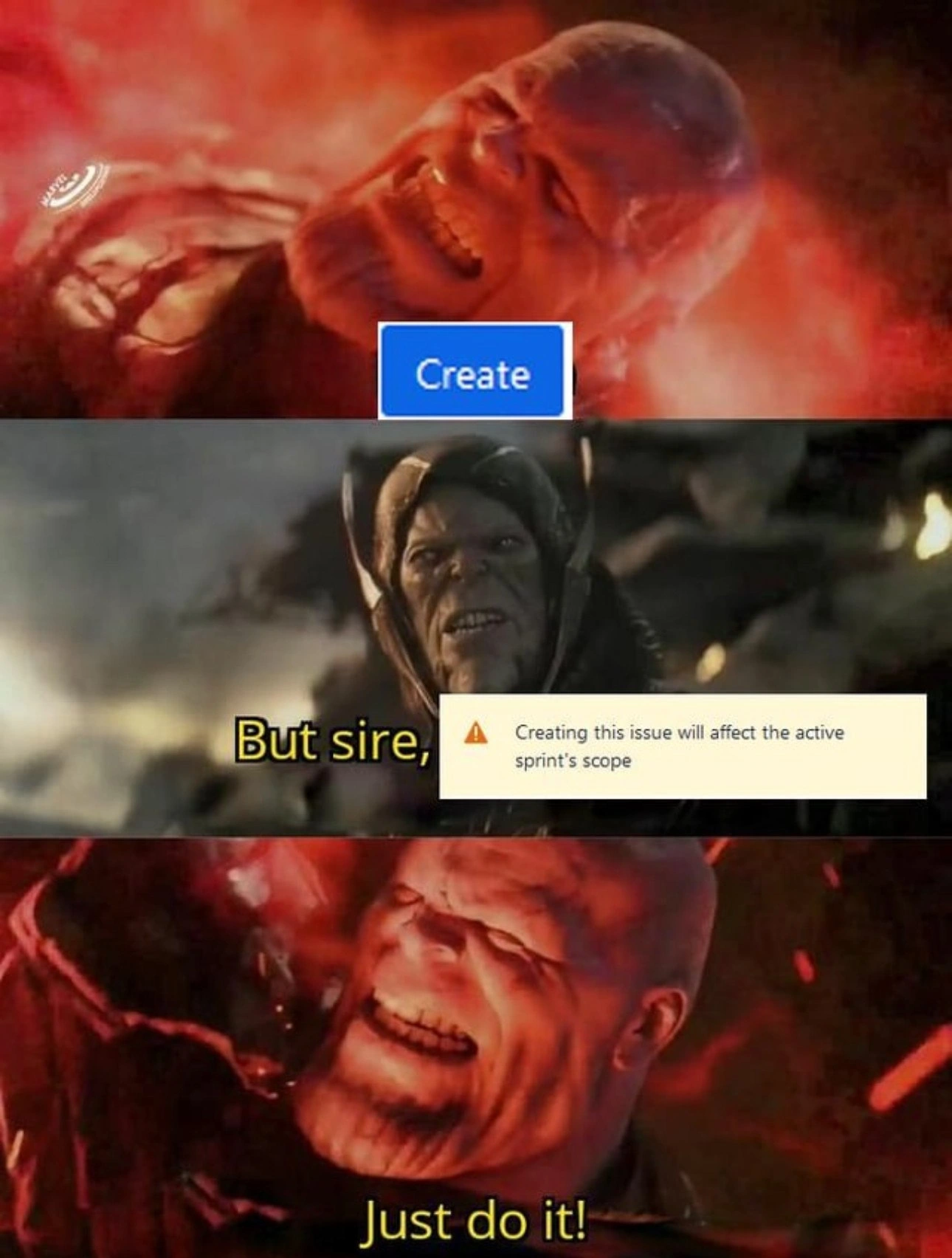
To manage work, teams use issue trackers like Jira or Azure DevOps Boards. These tools help you create “issues” or “tickets” for each piece of work (like a bug fix, feature, or task) and organize them into backlogs and sprints. When the meme shows a big blue “Create” button, it represents someone about to add a new issue/task. The yellow pop-up with the caution icon is the tool’s warning message. It typically reads something like, “Creating this issue will affect the active sprint’s scope.” In plain terms, the software is alerting: “Hey, you’re trying to put a new task into the ongoing sprint — doing so will change the plan we agreed on for this sprint.” Many tools deliberately throw this dialog box to make you stop and think, because altering the sprint should be an exception, not the norm.
In the meme, we see the subordinate character saying “But sire,” while showing that warning. This character symbolizes, say, a Scrum Master or a conscientious developer who knows the rules. They’re basically saying, “Uh, boss, the system (and our process) is telling us this isn’t a good idea.” The big boss character (Thanos in the image) shouting “Just do it!” is like a determined Product Owner or manager insisting the new work get added regardless of the warning. JiraTickets and agile tools don’t literally have a character shouting at you, of course, but this dramatization humorously captures the feeling when someone high up insists on making a late change that everyone else fears will cause problems.
Why is adding a new issue mid-sprint such a big deal? Imagine the team committed to 5 user stories this sprint. They allocated their time and resources to those. If you toss in a brand new story (especially without removing or swapping something out), suddenly they have 6 stories. Unless the new item is very small or someone works extra hours, something’s gotta give – likely one of the original 5 tasks will slip or everything will be done in a rush. It messes up the burndown chart (a graph teams use daily to track completed work versus time) – instead of a steady burn down to zero, you get a spike or plateau when new work is added. Newer developers might first encounter this when a critical bug pops up: even though it wasn’t in the plan, the team has to address it, so they push it into the sprint. The tool’s warning is effectively saying “you sure about this?” because it knows the team’s commitment is being altered.
For someone new to Scrum, it might be confusing why a simple click merits a warning. You might think, “Can’t we just add this one little thing? We’re agile, aren’t we supposed to respond to change?” Agile does encourage responding to change, but it’s all about balance. Scrum’s idea is to respond to change between sprints (like reprioritize before the next sprint starts) rather than constantly during a sprint – otherwise, nothing would ever be stable enough to finish. In practice though, emergencies happen. Good teams handle this by communicating: e.g., if we add this new high-priority issue, maybe we drop another story or at least acknowledge that our sprint commitment is changing formally. The warning dialog is prompting that discussion.
In our meme scenario, this discussion isn’t happening – it’s just “Full steam ahead!” The boss ignores the caution, which is played for laughs here because it’s so reckless. It’s akin to dismissing a smoke alarm because you really want to light another match. SprintPlanning and BacklogGrooming sessions (where the team plans and refines what to work on) are supposed to prevent these surprises. But sometimes teams either underestimate the work, or leadership ignores those limits. A junior developer witnessing this might be bewildered: “We had a plan, why are we changing it last minute?” The not-so-funny answer usually is: something important came up, and someone with authority said it can’t wait. It’s a crash course in the realities of workplace agility versus textbook Agile.
So, the meme is basically an AgileHumor depiction of a serious concept: ScopeCreep sneaking into an active sprint. We have the warning (the tool trying to enforce agile discipline) and the override (the human saying “we’ll break the rules just this once… again”). If you’re new to software teams, don’t be surprised if you encounter this scenario. You might even be the one hitting “Create” under pressure someday. The meme is a lighthearted way to say, “Yep, we know we shouldn’t, but sometimes we still do.” And everyone on the team shares a knowing smile (or groan) because they’ve seen how those last-minute adds can turn into mini-disasters by sprint’s end.
Key Terms Defined:
- Sprint: A short, fixed-length time period (often 1-2 weeks) in which a team aims to complete a set of tasks.
- Sprint Scope: The collection of user stories, tasks, or issues that the team plans to finish during the sprint. This is decided at the sprint’s start and ideally remains constant.
- Scope Creep: When additional work or requirements gradually expand beyond what was originally agreed upon. In a sprint context, it means new tasks are added after the sprint has begun (or tasks grow in complexity unexpectedly).
- Issue Tracker: A software tool (e.g., Jira, Azure DevOps, Trello) that teams use to document and track work items like feature requests, bugs, and tasks. It often shows who’s assigned to what and the status of each item.
- Active Sprint: The current ongoing sprint. An issue in an active sprint is “in scope” for the current iteration; adding an issue to it changes what the team will attempt to do before the sprint ends.
- Sprint Planning: A meeting at the start of a sprint where the team selects which items from the backlog to commit to and defines the sprint goal. This is where the sprint scope is set.
- Backlog Grooming (Refinement): Regular sessions where the product owner and team review the backlog of upcoming work, clarify details, and prioritize what to do in the future. Done well, this reduces surprises during a sprint.
The warning “affect the active sprint’s scope” basically means “You’re modifying the plan!” It’s like an app asking “Are you sure?” when you try to delete something important – it’s double-checking that you know the impact. In agile terms, that impact is that the team’s commitment for the sprint is no longer the same. The meme’s humor is that the person clearly sees the warning and charges ahead regardless. Everyone who’s used these tools has seen that dialog box and had that moment of hesitation. The laugh (or cringe) comes from knowing how often the answer is “Yes, I’m sure. Create the issue.”
To put it simply, the meme is using a supervillain meme template to dramatize a common project management situation. It teaches (with a wink) that while agile tools and principles try to keep us disciplined, ultimately humans call the shots – and sometimes we humans make choices that give agile purists a heart attack. If you’re early in your career, take note: scope changes mid-sprint are usually a red flag. But if your boss ever channels their inner Thanos and says “Just do it,” now you’ll understand the mix of laughter and groaning from your more experienced teammates. They’ve seen this movie before.
Level 3: Inevitable Scope Creep
Picture an Agile team in a heated moment of the SprintPlanning universe. The meme casts a Scrum drama as epic as an Avengers battle: a high-priority task emerges mid-sprint and the project manager is portrayed as Thanos, the relentless titan. The issue-tracking tool (like Jira or Azure DevOps) bravely pops up a warning about altering the sprint’s scope – essentially the software’s polite way of saying, "Are you sure you want to unleash ScopeCreep on this sprint?" The subordinate character (the developer or Scrum Master) hesitates: "But sire, this will affect the active sprint’s scope," echoing every cautious team member or Scrum Master who’s ever raised a timid hand to protest last-minute changes. And what does our Thanos-like boss do? Slams that big blue “Create” button with a fiery passion, growling “Just do it!” as if scope stability were a mere pesky hero to be snapped out of existence.
For seasoned developers and project leads, this scenario is painfully familiar and darkly funny. We’ve sat through countless sprint retrospectives lamenting scope creep – that insidious expansion of work that inevitably happens when someone yells “this can’t wait, add it now!” despite all the finely tuned plans. This meme nails the absurdity: a highly dramatized supervillain moment for something as mundane (yet destructive) as adding a Jira ticket mid-sprint. The humor lives in the contrast between the tool’s earnest caution (⚠️ "This will affect the active sprint's scope") and the boss’s almost cartoonish dismissal of process. AgilePainPoints like this arise when process collides with pressure. The whole point of a fixed sprint scope is to protect the team’s focus and make velocity predictable. But in real life, pressing business needs don’t care about your burndown chart – production incidents, new client demands, or sudden brainstorms can torch the plan faster than Thanos acquiring an Infinity Stone. The meme’s Thanos doesn’t just ignore the warning; he practically revels in it, which is a tongue-in-cheek jab at those with a “deliver at all costs” mindset in management.
From a senior perspective, the meme also hints at the organizational dysfunction that makes such moments common. Ideally, if something truly urgent must enter the sprint, Agile doctrine advises negotiating: maybe swap it with another task of equal effort, or formally adjust sprint goals. But how often have we seen that noble approach bypassed? Instead, a new ticket is jammed in (often on a Friday) with no trade-off, essentially dooming something else to not get done. It’s scope creep and magical thinking – assuming the team can just stretch to accommodate extra work with no consequence. Experienced devs have war stories of these “surprise extras”: the BacklogGrooming that wasn’t thorough enough, or the HiPPO (Highest Paid Person’s Opinion) that drops a last-minute feature. This meme captures that collective exasperation. The subordinate’s "But sire..." is every reasonable engineer or Scrum Master trying to defend the process, while the boss’s "Just do it!" is the reality of business pressure steamrolling best-laid plans. It’s funny because it’s true: tools like Jira try to enforce discipline with bright warning dialogs, yet here we are, clicking through them.
What really sells the joke is the Infinity War parallel: Thanos, the cosmic big boss, literally igniting chaos by insisting on his will despite warnings – that’s your overzealous product owner or stakeholder treating the sprint plan like a minor suggestion. The stakes in agile development aren’t life-or-death like in a Marvel movie, but tell that to a dev team whose weekend just got ruined by extra tasks. The meme exaggerates it to galactic proportions, and that melodrama is hilarious to those of us who’ve felt the real-life smaller-scale pain. We chuckle (or maybe groan) because we all know how the story goes after the “Create” button is smashed: the sprint’s burndown chart goes jagged, the team scrambles to squeeze in the work, and the Sprint Review becomes an exercise in explaining why half the original commitments vanished into dust. In the war of Process vs Pressure, pressure often wins – and ScopeCreep is “inevitable,” as Thanos might say. This shared understanding among veteran developers is what makes the meme instantly relatable: it’s a comedic catharsis for everyone who’s been on the receiving end of an “urgent” mid-sprint scope bomb. We laugh, perhaps a bit bitterly, because we’ve all lived through that Infinity War of agile planning where balance was lost the moment someone uttered, “Just one more ticket…”
Description
A three-panel meme using scenes from the movie 'Avengers: Infinity War' to satirize the violation of Agile sprint rules. In the first panel, the character Thanos is shown straining intensely, with a blue Jira 'Create' button overlaid, representing a user initiating a new task. The second panel features his subordinate, Corvus Glaive, saying 'But sire,', juxtaposed with a yellow Jira warning notification that reads, 'Creating this issue will affect the active sprint's scope'. This represents the process guardrails attempting to prevent unplanned work. The final panel shows a close-up of Thanos, exerting immense power and shouting the caption, 'Just do it!', signifying the user forcefully ignoring the warning and adding the new issue anyway. The meme humorously captures the all-too-common scenario in software development where managers or stakeholders disregard Scrum principles and introduce scope creep into an active sprint, much to the chagrin of the development team
Comments
7Comment deleted
The sprint commitment is 'perfectly balanced, as all things should be.' Then the product owner shows up with one more 'tiny' ticket, and suddenly reality can be whatever they want it to be
Leadership’s version of Agile: Thanos snaps away half the backlog at planning, then resurrects it mid-sprint by hammering “Create” - turns out scope, like energy, is only transferred to engineering pain
After 15 years of Agile transformations, we've successfully transformed 'the customer can change requirements at any time' into 'the customer WILL change requirements at the worst possible time' - and somehow we still act surprised when that yellow warning appears like it's the first time we've seen it
Every senior engineer knows this moment: you've carefully groomed the backlog, negotiated sprint capacity, achieved team consensus on the commitment - and then mid-sprint, someone with authority discovers the 'Create' button. The warning dialog might as well read 'Your velocity metrics are about to become fiction' because we all know how this story ends. It's the Agile equivalent of deploying to production on Friday afternoon: technically possible, universally inadvisable, yet somehow inevitable when stakeholders are involved
Pressing Create mid‑sprint is our executive-only feature toggle - bypass WIP limits, corrupt the burndown, and still claim velocity improved because we quietly changed the denominator
Jira's scope warning: inevitable disruption. Thanos PM: Fine, I'll do it myself - right into this sprint
Jira modal: “This will affect the active sprint’s scope.” Stakeholder: “Perfect - hit Create.” Agile’s CAP theorem: commitments, scope, sanity - pick two