Sprint planning meeting: everything is made up and points don’t matter
Why is this Agile meme funny?
Level 1: Points Don’t Matter
Imagine you and your friends are playing a pretend game where you have to clean up your room and do homework. You all make a guess about how hard each chore is by giving it some points – maybe cleaning your desk is 2 points and doing math homework is 5 points because it seems harder. 😄 You spend time in your little meeting coming up with these points. But when it’s time to actually do the chores, you find out the points were just made-up labels. Cleaning the desk might end up taking much longer than the “5-point” homework, even though you gave it a smaller number. In the end, everyone still has to finish their chores and homework, and those points didn’t really change anything. The meme is joking that sometimes work meetings are like that game – grown-ups sit around making up points for tasks, but it can feel silly because the work will take as long as it takes. It’s funny in the same way a joke is funny when someone says, “I’ll give you 1000 points for effort!” even though those points aren’t real. The picture even shows a game show host who used to give out fake points. So the big joke is: planning for work can feel like a make-believe game show, where we pretend to score tasks, but at the end of the day the scores (points) don’t really matter – getting the job done matters.
Level 2: Points and Velocity
Let’s break down the humor for those newer to Agile or Scrum practices. A sprint is a short, fixed-length period (often 1 or 2 weeks) during which a software team works to complete a set of tasks or user stories. The sprint planning meeting is where the team decides what work to pull in for the next sprint. In this meeting, there’s a ritual of estimating each task using story points. Story points are an abstract metric – basically a number that represents how much effort or complexity a task might involve. Commonly, teams use a scale like Fibonacci numbers (1, 2, 3, 5, 8, 13, ...), where higher numbers mean “this feels like it will take more work”. For example, a simple bug fix might be 1 point, adding a small feature might be 3 points, and a big feature with lots of unknowns could be 8 or 13 points. These points are not exact hours or days; they’re relative measures. If one task is 2 points and another is 4 points, the second task is assumed to take about twice as much effort as the first – in theory.
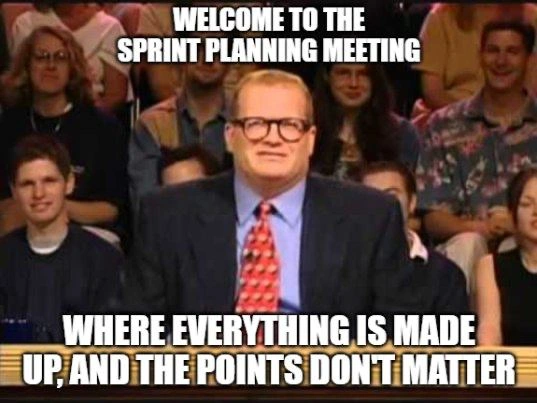
Now, how do team members decide these numbers? Often through a fun little activity called Planning Poker. Not actual gambling, but it feels like a game: each developer gets a set of cards with point values. For each user story, everyone secretly picks a card with their estimate (to avoid influencing each other), then all reveal at once. If most people picked, say, 5 and one person picked 13, that sparks a discussion: maybe the 13-pointer thought of some risk or complexity others missed. The team talks it out and might agree on a revised estimate. This process is meant to harness collective wisdom and ensure everyone understands the work. It’s a bit like improv – unscripted, each person throwing out a number, then collaboratively making up a consensus estimate. That’s where the meme’s comparison to an improv comedy show comes in. In the image, Drew Carey (the host of Whose Line Is It Anyway?) welcomes us to this meeting as if it’s a comedy game. On that TV show, performers improvise scenes and Drew awards random “points” for laughs, famously saying “the points don’t matter.” The meme humorously suggests that a sprint planning meeting can feel the same: we toss around story point numbers, but they might be meaningless in the grand scheme.
After the sprint is planned and underway, we track velocity – which is just the total number of story points the team finishes in that sprint. For example, if a team completes 5 tasks that were estimated at 3 points each, that’s 15 points of work done, so the velocity is 15. Teams use their past velocity as a guideline for how much they can take on next time. If you usually do around 30 points in a sprint, you probably shouldn’t commit to 60 points in the next one without a really good reason. So, story points and velocity are supposed to help with forecasting and avoiding overcommitting. The funny (and frustrating) part is that these numbers are very squishy. Each team has its own scale (one team’s “5 points” could be another team’s “2 points”), and even within a team the estimates are just our best guesses. New developers often discover that estimation is tricky – you might give a task 3 points thinking it’s small, and then it blows up into a monster that eats the whole sprint! Meanwhile, some tasks you fear will be huge (8 points) turn out to be done before lunch. It’s not an exact science; it’s informed guessing.
The meme taps into agile skepticism – the feeling that all this ceremony around story points might be somewhat futile. If everything changes or unexpected hurdles come up, those careful estimates can go out the window. When it says “everything is made up and the points don’t matter,” it’s highlighting that often reality doesn’t care about our estimates. The project will take the time it takes, regardless of what number we wrote down in a meeting. Developers sometimes joke that we spend more time estimating work than it would take to actually do some of it. That’s an exaggeration, but it captures the frustration of long planning meetings. Also, in some company cultures, managers start focusing too much on the numbers – “Why did we only get 20 points done this sprint when we did 30 last time?” – without realizing the context (maybe last sprint’s tasks were easier, or this sprint someone fell sick, etc.). This can make story points feel like a meaningless score we’re being graded on, rather than a tool to help us. For a junior developer, it might be surprising or even funny to hear experienced colleagues joke about “points not mattering,” especially after you’ve been told how important sprint estimates are. But the joke is a kind of gentle rebellion: it reminds everyone not to take these numbers too seriously. After all, agile was meant to be flexible and human-centric, not obsessed with metrics. The meme uses a bit of pop culture humor (the Whose Line reference) to say, “Relax, we know we’re kinda winging it during planning, and that’s okay – the real priority is doing the work, not the estimates.”
Level 3: Whose Sprint Is It Anyway?
In the Agile world of software development, a sprint planning meeting sometimes feels like an improv comedy sketch. The meme shows Drew Carey from the improv show Whose Line Is It Anyway? with the famous tagline, "Everything is made up, and the points don’t matter." Seasoned developers smirk at this because story point estimates in Scrum often feel just as arbitrary. We sit around a table (or Zoom call) playing Planning Poker – each engineer throwing out numbers like 3, 5, 8 as if we’re guessing lottery numbers. In theory, story points measure the relative effort of a task (a user story). In practice, they can be glorified guesstimates. The joke lands because after years of sprint ceremonies, we’ve seen how velocity (the total points completed per sprint) can become a vanity metric rather than a meaningful measure of productivity. It’s a shared secret among experienced devs that these points are a bit like the show’s meaningless scorekeeping – the team’s performance isn’t truly defined by the sum of points, yet management often treats it like the final score.
Behind the humor is a raft of AgilePainPoints. Estimating is hard – humans are notoriously bad at guessing how long complex coding tasks will take. We’ve all watched a 5-point task blow up into a 15-point slog due to hidden complexities or scope creep. Conversely, sometimes we bicker over whether something is 2 or 3 points, knowing deep down it won’t change how fast it gets done. The meme’s cynicism rings true: teams often make up numbers just to satisfy the ritual of sprint planning. We pretend our estimation process is scientific, perhaps discussing past velocity charts or using the Fibonacci sequence for point scales (1, 2, 3, 5, 8, 13...). But let’s face it – it’s more art than science. One developer’s 8 can be another’s 5, and each team’s scale is unique. There’s no universal unit for a “story point” – it’s not hours or days, just an abstract relative size. That means comparing velocities between teams is futile, yet you still hear things like, “Team A delivers 50 points per sprint, why can’t we?” Cue the eye-rolls from veteran engineers who know those numbers are as fungible as crypto.
The tragicomedy here is that Agile frameworks intended story points to foster discussion and roughly plan work, not to create a pseudo-scientific metric to obsess over. But corporate culture loves numbers, so velocity becomes a target. Enter Goodhart’s Law: “When a measure becomes a target, it ceases to be a good measure.” Teams under pressure to ramp up velocity might start inflating estimates (subtly labeling tasks as 8 points instead of 5) to hit the same velocity without actually doing more work. Suddenly, velocity goes up but actual output doesn’t – proving the meme’s point literally. Everything was made up, and the points didn’t matter. We just moved the goalposts. Experienced devs have sat through retrospective meetings where everyone quietly acknowledges, “Yeah, we kind of juiced the numbers,” but no one wants to admit the emperor (our estimation process) has no clothes. Instead, we half-jokingly promise to “estimate better” next time, knowing the cycle will repeat.
This meme perfectly captures that weary humor: Sprint planning can feel like a game where we perform the motions – breaking down work, assigning points – while knowing reality will laugh at our plans. It highlights an industry in-joke: the difference between Scrum in theory and Scrum in practice. In theory, story points help a team communicate complexity and learn to plan better over time. In practice, they’re often used as a managerial scorecard, which leads to gaming the system. The result? Developers end up feeling like contestants in an unwinnable game show. We crack dark jokes (like this meme) to cope with the absurdity. After all, when the production deadline looms and everything’s on fire, it doesn’t matter if we estimated a task as 3 points or 8 – what matters is shipping the fix. As a cynical veteran might say with a smirk: “Welcome to sprint planning: leave your sanity at the door, draw a card for your estimate, and remember – the house (reality) always wins.”
Description
The meme is a screenshot from the TV improv show parodying a game-show set: a suited host sits behind a desk facing the camera, audience members with blurred faces seated behind. Bold white Impact-font text spans the top and bottom. Top: “WELCOME TO THE SPRINT PLANNING MEETING”. Bottom: “WHERE EVERYTHING IS MADE UP, AND THE POINTS DON’T MATTER”. The joke riffs on Agile sprint planning, likening story-point estimation to the show’s famous line that scores are meaningless, highlighting developer frustration with arbitrary velocity metrics and estimation rituals
Comments
12Comment deleted
Story points: the only unit where “add a checkbox” and “replatform the monolith to Kubernetes” can both be an 8 - yet the burn-down chart still pretends the universe is linear
After 15 years of Agile, I've realized story points are just cryptocurrency for project managers - everyone pretends they have value, nobody really understands the exchange rate, and somehow we're all still mining them every two weeks
After 15 years in the industry, you realize sprint planning is just collaborative fiction writing where everyone pretends a 5-point story is exactly 62% of an 8-point story, the Fibonacci sequence somehow maps to human effort, and yesterday's 3-pointer that took two weeks will definitely inform today's estimates. The real skill isn't estimation - it's maintaining a straight face when the PM asks why velocity dropped after you finally started counting bug fixes
Story points: Fibonacci improv where the house (retrospective) always resets the score
Planning poker: the only estimation game where the Nash equilibrium is whatever keeps the burndown linear and the QBR slide green
Sprint planning: we turn ambiguity into Fibonacci, management turns it back into dates, and the only thing with velocity is scope creep
Sprint planning: This task is easy - we'll do this in 3 days! 7 month later: let's mobilize more resources :) Comment deleted
Who came up with this estimation — chairborne homebrew experts? Comment deleted
In any case, the collapse of the project cannot be avoided 🙃 Comment deleted
Alternatively, a new division may be formed by new hires and/or merger. Comment deleted
Nothing will save this dull and useless project from collapse. Also, the customer has long stolen all the money from the project. Even such "brain washed" employees as you will not be able to save the situation. The corporation has not been profitable for a long time and will soon come to an end. Final accord... Comment deleted
Non-profitable? Okay... Comment deleted