Skip to content
DevMeme
5066 of 7435
Squidward Roasts Cliché Programmer Jokes
DevCommunities Post #5545, on Sep 29, 2023 in TG

Squidward Roasts Cliché Programmer Jokes

Why is this DevCommunities meme funny?

Level 1: Heard It Before

Imagine you have a friend who keeps telling the exact same joke about you every time they see you. The first time, you might laugh or smile. But after hearing it over and over, you’d probably just sigh and roll your eyes because it’s not funny anymore. That’s what’s happening in this meme. It’s like a kid who does their homework every day, but someone always teases, “Ha, I bet you don’t do any homework at all!” and then adds, “You must study so much you never go out and play!” After a while, you’d think, “Come on, make up your mind – am I lazy or do I have no life? And also, can you please get a new joke?” In the meme, the cartoon character Squidward is reacting just like that tired kid. Squidward represents a programmer who’s heard people say “Programmers are lazy and do nothing” and “Programmers have no social life” so many times that he’s completely unimpressed. When Squidward says, “How original… Daring today, aren’t we?” in a sarcastic tone, he really means, “Wow, what a NOT original joke. You’re really being ‘daring’ by repeating that old line, huh?” It’s funny to people who code because they feel the same way — they’ve heard those stereotypes a hundred times. Just like you’d groan at the same old untrue joke about you, programmers laugh at this meme because it shows their eye-rolling reaction in a silly cartoon form. The big feeling here is annoyance turned into humor: it’s frustrating to be misunderstood, but seeing Squidward mock the joke makes programmers smile, because finally someone (even a cartoon squid) is saying, “Ugh, not this again!” in a way everyone can understand.

Level 2: Bored or Burnt Out?

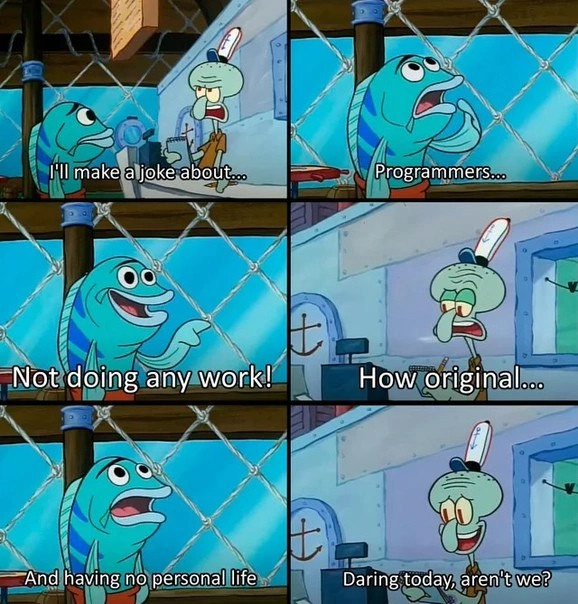
Let’s break down what’s happening in this SpongeBob meme and why developers find it so relatable. First, the setup: A blue fish character declares, "I'll make a joke about programmers..." and finishes with "not doing any work!" and "having no personal life." These are two classic stereotypes about people who code:

  • “Programmers not doing any work” – This is the idea that programmers are goofing off or being lazy on the job. It might come from the fact that a lot of what developers do doesn’t look like traditional manual labor or obvious activity. If you’ve ever been waiting for code to compile or tests to run, you know there can be periods where you’re just sitting there, maybe spinning in your chair or checking your phone. To someone who doesn’t understand coding, that moment might look like “See, they’re not doing anything!” But in reality, you’re actively working — planning your next steps, mentally debugging, or simply waiting for the tools to do their thing. Early in your career, you might even feel guilty that you’re not typing all the time. But developer productivity isn’t about constant motion; it's about the results. For example, a coder might spend an afternoon apparently “doing nothing” except researching a bug, and then in the last hour fix it with 3 lines of code. From the outside it looks like magic (or slacking then a sudden fix), but all that quiet time was real work. There’s even a well-known tongue-in-cheek saying in tech: “Never underestimate the power of a lazy programmer.” It suggests that a good programmer might write a quick script or automation to avoid a repetitive task. That might seem lazy, but it’s actually smart efficiency. Unfortunately, people who aren’t familiar with programming might misinterpret that efficiency and down-time as laziness. Hence the overused programmer laziness joke depicted by the fish character.

  • “No personal life” – This part of the joke claims that developers have no life outside of coding. This is the no_personal_life trope. It paints a picture of a coder as someone who works crazy hours, stays up all night on the computer, and doesn’t socialize — basically, that they live and breathe code 24/7. You might have seen characters like this on TV or movies: the hacker who barely leaves their room, or the IT person who everyone says lives on caffeine and pizza. It’s a stereotype that stems from some truth in tech culture: tech jobs can be demanding, and yes, some programmers are so passionate or under pressure that they put in very long hours. Early in your career, you might even go through a phase where you’re extremely absorbed in coding (for instance, learning a new framework over a weekend or crunching for a deadline). But the key is, real life programmers are normal people with hobbies, families, and friends too. Many developers maintain a healthy work-life balance — meaning they make sure to have time for personal life, not just work. In fact, the tech industry nowadays often encourages developers to avoid burnout by taking vacation, having weekends off, and so on. So while the image of the forever-coding, no-social-life programmer is popular in jokes, it’s not an everyday reality for most. It’s more of a worst-case scenario or a caricature. New engineers sometimes worry, "Do I have to sacrifice my personal life to succeed?" The answer is generally no — good employers and good time management let you do your job and enjoy life outside of work. When someone jokes “haha you must have no life,” developers find it annoying because it assumes they’re all one-dimensional code machines.

Now, why does Squidward respond with "How original... Daring today, aren't we?" in the meme? This SpongeBob SquarePants scene has become a famous meme format for calling out unoriginal or predictable statements. In the original cartoon, Squidward says these lines sarcastically to a customer who’s not being very creative (exactly like here). So in our context, Squidward represents the programmer (or the developer community) replying to the fish (who represents people who make these clichéd jokes). By saying “How original,” Squidward is basically rolling his eyes. It’s a very sarcastic way of saying “Wow, I’ve never heard that one before…” when in fact he’s heard it a million times. And “Daring today, aren't we?” means “Oh, you think you’re being bold or edgy by saying that?” when it’s actually just the safest, most obvious joke about programmers ever. This meme format is popular in TechHumor circles because techies love SpongeBob memes (a lot of us grew up watching SpongeBob) and it’s a perfect way to react to stale jokes or comments. If you browse any DeveloperHumor forum or hang out with a group of coders, you’ll notice we have our own jokes and memes about code, bugs, and frameworks. When an outsider comes in with the old “lazy geek with no life” joke, it sticks out as unoriginal. This SpongeBob template is a funny, lighthearted way for us to say “we’ve heard that one before, try something new.”

For a junior developer or someone new to the programming world, it’s useful to understand these stereotypes and why they persist:

  • Stereotype (definition): A stereotype is a widely held but oversimplified idea of a type of person. Here, the stereotypes are about programmers — painting all of us with the same brush.
  • Why "not doing any work" stereotype exists: People outside of tech sometimes don’t see how coding work happens. It’s not always visibly exciting — often you can’t tell if a programmer is stuck or brainstorming just by looking at them. Unlike, say, a construction worker who is clearly lifting bricks or hammering nails, a programmer might just look like they’re staring or browsing. There’s even the classic scene of a developer leaning back in their chair tossing a stress ball around, which to them might be thinking time, but to someone else it looks like goofing off. Without understanding what’s happening inside that person’s head or on their screen, it’s easy (but incorrect) to joke “ha, you’re not working at all!”.
  • Why "no personal life" stereotype exists: This comes from the image of the “obsessive coder.” It’s true that some projects or tech companies have periods where everyone is working very long hours (startups near a launch, game developers in “crunch mode,” etc). Popular culture also loves the idea of the socially awkward coder who would rather deal with computers than people (think of characters in shows like The IT Crowd or movies like The Social Network). These depictions reinforce the trope. When you’re new in the industry, you might meet a few folks who are extremely into tech and talk about coding even in their free time. You might even go through intense times yourself. But it’s not fair or accurate to say all programmers have no life. It would be like saying all doctors have messy handwriting — a stereotype that might be true for some but not all.

The meme also resonates with DevCommunities because inside these communities, we often vent about how people misunderstand our jobs. It’s a form of relatable humor that bonds programmers together. Maybe you’ve experienced this: you tell a friend or relative that you’re a software developer and they quip, “Oh, so you just sit and play on computers all day?” Or someone asks you to fix their laptop as a joke like that’s all you’re good for. The first time, you might chuckle. After the tenth time, it gets old. This meme is basically every developer after hearing those jokes again and again.

Visually, the meme uses a scene from a well-known cartoon to drive the point home:

  • Squidward’s bored expression in panel 4 and 6 (half-lidded eyes, unamused face) is exactly how a developer feels listening to these clichés yet again. Squidward is known for being cynical and easily annoyed, which fits perfectly here.
  • The blue fish in panels 1, 2, 3, and 5 looks enthusiastic and clueless. He’s smiling widely, thinking he’s come up with something hilarious and clever about programmers. This is like that one coworker from another department or a friend who keeps forwarding you “funny programmer jokes” that are actually very old. In the meme, the fish is essentially saying: “I’ve got a funny one: those programmers don’t actually work, haha! And they have no social life, haha!” He represents people who don’t realize their joke is unoriginal.
  • The setting (the chain-link net pattern and wooden beams) is the Krusty Krab restaurant interior from SpongeBob. It doesn’t have a deep meaning in the coding context; it’s just part of the cartoon. But it sets a scene that many viewers recognize instantly, which makes the meme accessible.
  • Text on top of each panel: In memes, especially multi-panel ones like this, the dialogue is often written as subtitles. Here, each panel’s text is the dialogue between the fish and Squidward. The final panel’s caption "Daring today, aren't we?" has become a punchline on its own in many memes, used whenever someone is being not-so-bold with their ideas.

For someone new to programming, the big takeaway is that these jokes (“lazy coder” and “no-life coder”) are considered low-effort and stereotypical. Why do developers roll their eyes at them? Because they ignore the reality of what we do and who we are. It’s comparable to an old joke about any profession that doesn’t ring true. Once you start working in tech, you’ll likely find that you and your coworkers do work very hard at times — and also enjoy normal things like weekends, video games, going out with friends, spending time with family, etc. So hearing someone reduce your whole field to “bunch of nerds who do nothing but type or play ping-pong” is frustrating. That’s why this meme strikes a chord: developer culture has a bit of a chip on its shoulder about being misunderstood by the outside world. We cope with that by sharing memes and jokes on our own terms (in our Slack channels, subreddits, Discord servers, etc.), often turning the frustration into humor. When you see Squidward’s sarcastic lines, you can almost hear a seasoned coder saying it in a monotone voice the same way, maybe at the office after someone in a meeting made a cheesy crack about engineers being “in their caves.” It’s workplace humor that doubles as a gentle lesson: If you’re not a programmer and you’re about to make a joke about how easy or weird their job is, know that they’ve likely heard it before — and they might reply with a Squidward-esque smirk.

In summary, unoriginal programmer jokes like the ones in the meme are well-known in the tech world, and this SpongeBob meme format is used by developers to playfully mock those clichés. It’s a way of saying “we’re tired of this narrative” in a humorous, meme-savvy way. As a new dev, you’ll quickly recognize these tropes, and you might even catch yourself making a Squidward face the next time someone teases you with “Don’t work too hard, hehe” when you know you’ve been debugging a tough problem all day. At least now you know: you’re not alone, and there’s a meme for that feeling!

Level 3: Schrödinger's Developer

In this meme, the tired stereotype about programmers is exposed as a paradox — apparently devs are both lazy slackers and work-obsessed hermits at the same time. It's a case of Schrödinger's Developer, where outsiders imagine us in two contradictory states until they actually see what we do. The six-panel SpongeBob SquarePants format delivers this with biting sarcasm. A blue fish customer proudly proclaims, "I'll make a joke about programmers not doing any work!" and then adds, "and having no personal life!" Meanwhile, Squidward (the grumpy cashier, standing in for a world-weary developer) responds with deadpan disdain: "How original..." and "Daring today, aren't we?"

This scene hits home for experienced engineers because it satirizes how unoriginal and tired these mainstream jokes have become. It's poking fun at the overused trope that developers are either not really working or have zero social life. Seasoned devs have heard this all before at family gatherings, from non-tech colleagues, or in cheesy media portrayals. After spending late nights crushing bugs or carrying the on-call pager, being told we "don't do any real work" is ironically funny (in a dark way). Developer communities love this kind of meme because it roasts the simplistic view that writing software isn’t “real work.” We know that a lot of our job happens in our heads: designing systems, debugging tricky issues, or researching solutions. To the casual observer, that might look like “not doing any work”—after all, how exciting is a person staring at code or thinking quietly? But as any senior engineer knows, productivity isn’t measured by keystrokes per minute or lines of code; it’s about problem-solving and generating value. Often the hardest part of programming is figuring out what to write, not furiously typing all day. So when someone cracks the “programmers hardly work” joke, the ironic humor is that they’re revealing their ignorance of what effort in knowledge work looks like. Squidward’s "How original..." is basically every developer’s internal response when hearing these clichés for the hundredth time.

The second punchline in the meme — "And having no personal life" — jabs at the no_personal_life trope, another caricature we’re tired of. It's the image of the coder who lives in a dark basement, surrounded by empty pizza boxes, coding till 4 AM, and presumably never seeing daylight or friends. This trope has roots in real problems like workplace burnout and tech Crunch Culture, but applying it as a universal joke is just as uninspired. Many of us have lives outside of work: families, hobbies, social activities (shocking, I know!). Sure, there are crunch times when a release or a production outage might consume our evenings and weekends, leading to that "no life" phase — but that’s a bug in the system, not a feature of the job. The meme highlights the developer irony that we get stereotyped as both idle and overworked. In reality, if a dev is truly pulling endless hours, they definitely are doing work (possibly too much of it); if they’re caught chilling at the desk, it might be because they automated some task or are on a much-needed mental break after solving a tough problem. Yet popular culture often ignores these nuances, recycling the same jokes as if they're daring insights. As Squidward quips: "Daring today, aren't we?" — it drips with sarcasm because there’s nothing daring about parroting a joke everyone’s heard since the 1990s.

From a senior perspective, this meme is workplace humor reflecting real frustrations. The first three panels could be any non-tech manager or random friend saying, “Working hard or hardly working, eh?” – a tease nearly every programmer has endured. The eye-rolling Squidward response is our collective mood when we encounter these one-liners for the Nth time. It’s relatable humor precisely because it’s an inside acknowledgment: Yes, they really still think this is funny. We've also seen how these stereotypes can affect us professionally. For example, some higher-ups who don’t understand software development might genuinely worry their dev teams are “just browsing Reddit all day” if they don’t see constant tangible output. Hence the rise of productivity theater like daily stand-up meetings or micro-managing via Jira tickets – attempts to assure everyone that developers are indeed working. Meanwhile, on the flip side, tech companies historically have glorified the “no life coder” mythos: the workaholic programmer who codes all night fueled by energy drinks. This has fed into unhealthy expectations (think of startup cultures bragging about 80-hour weeks). The meme targets the absurdity of holding both these views at once or defaulting to either as a joke. We laugh a bit ruefully because, as DeveloperCulture, we’re proud of working smart (sometimes called "lazy efficiency") and we also advocate for healthy work-life balance — but outsiders reduce it to a cheap punchline.

In essence, the meme is calling out unoriginal programmer jokes the same way devs might flag duplicate code or a copy-pasted Stack Overflow snippet: with a "seen this before, please try something new" attitude. It resonates with engineers who are jaded by seeing the same low-effort humor about their profession. Just as Squidward at the Krusty Krab has seen it all when it comes to annoying customers, experienced devs have heard it all regarding these stereotypes. The combination of sarcasm and a SpongeBob reference makes the message clear: making fun of programmers using these clichés is old hat, and the real joke is on the person thinking they're being clever. After all, in a field that prizes creativity and innovation, repeating a stale trope is the one thing guaranteed to get a "How original..." reaction from us. (If only outdated jokes were as easy to refactor as code!)

Description

A six-panel meme using the 'Daring today, aren't we?' format from the cartoon SpongeBob SquarePants. The scene features a dialogue between an enthusiastic blue fish and a cynical, unimpressed Squidward Tentacles. In the first three panels, the fish excitedly announces his plan to make a joke about 'Programmers... Not doing any work!'. In the fourth panel, Squidward sarcastically retorts, 'How original...'. The fish then adds, 'And having no personal life', to which Squidward, with a condescending smile, replies in the final panel, 'Daring today, aren't we?'. This meme serves as a meta-commentary on the tired, overused, and often contradictory stereotypes that plague the programming profession. It captures the exasperation of experienced developers who have heard these unoriginal jokes countless times, using Squidward's voice to mock the lack of creativity in mainstream humor about tech
Comments

13
Anonymous ★ Top Pick The paradox of programmer stereotypes: we're simultaneously lazy slackers who do no work and obsessive hermits who do nothing but work. It's like they think our lives are running in non-deterministic parallel threads
  1. Anonymous ★ Top Pick

    The paradox of programmer stereotypes: we're simultaneously lazy slackers who do no work and obsessive hermits who do nothing but work. It's like they think our lives are running in non-deterministic parallel threads

  2. Anonymous

    “Right, we’re the lazy ones - my idea of ‘not working’ last night was diff-scrolling 800-line lockfiles by candlelight to find which microservice’s transitive dependency silently upgraded OpenSSL and pancaked prod at 2 a.m.”

  3. Anonymous

    After 20 years in tech, the only thing more predictable than a null pointer exception in production is hearing these exact 'programmer jokes' at every family gathering, usually right after explaining for the hundredth time that no, you can't fix their printer

  4. Anonymous

    This meme perfectly captures the irony of programmer humor: we're so overworked and burned out that even our jokes about being overworked and burned out have become overworked and burned out. It's recursion all the way down - except we forgot the base case, so now we're stuck in an infinite loop of self-deprecating meta-commentary about our lack of work-life balance. At least we're consistent in our inconsistency

  5. Anonymous

    We’re “not doing any work” - it just looks like architecture reviews, SLO renegotiations, and schema migrations instead of green bars on your commit graph

  6. Anonymous

    We look lazy because our best commits are deletions; you only notice us when someone gets daring and ships a Friday deploy without a feature flag - then the pager explains why we allegedly have no personal life

  7. Anonymous

    Squidward gets it: true daring is merging a personal life into prod without downtime

  8. @Sava_SKk 2y

    🐳

  9. Deleted Account 2y

    what does these whales means?

    1. @Sp1cyP3pp3r 2y

      🐳

    2. @dsmagikswsa 2y

      Docker, shit it

  10. Felix 2y

    i read them as ignorant-happy

    1. Deleted Account 2y

      i read this as offense-praise

Use J and K for navigation