Clean Compile, Utter Confusion
Why is this Compilers meme funny?
Level 1: Beginner’s Luck
Imagine you’re trying to solve a really hard puzzle, but you’re not following any instructions – you’re just randomly trying pieces. You feel totally lost while doing it. Then, by some miracle, all the puzzle pieces click into place and you finish the puzzle perfectly. You step back, surprised, and say, “Wow, I have no idea how I did that, but it turned out great!” This meme is laughing about that exact kind of moment, but with writing code.
Think of the programmer as someone doing a big jigsaw or building a Lego set without the manual. When their code compiled with no errors, that’s like the puzzle suddenly being all done with no pieces missing. It’s a happy moment! But it’s also a little funny, because the person is standing there scratching their head, thinking, “Uh, what just happened? I wasn’t sure what I was doing, but somehow it worked out.” It’s like when you get a perfect score on a test you felt unsure about – you’re proud and confused at the same time.
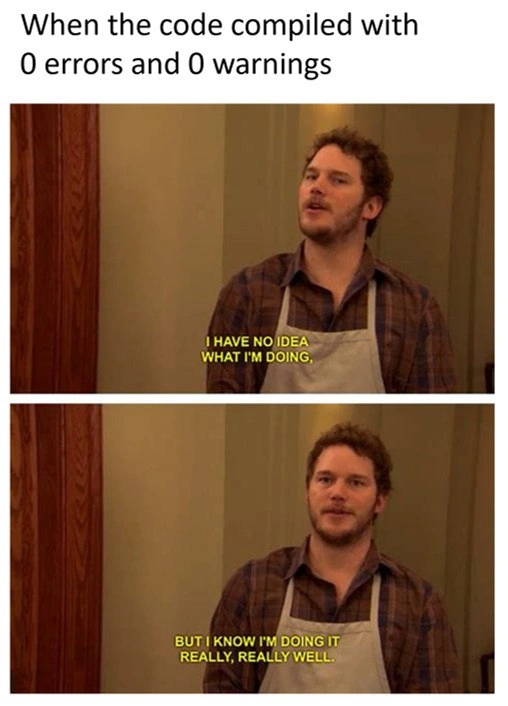
The meme shows a man saying first, “I have no idea what I’m doing,” and then, “But I know I’m doing it really, really well.” It’s silly because usually you do something well when you know what you’re doing. 😊 Here, he’s basically saying, “I succeeded, but I’m not even sure why or how!” That mix of emotions is what makes it funny. It’s something many people (especially those learning new things) have felt: sometimes you get it right by luck. In plain terms, the meme is joking about beginner’s luck in programming — when your code works even if you were uncertain, and you’re left happily mystified by your own success.
Level 2: Zero Errors, Zero Clue
Let’s break down the meme in simpler terms. The top text says, “When the code compiled with 0 errors and 0 warnings.” This describes a scenario every coder encounters. To compile code means to run it through a compiler, which is a special program that translates the code you write (source code) into a lower-level form the computer can execute (like machine code or bytecode). Think of the compiler as a very strict grammar teacher for programming languages. It will refuse to compile your program if it finds any errors – those are usually violations of the language rules, such as missing punctuation (like a missing semicolon ; in C++), using a variable that wasn’t defined, or calling a function with the wrong number of arguments. When an error is encountered, the compiler stops and spits out an error message (pointing to a file and line number) so you can go fix it.
A warning, on the other hand, is like the compiler saying, “Hmm, this isn’t technically wrong, but it looks suspicious.” Warnings don’t stop the compilation, but they alert you to potential issues: for example, if you declared a variable and never used it, or you included a library you didn’t end up needing, or you used a lot of == in Java where .equals might be intended. You can still run the program if it has warnings, but good developers pay attention to them because they often hint at bugs or sloppy code. Many projects actually treat warnings seriously (some even configure build systems to treat warnings as errors) to maintain high code quality. So, 0 errors and 0 warnings is basically the compiler reporting: "All clear! I found nothing wrong at all." It’s like getting an all-A report card from your compiler – the best outcome of a build.
Now, the meme image is a two-panel scene from a sitcom (the show Parks and Recreation). In it, the same character (Andy Dwyer, a goofy, well-meaning guy) appears twice. In the first panel, he looks a bit bewildered and the subtitle on the screen says, “I HAVE NO IDEA WHAT I’M DOING.” In the second panel, he looks mildly confident or optimistic and the subtitle reads, “BUT I KNOW I’M DOING IT REALLY, REALLY WELL.”
Top Panel: "I HAVE NO IDEA WHAT I’M DOING."
Bottom Panel: "BUT I KNOW I’M DOING IT REALLY, REALLY WELL."
So how does this relate to a programmer compiling code? It’s presenting a humorous internal dialogue. Imagine a programmer who has been trying to get their code to compile. They run the compiler, and to their surprise, it finishes without a single complaint — no error messages, not even a warning. The code compiles on the first try (or after a long struggle) flawlessly. Externally, this means they did everything right — the toolchain, the compiler, all are happy. So part of them is thinking, “I must be doing really well!” That’s the second panel’s sentiment.
But the joke is that internally, the programmer is stunned: “How on earth did that work? I wasn’t expecting it to succeed.” This is the first panel: “I have no idea what I’m doing.” It’s a confession of confusion. Maybe the coder was experimenting, or using a piece of code they don’t fully understand (like copying some solution from the internet), or just trying out random fixes. When it suddenly worked, they’re left feeling, luck more than skill. Every developer, especially in the early years, experiences this. For instance, you might be configuring a complex build system (like trying to set up a Continuous Integration workflow) and you toggle some settings or add a mysterious line you found on a forum. Suddenly, everything runs perfectly. You feel relief, but also a bit like, “Uh, what did I just do?!”
This meme is a form of CodingHumor that’s very relatable. It pokes fun at the idea that just because your tools aren’t complaining, doesn’t mean you’re a genius mastermind — sometimes it can feel like you got away with something. It’s common for developers to joke about their own surprise when something works. In fact, new programmers sometimes equate a successful compile with success of the program (“It runs, so I’m done!”). With experience, you learn that compiling is just one step, but early on, it genuinely feels like a huge win to see zero errors. So the meme exaggerates that feeling: the guy in the picture is boasting about doing it "really well", but ironically he also admits he doesn’t understand what he did.
Let’s connect this with real-world newbie experiences: Suppose you’re learning C++ and you keep getting a compiler error about an “undefined reference” or missing #include for some library. You then google the error, find a Stack Overflow answer that says “add -lm to your compile command” (to link the math library, for example). You do that, and next thing you know – the code compiles perfectly! In that moment, you might chuckle and think, I have no clue why -lm was needed, but hey, it worked! You might even message a friend saying, “Haha, I fixed it, but I basically tried a magic flag I found online.” That’s essentially the joke here. The developer feels a bit like Andy: outwardly successful (the program compiled), but inwardly a little embarrassed or perplexed that they don’t fully grasp the solution. It’s a gentle nod to what’s called imposter syndrome, where you feel like you just got lucky rather than earned the success.
The use of a popular sitcom scene (Andy Dwyer’s clueless-yet-proud quotes) makes the meme extra fun. Even if you don’t know the character, the lines themselves are clear enough to convey the mood. And if you do know Andy, you know he often stumbles into good fortune with a big goofy grin – just like a newbie programmer might stumble into a working program. The meme’s text “When the code compiled with 0 errors and 0 warnings” sets up a scenario, and Andy’s lines deliver the punchline: It worked, but I don’t know why it worked... yet I’ll pat myself on the back anyway! It’s both celebratory and self-mocking.
In summary, at this level we understand that the meme is laughing at the confusion behind a perfectly compiling code. It’s highlighting an experience where tool feedback (no errors from the compiler) doesn’t match the coder’s personal confidence. Anyone who has wrestled with code, from a school assignment to a big project, can recognize that mix of “Yay, it runs!” and “Wait, is this for real?”. The meme assures us we’re not alone in that feeling — it’s a rite of passage in the journey of programming.
Level 3: The Build Confidence Paradox
This meme nails a feeling that seasoned developers know all too well: that paradoxical moment when everything seems perfect, yet you’re filled with doubt. In the software world, seeing “compiled successfully” with 0 errors and 0 warnings is like reaching a milestone. After battling cryptic compiler errors or tweaking a gnarly build system, getting a clean build should be cause for celebration. And it is – for a second – until the imposter syndrome kicks in: “Wait, it compiled… but do I actually know what I’m doing?”
What makes this humorous is that usually compilers are very hard to please. You miss one ; or misuse a variable, and you’re greeted with a wall of red errors. So when the compiler finally says nothing (i.e., it’s happy), any developer expects to feel confident. Yet here, the programmer response is the opposite: confusion. This is the build confidence paradox in action: a successful build was supposed to boost confidence, but instead it triggers self-doubt about one’s own understanding. Why? Because we’ve all had those lucky breaks where the code works or the bug disappears and we’re not entirely sure what we did right. It’s both relieving and unsettling.
The two-panel image (borrowed from a comedic moment in Parks and Recreation) perfectly captures this. In the first panel, the developer proxy (Andy Dwyer, played by Chris Pratt, wearing a clueless expression and an apron for some reason) declares, “I HAVE NO IDEA WHAT I’M DOING.” In the next, he adds with a dazed grin, “BUT I KNOW I’M DOING IT REALLY, REALLY WELL.” Those subtitles mirror a programmer’s internal monologue when a hard problem suddenly builds without errors. It’s the ultimate instance of DeveloperSelfDeprecation: making fun of oneself for stumbling into success. The humor is in the contradiction – normally, if someone confidently says they’re doing something really well, you’d assume they know what they’re doing! Here we have the opposite, and every developer recognizes that ironic brag. We’ve all half-joked to colleagues, “It works... I have no idea why it works, but hey, I’ll take it.”
This scenario is incredibly relatable. Maybe you copy-pasted some code from Stack Overflow to fix a bug, toggled a few compiler flags, or tried a random CI/CD pipeline setting, and suddenly the build went green. You’re happy, but also thinking, Did that really just fix it? :sweat_smile: It’s like performing some ritual with a complex build system (Maven, CMake, you name it) and magically the incantation succeeds. A senior engineer might quip, “It compiled on the first try – must be black magic!” In fact, among developers there’s a running joke: “It compiles, ship it!” In other words, if the code finally compiled, let’s deploy it immediately before anything else goes wrong. Of course, this is said with heavy sarcasm – we know a successful compile is just one step, but it’s such a struggle sometimes that it feels like victory. The meme plays on the same exaggeration for comedic effect.
Another aspect here is the subtle dread of “too good to be true.” A flawless compile on the first attempt is so rare that it can make an experienced programmer suspicious. For instance, you might wonder: Did I actually compile the latest code? Did the tests really run? In continuous integration systems (BuildSystems_CICD in action), a green build might hide the fact that, say, all the tests were accidentally skipped due to a misconfigured script. Seasoned devs have been burned by false positives before. So that expression of confusion in the meme also hints at the thought: Something’s off, I expected at least one error. Did I overlook anything? This healthy paranoia is part of the RelatableDeveloperExperience. We know that feel: you get success when you weren’t expecting it, and instead of pure joy, you feel developer confusion.
The Parks and Rec reference adds an extra layer for fans: Andy Dwyer’s character is lovable, enthusiastic, and often in over his head — basically an affable newbie at many things. Seeing him say those lines is like the embodiment of a programmer’s imposter syndrome with a smile. You can almost imagine Andy as a junior dev who ran a build and is now telling Ron Swanson, “I literally have no clue what I did, but apparently I’m a natural at this coding thing!” It’s hilarious because we know Andy’s successes are often accidental, much like some of our coding wins.
In day-to-day developer life, this meme is a lighthearted reminder not to take every success at face value. It encourages us to laugh at ourselves: even when our code compiles and all looks well, it’s okay (and common) to admit we might have gotten there by trial and error. The true pros aren’t those who never feel lost — they’re the ones who double-check why something worked, even as they celebrate that it did. This meme gives a knowing wink to that culture: yes, the compiler is happy, and you’re happy, but you’re also scratching your head — and that’s okay! It’s a shared joke about the times we feel like an accidental genius in programming.
Level 4: Compilation vs Comprehension
At the most granular level, this meme touches on the fundamental difference between code that compiles and code that is understood. When your program compiles with 0 errors and 0 warnings, the compiler has essentially said: "Your code follows all the syntax and type rules of the language. I can translate it into machine instructions." Behind the scenes, the compiler (be it gcc, Clang, javac, etc.) has performed lexical analysis (breaking your code into tokens), parsing (building a syntax tree), semantic checks (type checking, scope resolution), and maybe optimizations. If none of those phases complained, the result is a binary or bytecode ready to run.
However, passing a compile is a necessary but not sufficient condition for a program to be correct or meaningful. The compiler’s green light doesn’t prove your logic is sound; it only proves your code is well-formed. This is a crucial distinction in computer science theory: compilers guarantee syntactic correctness (and basic semantic consistency), but not program correctness. There’s a famous saying in programming, "It compiles; let's ship it!" — it’s a tongue-in-cheek joke because experience teaches us that a bug-free compile doesn’t equal a bug-free program.
Why can’t compilers catch deeper logical errors? It comes down to fundamental limits like the Halting Problem and the complexity of static analysis. A compiler can easily spot a missing semicolon or a mismatched data type, but it can’t deduce if your code actually meets the requirements or if it will crash at runtime in all cases. In theoretical terms, determining arbitrary program behavior or correctness is undecidable – meaning there’s no general algorithm that can perfectly catch all logical bugs before running the code. For example, a compiler won’t know if your function to calculate prime numbers actually implements the math correctly; it only knows if you wrote it in valid C++ or Java or Rust. There’s an entire field of formal methods and program verification dedicated to proving program correctness (using tools like model checkers or theorem provers), but those go way beyond what a normal compile step does in everyday software development.
To illustrate, consider a C snippet that compiles cleanly but hides a fatal flaw:
#include <stdio.h>
int main() {
int numbers[2];
numbers[5] = 42; // No compile error, but writing out of bounds (undefined behavior!)
printf("Value: %d\n", numbers[5]);
return 0;
}
The code above would likely produce 0 errors, 0 warnings (unless extra analyzer flags are on). The compiler is totally fine with you accessing numbers[5] because, from a purely language rule perspective, it doesn’t immediately violate syntax or type rules. The compiler isn’t required (nor usually able) to prove that index 5 is invalid at runtime – that’s a logical error leading to undefined behavior. So it happily generates an executable. Of course, running that program could crash or print garbage, because writing to an array out of bounds corrupts memory. This highlights the gap: the code is syntactically correct (the compiler’s job) but semantically dangerous (the programmer’s concern).
In a more abstract sense, this meme humorously exposes that gap between compilation and comprehension. A clean compile tells us "the program is structurally okay," but only the developer (and thorough testing) can determine if the program is conceptually okay. Modern build tools and compilers even provide options like treating warnings as errors (-Werror) to enforce higher code quality, but even with 0 warnings, the compiler’s approval is limited. It can’t read your mind or verify you didn’t just implement total nonsense that happens to obey the language grammar. As enthusiastic engineers, we marvel at how much heavy lifting compilers do (catching thousands of mistakes automatically), but we also learn not to equate the compiler’s silence with our own understanding. The meme captures that ironic disconnect: the code might be in perfect shape from the compiler’s viewpoint, while the developer is still in the dark about how or why.
Description
A three-panel meme. The top panel has text that reads, 'When the code compiled with 0 errors and 0 warnings'. The middle and bottom panels are screenshots of the character Andy Dwyer (played by Chris Pratt) from the TV show 'Parks and Recreation'. In the middle panel, he says, 'I HAVE NO IDEA WHAT I'M DOING,'. In the bottom panel, he continues, 'BUT I KNOW I'M DOING IT REALLY, REALLY WELL.' This meme captures the paradoxical feeling of success and suspicion that developers, especially those working with complex compiled languages, sometimes experience. A perfectly clean compile on the first try can be so rare that it feels like something must be wrong. It humorously portrays the imposter syndrome and the blind faith required when a complex system works without any obvious hitches, leaving the developer both proud and deeply unsettled, wondering what horrors might be lurking at runtime
Comments
7Comment deleted
A clean compile with no warnings is the compiler's version of 'I'm not mad, I'm just disappointed.' The real errors are waiting for you in production at 3 AM
Compiler exits 0; great, the syntax is valid - now place your bets on which microservice will be first to discover the race condition we just promoted to prod
After 20 years in this industry, I've learned that code compiling perfectly on the first try just means the real bugs have achieved sentience and are hiding from the compiler
The most terrifying moment in any senior engineer's career isn't when the build fails with 500 errors - it's when a complex refactoring compiles cleanly on the first try. You know something's wrong, you just don't know what yet. Time to add `console.log('how did we get here')` and start the archaeological dig through your own code from 20 minutes ago
0 errors, 0 warnings - amazing what -Wno-everything and a stale CI cache can do; PagerDuty will handle the peer review
Compiler's clean bill of health: the ultimate gaslighting before runtime exposes your architectural sins
0 warnings means the types agreed; the invariants, SLOs, and the pager didn’t get a vote