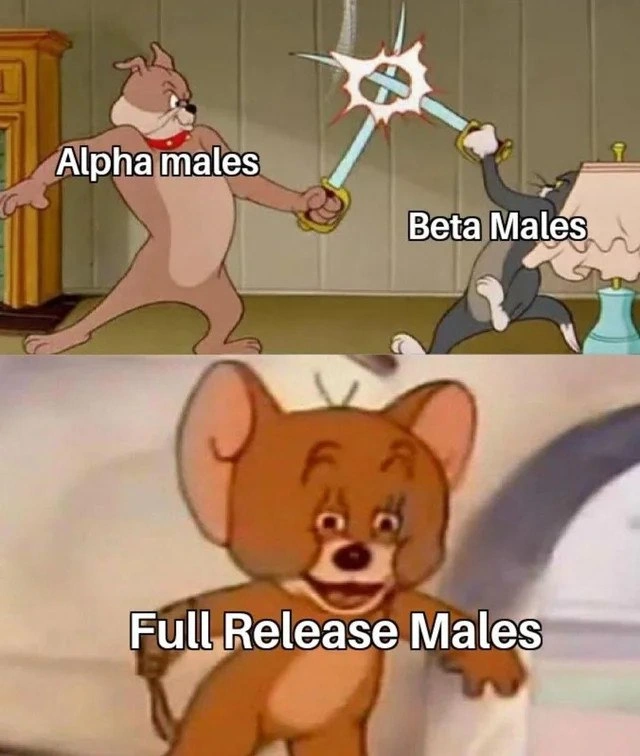
The true final form: Full Release Males
Why is this SDLC meme funny?
Level 1: Practice vs Performance
Imagine you and your friends are rehearsing a school play. During practice, everything is messy – people forget their lines, bump into each other, and there’s a lot of giggling and arguing (that’s the “alpha” and “beta” chaos, like two cartoon characters fighting with toy swords 🐕🐈). It’s a bit like two siblings squabbling while trying to clean up a messy room. But once all that practice and fixing mistakes is done, it’s showtime. On the day of the big performance, you walk on stage and deliver your lines perfectly. The show goes smoothly, and you take a bow with a huge proud grin 😁. That final confident walk on stage is just like the full release strolling into production – looking calm and cool because all the hard work (and little fights) happened earlier, behind the scenes. The reason this meme is funny is the same reason we laugh when someone acts super confident after a huge struggle: we know things were wild back stage, but the audience (or users) only see the easy, successful finish. It’s the calm after the storm – and seeing that tiny mouse Jerry strut happily while the cat and dog were fighting just moments before is a silly way to show how finally being done feels great.
Level 2: Alpha, Beta, Release
Let’s break down the software release phases pictured in this meme, and why it’s so relatable for developers at any stage – especially if you’re new to shipping code. In software development, projects usually go through three main release stages before and as they hit the public: Alpha, Beta, and Full Release. These terms help teams communicate how complete or stable the software is. The meme personifies each stage with a cartoon character, making a joke out of the serious business of deployment. To understand the humor, you need to know what each phase typically means:
Alpha version – This is the earliest test build of a product. Think of it as the first draft. It’s often incomplete and likely very buggy. Alpha builds are usually tested by the developers themselves or a very small group within the company. New developers might encounter alpha versions in internal demos or when running code that’s still under heavy construction. In the meme, Spike the bulldog is labeled “Alpha males” because he’s big and rough: an alpha build is rough and tough, known to crash or break easily while we’re still adding features. It’s expected that things will go wrong at this stage – it’s practically the software’s baby steps. If you’ve ever run an early build of an app and it immediately crashes, that’s the alpha experience! 🐕🔧
Beta version – This comes after alpha. A beta build is more like a second draft that’s feature-complete. By the time software is beta, all the planned features are there, but there may still be bugs and performance issues to iron out. Beta releases are often shared with external testers or a subset of real users (think of those “Join the Beta Program” invites you see for apps). The idea is to get feedback and catch issues that the dev team might have missed. In the meme, Tom the cat is labeled “Beta Males,” and he’s fencing with Spike. Tom is agile but still gets into fights – similarly, a beta build is better than alpha but can still “fight” with testers by throwing unexpected errors. If you’re a junior dev, your first experience delivering a beta version might involve fixing lots of bug reports from QA. It can feel like a duel: you fix one thing, another bug pops up! 🐈🛠️
Full Release (Production) – Once the software has been tested thoroughly in beta and the major bugs are resolved, it graduates to a full release. This is the version that’s deemed stable and ready for everyone (all customers or the general public). It’s often version 1.0.0 (or another semantic versioning label without “-alpha” or “-beta” suffix). Developers sometimes call this going “GA” (General Availability) or simply going to prod. In the meme, Jerry the mouse waltzing in as “Full Release Males” is that final, polished product. Jerry has a smug grin because the production release is confident – it passed all the tests, it’s packaged via the build system, and it’s deploying with a green light. For a new developer, seeing your code reach this stage is like winning a game or acing an exam. It means all that testing and debugging paid off. The product is out in the real world, and you can (hopefully) relax a bit. 🐭🚀
These stages are part of the SDLC (Software Development Life Cycle) and are managed through processes like a build pipeline in CI/CD (Continuous Integration/Continuous Deployment) systems. For instance, imagine your team uses Jenkins or GitHub Actions: it might automatically label builds as alpha, run tests, then mark some as beta for QA to test, and finally push a release build to production if everything passes. You might see version names like v2.0.0-alpha1, v2.0.0-beta, and then v2.0.0 as the final release. Those labels tell everyone how ready the software is. The meme capitalizes on these familiar labels, joking that alpha and beta builds are busy battling (because they’re notoriously unstable and release management teams struggle to get them right), while the full release struts by proudly (because once it’s in prod, it’s considered mature and stable).
If you’re early in your career, you might have felt release anxiety around deploying code. That’s normal! An alpha or beta release often comes with nerves – “Will it crash? Did we miss something major?” By the time it’s a full release, there’s still some butterflies (there always are when real users are involved), but you’ve squashed the big bugs and proven the software in tests. The meme’s humor is that the final release appears completely unbothered by those worries – like a cool character walking past a fight. Of course, in reality, getting to that worry-free deployment takes a ton of effort (and more than a little caffeine ☕ during crunch time). But when it finally ships and works, you do feel a bit like Jerry: Oh yeah, we nailed it. 😎
Level 3: Alpha-Beta Brawl
In the top panel of this meme, we see Tom & Jerry characters Spike (the bulldog) and Tom (the cat) clashing swords. The labels rebrand them as “Alpha males” (Spike) and “Beta Males” (Tom), which is a clever play on software release jargon. In development, an alpha build is an early, unstable version of software (often tested internally), and a beta build is a later pre-release version that’s more polished but still not final. Here they’re depicted dueling, humorously showing how alpha and beta versions often “fight it out” in terms of bugs and stability issues. Meanwhile, the bottom panel shows Jerry (the mouse) strolling in confidently, labeled “Full Release Males.” This represents the full release version of software – the production-ready build – smugly walking past the chaos. It’s a tongue-in-cheek way to say that while pre-release builds (alpha, beta) might be in constant conflict (with developers and testers battling bugs like cartoon characters with swords), the final release can waltz into production like a hero who’s above all that drama.
From a seasoned developer’s perspective, this meme nails the release cycle humor. Software release phases are being anthropomorphized: the alpha phase is rough and prone to breakage (Spike’s brute-force approach), the beta phase is a bit more refined but still struggles (Tom’s frantic efforts), and the production release is the confident final form (Jerry’s smug ease). The term “Alpha male” vs “Beta male” is a cultural reference to dominance hierarchies, but here it’s subverted: “Alpha build” vs “Beta build” are slugging it out, while the stable release struts by. Developers find this hilarious because it highlights a truth in our SDLC (Software Development Life Cycle) – those early versions are a warzone of bug fixing and feature tweaking. Release management often involves wrangling these volatile pre-prod versions, and it can feel like a sword fight between stability and haste. By the time you reach a full release, most major bugs have (hopefully) been vanquished, so it should be smooth sailing into production. The meme exaggerates that contrast: after all the release anxiety and chaos of alpha/beta phases, the final build saunters into prod as if nothing ever went wrong.
In real projects, alpha vs beta can be a tension point. At alpha stage, developers might be clashing with QA over critical bugs (“Spike” swinging a sword at “Tom” is like devs vs testers dueling over reports). By beta stage, things are more stable but you still have Beta testers finding edge-case issues, possibly sparking last-minute fixes (imagine Tom desperately lunging to catch Jerry – akin to chasing down final bugs). Meanwhile, the project manager or release engineer (our smug Jerry) is preparing the pipeline for deployment. It’s common in CI/CD pipelines to first deploy alpha builds to internal servers, then promote a beta build to a staging environment, and only then push the full release to production. The bottom panel’s Jerry grin embodies that victorious feeling when a build passes all tests and goes live. After countless continuous integration builds and continuous deployment trials, the production release is like, “Outta my way, I’ve got users to impress!” – strolling into the live environment with confidence.
There’s industry truth baked in: Alpha and Beta releases often come with warnings (“use at your own risk” or “for testing only”). They’re expected to be imperfect, which is why developers and testers spend those phases battling bugs and performance issues. Only once those duels are settled do we declare a Release Candidate or go GA (General Availability) with a full release. The meme’s humor lies in the stark difference – it’s as if the production build (Jerry) doesn’t even acknowledge the struggle that came before. Seasoned devs chuckle at this because they’ve lived it: one minute you’re in a heated alpha/beta bug-squashing frenzy, and the next, your polished version glides into prod as if it was no big deal. It’s a comedic relief that after all the build pipeline headaches, the final product gets to take all the glory.
(Side note: Tech folks also enjoy the double pun – mixing “alpha/beta males” from pop culture with alpha/beta software. It’s a geeky wordplay on the term ReleaseCycles that only devs would merge with a Tom & Jerry duel scene. Spike being the “Alpha” and Tom the “Beta” is extra ironic, since Tom (beta) usually loses – just like how beta builds eventually give way to the final winner: the stable release.)
Description
A two-panel meme using characters from the cartoon 'Tom and Jerry' to satirize both masculinity tropes and software development stages. In the top panel, Spike the bulldog, labeled 'Alpha males,' and Tom the cat, labeled 'Beta Males,' are shown aggressively sword fighting, representing a chaotic struggle. In the bottom panel, Jerry the mouse stands alone with a smug, knowing expression, labeled 'Full Release Males.' The humor comes from the clever wordplay, co-opting terms from the software development lifecycle (SDLC). 'Alpha' and 'Beta' refer to early, often buggy, testing phases of a product, while a 'Full Release' is the stable, complete version. The meme humorously suggests that while 'alphas' and 'betas' are busy fighting, the truly superior form is the polished, final product, calmly observing their pointless conflict
Comments
9Comment deleted
Forget alphas and betas. The real gigachad is the Long-Term Support (LTS) release: stable, reliable, and doesn't introduce breaking changes every two weeks
Alpha and beta can keep fencing over feature flags - GA just strolls into main as a “patch” version, invalidates every cache key, and lets the SRE discover the new schema at 2 a.m
The real power move is letting everyone else debug your software for free while you wait six months for the patches that fix the patches that fixed the original bugs
This perfectly captures the software release lifecycle: Alpha is aggressively breaking things and fighting for dominance, Beta is desperately trying to survive the chaos, and Production? Production is just vibing with that 'we shipped on Friday and nothing caught fire' energy. The real joke is that we all know Full Release Males are actually held together with duct tape, prayers, and that one critical bug everyone agreed to call a 'known limitation' in the release notes
Alpha and beta posture; GA is the same build behind a feature flag, a CAB approval, and SRE’s pager number
Alpha males fork aggressively, betas submit frantic PRs, but full release males? They finally nut... er, nail production stability
Alpha vs beta is a knife fight; GA is the same build with flags default-off, SLOs, and a rollback plan - and suddenly it’s “production ready.”
where no release? Comment deleted
U Comment deleted