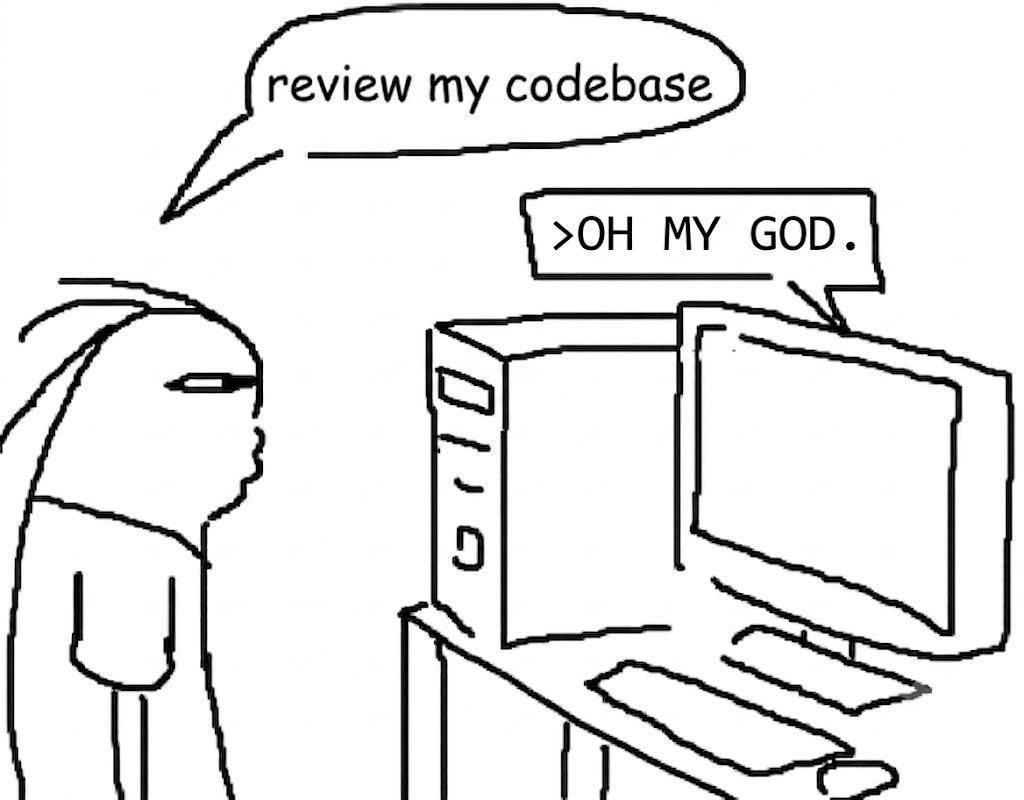
The sacred developer ritual: blame the previous engineer before fixing
Why is this TechDebt meme funny?
Level 1: Who Made This Mess?
Imagine you walk into your living room and find toys scattered everywhere. You need to clean it up, but before you start, you frown and say, "Ugh, who left this place so messy?!" You’re blaming whoever played there last because you're annoyed you have to deal with the mess. But then you remember that yesterday you left your own room in a big mess for someone else to clean. Oops. You realize you do the same kind of thing. This meme is funny for the same reason: a software engineer was about to tease an electrician for complaining about the last person’s work, but then remembered that programmers always do that too. It’s a silly human habit — we all tend to complain about someone else’s mess right before we clean it up, even though we probably leave messes of our own for others to deal with sometimes.
Level 2: First Blame, Then Fix
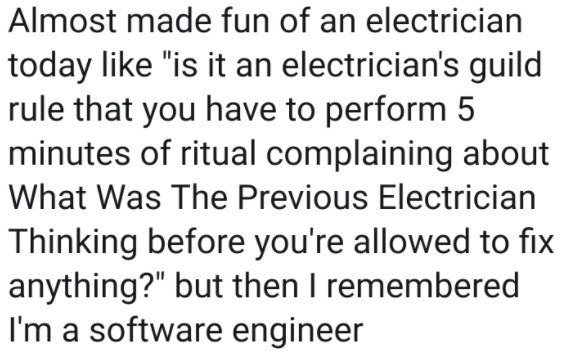
This meme highlights a well-known programming habit: before fixing a problem in code, developers often gripe about how the code got that way. The text jokes about an "electrician's guild rule" where an electrician spends 5 minutes complaining about the previous electrician’s work before fixing anything. The punchline is the author remembering they are a software engineer who does the exact same thing. In other words, it’s poking fun at how programmers always seem to blame the last developer for a mess before actually solving it. It's a cultural quirk in software teams — a kind of inside joke that many in the field find relatable.
Why do developers do this little ritual? It usually comes down to encountering legacy code or a messy system left behind by someone else (sometimes even by your own past self!). Legacy code means old code that was written in the past and is now being reused or maintained rather than created fresh. Often, legacy code comes with a lot of technical debt. Technical debt is a term for the extra work caused by quick-and-dirty coding solutions. Imagine a developer took a shortcut to meet a deadline, leaving code that's not very clean or future-proof. That shortcut is like borrowing time — it makes things faster now, but it creates a "debt" that someone will have to pay later by fixing or improving the code. Just like real debt, if you don't pay it off, it accumulates interest: the longer you wait to clean up the code, the more problems it can cause and the harder it becomes to change. So when a new engineer inherits a program with lots of these leftover issues, it's frustrating. They might shake their head and joke, "What was this person thinking?!" because now they have to invest time cleaning up the mess.
Code quality is another important idea here. This refers to how well-written and maintainable the code is. High code quality means the code is clear, organized, and easy to work with. Low code quality means the code is confusing, fragile, or filled with hacks that only sorta work. When developers encounter low-quality code (for example, confusing variable names, no comments explaining things, or weird workarounds that are hard to follow), they get annoyed. It’s a very familiar developer pain point to struggle with such code. Complaining is a way to express that frustration. In fact, it's so common that it has become a bit of maintenance humor among programmers. You might hear a programmer mutter things like, "Who wrote this?!" or "This makes no sense," when dealing with mysterious old code. It’s not a formal process or anything — more of an emotional outlet. Everyone working in software long enough knows the feeling of puzzling over some bizarre piece of code and venting about it.
The electrician analogy in the meme is a fun comparison: just like an electrician might roll their eyes at some messy old wiring before installing a new light, a programmer will roll their eyes at messy old code before writing a fix or new feature. Of course, there's no real "guild rule" requiring complaining first, but it happens so often that it feels almost official. Newer developers (junior engineers) quickly learn that this is something people do to blow off steam. It doesn’t actually fix anything, but it makes you feel a little better before you concentrate on the solution. And it's not necessarily that the previous engineer was bad at their job — they might have had tough time constraints or different knowledge at the time. Still, when you’re the one slogging through the troublesome code, it’s hard to resist saying, "Ugh, why did they do it this way?"
If you're a junior developer, the first time you witness this, you might be a bit surprised or amused. For example, you might be pair-programming with a senior and notice they sigh and poke fun at the code before changing it. It's almost like a programmer bonding activity: both of you acknowledge the code is a pain, share a little laugh or groan, and then move on. Over time, you might catch yourself doing it too. The truth is, working with legacy systems can be stressful, and a quick gripe is a harmless way to vent. Even outside software, people do this: think about a cleaner saying "Wow, what a mess these folks left!" before tidying up, or a plumber muttering about the last plumber’s work while fixing a pipe. We all tend to complain about the person who came before us when we inherit a problem. This meme is funny to developers because it’s a tongue-in-cheek reminder that we're guilty of the same behavior. We laugh because the next time we start grumbling about some messy code, we might remember this joke and think, "Okay, time to quit whining and just fix it — after all, I do the exact same thing I'm complaining about." In the end, after the ritual complaining is over, the software engineer will fix the bug or refactor the code. The complaining is just a relatable little prelude before the real work begins.
Level 3: Blame-Driven Development
In every codebase with a bit of age on it, there's a nearly sacred ritual that takes place: the incoming engineer performs a ceremonial gripe about how terrible the code left by their predecessor is, even before attempting a fix. It's practically mandated by an unwritten Programmer’s Guild edict: "Thou shalt lament the last developer's questionable choices for no less than five minutes before proceeding to debug or refactor." This meme nails a core truth about working in legacy systems rife with technical debt: before a software engineer fixes a problem, they often indulge in a 5-minute “What were they thinking?!” rant about the previous developer’s code. It's a form of complaining about the previous developer that has become almost reflexive in our industry.
Here we see the electrician analogy: an electrician supposedly must grumble "What Was The Previous Electrician Thinking?" prior to touching any wires. The meme’s author catches themselves about to mock this habit, only to realize developers do the exact same thing with code. It's a classic case of the pot calling the kettle black, only with circuit diagrams and code commits. In software engineering, this pre-fix rant is practically a team sport. Coworkers will nod in agreement as one person vents about the legacy code — that confusing tangle of outdated patterns, mysterious naming, and missing documentation left behind. We gripe about code quality issues as if exorcising the demons of bad design choices before attempting a solution.
Why is this so relatable? Because every experienced developer has inherited a codebase or module that feels like a crime scene left by some long-gone dev. There's a universal developer pain point here: debugging or extending code that’s poorly written or oddly structured. Maybe the original author was in a rush, or had different requirements, or was using now-obsolete frameworks. Whatever the reason, the result is a pile of technical debt that now someone else has to pay off. (In financial terms, technical debt even accrues interest: the longer messy code stays unrefactored, the more cumbersome and costly it becomes to change. And guess who ends up paying that interest? The maintainers, which naturally leads to some choice words for those who racked up the "debt" in the first place.) It's easier (and emotionally satisfying) to momentarily blame the previous coder than to immediately confront the convoluted reality. In fact, griping about one’s predecessor feels like an initiation rite for working on a LegacySystems project: perform the ritual complaint, and only then are you mentally prepared to fix the bug.
This tradition persists in part because it’s cathartic. Venting for a few minutes about the absurd architecture or the spaghetti code you just read helps relieve frustration and dread. It also serves as a bonding exercise among developers: "Look at what I have to deal with!" one says, and others respond, "Oh boy, I've seen worse!" It's darkly comedic and entirely too common. There's even a git blame command in version control that literally lets you see who last modified each line of code – essentially an official tool to find out whom to (semi-jokingly) curse under your breath. Seasoned engineers carry the irony that one day their code will be the "WTF were they thinking?" for some future developer, yet in the heat of the moment, we all like to believe this time, the blame is well-deserved.
In real-world scenarios, this blame ritual shows up a lot. A production outage at 3 AM? The bleary-eyed on-call dev groans and mutters about the “poor soul who wrote this fragile script” while scrambling to patch it. A new feature taking twice as long because the underlying module is a mess? Cue the mini history lesson: "This part hasn’t been refactored in 5 years; it's basically an archaeological dig site." Fixing a bug in old code becomes equal parts coding and code archaeology – you're digging through layers of past decisions. No wonder the first impulse is to question the judgment of those who came before. It's both a coping mechanism and a running joke on software teams.
Ironically, every developer does this, even though we all know we've been that previous engineer ourselves at some point. Who hasn't opened their own old code after a year and thought, "Who wrote this garbage... oh wait, it was me"? In software, time turns all of us into the "previous dev" eventually. Recognizing that fact doesn’t always stop the ritual complaining, but it does add a wink of self-awareness to it. The humor in the meme comes from exactly that self-realization: the poster almost mocked another profession for something that's effectively an unwritten rule in software engineering culture. It’s a gentle roast of our own habits: we can’t start fixing a bug until we've thoroughly shamed the poor code (and by proxy, the person who wrote it). Only then do we roll up our sleeves and get to work.
The unspoken steps of this developer ritual might go something like:
- Encounter a perplexing bit of legacy code
- Utter a dramatic sigh or a “WTF?!” under your breath
- Run
git blameto find the culprit and cringe or chuckle at the name it reveals - Rant for a few minutes to a teammate (or a rubber duck) about how nonsensical this implementation is
- Finally, with frustration vented, start actually coding the fix or refactoring the ugly parts
We laugh at this because it’s true. The industry as a whole has seen decades of technical debt accumulation, and with it, decades of developers performing this same tongue-in-cheek ritual. From ancient COBOL programs on mainframes to modern Node.js apps littered with // TODO: fix later comments, the refrain echoes through time: "What on earth was that last person thinking?" It's almost comforting to discover that electricians do it too. Whether you’re dealing with wires or code, blaming the previous person seems to be a universal impulse before diving into the real work of a fix.
Description
Meme-style white background with black sans-serif text. The full text reads: "Almost made fun of an electrician today like 'is it an electrician's guild rule that you have to perform 5 minutes of ritual complaining about What Was The Previous Electrician Thinking before you're allowed to fix anything?' but then I remembered I'm a software engineer." The joke compares electricians’ alleged griping about earlier work to the very real software-engineering tradition of venting about legacy code before touching it. For developers, this highlights the ubiquity of technical debt, code archaeology, and the cathartic pre-refactor rant that precedes any bug-fix or maintenance task
Comments
11Comment deleted
Electricians vent for five minutes; we schedule an hour of git-blame archaeology, wrap the fossil in a feature flag, and call it a microservice - same ritual, just with more YAML
The real difference between electricians and software engineers? Electricians only complain for 5 minutes before fixing things, while we've institutionalized it into sprint retrospectives, post-mortems, and mandatory code review comments that start with 'I wonder why the previous developer...' before ultimately keeping the same pattern because touching it might break prod
Every senior engineer knows the sacred pre-refactoring ceremony: open the legacy codebase, run git blame, spend exactly 5 minutes questioning the previous developer's life choices and architectural decisions, then proceed to write code that the next engineer will ritually complain about in 18 months. It's not technical debt - it's job security through tradition
Electricians have guilds; we have Git blame - both enforce ritual finger-pointing before the fix
Our pre-deploy ritual is five minutes of git-blame meditation on a 2012 “temporary fix” that became an ADR, then carefully preserve the bug for backward-compatibility
Our guild’s version: run git blame, realize it was 3am‑me during a P0, then file a refactor ticket to the backlog’s cold storage
че за кринж Comment deleted
I can count on one hand the number of times I’ve opened a project and gone “huh, this code is easy to read and I know exactly where to address the problem!” Did I say one hand? I meant one finger. Comment deleted
oh, so your only project Comment deleted
I wish I could say you were wrong Comment deleted
I can count on one mid-sized datacenter the number of times I've wanted to make a PR, took one look at the source code and gave up. Comment deleted