When the Vending Machine Hits a Stack Overflow Error
Why is this Bugs meme funny?
Level 1: Too Many Snacks, One Small Box
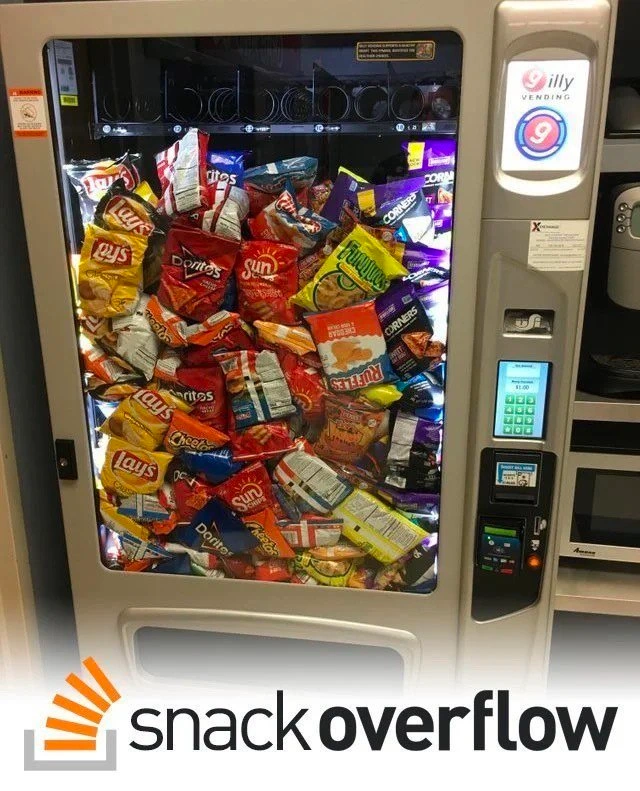
Picture a gumball machine where the gumballs got jammed and someone kept cranking the handle anyway — soon there's a mountain of gum smooshed against the glass and nothing comes out the bottom. That's what happened to this vending machine, except with chips. Programmers laugh because computers have the exact same problem: if you keep stuffing things into a space that's already full, everything jams and breaks. There's even a famous website called Stack Overflow, named after that mistake, where programmers go for help — so someone slapped its logo under the jammed machine and renamed it "snack overflow." It's the joy of seeing a computer error you fight all day suddenly happen to a pile of Doritos.
Level 2: When Data Outgrows Its Box
Two terms to take from this meme, because you'll meet both within your first year:
- Stack Overflow (the website) — the Q&A site where developers search every error message they've ever seen. The orange logo at the bottom of the image is its trademark; recognizing the parody is a developer shibboleth.
- Stack/buffer overflow (the errors) — what happens when a program puts more data into a space than the space can hold.
A buffer is just a fixed-size container in memory. Think of an array meant to hold 10 items:
char buffer[10];
// writing 50 characters into it doesn't stop at 10 in C —
// it spills into neighboring memory, corrupting whatever lived there
A stack overflow specifically happens when function calls nest too deep — the classic beginner version is recursion with no exit:
def f():
return f() # each call stacks a new frame... until the stack is full
f() # RecursionError — Python's polite stack overflow
The vending machine is the buffer: a container with a designed capacity and an orderly structure (those spiral coils are basically array slots). Once items left their slots and piled up against the glass, the container held more chaos than its structure allows — data outside its bounds, in crinkly foil form. When you eventually crash a program with infinite recursion — everyone does — you'll appreciate that the most famous website in software is named after that exact mistake.
Level 3: Marked as Duplicate of "Machine Ate My Dollar"
What elevates this from dad joke to engineering parable is how complete the metaphor is. A vending machine is a physical dispatch system with rigid invariants: items live in spiral coils, one rotation yields one item, gravity handles delivery. The photo shows every invariant violated at once — Lay's, Doritos, Cheetos, Sun Chips, Ruffles, Funyuns, and Corners avalanched against the glass in a state the machine's designers never modeled. Some dispense loop kept pushing without checking capacity or confirming successful drops, and now the system is in textbook undefined behavior: inventory says full, customers see chaos, and no single button press can recover it. It's an unbounded write with bag-of-chips semantics.
The "snack overflow" wordmark — rendered in Stack Overflow's exact logo and typography, orange stacked-trays icon included — adds the second layer, and the cultural irony is rich. Stack Overflow the website was named after the error as a self-aware joke in 2008: the place you land when your program blows its stack. So the meme is a parody of a brand that is itself a pun on a bug, applied to a machine experiencing the physical version of that bug. Three layers deep, and every layer is load-bearing.
There's also a sly systems lesson in why this failure state is so familiar to anyone who's run production software. The machine almost certainly reported healthy the entire time — payment accepted, motor turned, transaction logged complete. The actual outcome (snack wedged against the glass, or in this case forty snacks in a heap) was never verified, because the feedback loop ends at "motor rotated" rather than "item delivered." That's the classic gap between fire-and-forget dispatch and end-to-end confirmation, the same gap that produces queues that report success while consumers silently drop messages. Modern machines added drop sensors and auto-retry for exactly this reason — a literal hardware patch for missing acknowledgment semantics. Somebody filed the bug; the fix shipped a hardware generation later. Sounds about right.
Level 4: Smashing the Snack for Fun and Profit
The pun's technical namesake deserves its due, because a stack overflow is one of the most consequential failure modes in computing history. Every thread of every process gets a contiguous region of memory — the call stack — where each function call pushes a stack frame: local variables, saved registers, and crucially the return address telling the CPU where to resume after the function ends. The stack has a fixed budget (commonly 1–8 MB). Recurse too deep, or allocate a giant local array, and the stack pointer marches past its guard page — the OS catches the violation and the process dies with the error this meme's namesake website is named after.
Its sibling, the buffer overflow, is what the vending machine is actually pantomiming: a write that exceeds a container's bounds. In C, strcpy(buf, attacker_input) into a 64-byte stack buffer happily keeps writing past byte 64 — over adjacent locals, over the saved frame pointer, over the return address itself. Overwrite the return address with a pointer to your own payload and the function's ret instruction politely jumps into attacker-controlled code. This technique, canonized in the 1996 Phrack article whose title this section riffs on, defined two decades of security warfare and spawned the whole countermeasure arms race: stack canaries (tripwire values checked before return), NX/DEP (non-executable stacks), ASLR (randomized memory layout). Languages like Java, Python, and Rust enforce bounds checking precisely so that "data exceeding its allotted container" becomes a clean exception instead of an exploit. The vending machine, evidently, was written in C.
Description
A photo of a modern vending machine where the entire internal glass display is chaotically crammed and overflowing with bags of snacks like Lay's, Doritos, Sun Chips, and Ruffles. The dispensing mechanism is completely buried under the avalanche of chips. At the bottom of the image, the iconic Stack Overflow logo (a stack of orange bars) is repurposed with the text 'snack overflow.' The meme is a clever visual pun, equating the physical overflow of snacks in the machine with the 'stack overflow' error in programming, which occurs when a program exhausts its allocated memory on the call stack, often due to excessively deep or infinite recursion. It's a relatable joke for any developer who has faced this common and frustrating bug, while also touching on typical office life

Comments
8Comment deleted
Looks like the snack provisioning service had a recursive function with no base case. At this point, you don't debug it, you just declare snack bankruptcy and reboot the machine
Classic case of disabling back-pressure: the producer thread overfilled the snack queue, the consumer coil is starved, and now we’ve got a vending-machine deadlock the PM calls “feature richness.”
Finally, a Stack Overflow where the accepted answer is "just keep pushing until something falls out" and nobody complains about it being a duplicate question
Classic unbounded write: the dispenser kept pushing without checking capacity, and now every item is in an undefined state. Marked as duplicate of 'vending machine ate my dollar' (2009)
When your vending machine implements a stack data structure but forgets to check bounds before push() operations - classic off-by-several-hundred error. The real question is whether this requires a LIFO or FIFO retrieval strategy, though at this density, you're looking at O(n²) complexity just to extract a single bag of chips. Someone clearly didn't implement proper capacity planning in their snack provisioning system
Live demo of capacity planning: the breakroom LIFO lacked a guard page, so unbounded pushes triggered SnackOverflowException - fixed by on‑call performing manual GC
Infinite recursion in the snack stack - no tail-call optimization, just endless crunching till you pop the top
Classic breakroom outage: 20 producers, zero consumers, backpressure disabled - unbounded queue, otherwise known as Snack Overflow