Skip to content
DevMeme
6601 of 7435
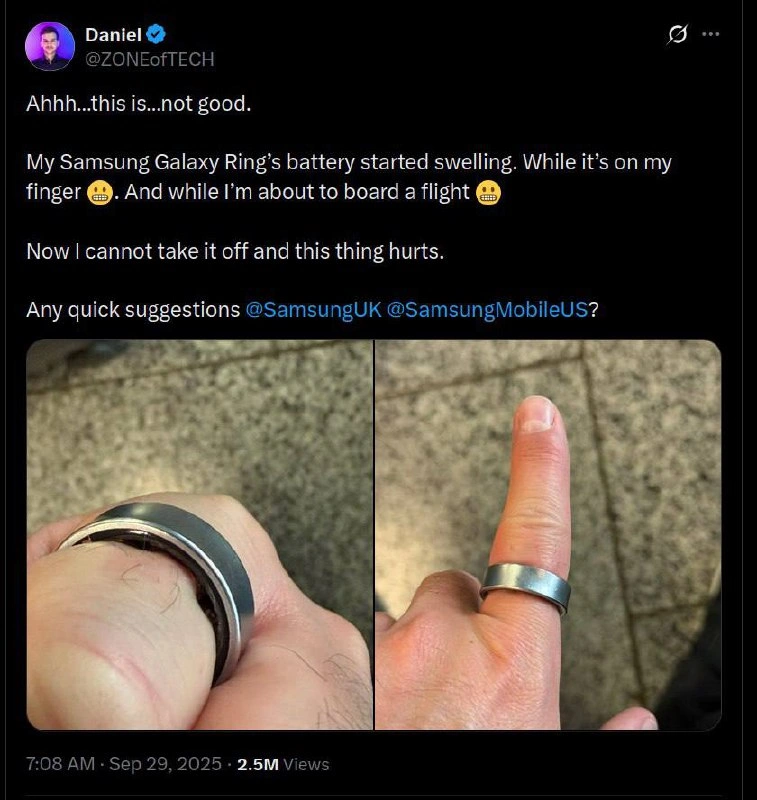
Samsung Galaxy Ring Battery Swelled on Finger Causing Hospital Emergency
Hardware Post #7235, on Oct 8, 2025 in TG

Samsung Galaxy Ring Battery Swelled on Finger Causing Hospital Emergency

Why is this Hardware meme funny?

Level 1: The Not-So-Smart Ring

Imagine you have a really cool ring that can track your steps and health, like a tiny superhero gadget on your finger. You’re super excited to wear it all the time. Now imagine one day you’re about to go on a big trip, but right before you get on the plane, your special ring starts acting weird – it’s getting hot and puffing up like it’s about to burst. The airport security guard sees it and thinks, “Uh-oh, that looks dangerous!” They won’t let you get on the plane with it. You end up missing your flight, and you’re exhausted because you’ve been traveling forever. To make it worse, the ring got so tight and scary that you have to go to the doctor to have it taken off your finger safely.

It’s like if your new toy started smoking at school – the teacher would be alarmed, you’d have to stop everything, and you might even need the school nurse to help you get rid of it. In this story, the little “smart” ring caused a big problem. It’s funny in a “can you believe this?” way because gadgets are supposed to make our lives easier, not get us kicked off airplanes and sent to the hospital! The meme jokes that the ring failed some basic tests – meaning it didn’t do the one thing every device absolutely must do: be safe to use. In the end, the not-so-smart ring turned out to be more trouble than it was worth, which is scary when it happened but a bit ironically funny when you tell the story later.

Level 2: Tiny Gadget, Big Trouble

Let’s break down what’s happening in this meme in simpler terms. We have a smart ring – basically a small wearable device, like a mini-computer you wear on your finger (imagine a tiny Fitbit or Apple Watch shrunk into a ring). This ring is an example of WearableTechnology and part of the InternetOfThings (IoT) world. IoT devices are “smart” gadgets that connect to your phone or the internet to share data (for example, a smart ring might track your heart rate or sleep and send that info to an app).

Inside this ring, there’s a tiny lithium-ion battery powering it. Lithium-ion (Li-ion) batteries are the rechargeable batteries we use in phones, laptops, and wearables because they pack a lot of energy for their size. However, they can be finicky and even dangerous if something goes wrong. One known issue is a battery getting swollen. That’s when the battery gets bloated (like a little balloon) because of internal damage or a defect. It’s a big red flag: a swollen Li-ion battery means something is very wrong. It can make a device stop working, or worse, the battery can leak or catch fire. You might have heard of tech warnings like “if your phone’s battery bulges, stop using it immediately” – that’s this problem. So in our scenario, the smart ring’s battery was visibly swollen and busted the ring’s inner casing.

Now, “CI” in the title stands for Continuous Integration. That’s a practice in software development where programmers frequently merge their code changes into a shared project, and automated tests run to make sure nothing is broken. If those tests find a problem (if something fails), the CI system will flag it and stop that update from going forward. Think of it like a quick exam for your code every time you make a change: if you fail the test, you don’t get to move on. So when the meme says the smart ring fails CI, it humorously means “if this product had an automated test suite or quality check, it would have failed – and maybe shouldn’t have been released to users.”

The other part of the joke is the “TSA smoke test.” TSA is the Transportation Security Administration, the agency responsible for airport security checks. A “smoke test” in tech is a very basic test to see if the main functions of something work – the term comes from the idea of plugging in new hardware and seeing if it starts smoking (which would obviously mean it failed!). Combining these, the meme implies that the ring basically underwent a “TSA-administered smoke test.” In plain language: when the person went through airport security, the ring’s swollen battery was essentially tested for safety (by the fact that it was about to smoke or explode), and it failed that test spectacularly. Airport security is extremely strict about batteries and devices because a smoking or exploding gadget on a plane is a huge danger. So if they see a device with a bulging battery or something suspicious, they’ll stop you – exactly what happened here.

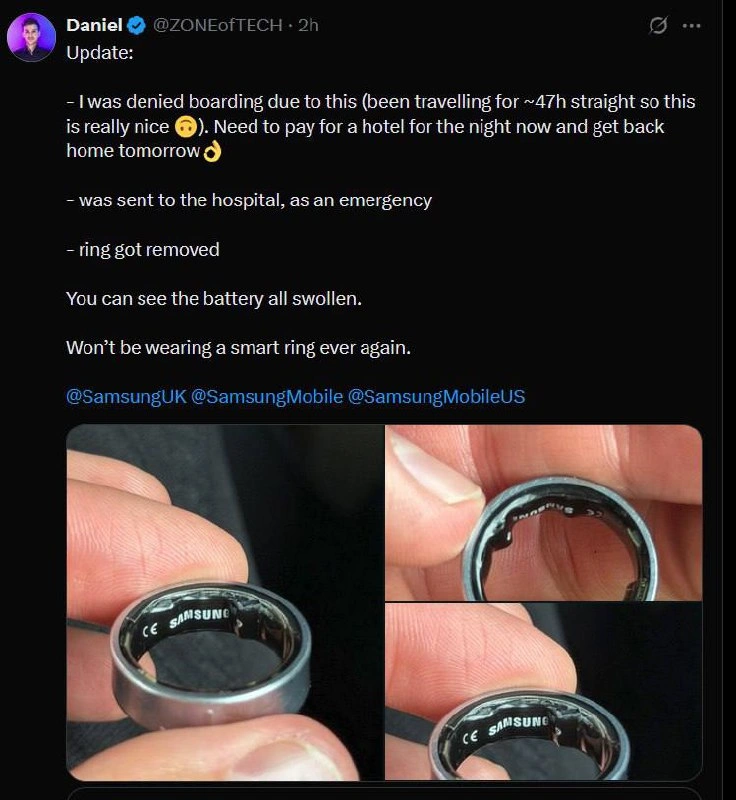
So what actually happened according to the tweet in the meme? The person wearing the ring had been traveling for about 47 hours straight (likely multiple flights or connections – an exhausting journey). When he tried to board another flight, the swollen battery in his smart ring caused a big problem. Security likely noticed the device was damaged (maybe it showed up oddly on the scanner or the person himself might have felt it and alerted them). They denied him boarding the plane due to this gadget – meaning they wouldn’t let him fly with that ring because it was considered a safety hazard. That is a pretty unusual and dramatic situation! As a result, he couldn’t catch that flight, had to pay for a hotel overnight, and planned to go home the next day instead.

But it didn’t stop at the airport. The tweet says he was sent to the hospital as an emergency, and the ring got removed. This suggests that the ring’s battery situation was so bad that it might have been burning his skin or so swollen that the ring was stuck on his finger. He needed medical professionals to safely get it off. In the photos he shared, you can see the metal ring is cracked open from the swelling and the battery inside is all puffed up. Fortunately, they got it off him, but it’s definitely scary. After that ordeal, he understandably says he’s never wearing a smart ring again. He even tags Samsung’s official Twitter accounts in the post, because the ring was apparently a Samsung product (their name is on the ring). He’s basically telling the manufacturer, “Look what happened to me because of your device!”

So why do tech folks find humor in this (apart from feeling bad for the guy)? It’s the irony of the situation and the clever use of tech terms. Failing CI is a funny way to say the product didn’t pass basic quality checks. And a TSA smoke test is a funny mashup meaning the device failed the most basic safety check at the worst possible place – airport security. Essentially, the one thing a smart device absolutely shouldn’t do (blow up or endanger people) happened, and it happened at the most inconvenient time. It’s a HardwareHumor way to highlight a serious issue. The meme caption “When your smart ring fails both CI and the TSA smoke test” is saying: this fancy ring failed the tech tests and the real-world safety test. It’s a bit of dark humor, because on one hand it’s a dreadful situation, but on the other hand the odds and timing of it are almost cartoonishly bad.

In simpler terms: the gadget was supposed to be high-tech and helpful, but it wasn’t even safe enough to take on a plane, and the poor owner ended up in the ER because of it. That contrast – between the promise of new technology and a fail as basic as “it might catch fire on your finger” – is what makes techies smirk and shake their heads when they see this meme.

Level 3: From CI to ER

This meme lands squarely in the realm of hardware humor that makes seasoned developers and engineers wince and chuckle at the same time. It strings together the concept of software Continuous Integration (CI) with a very real hardware failure at airport security, and the results are both comical and cringeworthy. In a typical software project, when your code fails CI, your new feature doesn’t get merged and you might get a stern email or a joking “it’s always the small change that breaks the build” comment. But when your IoT gadget fails what is essentially a real-life integration test, the consequences escalate quickly – in this case from CI to the ER (Emergency Room) and an unexpected travel disaster.

Picture a smart ring’s product timeline as a pipeline: design, development, internal testing, and finally deployment to users (literally, users wearing it). A failure at any earlier stage – say a QA engineer noticing a swollen battery during a stress test – would have saved everyone a ton of trouble. That’s the continuous integration mindset in hardware: catch issues early, before you "deploy" devices onto real people in the wild. The meme’s joke about failing CI implies the smart ring had a critical flaw that should have been caught in the lab. Instead, it slipped through to production (i.e. onto a customer’s finger). The result? The device’s battery decided to do its best smoke-test impression at 30,000 feet (or at the checkpoint), and suddenly this hardware_ci_fail turned into a full-blown airport incident.

For instance, if there were an automated check in the ring’s development pipeline, it might have looked like:

Running SmartRing_Test_Suite...
✓ HeartRateSensorTest: PASS  
✓ BluetoothConnectivityTest: PASS  
⚠️ BatteryHealthTest: **FAIL**  
    Reason: Cell expansion > allowable limit  
✖️ Overall Result: FAILED (Unsafe for deployment)  

(Too bad reality didn’t have this test in place before the ring shipped.)

Now, let’s talk about that “TSA smoke test.” The TSA (the folks who run airport security) couldn’t care less about your cool gadget’s features; they care about safety. A bloated, damaged lithium battery looks an awful lot like a potential fire hazard (or even an explosive) on an X-ray machine. It’s the sort of airport_security_fail scenario that triggers serious response. For senior tech folks, this immediately brings back flashbacks of the Samsung Galaxy Note7 debacle – where phone batteries caught fire spontaneously and those devices got banned from all flights. So here we have what some might tongue-in-cheek label samsung_ring_gate: Samsung (whose logo is on this ring) facing another battery fiasco, this time literally ring-shaped. The tweet’s author even tagged @SamsungUK, @SamsungMobile, etc., effectively turning this into a public bug report. It’s like a QA ticket posted on Twitter for the world to see, saying “Your smart ring nearly started a fire and cost me a flight and a hospital visit.” Talk about bad PR.

From a senior developer or engineer’s perspective, there’s a mix of “I can’t believe this happened” and “Actually, I totally can believe it.” We’ve seen HardwareTradeoffs where pushing the envelope on size and battery life can backfire spectacularly. Every hardware team fears the nightmare of a failed safety test in production. It’s the hardware equivalent of a catastrophic software bug hitting prod—except instead of just deploying a quick fix, you’re dealing with recalls, regulations, and users in physical danger. There’s an unwritten rule in engineering: anything that can fail, eventually will fail, so you design safety margins and backup plans. Here, the fail-safe ended up being an airport security officer and an ER doctor, which is definitely not according to design.

The scenario described – 47 hours of traveling and then denied boarding because of a gadget – is maybe the ultimate bad-day-at-work for both the traveler and the device’s creators. It’s a literal travel_delay_due_to_iot situation — a tiny gadget creating outsized havoc. Imagine being the engineer on that smart ring team, waking up to see this story blowing up (pun intended) on social media. Beyond the traveler’s personal ordeal (paying for an unexpected hotel night, exhaustion, and getting a ring cut off a swollen finger in the hospital), there’s the professional horror: a device you helped build has not only failed, it failed publicly and dangerously. A piece of WearableTechnology that was supposed to seamlessly enhance daily life ended up causing a health scare and a travel nightmare. As one might joke, the ring was too smart for its own good – it could track your sleep, sure, but it didn’t know how to not self-destruct at the worst moment.

Let’s not overlook the hospital part of this saga – an unplanned_hospital_visit thanks to consumer tech. When was the last time a software glitch physically sent someone to the ER? In software, a bug might crash your app; in hardware, a bug (or design flaw) can latch onto your finger and require medical tools to remove. The tweet’s author concludes “Won’t be wearing a smart ring ever again.” That’s a huge loss of trust. Any senior product engineer knows that when a user swears off your entire product category, the damage isn’t just to one device, it’s to the whole idea of that device. It’s like someone swearing off all ride-sharing apps after a scary accident — a nightmare outcome for the industry. Here, a lithium_ion_risk turned a tech-savvy customer into a wary skeptic of wearables.

In the end, the humor for those of us in tech comes from the absurd proportionality of it all. A tiny ring managed to cause an incident big enough to ground a flight and involve both security staff and doctors. It’s a perfect (if painful) example of Murphy’s Law in IoT: anything that can go wrong will go wrong at the worst possible moment. Seasoned devs might shake their heads and quip, “This is why we don’t test in production,” or “Guess the ring’s QA was outsourced to TSA.” The meme (with its tweet and photos) is basically a post-mortem report wrapped in dark humor. It prompts experienced folks to double-check their own gadgets and mutter, “Geez, you had one job ring, just don’t explode,” while nervously remembering that no matter how well we test, reality can always surprise us.

Level 4: Lithium-ion Under Pressure

This meme’s humor has a surprisingly deep technical core rooted in electrochemistry and hardware QA. At its most complex, it’s spotlighting how lithium-ion batteries – the tiny powerhouses inside our modern gadgets – can literally become ticking time bombs. In a smart ring (a miniaturized Internet of Things device worn on your finger), a Li-ion cell is crammed into a tiny metallic enclosure. When a Li-ion cell fails, it often undergoes what engineers politely call swelling – essentially the battery’s internal layers break down and release gas, causing the cell to inflate like a balloon under pressure.

Why does this happen? Inside a Li-ion battery, there's a delicate balance: a graphite anode, a lithium cobalt oxide cathode (or similar chemistry), and an electrolyte that shuttles lithium ions back and forth. Overcharge it, overheat it, or manufacture it with microscopic impurities, and you risk lithium plating or dendrite formation – spiky lithium metal growths that can short the battery internally. A short leads to rapid heat and gas generation (a mini internal combustion, if you will). The battery’s flexible pouch or casing swells up with nowhere to go. If it’s tightly encased (like in a ring of stainless steel), the pressure builds until something gives – either the casing cracks (as shown in the meme’s photos) or, in worst cases, the cell ruptures violently. This kind of failure can initiate thermal runaway, releasing smoke or even flames – the ultimate "🔥 smoke test" that you don’t want your hardware to perform unannounced.

Engineers typically run extensive hardware integration tests on devices like this: think of environmental stress trials where a gadget is cycled through high temperatures, rapid altitude changes, and fast charge/discharge cycles to provoke any weakness. There are industry standards (like UN 38.3 for air transport safety of batteries, or UL certifications for consumer electronics) intended to catch these failure modes. Essentially, the smart ring should have passed a rigorous series of abuse tests long before a user ever wore it on a plane. If a device has a swollen battery, it means either a freak manufacturing defect slipped through or a fundamental design flaw under certain conditions. The meme’s quip about failing CI hints that at some stage in the product’s development pipeline (the hardware equivalent of an automated test suite), such a scenario should have been caught.

And then there's the "TSA smoke test" – a darkly comic twist on the term smoke test. In software and hardware lingo, a smoke test is a basic check to see if the main systems run without catching fire (literally coming from powering on new hardware to see if it produces smoke). Here, the TSA (Transportation Security Administration) applies a literal smoke test of sorts: if your gadget might smoke or combust, it absolutely fails airport security. Modern air travel rules treat a swollen Li-ion battery as a serious red flag – recall how the infamous Samsung Galaxy Note7 was outright banned from flights in 2016 due to fire incidents. Any device showing signs of battery failure (bulging, overheating) triggers alarms because a battery fire mid-flight is a nightmare scenario. So this smart ring essentially flunked both the lab’s hypothetical integration check and the real-world safety check at the airport.

The complexity beneath the humor is that it underscores very real limitations of battery chemistry and IoT design. No matter how smart or sleek a device is, it’s ultimately beholden to the laws of physics and chemistry. Squeezing power storage into a ring – a form factor with almost no room for error or heat dissipation – is a bold HardwareTradeoffs decision. You sacrifice battery robustness (thicker casings, larger safety buffers) for wearable convenience. When those trade-offs go wrong, you get a wearable_disaster: the device might pass all its feature demos, but one flaw in the power unit can derail everything in spectacular (and airport-alarming) fashion. In short, this meme hints at an uncomfortable truth: even minor hardware bugs (like a battery defect) can cascade into major real-world failures. It's a complex dance of EmbeddedSystemsAndIoT design, battery science, and safety engineering – all compressed into a ring that quite literally cracked under pressure.

Description

A follow-up tweet from Daniel (@ZONEofTECH) providing an update about a Samsung Galaxy Ring malfunction. The text explains: he was denied boarding a flight due to the ring's battery swelling while on his finger (after travelling for ~47 hours straight), was sent to the hospital as an emergency, and the ring had to be removed. Photos show close-ups of the Samsung Galaxy Ring with visibly swollen battery, displaying the 'CE SAMSUNG' marking. He states 'Won't be wearing a smart ring ever again' and tags @SamsungUK, @SamsungMobile, and @SamsungMobileUS. This is the follow-up post to the initial incident report
Comments

7
Anonymous ★ Top Pick Samsung's Galaxy Ring: the only wearable that gives you a hardware exception AND a hospital visit simultaneously. At least it's not a Galaxy Note 7 on your finger
  1. Anonymous ★ Top Pick

    Samsung's Galaxy Ring: the only wearable that gives you a hardware exception AND a hospital visit simultaneously. At least it's not a Galaxy Note 7 on your finger

  2. Anonymous

    Great, now we need a new pipeline stage: `pytest && xray && TSA-approval`

  3. Anonymous

    The only ring that expands faster than scope creep in production - at least your sprint retrospective won't need to cover why the deployment literally caught fire at 30,000 feet

  4. Anonymous

    When your smart ring's battery management system implements exponential growth algorithms a bit too literally. Turns out 'always-on health monitoring' shouldn't include real-time demonstrations of lithium-ion failure modes. At least it's giving Samsung engineers some valuable field data on what happens when you try to cram a battery into a form factor with zero thermal headroom - though I suspect 'emergency hospital visit' wasn't in the original test plan

  5. Anonymous

    Autoscaling is great until your lithium pouch cell does it on your finger - rollback requires an orthopedist and airport security as the change‑approval board

  6. Anonymous

    Galaxy Ring battery: the hardware memory leak that physically outgrows your finger before the OOM killer arrives

  7. Anonymous

    Turns out ring buffer overflow is scarier in hardware: a Li-ion swell at Gate C became a sev-1, SLO 10 fingers breached - add IEC 62133 to CI before shipping BLE jewelry

Use J and K for navigation