Skip to content
DevMeme
6279 of 7435
Agile Mythology: Zeno's Sprint and Sisyphus's Rollback
Agile Post #6882, on Jun 13, 2025 in TG

Agile Mythology: Zeno's Sprint and Sisyphus's Rollback

Why is this Agile meme funny?

Level 1: Never-Ending Task

Imagine you’re trying to roll a big heavy ball up a hill. You push and push, getting super close to the top – you’re almost there – but then, oops, the ball slips from your hands and rolls all the way back down to the bottom. 😟 Now you have to go back down and start pushing it up again. This keeps happening every time you near the top. Pretty frustrating, right? But if you think about it like a silly cartoon, it’s also a bit funny because you’re always almost winning but never quite finish the job. That’s the feeling this meme is joking about. It’s comparing a programmer’s work to that kind of never-ending task. Sometimes when people write software, it feels like no matter how hard they try, they’re always only halfway done or they have to redo something all over again. The meme makes us laugh at that situation by using famous old stories (about a guy who could never reach the end and another who had to redo his work forever). In simple terms, it’s funny because it’s like saying, “Haha, ever feel like your work just never ends? These legendary guys feel it too!” That little touch of “I know, right?!” makes everyone smile and feel a bit better about their own never-ending chores.

Level 2: Scrum Mythology 101

If you’re newer to Agile or not up on your Greek legends, let’s break down the references in this meme. On the surface, it shows two developers (or rather, two famous figures imagined as developers) giving their updates in a daily Scrum meeting. One is Zeno and the other is Sisyphus. Here’s what that means:

  • Sprint – In Agile development (specifically the Scrum framework), a sprint is a short, fixed-length cycle for work. Teams plan a set of tasks or user stories and try to complete them in, say, 2 weeks. Being “halfway through the sprint” literally means you’re at the midway point time-wise (like one week into a two-week sprint) and ideally about halfway done with the planned work. It’s a common checkpoint to see if the team is on track.

  • Daily stand-up – This is a brief daily meeting (often each morning, and people traditionally stand up to keep it short). In this Agile ceremony (routine), each team member answers three questions: What did I do yesterday? What will I do today? And is there anything blocking me? It keeps everyone in sync. In the meme, Sisyphus is sharing his update during the daily stand-up.

  • Roll back changes – To “roll back” means to undo a recent change. In software deployment, if a new release or update causes problems, the team might roll back to the last stable version of the code. Think of it like an undo or Ctrl+Z for code that’s been sent out. Saying “I had to roll back some changes” is developer-speak for “the update we tried to push didn’t work out, so we reverted to how it was before.” It often happens when a bug in new code breaks something critical, so you go back to the old code to keep things running. It’s a safety move, but it can be a bit demoralizing because yesterday’s work vanishes.

  • Zeno – Zeno of Elea was an ancient Greek philosopher known for brain-teaser paradoxes. The one referenced here is usually called “Zeno’s Paradox” (or one of them, at least). Imagine you’re trying to walk to a finish line. First you go halfway, then you go half of the remaining distance, then half of that, and so on. Logically, you can always take another half-step, so it seems like you’d never actually arrive. Of course, in real life you do finish – the paradox is more a mind puzzle about infinite division. In the meme, when Zeno says “we’re half way through the sprint,” it’s funny because if he applies his paradox to sprints, you could tongue-in-cheek argue a team might never reach the end of the work – they’d just keep getting to the “halfway” point. It’s an absurd twist on a normal status update.

  • Sisyphus – Sisyphus is a character from Greek mythology. He was a king who, as punishment from the gods, was forced to roll a huge boulder up a hill. But every time he almost got the boulder to the top, it would roll back down to the bottom due to magic (the gods’ curse). Then he’d have to trudge down and push it up again, forever. It’s a legendary image of a pointless, never-ending task. If someone says a job is “Sisyphean,” they mean it feels futile or endless. In the meme, Sisyphus says he had to roll back some changes – a perfect double meaning. Literally, his stone rolled back. In software, his code changes rolled back. In either case, yesterday’s progress was erased, and he’s back at square one today.

Now put it together: the meme imagines a software team’s stand-up where these two mythical guys are on the team. Zeno pipes up with, “okay team, we’re half way through the sprint,” and knowing his paradox, the rest of us grin because we suspect he’s going to say the same thing tomorrow and the day after – always halfway, never done. Then Sisyphus gives his update: “i had to roll back some changes,” which in normal developer terms means yesterday’s deployment failed and we undid it. But since it’s Sisyphus, it hilariously matches his eternal fate of having his work undone every time. It’s a mash-up of mythology meets Scrum: using well-known Greek stories to exaggerate real feelings in an Agile team. Even if you’re new to coding, you can see the silliness – it’s basically saying some days, writing software feels like endless work that never gets you closer to the goal. Zeno and Sisyphus are just extreme examples to get that idea across in a nerdy way.

Don’t worry if you haven’t experienced this yet. Over time, you might recognize these situations: maybe a project where requirements kept expanding so it felt like you were never finished, or a time you had to revert your code because it broke something. It’s all part of the learning curve. The meme gives a lighthearted spin to those moments. It’s classic Agile humor – taking a routine meeting and turning it into a comedic legend. The reason developers find it so relatable is because it captures a bit of truth: progress in software development isn’t always a straight line; sometimes it feels like one step forward, one step back (or half a step forward). And when things go awry, at least we get a funny story (or meme) out of it!

Level 3: Sisyphean Stand-up

From a senior developer’s vantage point, this meme elicits a pained laugh of recognition. It’s portraying a daily stand-up meeting that has descended into a mythological farce – and anyone who’s survived a tough sprint can relate. In a Scrum team’s morning stand-up, each member shares what they did yesterday, what they’ll do today, and if anything is blocking them. Now imagine one teammate is “Zeno” casually announcing, “Okay team, we’re half way through the sprint.” On day 3 of a 2-week sprint, that’s a normal update. But the joke is that Zeno would say “halfway through” no matter what day it is or how much gets done. It pokes fun at how Agile timelines sometimes feel: the project status never quite hits “100% done” because new work keeps appearing. Seasoned devs have sat through mid-sprint check-ins where, due to shifting requirements or underestimated tasks, the team is still only halfway on the burndown chart. The Zeno paradox of sprints is a comical exaggeration of those retrospectives where it seems every achievement just reveals another mile to go. It’s Scrum humor with a philosophical twist – progress gets sliced thinner and thinner, and the finish line moves as fast as you approach it. Any team that’s experienced story scope creeping outward (“oh, we finished that feature, but now we have three new bug tickets”) will chuckle at this. It’s the Agile version of running on a treadmill: lots of effort, not as much visible movement forward.

Now add the second part: Sisyphus giving his stand-up report: “I had to roll back some changes.” To an experienced engineer, those words are both terribly familiar and darkly comedic. This line is basically stand-up shorthand for “yesterday’s deployment failed, and we had to undo it, so we’re back to where we started.” It’s the ultimate setback update. Everyone in the room understands the pain behind that mild statement – the code that worked on staging brought production down, the hotfix introduced a hotter bug, or the migration script nuked some data, so the team had to revert. Rolling back a release is a classic DeploymentPainPoint that senior devs know all too well. Hearing Sisyphus report it is like getting a wink from the universe about just how eternal that struggle can feel. You can almost picture the team’s faces at stand-up, nodding grimly because they’ve all been Sisyphus at one time or another: late nights, on-call alerts, furiously pushing that “boulder” of a fix uphill, only to watch it roll back in the form of a version rollback. It’s tragic, it wastes time, and yet in retrospect it becomes a shared joke — the kind of relatable developer experience you later meme about to cope with the trauma.

What makes this meme especially satisfying for seasoned developers is how it nails two different flavors of frustration that are common in tech. The Zeno side is the abstract frustration: the feeling that no matter how fast you work, the goalposts keep shifting – you’re perpetually “50% done.” The Sisyphus side is the tangible frustration: the feeling of undoing hard-won progress and starting over – the code you wrote yesterday is literally gone today due to a rollback. Together, these capture the irony of Agile life: even with tight iterations and daily sync-ups, progress isn’t linear or guaranteed. Sprints can stretch out or repeat, and deployments can fail, sending you back to square one. In Agile ceremonies like stand-ups and retrospectives, teams often joke about being stuck in loops or having tasks that never die; here the meme just pushes that to a literary extreme. It’s meeting humor meets Greek tragedy. Imagine a team’s Scrum Master chuckling, “We flew too close to the sun” when a sprint goal slips away (mixing myth metaphors!), or a developer posting a Sisyphus GIF after the third retry of a release. This post resonates because it validates that feeling: Yup, sometimes our work really does feel like pushing a rock uphill or chasing an ever-receding finish line. And by casting those feelings as grand mythological characters in a stand-up, it lets us laugh about it. It’s cathartic. The next time you’re in a stand-up from hell, you might remember this meme and smirk, thinking, “We’re basically a bunch of Greek legends cursed by Zeus… and also by that last commit.” It’s humor that says: we’ve all been there, and somehow, we’re still here sprinting again.

Level 4: Zeno’s Asymptotic Sprint

At the highest level, this meme draws on ancient logic to lampoon a fundamental paradox of iterative progress in software. Zeno’s paradox is a classic thought experiment about infinity: to reach a goal, you must first go halfway, then half of the remainder, then half again, and so on. In theory, you’re always partway there, because there’s an infinite number of halves to go. Mathematically, we know an infinite series of shrinking halves can converge (½ + ¼ + ⅛ + ... = 1), so real runners do reach the finish line. But the meme imagines a Zeno-style sprint where progress is infinitely divisible and completion remains eternally just out of reach. In Agile terms, picture a two-week sprint where every day someone like Zeno cheerfully announces “we’re halfway through!” no matter how much work has been done. It’s an absurdist take on the idea of asymptotic progress – you keep closing more tickets, yet “Done” stays perpetually around the next corner. This hints at a deeper project management truth: tasks can always be refined or subdivided, and requirements can keep emerging, so a team might feel like they’re approaching the goal line without ever truly crossing it. It’s a satirical nod to an infinite backlog or scope creep scenario, where each increment of work uncovers a new layer of “almost finished.”

On the flip side, the meme invokes Sisyphus, a figure from Greek mythology doomed to an eternal loop of futility. Sisyphus’s punishment was to push a giant boulder up a hill only for it to roll back down each time he neared the top, forcing him to start over forever. In engineering terms, this speaks to a process that lacks permanent progress – every cycle resets to the beginning. Think of a deployment pipeline or iterative algorithm that continually loses its progress due to a reset or failure. In a theoretical sense, it’s like a non-convergent loop that never reaches a terminating condition. When the developer says “I had to roll back some changes,” it’s basically a real-life Sisyphus moment in DevOps. You deploy new code (push the boulder up) and then discover a critical bug that forces a rollback (the boulder tumbles back down), returning you to the previous state. From a systems perspective, this is a non-monotonic progress scenario: your state can revert, not just move forward. It’s a bit like an algorithm that occasionally backtracks and erases some of its own work. Here’s a tongue-in-cheek pseudo-code of that Sisyphean deployment cycle:

deploy(new_release)  
if not production.is_stable():  
    rollback_to_previous_version()  
    # Boulder rolled back – we're back to start 

Each failed release sends the team back to square one, mirroring Sisyphus’s eternal reset. By referencing these two legendary predicaments, the meme highlights a pair of fundamental challenges in development: one of infinite subdivision of work (progress approaching a limit but never quite completing, like Zeno’s sprint paradox) and one of repetitive loss of progress (work achieved then undone, like Sisyphus’s rollback curse). It’s a high-brow way to capture the feeling that iterative development sometimes skirts the edge of an infinite loop. Despite all our modern Agile practices, there are moments that feel governed by the laws of paradox and futility – a reminder that even in software, reality can imitate ancient philosophy. The humor lands because it merges lofty concepts of infinity and eternal toil with the very down-to-earth experience of a tough sprint, giving veteran engineers a chance to knowingly smirk at the paradox of progress in their daily work.

Description

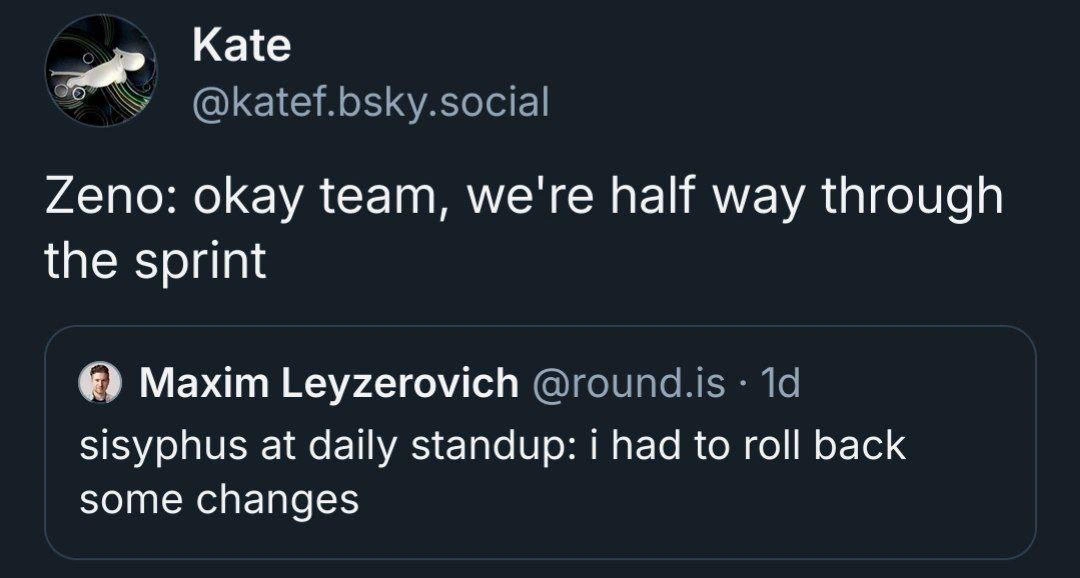
A screenshot of two nested social media posts on a dark background. The top post is from a user named Kate (@katef.bsky.social) and reads, "Zeno: okay team, we're half way through the sprint". Below it, a reply from Maxim Leyzerovich (@round.is) reads, "sisyphus at daily standup: i had to roll back some changes". The humor is a deeply intellectual combination of Greek philosophy, mythology, and Agile software development practices. The reference to Zeno's paradox implies a sprint that never ends, as one can always be 'halfway' to the goal. This is paired with the myth of Sisyphus, who was condemned to an eternity of futile labor - rolling a boulder up a hill only for it to roll back down. In this context, the developer's daily stand-up report of having to 'roll back some changes' is the perfect modern equivalent of Sisyphus's eternal, fruitless task. The joke resonates with senior engineers who have experienced sprints that feel endless and progress that is constantly undermined, capturing the existential dread of futile work in a corporate setting

Comments

10
Anonymous ★ Top Pick The only thing missing is Tantalus as the product owner, forever reaching for a feature that's always just out of the sprint's scope
  1. Anonymous ★ Top Pick

    The only thing missing is Tantalus as the product owner, forever reaching for a feature that's always just out of the sprint's scope

  2. Anonymous

    Sure, your burndown chart looks linear - until Zeno starts estimating story points and Sisyphus owns the rollback pipeline

  3. Anonymous

    The real Sisyphean task isn't pushing the boulder up the mountain - it's explaining in tomorrow's standup why today's rollback means we're technically still 'halfway through the sprint' according to Zeno's paradox, while the PM insists we're actually at 0% because nothing's deployed

  4. Anonymous

    The real Zeno's paradox in software engineering: you're always halfway through the sprint because every story point completed reveals two more edge cases, and Sisyphus keeps rolling back your PRs because 'the tests passed on my machine.' At this velocity, we'll ship in O(∞) sprints - which, coincidentally, is when stakeholders expect the MVP

  5. Anonymous

    Enterprise Scrum math: “halfway through the sprint” is Zeno’s limit - velocity converges, scope diverges, and rollback is just Sisyphus with a Git history

  6. Anonymous

    In our Zeno Sprint Framework the burndown asymptotes to zero while Sisyphus keeps the change failure rate flat by rolling back every deploy - DORA calls it continuous delivery to the same rock

  7. Anonymous

    Zeno hits 'halfway' just as Sisyphus cues the rollback - Agile's theorem: every sprint velocity spikes downhill

  8. @SamsonovAnton 1y

    Sisyphus is how they call development repository for ALT Linux. 🐧

  9. @callofvoid0 1y

    oh new thing?

    1. @sylfn 1y

      yeah, but it's [mod only]

Use J and K for navigation