Shaping the Future of Software: Anime Girls Holding Programming Books
Why is this DevCommunities meme funny?
Level 1: The Fancy Library Full of Comic Books
Imagine a city builds a grand library and puts up a banner: "Where millions of citizens write the great books of tomorrow, together!" Then you walk in and find the most popular, most lovingly organized shelf in the whole building is a collection of cartoon characters posing with textbooks — maintained with more care than almost anything else there. It's funny because both things are true at once: people really do build amazing stuff together in that library, and also, given total freedom, the first thing humans organize beautifully is the silly thing they actually love.
Level 2: The Anatomy of a Repo Screenshot
To get the joke, you need the vocabulary of the screenshot itself:
- A repository ("repo") is a project's home on GitHub — code, images, docs, anything under version control with Git.
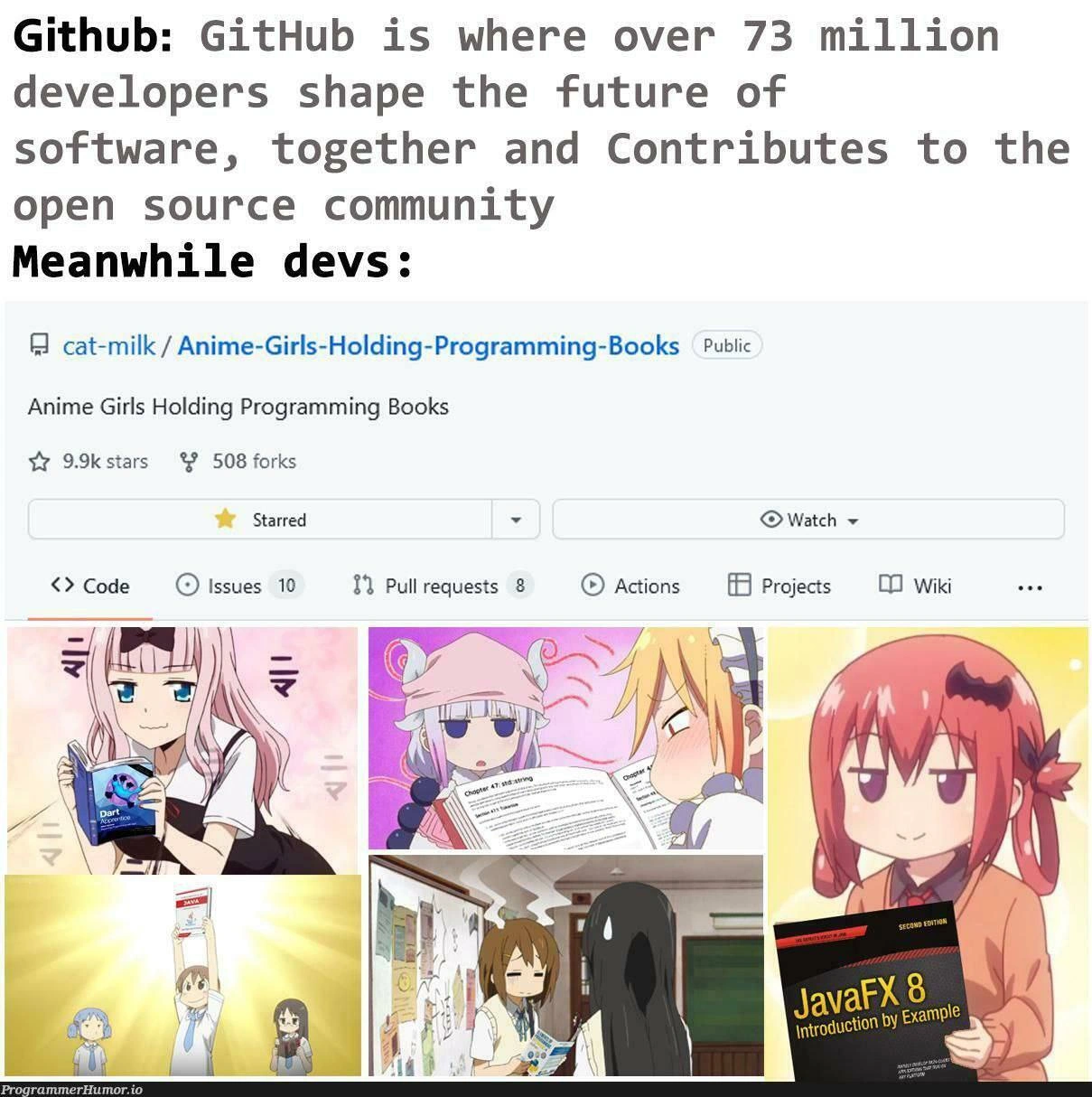
- Stars (
9.9k stars) are bookmarks/upvotes; they're the de facto popularity score of the open-source world. - Forks (
508 forks) are personal copies people make, usually to propose changes back. - Issues (
10) and Pull requests (8) are the collaboration machinery: issues report problems or requests, PRs offer actual changes for review. The tabs along the bottom —Code,Actions,Projects,Wiki— are standard equipment on every repo.
The punchline depends on knowing these mechanics: every signal that normally says "serious, well-maintained software project" is here attached to a curated gallery of anime screenshots. Early-career developers usually discover this genre of repo in their first month on GitHub — right after discovering that starring things feels like productivity. The pictured books are real too: Dart (the language behind Flutter) and JavaFX 8 (Java's desktop UI framework), because the bit only works if the girls hold legitimately niche technical literature.
Level 3: Mission Statement vs Merge History
The structure here is the classic corporate idealism vs community reality split. The top half quotes (with the meme author's own charmingly broken grammar — "together and Contributes to the open source community") GitHub's actual marketing line about 73 million developers shaping the future of software. The bottom half is the receipts: a real, Public, thriving repository — cat-milk/Anime-Girls-Holding-Programming-Books — sitting at 9.9k stars, 508 forks, 10 issues, and 8 open pull requests, above a collage of anime girls dutifully holding up a Dart book and a very legible JavaFX 8: Introduction by Example.
What experienced developers recognize instantly is that the joke is only half a joke. That repo's metrics describe a genuinely healthy open-source project: active issue tracker, real PR throughput (contributors submit new images, argue about folder taxonomy per language, and enforce contribution guidelines — yes, it has standards for what counts as a valid anime-girl-holding-a-programming-book), hundreds of forks, organic growth. Plenty of corporate "open source" repos — the ones launched with a blog post about shaping the future — are graveyards with three commits, an unanswered issue from 2021, and a CONTRIBUTING.md nobody read. The shitpost repo has a healthier community than the strategy deck.
This is the deeper truth about commons-based peer production that GitHub's marketing can't quite say out loud: you don't get the Linux kernels and the Kubernetes-es without a substrate of play. Meme repositories — this one, the various awesome-* lists that are 40% memes, repos that are just a single README joke with 50k stars — are how a community demonstrates it's alive rather than merely employed. Stars are a social signal, not a quality metric, and developers allocate them the way they allocate desk toys: sincerely, but not solemnly. The meme's irony cuts both ways, too — choosing JavaFX 8 as the book being lovingly held is its own dagger, given that JavaFX was unbundled from the JDK and left to community maintenance; the anime girl may be the most enthusiastic JavaFX advocate remaining.
Description
A meme contrasting GitHub's lofty mission statement with developer reality. Top text in monospace font: 'Github: GitHub is where over 73 million developers shape the future of software, together and Contributes to the open source community. Meanwhile devs:'. Below is a screenshot of the real GitHub repository 'cat-milk/Anime-Girls-Holding-Programming-Books' (Public) with 9.9k stars, 508 forks, 10 issues, 8 pull requests, and standard repo tabs (Code, Issues, Pull requests, Actions, Projects, Wiki). Under it is a collage of anime screenshots of characters holding programming books, including a visible 'JavaFX 8 Introduction by Example' cover and a Dart book. Watermark: ProgrammerHumor.io. The humor lies in the gap between corporate open-source idealism and what the community actually builds and stars en masse
Comments
17Comment deleted
9.9k stars, 508 forks, and 8 open PRs - that repo has a healthier contribution pipeline than most companies' internal platform
I need to take a picture holding a programming book in my Senko cosplay Comment deleted
Meanwhile me: on GitHub publishing stolen RSA private keys Damn it feels good to be a gangsta! Comment deleted
ew Comment deleted
09 F9 11 02 9D 74 E3 5B D8 41 56 C5 63 56 88 C0 Comment deleted
What is this? It does not look like a RSA key. Comment deleted
Thats forbidden number, dmca violator, the great key of hddvd and blueray encryption, the aacs breaker, the freedom bringer. Comment deleted
All from 16 bits Comment deleted
Thats 128 bits key Comment deleted
My mistake, meant 16 bytes Comment deleted
Ah, that's different. While it is totally fine (and the only right thing to do) for a typical symmetric cypher (like AES) key to consist of pure random bits, digital signature algorithms (like RSA) require prime numbers, or pseudo-prime (statistically indistinguishable), to be secure. So, when you see a byte sequence whose most-significant and/or least-significant bit is zero, that is a bad choice for RSA / DSA parameter. Comment deleted
I'm pretty sure it's just little-endian Comment deleted
aah, nvm, it's just a symmetric cypher Comment deleted
yeah, I don't know why I expected a 256-bit string to be an RSA key Comment deleted
I get your point. Well, this is another difference between expressing cipher keys as a stream of bytes and signature parameters as a single big number. And, while numbers may be stored in host memory in a host-soecific manner, interoperability usually mandates big-endian serialization for host-to-host exchange. Comment deleted
outdated picture, it now has 22k stars Comment deleted
based Comment deleted