The Senior Developer's Lament: From Coder to Critic
Why is this CodeReviews meme funny?
Level 1: Coach Instead of Player
Imagine you joined a soccer team because you love scoring goals, but as time goes on, you end up becoming the coach who trains others and hardly ever kicks the ball yourself. One day you’re holding the clipboard, watching the team play, and you suddenly think, “Oh no, when did I stop being a player and turn into just the coach?” You feel proud that you’re helping everyone, but also a bit sad because you miss actually playing on the field. That’s exactly the feeling this meme is joking about, but with coding. The person in the meme realized they’ve been spending most of their time checking and giving advice on other people’s code (like a coach or a teacher) instead of writing their own code (like a player). Their reaction — dramatically saying “What have I become?” — is a funny, exaggerated way to express that surprise. It’s humorous because it’s a big emotional response to something that happens to a lot of people: growing into a helper role and suddenly missing the thing you used to do all the time. In simple terms, the meme is funny because it shows a coder feeling like they turned from a creator into an overseer, kind of like turning from a soccer player into a full-time coach, and being very dramatic (in a silly way) about that realization.
Level 2: Code Review Overload
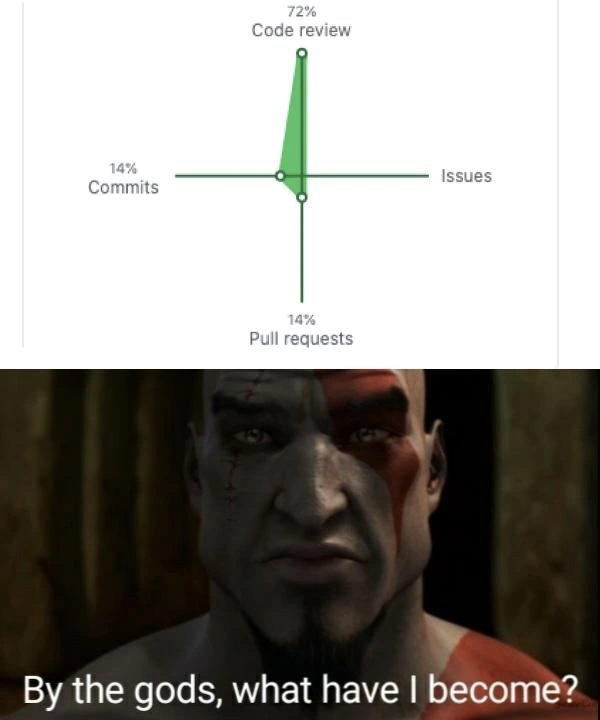
In this meme’s top image, we have a GitHub activity chart (specifically a kind of radar/spider diagram) breaking down a programmer’s contributions by type. The axes on this chart represent different activities: Commits, Code review, and Pull requests (which likely also includes things like issues or project discussions). The green shape drawn on the chart is heavily stretched towards the Code review side, with a label showing 72% there. Meanwhile, the other categories like Commits and Pull requests are much smaller slices, around 14% each, barely extending out. In plain terms, this means out of all the things that developer did on GitHub in that period, 72% of it was reviewing other people’s code changes. Only 14% was actually writing their own code (commits), and another 14% was related to opening their own pull requests or issues.
Let’s clarify some of those terms for anyone new to this: A commit is a record of changes you’ve made to the code; think of it like saving a version of your project with a message describing what you did (for example, “Updated the login function to fix the password bug”). A pull request (PR) is when you take the commits you’ve made and ask to merge them into the main codebase; it’s a request for others to review your work and approve it. Now, code review is the step where another developer examines that pull request. They read through the code changes, make sure it’s correct, suggest improvements, and ultimately decide if it should be accepted. Code reviews often involve leaving comments like “Good catch!” or “Maybe handle the error case here,” and then either approving the change or asking for adjustments. This process is central to collaborative programming because it helps catch mistakes and spreads knowledge.
In the scenario shown, the person’s GitHub tools tallied up how often they perform each of these actions. So seeing “Code review 72%” means this developer spent most of their time checking other people’s code rather than writing new code themselves. That can happen when you’re the person who reviews lots of teammates’ work — for example, a senior dev or a repository maintainer who is responsible for overseeing contributions. Meanwhile, “Commits 14%” suggests they didn’t make many direct code changes of their own (at least relative to everything else), and “Pull requests 14%” indicates they also didn’t propose many changes for review (which makes sense if they weren’t writing much new code to begin with). It’s a very lopsided breakdown, and that’s kind of the point of the joke: it’s quantitatively showing how skewed this developer’s role has become.
Now, the bottom image is where the humor really shines: it’s the video game character Kratos with a stunned, anguished look, saying “By the gods, what have I become?” Kratos is known for being a fierce warrior (from the God of War series) who usually delivers lines in a very grave, dramatic tone. Placing his epic despair in the context of a GitHub stat is funny because it’s such an overreaction to a situation that, on the surface, is normal in tech work. Basically, the developer is looking at that 72% code review stat and reacting as if they’ve undergone a horrifying transformation. The phrase “existential dread” in the title hints that the person is suddenly questioning their identity or worth. In simpler terms: the dev is thinking, “Wait, am I even a programmer anymore? I hardly write code, I just review others’ code! Is this what I’ve become?” It’s a mix of humor and a real feeling some people get when their job duties shift over time.
For a junior or someone early in their career, all this might be new. Early on, you probably measure your day by how much code you write or how many features you build. Getting code reviewed is something that happens to you (your mentor or senior colleague reviews your code). But as you gain experience, you start doing the reviewing as well. It might start small: maybe you give a thumbs-up on a teammate’s tiny change or you comment on a peer’s code in a school project. Over time, especially if you become the go-to person on a project, you might find that reviewing others’ work becomes a big part of your responsibilities. It’s actually a sign of trust — the team relies on your expertise to ensure everything is OK. However, it also means you have less time to code new things yourself. The meme is exaggerating that scenario to an extreme: 72% is an extreme skew, like saying “for every one thing I coded, I reviewed five things for others.” That is indeed a situation that can make you pause and think.
The combination of images delivers a lighthearted warning of sorts: “Hey, this could be you someday!” It’s telling us that even the mightiest coder can find themselves mostly managing and guiding rather than creating. And it’s okay to find that a bit startling. The humor works because the top image is so quantitative and dry (just a green graph with percentages) and the bottom is so emotional (a tattooed warrior looking distraught). It’s a contrast between the sterile data and the human reaction. For a newer dev, the takeaway is both a chuckle and a bit of insight into the career path: writing code isn’t the only thing developers do. They also spend a lot of time on things like code reviews, which are crucial for teamwork and product quality. And apparently, if you do too much of that, you might jokingly wonder if you’ve lost a piece of what made you love the job in the first place. But fear not — being good at code reviews just means you’re becoming a senior developer who cares about quality. The meme is what we’d call developer humor: it finds comedy in an experience that’s fairly common in the software world, especially as you grow into leadership roles.
Level 3: From Coder to Critic
In the top panel, we see what looks like a GitHub radar chart measuring a developer's contributions. One axis (the vertical up line) is labeled "Code review 72%" and it spikes way out, while the other axes — "Commits 14%" and "Pull requests 14%" — barely register. For an experienced engineer, this image hits home. It means nearly three-quarters of their tracked activity involves reviewing other people’s code, not writing their own. The bottom panel shows Kratos (the grizzled protagonist from the God of War video games) staring downward in shock and horror, captioned "By the gods, what have I become?" This dramatic imagery is hilariously over-the-top for something as mundane as a GitHub stat, and that contrast is the core of the joke. The meme takes a routine dev experience – realizing you’ve become a full-time code reviewer – and elevates it to an almost mythic existential crisis. It’s funny because it’s true: many senior developers have a moment where they look at the balance of their work (perhaps a metrics dashboard, or just the pile of pull requests waiting in their queue) and feel exactly this brand of shock.
For seasoned engineers, this scenario is painfully relatable. As you climb the ranks or maintain a key project, your day-to-day work quietly shifts. Instead of churning out new features, you’re submerged in code review overload. Morning stand-up is followed by a hot cup of coffee and a long list of pull requests to review. You put on your headset and start approving, requesting changes, and leaving nit-picky comments on syntax and architecture decisions. By lunch, you might have written more feedback text than production code. In many teams, senior devs become quality gatekeepers — the custodians of code health. They’re the ones tagging comments with nit: on inconsistent indentation, catching off-by-one errors, and ensuring new code conforms to standards. It’s important work, but it often feels like being a human linters/tooling system and mentorship guide combined. The lopsided chart (72% reviews vs 14% commits) is a perfect visualization of that imbalance. It shows, in cold hard numbers, what a lot of us live: writing fewer commits of our own while acting as the editor/reviewer for everyone else’s commits. It’s a modern software twist on the old line, “You either die a coder or live long enough to see yourself become the code reviewer.” Everyone who’s been the last person still reviewing PRs on a Friday night can nod (or shudder) in recognition.
The humor here comes from how absurdly true this feels and the way it’s presented. GitHub and other developer tools have started tracking all kinds of contribution metrics (not just commits, but comments, reviews, issue interactions, etc.), so it’s possible to quantify exactly how much of your time is spent on code reviews. Seeing “72% Code review” in your own stats can induce a mix of pride and panic. Pride, because it means you are doing the noble work of maintaining code quality across the team; panic, because you might wonder “Wait, am I becoming less of a programmer and more of an approver?” The meme exaggerates that second feeling for comic effect. Kratos, a battle-hardened demigod, reacts as if he’s confronted with a horrific monster — but the “monster” is just his own work pattern. This resonates with devs because we’ve been taught to value productive output (like writing new code, building things). When reality shifts and a majority of our effort goes into supporting others’ code via reviews, it can trigger an identity crisis. The line “By the gods, what have I become?” nails that melodramatic self-reflection with a wink. It’s the kind of thing you might half-jokingly think to yourself after a week where all you did was approve other people’s features and fix minor merge conflicts.
Real-world scenarios that lead to this abound. Open-source maintainers know it well: you create a popular library or tool because you love coding, but as the project grows, you spend your time reviewing incoming pull requests from dozens of contributors. Your own commit frequency drops off a cliff. In a corporate setting, perhaps you’re the tech lead or the most domain-knowledgeable person, so every code change of significance gets routed to you for review. Day after day, you’re reading diff after diff: checking logic, suggesting improvements, preventing disasters by catching bad bugs or design flaws before they merge. It’s gratifying to know you’re improving the overall codebase, but it can also be exhausting. The backlog of pending reviews can start to feel like a Hydra — finish one PR, and two more pop up in your notifications. Over time, you might notice you haven’t written a big piece of code in weeks; instead, you’ve been the behind-the-scenes editor for everyone else’s code. That first moment of realization can be surreal. The meme captures exactly that surreal moment: the developer’s equivalent of looking in a mirror one day and not recognizing yourself. In Kratos’s world it’s a mythical curse; in ours it’s the unintended side effect of modern software processes.
Why is fixing this situation hard? It’s not as simple as “well, just stop doing so many reviews.” Code review load is a byproduct of team structure and software complexity. Often, the person doing 72% of reviews is the go-to expert, so every complex change seeks their blessing. Delegating reviews can be tough if there’s a knowledge gap — you don’t want important details missed. There’s also an element of trust and habit: others might prefer when you review because you catch issues early or provide insightful guidance. Organizations often don’t account for the time that thorough code reviews consume. You might still be expected to deliver your own features and review everyone else’s. This leads to long hours or cutting corners (like rubber-stamp approvals) to cope. Neither is ideal: burnout looms if you overextend, and code quality suffers if reviews become perfunctory. So this meme highlights an industry pain point with a laugh: we hail code reviews as a best practice, but we rarely talk about the toll they take on the reviewers’ productivity and morale. It’s a trade-off that sneaks up on you. The developer in the meme is experiencing the “by the gods” shock of that trade-off made visible.
There’s a bit of historical context here too. In earlier eras of software development, code reviews were often formal, scheduled events (think of the classic conference room code inspection with a checklist, or even sending printed code listings around). They happened less continuously and were usually a smaller portion of a developer’s week. Fast forward to now: thanks to platforms like GitHub, GitLab, etc., code review is baked into daily workflow via pull requests. It’s asynchronous, constant, and highly trackable. Modern dev culture prizes peer review on every merge, which is great for quality and collective code ownership. But one side effect is exactly what the chart shows – you can effectively become a “full-time reviewer.” And because all this activity is digital, we now have data and graphs exposing the shift. In the meme, that radar/spider chart with its giant green spike is essentially technology tattling on the developer: “Psst, look how you spend your time now.” And the developer (via Kratos’s anguished face) is humorously lamenting this evolution of their role.
Ultimately, the meme is poking fun at the existential dread a developer might feel when they realize their passion for coding has morphed into a responsibility for code reviewing. It’s a shared joke about identity and change. The title “When 72% of your GitHub activity is code review, existential dread hits” says it all: there’s an absurd yet genuine moment of “oh no… I’m only reviewing code now?” The community laughs because so many of us have been there. It’s a mix of commiseration and humor — acknowledging that code reviews (though crucial) can take over your life if you’re not careful. And when that happens, even a battle-hardened character like Kratos is depicted feeling vulnerable and questioning himself. The meme cleverly assures us we’re not alone in that feeling, and that it’s okay to laugh at ourselves a bit when our job isn’t exactly what we thought it would be. In short: it’s an epic presentation of a very developer-specific form of mid-career crisis, one that balances on the fine line between dedication and burnout.
Description
A two-panel meme that captures a common career transition for software engineers. The top panel shows a GitHub-style contribution graph heavily skewed towards code reviews. The four axes of the graph are 'Commits' (14%), 'Pull requests' (14%), 'Issues' (0%), and 'Code review', which dominates at 72%. The bottom panel features a dramatic, close-up screenshot of a grimacing Kratos from the 'God of War' video game series, with the subtitle, 'By the gods, what have I become?'. The humor arises from the juxtaposition of the mundane reality of a senior developer's workload with Kratos's epic despair. It perfectly illustrates the moment a developer realizes their role has shifted from being a primary code contributor to spending the majority of their time reviewing others' work, a common and often bittersweet milestone in a technical career path
Comments
10Comment deleted
I've traded my IDE for the PR queue. My new job is basically being a very expensive, opinionated linter
GitHub says 72 % of my contributions are code reviews - turns out I’ve been silently refactored into a human circuit breaker between prod and anyone who still thinks ++ is atomic
The moment you realize your GitHub graph perfectly illustrates Conway's Law in reverse - instead of shipping org charts, you've become the org chart, spending 72% of your time gatekeeping other people's code while your own PRs gather dust in the 14% graveyard
The inevitable transformation from 'I ship features' to 'I ship approvals' - where your GitHub contribution graph becomes less a testament to your code and more a monument to your ability to diplomatically suggest 'maybe we should extract that into a function.' You've ascended from writing `git commit` to writing `git comment`, and your PRs now have more reviews given than received. The staff engineer's curse: you've become the bottleneck you once complained about, except now you understand *why* that 500-line PR touching 47 files really does need another round of review
Commits at 14%, but I've optimized more bad code than Dijkstra's shortest path - senior dev singularity achieved
When the dashboard says 72% code review, you’ve become a distributed semaphore throttling throughput - an SLO for commits with “nit: naming” as your write path
72% code review, 14% commits - I’m a human two-phase commit now: PREPARE = “LGTM”, COMMIT = “Merge”
He became a boss Comment deleted
Teamlead Comment deleted
He becomes a code reviewer,duh Comment deleted