
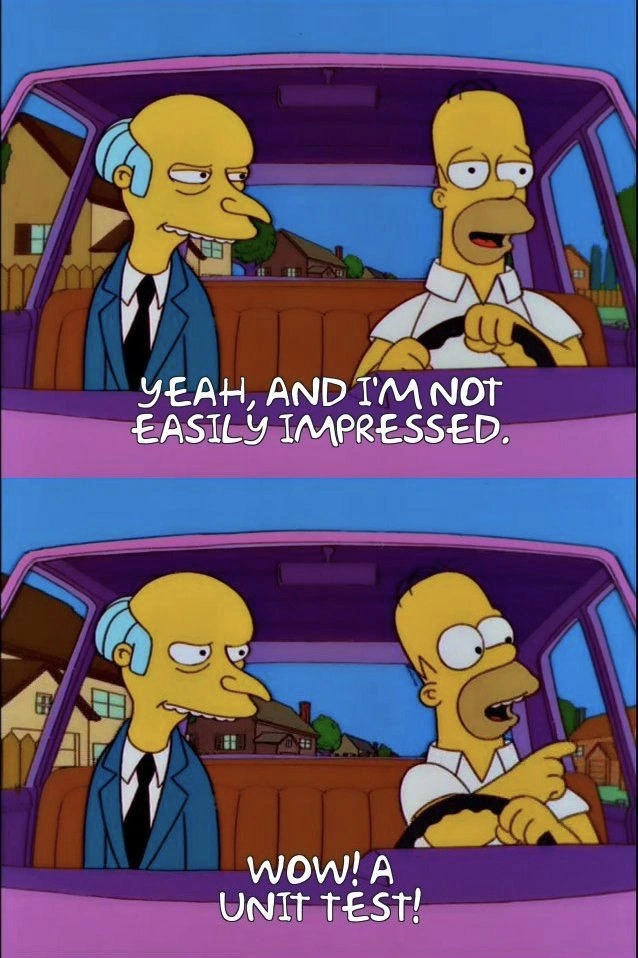
The Bare Minimum of Code Quality Impresses Some
Description
A two-panel meme from the animated TV show 'The Simpsons'. In the top panel, Mr. Burns is in the passenger seat of a car being driven by Homer Simpson. With a skeptical and unimpressed look, Mr. Burns says, 'YEAH, AND I'M NOT EASILY IMPRESSED.'. In the bottom panel, Homer points excitedly out the window, and the caption reads, 'WOW! A UNIT TEST!'. The humor satirizes the state of software projects where testing is so neglected that the mere existence of a single unit test is considered a remarkable and noteworthy event, worthy of being pointed out like a roadside attraction. It speaks to the low standards of code quality in some environments and the disconnect between what experienced engineers consider the bare minimum and what others might see as an achievement

Comments
7Comment deleted
Seeing a unit test in our legacy codebase is like finding a comment that's still relevant. You're not impressed, you're suspicious
Only in legacy-land can one happy-path unit test bump coverage from “ - ” to 0.1% and trigger a slide deck titled “Continuous Delivery Achieved.”
After 20 years of reviewing PRs, I've seen developers get excited about unit tests the same way archaeologists get excited about finding pottery shards in a landfill
This perfectly captures the moment when a senior architect reviews a PR and discovers the team's idea of 'comprehensive testing' is a single unit test with 12% code coverage - and somehow, that's still an improvement over the previous sprint's zero. It's the software equivalent of being impressed that someone remembered to add a README file, even if it just says 'TODO: Write documentation.' The real tragedy? In some codebases, this genuinely would be cause for celebration
These days, the only thing that impresses me is a “unit test” that doesn’t spin up Docker, talk to Kafka, or hit the DB - just a pure function and an assert
Our test pyramid is a stalactite: one unit test dangling over an ocean of integration-by-prayer
In enterprise codebases, spotting a unit test feels like finding CAP theorem compliance in a microservices mesh - pure astonishment