Skip to content
DevMeme
5665 of 7435
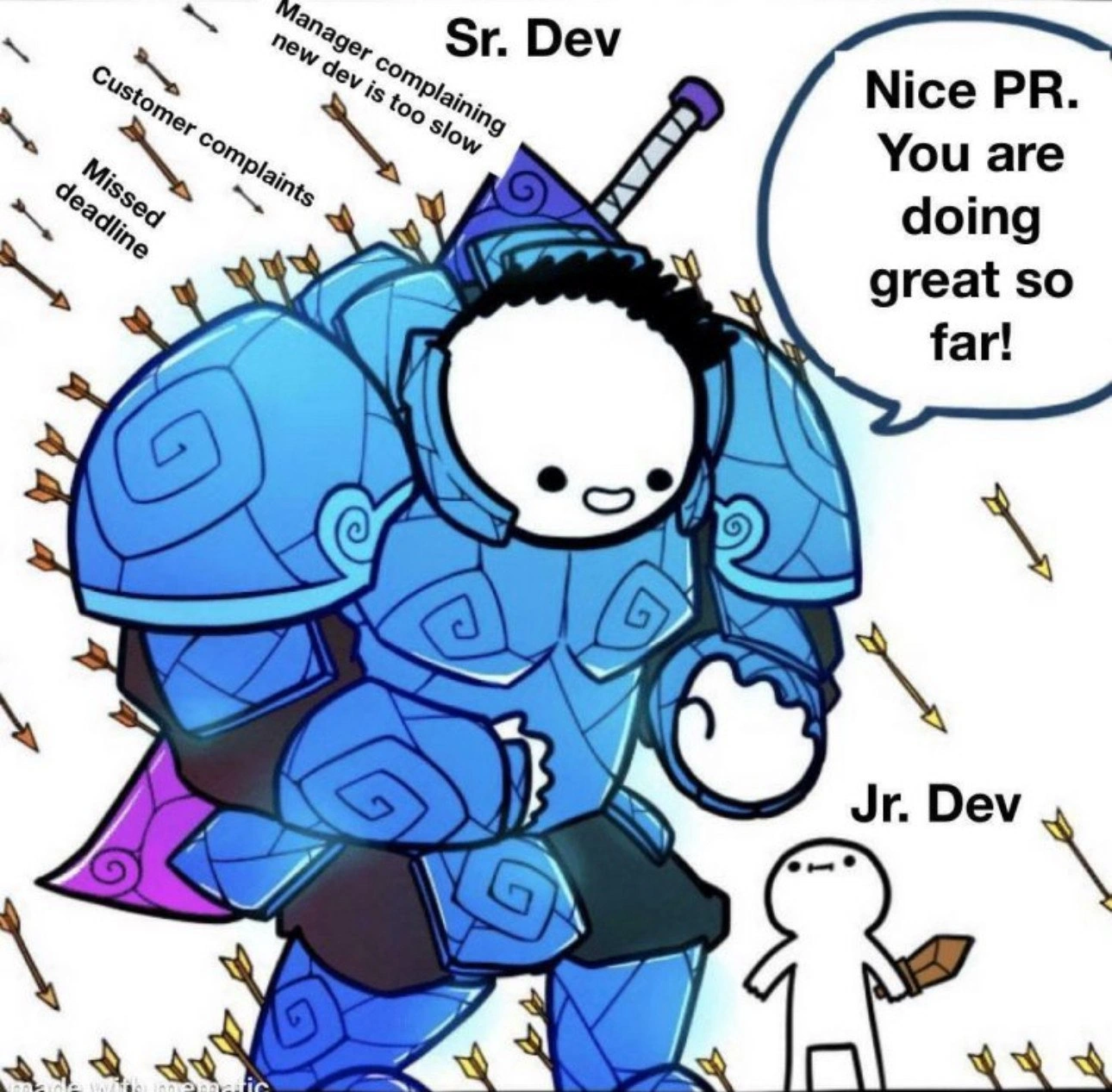
Senior dev in full armor absorbs the real-world arrows so juniors can thrive
CodeReviews Post #6215, on Sep 1, 2024 in TG

Senior dev in full armor absorbs the real-world arrows so juniors can thrive

Why is this CodeReviews meme funny?

Level 1: Protecting a Friend

Imagine you’re playing a game at school and you’re still learning the ropes. Some older kids start getting mad because you made a mistake that slowed down the game. Maybe they even start throwing balls or yelling criticisms at you. It’s a scary feeling! Now picture your best friend — who’s a big kid — stepping in front of you like a superhero. Your friend literally blocks the flying balls for you so they hit him instead of you. He then turns around to you with a smile and says, “Hey, you’re doing great, don’t worry!” You feel relieved and keep trying your best, right?

That’s exactly what this meme is about, but in a software team with programmers. The big friend is like the senior developer, and you are like the new junior developer. The senior (big friend) handles the angry people and problems (the flying arrows, like the balls or angry shouts) so that the junior (you) doesn’t get hurt or discouraged. Even while handling all that trouble, the senior still encourages the junior by saying “Nice job, keep it up!” It’s both funny and heartwarming, because the big friend in armor is getting hit by all those “arrows” of trouble, but he acts like it’s nothing just to keep his little friend feeling confident and safe. In simple terms: a good, experienced person protects the beginner from the bad stuff and cheers them on. Cute, right?

Level 2: Mentorship 101

Let’s break down the scene in simpler terms. The Sr. Dev character in the meme is a senior developer — meaning a very experienced programmer — and the Jr. Dev is a junior developer who’s just starting out in their career. In many software teams, seniors take on a mentorship role for juniors. This often involves practices like code review: when a junior writes some code, they create a Pull Request (PR) for the senior to review before the code gets added to the main project. In the speech bubble, “Nice PR. You are doing great so far!” is exactly the kind of encouraging comment a mentor might leave on a junior’s pull request. It means the senior is happy with the junior’s code changes overall. Even if there are mistakes, the senior is focusing on the positives and guiding them on improvements in a friendly way. This is called positive code review feedback – highlighting what was done well and gently coaching on what to fix. It helps new developers build confidence and learn best practices without feeling attacked.

Now, what about all those arrows flying at the senior? Each arrow label represents a real-world problem or pressure that software teams face:

  • Missed deadline – This means the team didn’t finish a feature or project by the due date. In a job, that can lead to a lot of stress: managers might get upset, and plans have to be adjusted.
  • Customer complaints – These are users or clients being unhappy with the software. Maybe something isn’t working (a bug) or a promised feature isn’t there yet. Customer complaints put pressure on the team to fix things quickly.
  • Manager complaining new dev is too slow – Sometimes bosses expect new hires to get up to speed fast. If a junior developer isn’t producing features immediately, an impatient manager might grumble that they’re “too slow.” This is actually pretty unfair – it’s normal for a new_dev_ramp_up period to take time. The junior has to learn the codebase, the product, and the team’s processes. In fact, there’s a famous idea in software management called Brook’s Law which says adding new people to a project can initially slow it down. Why? Because experienced folks have to spend time training the newcomer, like our senior dev is doing. So a good senior knows to manage the manager’s expectations in this situation.

In the meme, the senior developer (the knight) is standing in front of the junior, blocking those arrows. This symbolizes how the senior handles these issues so the junior doesn’t directly face them. For example:

  • If a customer complaint comes in about a bug that the junior’s code caused, the senior might be the one to jump on a call with the customer or write an apology email. The junior won’t be yelled at by the client; the senior takes responsibility and then later calmly helps the junior fix the bug.
  • If a deadline is missed because the junior needed more time to get the feature right, the senior will talk to the manager or product owner to adjust timelines or find solutions, rather than letting anyone scapegoat the junior. They might say, “Our team needs a bit more time to ensure quality,” shielding the junior from blame.
  • When a manager complains the new dev is slow, a senior dev will push back or shine light on the junior’s progress: “Actually, they’re picking up speed and contributing; I’ve been reviewing their code and it’s getting better each time.” They educate the manager about the ramp-up process, effectively stopping that negative feedback from reaching the junior’s ears.

All the while, the senior continues to encourage the junior — just like the quote in the meme: “You are doing great so far!” This is mentorship in action. The junior developer, with their tiny wooden sword, is like a beginner given a small task or tool. They’re trying their best, but they’re not equipped yet to fight off angry clients or demanding executives. The senior, with full armor and experience, is equipped to handle those stakeholder battles. The junior’s job is to learn and practice (swing that wooden sword in some safe sparring), and the senior’s job, aside from coding, is also to coach and protect the junior until they gain more experience (one day that junior will forge their own armor!).

This kind of supportive behavior builds what we call psychological safety on the team. The junior knows they can make mistakes or take their time to learn, and their senior will have their back. It’s an ideal CodeReviews culture: rather than tearing down the newbie for a bad commit or slow progress, the team emphasizes learning, sharing responsibility, and treating mistakes as opportunities to improve. Many companies pair up new hires with a “buddy” or mentor for exactly this reason. If you’re a new developer and you’ve had a senior colleague who shielded you from a tough client or took time to explain things when you messed up, you’ve experienced what this meme is showing. It feels great, right? You feel safe to ask questions and you grow faster as a result. And if you’re a senior dev, this meme might remind you of times you played the knight: maybe you’ve sat in meetings defending your junior team members (“We’ll sort out the issue, they’re still learning, but they wrote a solid module there!”) or you’ve stayed late to handle a hotfix so your junior could go home and rest. It’s all about teamwork and mentorship.

In short, the Sr. Dev in armor is demonstrating how a senior developer acts as a protector and coach. They manage the Stakeholders_Clients (like managers and customers) by taking the brunt of complaints and deadline stress, and they manage Juniors by giving constructive, uplifting feedback. The result? The project stays on track (or as close as possible), the stakeholders feel heard, and the junior developer thrives and learns without being crushed by negativity. It’s a win-win (and a funny, nerdy way to visualize it!).

Level 3: Shield of Seniority

At the highest level, this meme depicts a classic mentor_shielding scenario in software teams, exaggerated into a medieval battle tableau. The Sr. Dev is drawn as a hulking knight in ornate blue armor, acting as a literal shield for the tiny Jr. Dev. Those dozens of arrows flying in? They’re labeled with every DeadlinePressure and StakeholderExpectations nightmare a project can spawn: “Missed deadline”, “Customer complaints”, “Manager complaining new dev is too slow.” This imagery is a humorous visualization of real workplace issues bombarding an experienced developer.

In real life, senior engineers often absorb the “arrow fire” of project stress so that junior developers aren’t directly impaled by it. It’s a well-known dynamic in CorporateCulture: a good tech lead will take the heat from angry clients or managers, acting as a human firewall between the chaos and their team. Developers jokingly call this being a “shit umbrella” (crudely put) or simply a buffer – the senior dev’s broad shoulders (or in the meme, broad armor) carry the brunt of blame and pressure. Here, the knight’s armor represents years of experience and a thick skin earned from surviving many missed deadlines and production outages. Arrows that would panic a newcomer just bounce off a seasoned veteran. The SeniorVsJuniorDevelopers contrast is depicted perfectly: the junior has a toy-sized wooden sword (barely useful against flying arrows!) while the senior is armed and armored to the teeth, unfazed by the onslaught.

What really sells the joke is the senior’s speech bubble: “Nice PR. You are doing great so far!” The senior is literally getting stabbed with project issues from all sides, yet remains utterly positive and encouraging toward the junior developer’s work. This is comedic gold for those in the industry because it’s so true to healthy team dynamics. A skilled senior engineer might be fighting fires all day — calming an angry customer about a bug, pleading with a manager for a timeline extension, refactoring code at 2 AM to hit a deadline — but when they review the junior’s PullRequest (PR) on GitHub, they’ll still leave a supportive comment: “Good job on this feature, just a couple of suggestions.” It’s a hilariously wholesome contrast: outwardly facing, the senior is a battle-worn warrior taking flak; inwardly to the team, they’re a friendly coach.

This CodeReview culture of positivity is no accident. Experienced devs understand that dumping stakeholder stress onto a newcomer helps no one. Instead, they filter it. Notice the arrow “Manager complaining new dev is too slow”: rather than letting that criticism demoralize the junior, the senior likely tells the manager something like, “Don’t worry, I’m guiding them and we’ll improve speed soon.” Then they turn to the junior and celebrate their progress (exactly like the “Nice PR” in the meme). It’s a real-world tactic to balance StakeholderExpectations with junior ramp-up time. There’s even a bit of dark humor here: the senior dev is probably fixing the junior’s mistakes or working overtime to keep the project on track (taking those Missed deadline and Customer complaint arrows in the back), yet they still give the junior a confidence boost. It’s like a knight saying “Tis but a scratch!” while riddled with arrows, just to keep their squire motivated.

For veteran developers, this meme also triggers memory flashbacks (half humorous, half harrowing). You recall times when you’ve been that knight: telling a newbie “Your code looks good, just refine this function,” right after you spent an hour on a call calming an irate client about a bug in that same code. The DeveloperHumor shines through because we laugh at the extreme portrayal, but we also nod knowingly — this is what good leadership looks like on a dev team. The senior’s armor isn’t just for show; it’s protecting something precious: the junior’s psychological safety and learning environment. In tech terms, the senior acts as a protective abstraction layer between the raw, volatile input (manager demands, client anger) and the junior developer who is still in a fragile state of growth. By absorbing this “error input,” the senior prevents an exception in the junior’s development journey (i.e., burnout or fear). And by giving positive output (“Nice PR!”), they reinforce good behavior. In essence, the senior dev is a Pull Request Paladin – a knight dedicated to defending their apprentice and championing their code. We love to see it! 🎉

Description

Cartoon-style meme featuring a large blue knight labeled "Sr. Dev" clad in ornate armor that is being peppered by dozens of flying arrows. Some arrows are explicitly labeled "Missed deadline," "Customer complaints," and "Manager complaining new dev is too slow," illustrating typical project pressures. The knight is bent toward a much smaller, weapon-less stick figure labeled "Jr. Dev" who holds a tiny wooden sword; the senior’s speech bubble reads, "Nice PR. You are doing great so far!" The visual joke highlights mentorship and code-review culture: the senior shields the junior from stakeholder fury while offering encouraging feedback on a pull request. Colors are vivid blues and purples for the armor, with brown arrows and simple white background, making the text and arrows visually pop for easy readability
Comments

7
Anonymous ★ Top Pick Architecture diagrams rarely mention the ‘senior-dev firewall,’ yet it’s still our most reliable layer of defense in front of a half-finished microservice and an over-promised deadline
  1. Anonymous ★ Top Pick

    Architecture diagrams rarely mention the ‘senior-dev firewall,’ yet it’s still our most reliable layer of defense in front of a half-finished microservice and an over-promised deadline

  2. Anonymous

    The real senior dev superpower isn't writing perfect code - it's maintaining a poker face while saying 'interesting approach' to code that makes you question the fundamental laws of computer science, all while deflecting management's 'why isn't the new hire at 100% productivity yet' arrows that started flying approximately 3 days after onboarding

  3. Anonymous

    The senior engineer's true superpower isn't their architectural knowledge or debugging prowess - it's their ability to transform a barrage of 'why isn't this done yet?' into 'great job on that PR!' while their armor absorbs the slings and arrows of missed SLAs, scope creep, and that one PM who thinks 'just a small change' doesn't require a sprint planning discussion

  4. Anonymous

    The ultimate design pattern: Senior Facade shielding Junior implementation disasters from stakeholder arrows

  5. Anonymous

    True seniority is implementing the human bulkhead/circuit-breaker pattern: throttle PM retries and customer timeouts so a junior's first PR still returns 200 OK

  6. Anonymous

    Real seniority is being the circuit breaker and reverse proxy - absorb the manager DDoS, shed the blame traffic, and still return 200 OK: 'LGTM' on the junior’s PR

  7. @ZgGPuo8dZef58K6hxxGVj3Z2 1y

    You gotta start somewhere. What are we? The linux community?

Use J and K for navigation