The Unbeatable Server Security Strategy
Why is this Security meme funny?
Level 1: Playing Dead for Safety
Imagine you’re afraid someone might break your favorite toy. One “solution” you come up with: every time someone reaches for the toy, you immediately smash the toy yourself. Now no one can take or break your toy – because it’s already broken and gone! 🧸🔨 Of course, this means you can’t play with your toy either, which makes the solution pretty silly. That’s exactly the joke here. The website is like the toy: to protect it from bad guys, it just destroys itself whenever anyone tries to use it. It’s like the site is “playing dead” to avoid trouble. It’s funny because it solves the problem (no one can mess with it) in a completely over-the-top way that also ruins the whole point of having a website (or toy) in the first place.
Level 2: Crash to Stay Safe
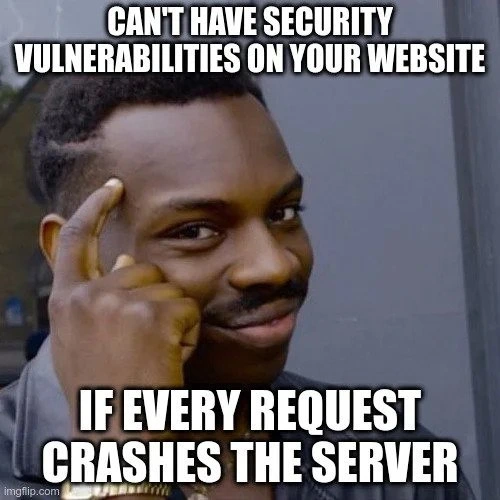
Let’s break down the joke in simpler terms. The meme shows a guy tapping his head as if he’s saying "smart thinking!". The text says you can’t have security vulnerabilities on your website if every request crashes the server. In plain English: if every time someone tries to use the website, the website immediately crashes (stops working), then nobody can hack it. Why? Because it’s never up long enough for hackers (or anyone) to do anything! This is obviously TechHumor – no sane developer actually wants their server to crash.
Some definitions: A security vulnerability is a weakness or bug in a website’s code that bad people (hackers) could exploit to do things they shouldn’t – like steal data or take control. The normal goal is to fix these SecurityFlaws so the site stays safe and online. An HTTP request is basically what happens when you visit a page or call an API: your browser asks the server for something. In a well-behaved backend, the server should send back a response (the page or data). But here, the joke is that the server instead just falls over on every request – essentially a guaranteed 500 Internal Server Error or no response at all because the process died. That’s what we mean by SystemCrashes: the program running the site encounters a fatal Bug and quits unexpectedly. A “segfault” (short for segmentation fault) is one kind of crash, often in lower-level languages like C or C++, where the program tries to access memory incorrectly and the operating system says “Nope!” and kills the program. Think of it like a safety fuse blowing – the program is stopped to prevent further damage. In higher-level terms (like Java, Python, etc.), it’s similar to an unhandled exception that forces the application to stop.
So the meme jokingly proposes making your website perform an instant crash on every request as a way to avoid any security issues. It’s like saying, “Our site can’t be hacked if it’s always down!” True, perhaps, but then it’s also a site nobody can use. 😅 This is a great example of BackendHumor because backend developers are the ones who deal with server reliability. They know that a site constantly crashing is the ultimate failure. The meme is poking fun at the absurd idea of treating a server failure as a feature. It hints at the concept of a denial-of-service – normally an attack where someone overloads your site to crash it. Here, the developer themself implements that behavior intentionally (a crash_on_request_strategy). It’s an obviously silly approach, meant to get a laugh. In real life, instead of letting the app blow up, we add things like error handling, input validation, and security patches to keep the server running and safe. But the visual of the Roll Safe guy implies this ridiculously smug “I’ve solved it!” moment, which is hilarious because it’s the worst possible solution in practice.
Level 3: Denial-of-Service by Design
This meme hits home for seasoned developers because it jokes about turning a catastrophic bug into a “security” policy. The image (the classic Roll Safe guy tapping his head) usually captions an ironically clever idea. Here the caption reads: “Can’t have security vulnerabilities on your website if every request crashes the server.” It’s proposing an insane “solution”: make your website crash permanently so attackers and everyone else can’t get in. Essentially, it’s a denial_of_service_self_inflicted – the server performs a DoS attack on itself by dropping dead on each request. The dark humor targets backend engineers who have experienced those dreaded production incidents where a single bad input or bug causes a full system crash. It’s taking that nightmare and saying, “hey, look on the bright side – at least hackers can’t exploit you if you exploit yourself first!” 🥴
SecurityVulnerabilities often come from software bugs that let bad actors do nasty things (like SQL injection or remote code execution). In real life, one common class of attacks is forcing an application to crash or overload – a denial-of-service attack – to knock a site offline. Here the meme flips it: the developer knowingly writes an app so fragile that every single request causes a crash. It’s like deploying a web server with an built-in kill-switch:
def handle_request(request):
# Process the request... nah, let's just crash.
import os
os._exit(1) # Immediately terminates the program (simulating a segfault)
Now your uptime SLA is 99.99% 0% by design! This is backend humor at its finest – joking that you could achieve perfect security by having no running website at all. Experienced engineers recognize the satirical nod to unhandled exceptions: that feeling when a simple bug (maybe a null pointer dereference in C++ or an uncaught exception in Python) brings down your entire server. In reality, we strive to handle errors gracefully so the server stays up, but here the code basically says “on any error, or any request whatsoever, just segfault out.” It’s a cynical commentary on how not to build robust systems.
There’s also a wink to the eternal trade-off between security and availability. You could lock down a system so hard that nobody can use it – extremely secure, but also pointless. The meme exaggerates this trade-off to absurdity: maximum “security” by totally eliminating availability. It mocks any nihilistic_security_approach where the solution to vulnerabilities is to stop offering the service entirely. Seasoned devs also recall adages like “no code, no bugs.” Here it’s “no running code, no hacks.” Sure, you’ll have SecurityFlaws technically fixed – because a crashed server can’t be hacked – but you’ve basically implemented Security by Segfault, as the title jokes. It’s funny because it’s a solve one problem by destroying the system scenario, something any grizzled engineer would facepalm at and laugh. After all, we’ve seen managers jokingly suggest “let’s just shut it all down if we can’t secure it,” and this meme takes that to a comical extreme.
Level 4: Security by Self-Destruct
In information security theory, there's the CIA triad: Confidentiality, Integrity, and Availability. The joke here is achieving the first two by completely sacrificing the third. If a server intentionally fails closed (crashes) on every input, it effectively removes availability in exchange for theoretical safety. It’s like an extreme fail-secure posture: the instant something tries to interact with the system, the system self-destructs, sealing itself off. No uptime means no unauthorized access – a tongue-in-cheek caricature of “air-gapped” security. This nihilistic model treats server_failure_as_feature, ensuring nothing can be stolen or corrupted if nothing is left running. It’s an absurd extrapolation of the saying, “the most secure computer is one that’s unplugged (and buried in concrete).” Here, the server is essentially unplugging itself on each request.
On a more technical level, the meme’s “Secure by Segfault” strategy riffs on low-level memory protection. A segmentation fault (segfault) is when a program tries to access memory it shouldn’t, and the operating system immediately kills it to prevent damage. In a way, that crash is the OS stepping in to maintain integrity – the process is stopped before any exploit can take hold in memory it doesn’t own. In security terms, a segfault aborts execution rather than let an attacker run arbitrary code. The meme exaggerates this: every incoming HTTP request triggers a crash, as if the server preemptively performs a self-Denial-of-Service. We could almost express the “logic” mathematically as:
P(exploit) = P(server_is_up) × P(vulnerability_exploited)
By making (P(server_is_up) \approx 0) for any request, the probability of a successful exploit goes to zero. It’s a darkly comedic take on system design, effectively crash_on_request_strategy as a twisted security mechanism. Of course, in practice, a system that always halts is 100% secure only because it’s 0% useful – a perfect security flaw in any real backend.
Description
This meme uses the popular 'Roll Safe' or 'Think About It' format, which features a man smiling knowingly and tapping his temple. The top text reads, 'CAN'T HAVE SECURITY VULNERABILITIES ON YOUR WEBSITE'. The bottom text completes the flawed logic with, 'IF EVERY REQUEST CRASHES THE SERVER'. The humor lies in the absurd 'solution' to a complex problem. Instead of implementing proper security measures, the 'strategy' is to have a system so broken that it's unusable, thereby preventing any potential exploits. It's a satirical take on lateral thinking that resonates with developers who've seen systems that are so unstable they are, in a way, 'secure' from attack simply because they cannot be reliably accessed
Comments
7Comment deleted
It's not a bug, it's a feature. We call it 'Crash-Driven Security.' Our attack surface is now a null pointer exception
Any incoming request triggers a SIGSEGV and an instant pod restart - attackers call it DoS, our CISO calls it an “ephemeral attack surface.”
Reminds me of that legacy system we couldn't decommission because it was 'too critical,' yet crashed so often that hackers gave up trying to exploit it. The pentester's report literally said 'Unable to complete assessment - target achieved 100% denial of service on its own.'
Ah yes, the ultimate defense-in-depth strategy: achieving a perfect zero-day vulnerability count by maintaining a perfect zero-uptime SLA. It's like implementing security through aggressive load shedding - can't exploit what never responds. Though I suspect this approach might not pass the next SOC2 audit, and your on-call rotation will have some pointed questions about why PagerDuty thinks you're mining cryptocurrency with alert volume
Security by CrashLoopBackOff: zero CVEs reported, 0 nines of availability, and the error budget burned before the pager finished its first ring
New architecture: crash-on-request - CVEs dropped to zero, right along with our nines
Ultimate zero-trust: reject all requests at the segfault layer, availability be damned