Secret Radio Crypto Meets Reality
Why is this Cryptography meme funny?
Level 1: Walkie-Talkie Secrets
This is funny because the picture looks like a normal car radio, but the story behind it is that important people trusted it to keep secrets, and the secret lock may have been weak on purpose. It is like finding out the school principal's "super safe" announcement box has a toy lock on it: everyone acted serious, but the box was never as protected as it looked.
Level 2: Buttons, Channels, Trust
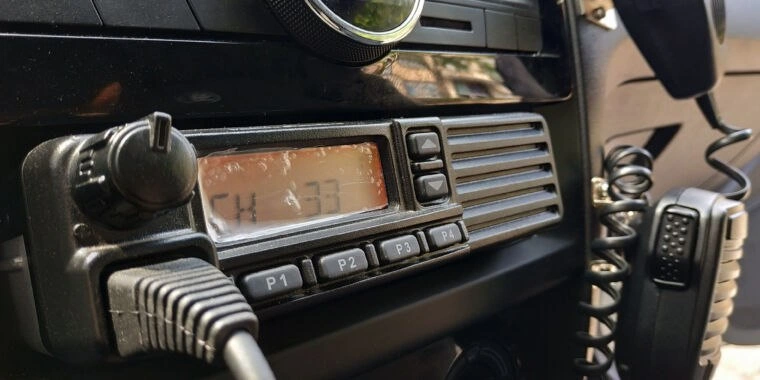
The image shows a vehicle-mounted radio unit. The buttons labeled P1 through P4 are likely programmable presets, the display shows channel information, the speaker grille outputs audio, and the handheld microphone is used for push-to-talk communication. This is the kind of equipment used when teams need fast shared voice communication without opening a phone app or joining a video call like civilization has failed them personally.
TETRA stands for Terrestrial Trunked Radio. It is a professional radio standard, not a meme font. "Trunked" means many users share a managed set of radio channels, with infrastructure assigning capacity instead of each group living permanently on one frequency. That makes it useful for emergency services, transit systems, utilities, industrial sites, and other organizations that need coordinated communication.
Encryption is supposed to make intercepted radio traffic unreadable. In a healthy design, someone listening over the air hears noise unless they have the right secret key. A cryptographic protocol defines not only the cipher, but also how devices authenticate, synchronize, generate keystreams, and decide what messages to trust. A security vulnerability is a flaw in any of those parts that lets an attacker do something the system was meant to prevent.
For a newer developer, the analogy is discovering that a legacy service uses HTTPS, but only because it terminates through a mysterious appliance nobody can audit, configured by a vendor nobody can reach, with a certificate process documented in a spreadsheet named final_final_2014.xls. The label says "secure." The architecture says "please stop asking questions near the executives."
Level 3: Dispatch Meets Reality
The meme lands because the object looks like boring field equipment, but the context says "critical infrastructure security incident." Anyone who has worked around embedded systems knows this genre: a device with physical buttons and a tiny screen quietly carries assumptions from the 1990s into a world where cheap SDRs, reverse engineering, and commodity compute have changed the threat model completely.
The visible radio is almost aggressively mundane. The LCD appears to be showing channel-style text, the preset keys imply routine operation, and the microphone suggests a dispatch workflow where people expect immediacy, not a cryptography lecture. That is why the security failure feels so absurd. The users are not trying to operate a research prototype. They are trying to coordinate police units, maintenance crews, airport ground staff, rail operations, or utility workers. The crypto is supposed to be invisible because everything else is already stressful enough.
The industry pattern being satirized is security by obscurity plus procurement gravity. A vendor or standards body ships a closed design. Agencies buy fleets of devices. Integrators build operational processes around them. Training, antennas, base stations, maintenance contracts, key loaders, replacement schedules, and regulatory paperwork all accumulate around the chosen system. Years later, a researcher says "the cipher has a deliberate weakness" and someone in a meeting asks if there is a firmware update, as if decades of deployment can be patched like a web app dependency. The answer, naturally, is "it depends," which is procurement-speak for "cancel your weekend."
Fixing this is harder than swapping an algorithm name in a config file. Radio networks have compatibility constraints, hardware lifetimes, field coverage requirements, and users who cannot tolerate downtime because their "production environment" may be an ambulance call or a train yard. Even when mitigations exist, adding end-to-end encryption can create interoperability problems, operational complexity, and key-management procedures that humans will absolutely find a way to make exciting at the worst possible time.
There is also a political layer. Export controls historically encouraged intentionally weakened cryptography for some markets. That means the technical debt was not merely accidental; it could be a feature negotiated into existence by policy, vendors, and governments. The joke is not "old radio bad." The joke is that an ordinary-looking transceiver can embody decades of institutional compromise, and the people depending on it may learn about those compromises only after researchers pry the algorithm out of the box.
Level 4: Secret Cipher Cabinet
The photograph is funny precisely because it refuses to look dramatic. There is no red "hacked" overlay, no matrix rain, no hooded figure. It is just a dashboard radio with a dusty LCD, preset buttons labeled P1, P2, P3, and P4, a speaker grille, a thick cable, and a coiled microphone hanging off to the side. That ordinariness is the point: mission-critical cryptography often lives inside equipment that looks like it was installed once, forgotten for twenty years, and then trusted during emergencies.
The deeper technical reference is TETRA-style professional mobile radio: trunked radio systems used for police, transport, utilities, industrial sites, and other critical communications. In those systems, the security boundary is not a sleek web login or a cloud KMS dashboard. It is a radio protocol, firmware, base stations, key material, air-interface encryption, and proprietary algorithms that may have been designed under export-control politics rather than modern public cryptographic review.
The cryptographic pain here is that secret algorithms age badly. A cipher can use impressive-sounding key sizes while still containing a structural reduction that makes the effective attack far cheaper. If an algorithm nominally works with an 80-bit key but collapses part of that security down to something closer to 32-bit strength, the phrase "encrypted radio" starts doing more public-relations work than engineering work. The radio still beeps, dispatch still talks, the channel display still glows, and meanwhile the mathematical foundation has been quietly replaced by wet cardboard.
This is why cryptographers keep invoking Kerckhoffs's principle: a system should remain secure even if the attacker knows how it works, as long as the key remains secret. Proprietary radio crypto often inverted that model. The algorithm was guarded, the implementations were locked in devices, and users were expected to trust the vendor and standards ecosystem. That can work only until someone extracts firmware, reverses the protected component, and discovers that the hidden mechanism was not stronger because it was hidden. It was just less inspected.
The radio hardware also hints at the protocol-level problem. A push-to-talk system is not just "voice, but encrypted." It has timing, channel assignment, base-station coordination, authentication assumptions, group calls, and sometimes machine-to-machine control messages. If unauthenticated timing or keystream reuse enters the design, the attack surface is no longer just passive eavesdropping. It can become replay, manipulation, or carefully staged message injection, depending on the exact deployment. That is the nightmare hiding behind a beige-gray handset.
Description
The image is a close-up photo of a vehicle-mounted radio transceiver or dispatch unit installed in a dashboard, with a small dusty LCD showing channel-style text, preset buttons labeled "P1," "P2," "P3," and "P4," a speaker grille, a plugged-in cable, and a coiled handheld microphone hanging on the right. There is no meme caption overlaid on the image itself. The sibling post metadata links this photo to reporting about researchers finding a deliberate weakness in police and critical-radio encryption, making the plain hardware shot a reference to TETRA-style mission-critical communications security. The technical humor is that the most ordinary-looking field radio can hide decades of proprietary crypto assumptions, export-control compromises, and operational risk.

Comments
3Comment deleted
Nothing says mission-critical security like proprietary crypto that only becomes peer-reviewed after the radios are everywhere.
Noice Comment deleted
Btw you can’t have resilience and full encryption… I guess, but you could make a real working system with a button that would allow to reduce security in order to ensure easier transmitting Comment deleted