A Glimpse into the Future: Scala 6.0
Why is this Languages meme funny?
Level 1: New Toy, Old Trash
Imagine you get a super hyped new toy that all the ads say is the coolest thing ever. You’re really excited and beg your parents for it. But when you finally have it, you realize it’s not much different from your old toys. You play with it for a day, then it just sits in the corner or ends up in the trash bin. Why is that funny here? Because that’s exactly the feeling this meme is joking about – only with a programming language instead of a toy. “Scala 6.0” is like a toy with a big shiny new version label on the box. Developers have seen many “new and improved” tech tools come out that claim to change everything. But often, after the excitement, they find it wasn’t such a big deal or it created new problems. So they feel like tossing it out. Seeing the name of the new thing on a trash can is a silly, exaggerated way to show that disappointment. It’s like saying, “Look, the next big thing is here… and surprise, it’s already garbage!” Anyone who’s ever been let down by an overhyped toy or gadget can understand the humor and relief in just laughing it off.
Level 2: Major Version, Minor Gains
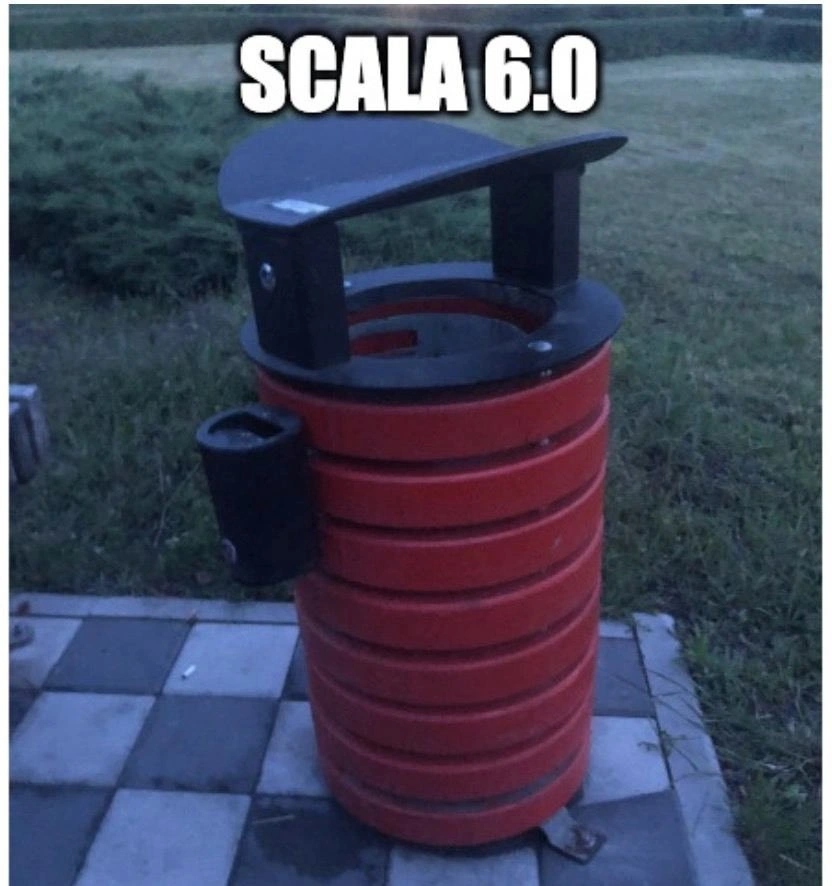
For a less experienced developer, let’s break down the joke. Scala is a programming language (runs on the JVM like Java) known for mixing functional programming (like math-style code) with object-oriented design (classes, objects, etc.). It’s powerful, but also complex. The current real-world version of Scala in mid-2021 was Scala 3.0, so “Scala 6.0” is a made-up future release. In software, version numbers typically work such that a jump in major version (e.g. from 3.x to 4.0, 5.0, etc.) signals big changes or improvements. Version hype is when the community or marketing around a language gets very excited about a new release, often claiming it will be game-changing. This meme makes fun of that hype. The image literally shows a red trash can with the label “Scala 6.0” in big white letters at the top. In internet and developer humor, calling something “trash” means you think it’s low quality or not worth caring about. So the meme is basically saying: “Scala version 6.0 – yeah, throw that in the garbage.” It’s a cheeky way to express skepticism about the value of yet another major release.
Why would someone be so sarcastic about a new version? Think of LanguageEvolution and release cycles: programming languages (and frameworks) evolve over time by releasing new versions. Scala 2 had a long life with many incremental updates (2.10, 2.11, 2.12, etc.), then Scala 3 came with big changes to syntax and the type system. Upgrading isn’t always easy — code written for Scala 2 might need adjustments to work in Scala 3. That’s a headache for developers. Now imagine future Scala 4, 5, and 6 each introducing more changes. The meme jokes that by the time Scala 6 arrives, developers are so tired of the churn that the fancy new version goes straight to the trash can. It pokes fun at industry trends where every release is hyped (“Now 100% better!”) but in practice, teams often skip or ignore versions because the benefits don’t outweigh the effort of upgrading. This is common in tech: for example, many projects stayed on Python 2 for years despite Python 3’s hype, because migrating was hard. That’s LanguageAdoption reality versus marketing.
The term LanguageWars refers to the playful (sometimes fierce) debates between fans of different programming languages. It’s like console wars (Xbox vs PlayStation) but for coding. Here, calling Scala’s new version trash is a jab you might expect from a rival camp or a frustrated Scala dev who’s feeling betrayed by the complexity. It’s satire about the release_cycle_satire itself: many new releases, not enough real improvement. The trashcan_meme_format you see (text on a photo of a garbage bin) is a popular way online to label something as garbage. Developers often use this format to joke about tools or practices they dislike. For instance, you might see a picture of a dumpster fire labeled “Production Server” to joke about bad deployments. In this case, the clean red garbage can labeled “Scala 6.0” suggests that Scala’s next big version is just disposal material. Of course, it’s tongue-in-cheek. Scala is not literally trash; the meme exaggerates to make a point about excessive hype and how each new version can feel unnecessary or over-sold. As a newer developer, it’s useful to know that while new versions can bring great improvements, there’s often skepticism too. Experienced devs might joke like this after living through many “shiny new” versions that didn’t live up to their promises.
Level 3: Garbage-Collected Hype
Seasoned developers have seen language version hype come and go so often that it becomes a running joke. The meme labels a trash can as “Scala 6.0,” implying that a hypothetical future version of the Scala language belongs in the garbage. Why is this funny? Because it satirizes the IndustryTrends_Hype around programming language releases: every major version is marketed as revolutionary, yet many of us suspect it’ll end up as just more junk we have to sort through. Scala is a powerful JVM language blending object-oriented and functional paradigms, but it’s also notorious for complexity. Each big release (Scala 2, then Scala 3, etc.) promised to clean up the design or add ambitious features. In reality, those updates often introduce new quirks and technical debt, leaving developers grumbling that “Scala 6.0 might as well be a trash bin for all the redundant features.”
This meme hits on a common LanguageWars trope: rivals and even fans poke fun at a language’s endless evolution. Scala enthusiasts touted it as a “better Java” with cool functional tricks (monads! implicits! type inference!). Yet over the years, some features turned out confusing or overused, and competitors like Kotlin stole some of Scala’s thunder by being simpler. A Cynical Veteran coder remembers the hype around Scala 3 (a.k.a. Dotty) with its cleaner syntax and refined type system, and how it was supposed to be a new dawn. Fast forward, and that same veteran is rolling their eyes at the idea of Scala 6.0 – “Oh great, another grand rewrite and more broken code. Been there, done that.” The humor is in the shared experience: major version bumps often break backward compatibility or require endless refactoring, all for changes that feel minor in practice. It’s a hype cycle we know too well.
This trash-can meme format is practically garbage collection for overblown expectations. It collects all those lofty release promises and dumps them where jaded engineers think they belong. We’ve all watched tools and languages go through this cycle: yesterday’s groundbreaking version becomes today’s outdated trash. Remember how AngularJS was hyped then tossed aside for Angular 2+? Or how Python 3’s long-awaited improvements initially felt like a dumpster fire to teams stuck on Python 2? This image taps into that trauma. By the time you’d reach “Scala 6.0,” perhaps after several hype-heavy iterations, even loyal Scala devs might sarcastically say, “just chuck it, we’ve heard this song before.” The bold white text and the choice of a literal garbage can drive the point home with dark humor. In the end, the meme speaks to a senior-level reality: language evolution can become a treadmill of promises that lead to cynicism, where each next big version is greeted not with applause but with a sigh and a smirk.
Description
The image displays a red and black public trash receptacle, of the type often seen in parks or on city streets. It is composed of stacked red rings, with a black lid and ashtray attachment. Overlaid at the top of the image in a large, white, bold font (Impact style) is the text 'SCALA 6.0'. This meme is a blunt and derogatory commentary on the Scala programming language. By labeling a trash can with a hypothetical future version number, the creator expresses a strong negative opinion, implying that the language is, or is becoming, 'garbage'. This type of humor is common in developer 'language wars,' where programmers express tribalistic loyalty or disdain for certain technologies. For experienced engineers, it's a cynical joke about Scala's notorious complexity, steep learning curve, and sometimes-controversial design decisions, suggesting that future iterations will only worsen its perceived flaws
Comments
30Comment deleted
I see Scala 6.0 finally achieved the ultimate expression of the single responsibility principle: one bin for all implicits
Scala 6.0: ships with a built-in TrashCan[F[_]] so your orphaned typeclass instances finally have somewhere to live
After spending 3 hours debugging implicit conversions and another 2 waiting for sbt to compile, the team finally understood why Scala 6.0 shipped with built-in waste management - it's self-aware enough to know where most of its overly clever abstractions belong
Scala 6.0 finally addresses the community's biggest complaint: it now comes with built-in garbage collection that actually works - just throw the whole language in the bin. After years of implicit conversions, type-level gymnastics, and migration guides longer than the codebase itself, the Scala team has pivoted to a revolutionary 'zero-code' approach where the compiler simply refuses to compile anything, achieving perfect type safety through non-existence
Scala 6.0 ships a given Trashcan[T] - sbt clean empties it while the compiler infers where to dump your side effects
Scala 6.0: we went from “implicit” to “given” to “discarded” - SBT now compiles straight to /dev/null
Scala 6.0: Proof even garbage collection can't save it from the bin
Wow, didn't that scala 6.0 looks exactly like a trash bin like those we have in out city Comment deleted
skala (рок) (hey admin so umm im not russian do not block me please) Comment deleted
no worries Comment deleted
So what Yeltsin doing there in your profile? kekw Comment deleted
he is just relaxin Comment deleted
Ahahaha, I look your profile pictures, and you "really dont russian" (im too) Comment deleted
HErP Comment deleted
HErPbl Comment deleted
Yeah, I hate niggers Comment deleted
New Scala is cool Comment deleted
thats not first time Comment deleted
ya tozhe Comment deleted
you too Comment deleted
ok Comment deleted
English please Comment deleted
It was just joke in russian Comment deleted
if it's untranslatable, just say so. Comment deleted
It was translit (idk was this word in english or not, but it when you write russian letters in english Comment deleted
Russian in Latin script Comment deleted
Yes Comment deleted
https://t.me/devs_chat/21715 As long as translation to English is present, you can talk in any language you want Comment deleted
yes Comment deleted
Russian please Comment deleted