Apple kills Ethernet, Fujitsu engineers a fold-out LAN jack mic-drop
Why is this Hardware meme funny?
Level 1: The Folding Door Trick
Imagine two builders asked to fit a normal-sized door into a very short wall. The first builder shrugs and says, "Doors are old-fashioned anyway — just climb through the window," and then sells you a ladder. The second builder invents a clever folding door that lies flat inside the wall and pops out to full size whenever you need to walk through. The meme is laughing at the first builder, because the second one proved the problem was never impossible — someone just had to care enough to build the hinge.
Level 2: Why a Port Can Be "Too Thin"
- LAN port / Ethernet / RJ45: the rectangular network jack with the little plastic clip. It carries wired internet, which is faster and far more stable than Wi-Fi. The connector has a fixed physical height defined by an old standard — you can't make a "half-height" plug and stay compatible with the world's cables.
- The thinness problem: modern ultrabooks are thinner than the port itself. So manufacturers either remove the port (Apple's route, pushing you to buy a dongle — an external adapter) or invent something like Fujitsu's mechanism, where the bottom half of the jack folds out of the chassis like a drawbridge when you need it.
- "Hold my beer" format: a meme template where one party declares something impossible or not worth doing, and another party performs an absurdly committed counter-move. Here it's localized to "hold my sake" with the playful jab "baka-gaijin" (roughly "silly foreigner"), framing it as Japanese engineering pride.
- Early in your career you learn this lesson concretely: the first time a deploy fails over hotel Wi-Fi, or a video call melts during an outage postmortem, you understand why graybeards keep a flat Ethernet cable in their bag. Wired connections are the
git commitof networking — boring, reliable, and what you wish you'd used after disaster strikes.
Level 3: Courage vs. Kinematics
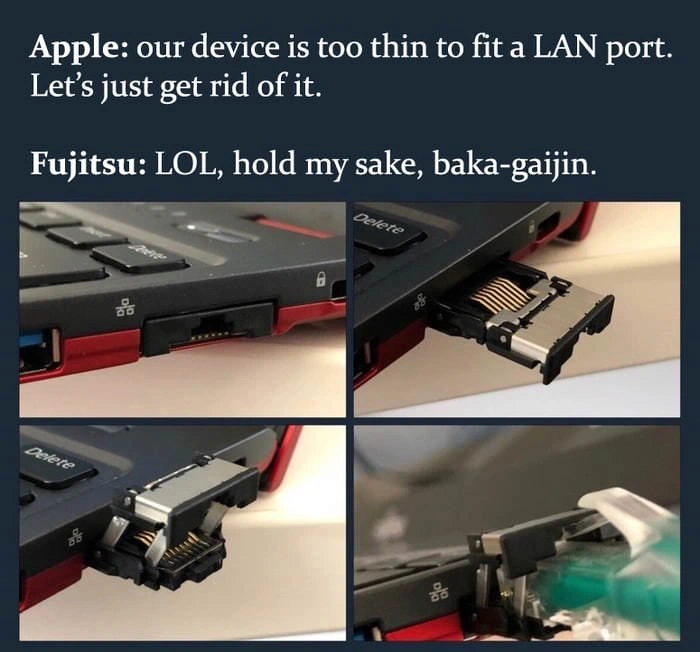
The four photos show a Fujitsu Lifebook-style collapsible RJ45 jack: closed, it sits flush in a chassis thinner than the 11.7mm minimum height the 8P8C connector standard demands; deployed, a spring-loaded hinged jaw folds downward and outward, creating the full port cavity with the gold contact pins visible on top. This is a genuinely clever piece of mechanical engineering, and the meme weaponizes it against Apple's most famous design argument:
Apple: our device is too thin to fit a LAN port. Let's just get rid of it. Fujitsu: LOL, hold my sake, baka-gaijin.
The deeper joke is about design philosophy as identity. Apple's port purges — floppy drive (iMac, 1998), optical drive (MacBook Air, 2008), Ethernet, then the headphone jack, famously defended with the word "courage" — follow a consistent logic: constraints are resolved by subtraction, and the ecosystem absorbs the cost via dongles and wireless. Fujitsu's laptop, aimed at the Japanese business market where wired LAN, VGA projectors, and physical reliability are non-negotiable procurement checkboxes, resolves the same constraint by addition: more parts, more hinges, more failure modes, but zero capability lost.
Seasoned engineers recognize this as the classic trade-off triangle nobody admits to:
| Approach | BOM cost | Failure modes | User cost |
|---|---|---|---|
| Keep full-height port | Thicker chassis | Few | Carrying a brick |
| Remove the port | Lowest | None (it's gone) | dongle_life, $29 adapters |
| Folding mechanism | Highest | Spring fatigue, hinge debris | None — until it snaps |
Neither answer is objectively wrong. Apple optimizes for margin and aesthetic minimalism at planetary scale; Fujitsu optimizes for the salaryman who must plug into the conference-room switch right now because the office Wi-Fi is, as always, a war crime. The meme lands because every developer has been the person frantically borrowing a USB-C-to-Ethernet adapter five minutes before a demo, while the one colleague with a chunky business laptop just... plugs in. Wired Ethernet still wins on latency, jitter, and not collapsing when forty laptops hit the same access point — which is why ops folks treat the LAN port the way chefs treat gas stoves.
There's also a quiet networking truth here: the RJ45/8P8C connector's dimensions were standardized decades ago for telephone-era tolerances and have outlived nearly everything around them. The connector can't shrink because billions of cables already exist — a textbook case of installed-base lock-in dictating industrial design in 2019 and beyond. Fujitsu didn't fight the standard; it origami'd around it.
Description
Dark-blue meme panel with white text reads: "Apple: our device is too thin to fit a LAN port. Let’s just get rid of it. Fujitsu: LOL, hold my sake, baka-gaijin." Below, four close-up photos of a red-and-black Fujitsu laptop show a spring-loaded, hinged RJ-45 port. Photo 1: the port is flush and closed, nearly invisible on the thin chassis. Photo 2: a small tray flips out, exposing the gold contacts and extending beyond the edge. Photo 3: the tray folds down, forming a full-sized Ethernet jack. Photo 4: a translucent Ethernet cable is partially inserted into the now-functional port. The meme contrasts Apple’s decision to drop wired networking in ultrathin hardware with Fujitsu’s mechanical workaround, highlighting hardware trade-offs, vendor design philosophy, and developer frustration with dongles

Comments
7Comment deleted
Fujitsu implemented lazy-loading at Layer 1 with a spring-loaded RJ-45; Apple just threw a DongleRequiredException and called it “courage.”
This is the same engineering philosophy that separates teams who solve problems from teams who sell dongles as a service model
Apple removed the port and called it courage; Fujitsu added a folding mechanism and called it Tuesday. One company ships constraints, the other ships hinges
While Apple's design philosophy treats physical ports like technical debt to be eliminated, Fujitsu engineers apparently attended the 'accordion school of mechanical design' - proving that sometimes the best solution to space constraints isn't minimalism, it's origami. It's the hardware equivalent of choosing composition over inheritance: why remove functionality when you can just make it collapsible? Meanwhile, Apple users are still carrying around a dongle bag that weighs more than the laptop itself
Apple axes Ethernet for thinness; Fujitsu shrinks it thinner than a legacy API layer - now that's hardware refactoring without breaking backwards compat
Apple: Ethernet is a dongle problem; Fujitsu: we shipped a hardware feature flag - RJ45 lazy‑loads from the chassis when you need strong consistency and deterministic 1 Gbps
Apple marked RJ45 as deprecated and pushed a USB‑C‑only breaking change; Fujitsu shipped an inlined compatibility shim - the drop‑jaw port - so the interface stays stable and our PXE deploys stop timing out