Rust Evangelism Strike Force Assembles
Why is this Languages meme funny?
Level 1: Safety First!
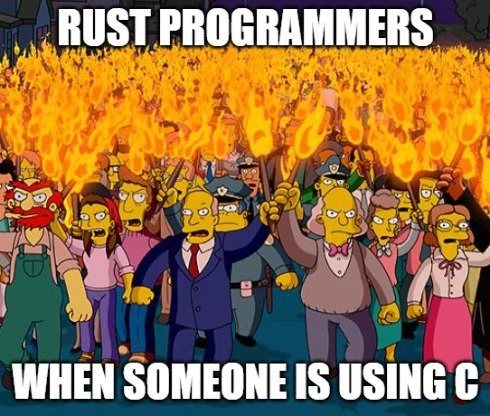
Imagine you have some really safety-conscious friends who freak out whenever someone isn’t following the “rules of safety.” Now picture one of them sees a kid riding a bike without a helmet. What do they do? They absolutely lose it! They run after the kid with a spare helmet, yelling “Stop! You’re gonna get hurt!” It’s an overreaction, but only because they care so much about avoiding accidents. This meme uses that same idea. Here, the super-concerned friends are the Rust programmers, and the kid without a helmet is someone programming in C. Rust folks think coding in C (without Rust’s safety features) is dangerous, so when they spot it, they react as if they’ve seen a serious hazard. The image from The Simpsons of an angry, torch-wielding mob is a goofy exaggeration of their reaction. It’s funny because normally, even if you strongly prefer safer habits, you wouldn’t literally form an outrage mob. But this meme jokes that Rust fans have zero chill when it comes to memory safety — they’ll bring the torches out for anyone daring to “live dangerously” with C. It’s basically saying these programmers believe “better safe than sorry!” so strongly that it becomes comedic.
Level 2: Memory Bugs 101
Let’s break down the joke in simpler terms. Rust and C are both programming languages, but they take very different approaches to managing memory safely. C (from 1972) is a powerful low-level language that lets you do almost anything with memory directly. That power is great for performance, but it also means if you make a mistake, the computer won’t stop you. You have to manually allocate and free memory (using functions like malloc and free), and if you mess up, you can get some nasty bugs. Rust (first released in 2015) is a newer systems language that was designed to automate those safety checks. Rust’s compiler effectively says “I’ll let you do low-level stuff, but you’ve got to follow some rules so you don’t shoot yourself in the foot.” Those rules are all about preventing memory errors.
What do we mean by memory errors? In C, common problems include:
- Buffer overflow: Writing past the end of an array or buffer (imagine putting 11 eggs in a 10-egg carton, the extra egg breaks something else).
- Use-after-free (dangling pointer): Using memory after you’ve freed it. It’s like you had a book, returned it to the library, and then later someone sees you still trying to read it – the pages might now contain garbage or someone else’s data.
- Double free: Freeing the same memory twice, which confuses the system (analogous to trying to return the same library book two times; the second time, the librarian is like “this book was already returned, something’s wrong”).
- Memory leak: Forgetting to free memory so the program keeps using more and more memory (like leaving a faucet running; not immediately dangerous but wasteful and can crash if memory runs out).
- Data race: Two threads (parallel tasks) accessing the same memory at the same time without coordination, leading to unpredictable results (imagine two people editing the same document simultaneously without telling each other – the final text will be nonsense).
Rust was created to prevent these mistakes by design. It introduces the concept of ownership and borrowing. In Rust, each piece of memory has one owner, and when that owner goes away, the memory is automatically freed (so no leaks and no double frees). If you try to use something after it’s freed, Rust’s compiler will stop you with an error – it won’t even compile.
For example, compare these tiny snippets of C vs Rust:
// C code (compiles fine, but it's unsafe)
#include <stdlib.h>
char *ptr = malloc(10);
free(ptr);
*ptr = 'A'; // use-after-free: C won't stop you, but this is bad news at runtime!
// Rust code (won't compile - the compiler catches the bug)
let s = String::from("hello");
drop(s);
// s.push('!'); // error: value used here after it’s freed (moved). Rust refuses to build this.
Essentially, Rust adds lots of compile-time guard rails. It’s like having a really strict but well-meaning coach: “No, you can’t do that risky move. Yes, it’s a bit inconvenient, but you’ll thank me later when you don’t get hurt.”
Now, why does the meme show an angry mob? The image is a famous scene from The Simpsons of a town mob carrying torches. In internet memes, an angry torch-bearing mob is a cartoonish way to show a group of people overreacting or banding together aggressively against something. Here, the text tells us who the mob is and what they’re angry about: the top caption says “RUST PROGRAMMERS” and the bottom says “WHEN SOMEONE IS USING C.” In other words, the joke is that Rust programmers become an angry crowd when they see a developer using C. It humorously suggests that Rust fans are so passionate about memory safety that they can’t tolerate seeing old-fashioned C code still being used. They’re depicted as grabbing torches, as if C is some kind of monster or serious wrongdoing that must be chased out.
This ties into real life in a playful way. Rust enthusiasts often evangelize their language, meaning they actively encourage others to adopt Rust, especially for systems programming tasks where C has been common. They’ll say things like, “Hey, that C program would be so much safer in Rust!” Sometimes this comes across as pushy or fanatical (hence the mob vibe in the meme). The term Rustaceans is what Rust developers call themselves (a pun on Rust + crustacean, since Rust’s mascot is a crab), and they’re proud of Rust’s approach to eliminating bugs. On the flip side, C is a tried-and-true language that’s been around forever, so some programmers stick with it out of necessity or familiarity. The meme exaggerates the Rust side of this conflict: basically, “Rust people go crazy when they encounter C lovers.” It’s funny because it’s an exaggeration of the real tech culture where folks have “language loyalty.” If you understand that Rust is built to avoid the kinds of dangerous mistakes that C allows, the picture of the mob makes comedic sense: Rust programmers are metaphorically up in arms (with flaming torches) at the sight of what they view as dangerously unmanaged C code.
Level 3: Memory Safety Vigilantes
Any seasoned developer familiar with modern systems programming has likely witnessed this exact dynamic: mention using C for a new project or library, and watch a swarm of Rustaceans emerge with 🔥 fervor. Rust programmers are known for being vocal advocates of their language’s memory safety guarantees. There's even a tongue-in-cheek notion of a “Rust Evangelism Strike Force” that shows up whenever someone posts a C code snippet online, ready to insist “Rewrite it in Rust!”. The meme captures this with the image of an outraged mob. It's not that Rust fans literally form mobs, of course, but the intensity of their pushback on C code can feel that way in technical discussions or code reviews.
This humor is rooted in a real industry trend. We’ve seen plenty of Language Wars before (Java vs C++, Python vs Ruby, etc.), but Rust vs C has a unique edge because it’s framed as safety vs. danger. Rust developers genuinely believe they’re promoting a better, safer world by moving people off C. When they see someone start a new project in C (or even continue maintaining old C code), they react almost like safety inspectors spotting a serious hazard. “You’re using manual malloc and free? That’s an accident waiting to happen!” is the kind of sentiment you’ll hear. They’ll point out every potential buffer overflow, every unchecked pointer, waving Rust’s guarantees like torches to illuminate the darkness of C’s pitfalls.
In many open-source communities and tech companies, this has become a familiar scene. A pull request comes in with some C code, and the code review comments flood in: Why not Rust? 😅 The phrase “rewrite it in Rust” has almost become a meme unto itself. It’s funny because of how predictably it arises; the moment a nasty memory bug in a C/C++ project is mentioned, someone will chirp up that a Rust implementation would have prevented it. Engineers who have experienced this repeatedly can’t help but smile at how accurately the Simpsons mob visual represents those dog-piled code reviews. The DeveloperTribalism aspect is real: Rustaceans have a tribe that rallies around the cause of memory safety, while C loyalists might roll their eyes and defend C’s use with practical arguments.
Why such zeal? Because the stakes feel high. Serious developers know that countless security vulnerabilities and crashes (think of infamous bugs like Heartbleed or countless Windows exploits) came from mistakes in C memory management. The Rust folks have a point: using Rust does eliminate those specific bugs. And with big players like Microsoft and the Linux kernel team exploring Rust, the Rust community feels validated – their once-new, unproven language is now a real contender to replace the legacy C code running the world. That excitement easily spills into evangelism. It’s almost missionary: “We can save everyone from segfaults and security holes, if only they convert their codebase.”
Of course, an experienced engineer also knows there’s a flip side: you can’t just drop a giant codebase in C and magically pick up Rust overnight. Rewriting systems in Rust costs time, requires retraining developers, and isn’t risk-free – you might introduce new bugs (logic bugs, performance issues, or integration problems) in the process. Legacy C code, for all its warts, often carries decades of tweaking and battle-testing. So there’s a bit of irony: the Rust mob’s fiery enthusiasm sometimes meets cold reality. In practice, many projects adopt Rust gradually (for new components or critical sections) rather than torching all the old C at once. But nuance isn’t the point of a meme. The meme exaggerates the one-sided perspective for comic effect, and anyone who’s seen a heated Rust vs C thread chuckles because they recognize the caricature.
The Simpsons reference is the cherry on top. That scene of an angry torch-bearing crowd is a classic symbol for “group outrage.” By labeling the mob “RUST PROGRAMMERS” and their target as “WHEN SOMEONE IS USING C,” the meme creators perfectly encapsulated the feeling of a collective rush to judgment. It’s absurd and hyperbolic — Rust fans wouldn’t literally burn C code (they might even begrudgingly admit C’s importance in history) — but it nails the emotional truth of how overzealous the advocacy can sound. In short, the meme is funny to developers because it takes a real tech culture phenomenon (Rust evangelism and C backlash) and pushes it to cartoonish extremes. Anyone who’s been caught in the crossfire of a systems language debate will appreciate the precise and fiery accuracy of this depiction.
Level 4: Exorcising Undefined Behavior
In low-level programming, a battle rages around the very laws of memory. C gives developers raw, pointer-level control over memory, but with that freedom comes the specter of undefined behavior (UB). Undefined behavior means if you make certain mistakes (like reading memory after you free it), the language makes no guarantees about what happens — your program might crash immediately, corrupt data silently, or open a security hole. C’s philosophy is essentially “here’s a loaded gun, try not to shoot your foot.” It compiles virtually anything, trusting the programmer to avoid mistakes that lead to memory misfires.
Rust, by contrast, was engineered to banish those demons of UB at compile time. Its compiler includes a sophisticated borrow checker that enforces an ownership and lifetime discipline. In simple terms, Rust’s type system acts like a built-in proof: every value has a single owner, borrows (temporary references) are checked so they don’t outlive the owner, and two pieces of code can’t mutate the same data at the same time without synchronization. This is akin to an affine type system (each piece of data is owned and used in a controlled way) and draws on decades of programming language research. The result? In safe Rust code (code not marked unsafe), entire classes of notorious C bugs are statically impossible. Buffer overflows, use-after-free errors, double frees, data races between threads – Rust’s compiler exorcises these from your code beforehand.
This level of guarantee is a paradigm shift. It’s as if Rust has a built-in verifier that says, “if it compiles, your pointers and threads won’t betray you.” That assurance was once only imaginable with heavy formal verification methods, but Rust brings a slice of that to everyday systems programming. The trade-off is that the compiler is much stricter. Rust will flat-out refuse to build code that would compile in C but has even a hint of potential memory unsafety. Seasoned C/C++ engineers recognize this as a revolution in software engineering: we’re reducing the bug surface by ruling out entire categories of errors at compile time.
So when a Rustacean sees C code, they’re not just seeing a different syntax — they see a time bomb of UB that their fancy Rust tools would have diffused. The meme’s imagery of a torch-wielding mob captures this technically-driven fervor. It’s a dramatization of Rust enthusiasts essentially saying “Burn the unsafe code!” (In fact, Rust’s keyword for opting out of these safety checks is literally unsafe, which feels almost heretical to use.) The torches burning bright orange even wink at Rust’s own signature orange color, as if the language’s spirit is literally setting the night ablaze. It’s a comically exaggerated take on a very real technical crusade: the push to eliminate the age-old plagues of memory corruption by using rigorous compile-time guarantees.
Description
This meme uses a well-known screenshot from 'The Simpsons' depicting an angry mob of Springfield residents, including characters like Mayor Quimby and Groundskeeper Willie, holding flaming torches and marching with furious expressions. The image is captioned with bold, white text in the Impact font. The top text reads, 'RUST PROGRAMMERS', and the bottom text says, 'WHEN SOMEONE IS USING C'. The humor comes from the hyperbolic portrayal of the Rust programming language community. It satirizes the stereotype of Rust developers being so passionate about their language's memory safety features that they react with aggressive evangelism, like an angry mob, whenever they see someone using the older, memory-unsafe C language. For experienced developers, this is a relatable caricature of online 'language wars' and the fervent advocacy that often surrounds newer technologies positioned as replacements for industry standards
Comments
13Comment deleted
The Rust mob is angry because they just spent an hour appeasing the borrow checker, only to see a C dev casually introduce three new CVEs with a single `strcpy`
When you enable `#![deny(unsafe_code)]` in Cargo.toml, apparently it also spawns a real-time riot controller for any C compiler spotted nearby
After 20 years of debugging segfaults and buffer overflows, you realize the Rust evangelists aren't wrong about memory safety... but you still reach for C when you need to write a kernel module because sometimes you need to live dangerously and actually ship before the heat death of the universe
The irony here is that while Rust programmers righteously brandish their borrow checker like torches against C's 'unsafe' practices, they conveniently forget that Rust's standard library, compiler toolchain, and LLVM backend are all... written in C and C++. It's the ultimate 'standing on the shoulders of giants while throwing rocks at their feet' scenario. Plus, half these 'angry mob' Rust evangelists are probably one `unsafe` block away from manually dereferencing raw pointers themselves when performance actually matters
Rust devs form a torch‑lit parade against C - then FFI into libc because the SLA outranks ideology
Rust devs with torches: because nothing quells a use-after-free like a lifetime-scoped witch hunt
The Rust mob always wins the architecture review - right up to the 2003 vendor C SDK, where we bless an FFI shim, forfeit the guarantees, and keep the 3am PagerDuty anyway
afaik rust developers have no beef with c devs, it's c++ devs who they despise Comment deleted
Oldschool C and C++ developers heading towards Rust developer riot Comment deleted
No package manager people vs Drama queen language Comment deleted
How comes that Rust developers all use torches, taking into account that this thing is very unsafe for both its user (let's call him Stack) and surroundings (Heap)? 😁 Comment deleted
because they use external haskell torches which have no side effects and that makes them allegedly safe also no one gives a shit about haskell Comment deleted
https://harelang.org/blog/2022-06-21-safety-features/ also anything C-like Comment deleted