Even Hell Shudders at Developers Who Use Single-Letter Variable Names
Why is this CodeQuality meme funny?
Level 1: The Monster Who Said "You're Too Much"
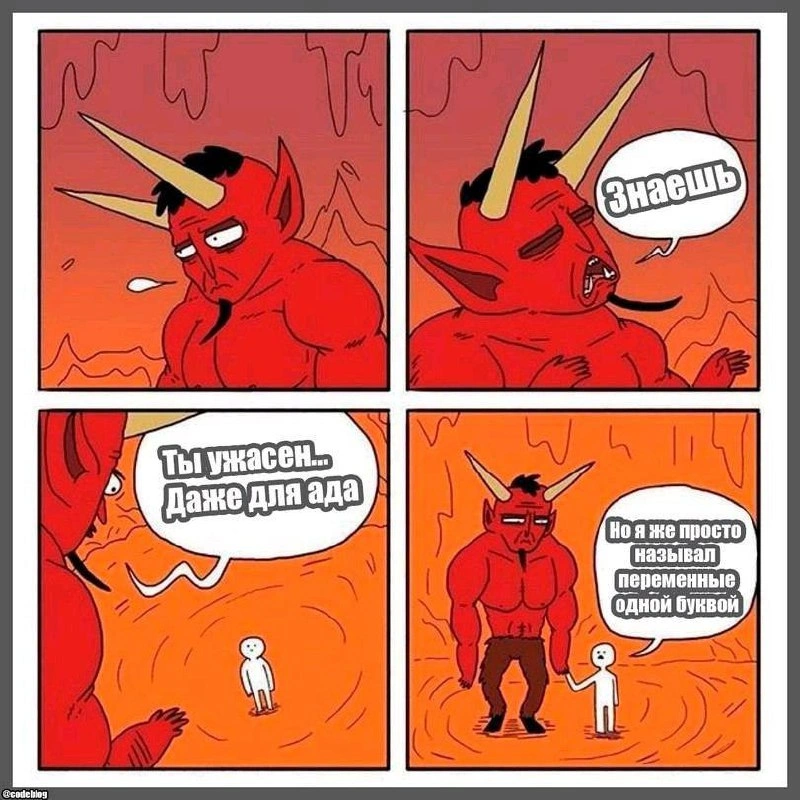
Imagine being so messy that even the messiest kid in school — the one who keeps old sandwiches in his desk — looks at your room and says "no, this is too much, you have to leave." That's the joke: the devil, whose literal job is dealing with terrible people, meets someone who wrote instructions so confusing nobody could ever follow them, and even he is offended. It's funny because the little guy thinks he did nothing wrong — like labeling every box in the house "stuff" and acting surprised when no one can find anything ever again.
Level 2: Why x Is Sometimes Fine and Usually Isn't
Naming conventions are the agreed rules for what to call things in code — variables, functions, classes. They matter because a name is the only hint the next person gets about what a value means. Compare:
# What the condemned soul wrote
def f(a, b, c):
return a * b * (1 - c)
# What hell's style guide demanded
def calculate_net_price(unit_price, quantity, discount_rate):
return unit_price * quantity * (1 - discount_rate)
Both run identically. The machine doesn't care — compilers strip names away entirely. Names exist purely for humans, which is why bad ones are categorized under code quality rather than correctness: the program works, and that's exactly what makes the sin invisible until someone has to change it.
Early in your career you discover this the painful way: you return to your own code from three months ago and find tmp2, data, and flag, and you can't reconstruct what past-you was thinking. That moment — being haunted by your own ghost — is the junior rite of passage this comic compresses into one small white soul. The accepted carve-outs are narrow: i/j for loop counters, e for a caught exception, x in a short lambda. The test is scope: a name may be as short as its lifespan. Three lines, one letter is fine. Three files? You belong in panel three.
Level 3: Banished From the Ninth Circle of Code Review
The four-panel structure here is doing surgical work. The devil — a creature whose entire job description is tolerating the worst of humanity — sighs, winds up with a weary "Знаешь" ("You know..."), and delivers the verdict to a tiny, pale soul:
Ты ужасен... Даже для ада ("You're terrible... even for hell")
And the soul's defense, as he's led away by the hand like a toddler who drew on the walls:
Но я же просто называл переменные одной буквой ("But I just named my variables with single letters")
That "просто" — just — is the whole satire. Every maintainer has heard this word deployed as exculpation. "I just hardcoded the credentials temporarily." "I just copied it from the other service." The sinner genuinely doesn't understand the charge, which is precisely what makes the crime unforgivable: single-letter naming isn't malice, it's indifference to the next reader, and codebases are murdered by indifference far more often than by malice.
The deeper truth experienced developers nod at: variable naming is the cheapest form of documentation that exists, and the one most reliably skipped. Code is read an order of magnitude more often than it's written, so d instead of daysSinceLastDeploy is a loan taken out against every future colleague — classic technical debt, except the interest is paid in 2 AM archaeology sessions with git blame revealing the author left the company in 2016. There's a reason naming made it into both of computing's favorite aphorisms: it's one of the "two hard things in computer science," and Knuth-era mathematical convention (i, j, n, x) is constantly invoked to justify it long after the code stopped being math. A loop index named i is idiom; a domain entity named a holding a customer's tax residency status is a war crime in a trench coat.
And note the comic's quiet organizational joke: hell has a quality bar. The devil performs the role of the one senior reviewer who finally blocks the merge — except in most real teams, that reviewer gets worn down, the PR is approved "to unblock the release," and the single letters metastasize. Code review exists exactly to be this devil, and the meme works because we've all watched the devil shrug and click approve.
Description
Four-panel comic set in a bright orange cartoon rendition of hell. A red, horned demon with a small goatee faces a tiny white stick-figure programmer. Panel 1: the demon looks disappointed; no text. Panel 2: close-up of the demon saying «Знаешь» (“You know”). Panel 3: the demon, looming over the programmer, says «Ты ужасен… Даже для ада» (“You are terrible… even for hell”). Panel 4: full-body view of the muscular demon holding the programmer’s hand while the programmer protests «Но я же просто называл переменные одной буквой» (“But I only named my variables with a single letter”). The joke highlights poor naming practices as a ‘sin’ so egregious that it shocks even the underworld, satirizing how unreadable, single-character identifiers create long-term maintenance and code-review nightmares for real-world engineers
Comments
7Comment deleted
Dante missed a circle: eternal grep through your own decade-old codebase where every variable is x, y, or z, and git blame keeps pointing back at 2009-you
Even Satan's infrastructure runs on a monolith he's been meaning to decompose for the last three millennia, but the migration keeps getting pushed to next quarter
Hell has standards: x, y, and tmp are fine in a loop, but naming your domain entities a, b, and c gets you escorted past the ninth circle to maintain your own code forever
Even Satan himself draws the line at single-letter variable names - because while eternal damnation is one thing, trying to debug someone's code full of 'x', 'y', and 'z' six months later is a special circle of hell that even Dante didn't anticipate. At least in the inferno, the suffering has a clear purpose; in production code with variables named 'a', 'b', and 'c', the only purpose is making your future self question every life decision that led to this moment
Mastered Raft consensus? Good - now pitch it as 'group chat where no one flakes' to the PM without invoking logs or terms
Single-letter vars are a great optimization - if your objective function is minimizing diff size, not cognitive load or on-call MTTR
Single-letter variables are Huffman encoding after you rm -rf the codebook: great compression, infinite MTTR