Skip to content
DevMeme
3399 of 7435
Debugging Dice: Roll for New Bugs
Bugs Post #3732, on Sep 22, 2021 in TG

Debugging Dice: Roll for New Bugs

Why is this Bugs meme funny?

Level 1: Whack-a-Mole Bugs

Imagine you’re playing a game at a carnival where little toy moles pop out of holes, and you have to hit them with a mallet. Now, picture that every time you whack one mole down, two more pop up elsewhere. You’d never win – as soon as you fix one problem, even more problems appear! Fixing software bugs can feel just like that. The meme is joking that when a programmer repairs one mistake in the code (knocks one “bug” down), suddenly a bunch of new mistakes show up (more bugs pop up). It’s a funny way to say that sometimes solving a problem doesn’t really solve everything – it might even make things a little more crazy. This is both silly and frustrating, kind of like trying to plug a hole in a leaking boat and immediately seeing two new leaks start spouting water. The reason it’s humorous is because it’s a bit backwards: you’d think fixing something would make the number of problems go down to zero, right? Instead, here we’re laughing at the times when fixing one thing makes other things break unexpectedly. It’s an “if I didn’t laugh, I’d cry” situation. By picturing a rubber duck trapped in a dice predicting the chaos, the meme turns that frustrating experience into a playful visual. In simple terms: programming can be a whack-a-mole game, and this joke helps people feel better about it by sharing a laugh.

Level 2: Dicey Debugging Basics

Let’s break down the meme in a more straightforward way, especially if you’re newer to programming or the references:

Rubber Duck Debugging: This is a famous informal technique used by programmers when troubleshooting code. The idea is simple: if you have a bug (an error in your code) and you’re stuck, try explaining the problem out loud as if you’re talking to a rubber duck. Why a duck? It’s just a tradition – any object works, but a little yellow rubber duck is classic programmer humor. By explaining what your code is supposed to do, line by line, you often end up finding the mistake yourself. The duck, of course, doesn’t solve anything on its own (it just listens silently 🦆). The act of articulating the problem forces you to think clearly and not skip over details. For example, a developer might put a rubber duck on their desk and literally say: “Okay, Duck, I’m going to walk you through this function. First, I fetch the data, then I filter it. Wait... I never checked if the data was null. Aha!” In discovering that oversight, they effectively debug the issue thanks to the “help” of the duck. It’s a quirky but surprisingly effective Debugging method — and a staple of DeveloperHumor to joke about. Many coders actually have a duck (or some toy) by their side for this exact reason.

Twenty-Sided Dice (d20): The clear dice you see in the image with numbers on them are twenty-sided dice, often written as “d20”. They are iconic in tabletop gaming, especially in role-playing games like Dungeons & Dragons. A d20 has the numbers 1 through 20 on its faces. When you roll it, you get a random number between 1 and 20. In games, this number might determine how successful an action is. A high roll (like 18, 19, 20) usually means a great success, and a low roll (like 1, 2, 3) can mean a failure. These dice are basically symbols of chance and unpredictability. If you’re not familiar with D&D: imagine you’re playing a game where you have to, say, pick a lock. You’d roll a d20 — a high number means you picked the lock flawlessly, a low number means your lockpick might have broken. Now, in the meme, they’ve put a tiny rubber duck inside each clear d20. That’s not something you’d see in a real game (it would definitely distract the dungeon master!), but it’s done here for the sake of the joke, combining the duck with the dice.

Bugs and Debugging: In software, a bug is a mistake or problem in the code that causes it to behave in a way it shouldn’t. It could be a typo, a logical error, or something not handled correctly. Debugging is the process of finding those bugs and fixing them. Normally, when you fix a bug, your program should have fewer problems afterward. That’s the goal! But sometimes, especially in complex programs, fixing one thing can break something else unintentionally. For example, imagine a code for a game where you fix a bug that was making an enemy character not appear. You change a few lines, and the enemy shows up now (bug fixed ✅). But suddenly, you discover later that the treasure chest in the next level doesn’t open anymore. Huh?! It turns out the code for the chest was indirectly connected to the code you changed (maybe they shared a function or a variable). By fixing the enemy bug, you accidentally caused a new bug in the chest logic. When a new bug like this appears in a feature that used to work, developers call it a regression. It means the software has “regressed” in functionality – something that was fine before has gone wrong now, due to a change. Regressions are the bane of developers’ lives: it’s like taking one step forward and two steps back.

“Fix one, add more” – The Joke: The meme caption puts this in a funny way: “Show how many bugs you will add by fixing just one.” It’s joking that every time you fix a bug, you roll the dice to see how many new bugs you introduced with that fix. Obviously, in reality, we hope to not add any new bugs when we fix something. But it does happen that a fix can have side effects. The meme exaggerates it (it implies you might add up to 20 new bugs for one fix – yikes! That would be an extreme case). The humor is a bit self-deprecating for developers: we’re laughing at our own tendency to sometimes create new problems when trying to solve a problem. It highlights a kind of pessimistic irony: “I fixed that bug, but I bet I unknowingly broke something else!” If you’ve ever played a game of whack-a-mole, it’s the same vibe. You hit one mole down, another pops up. Similarly, you solve one issue, and suddenly another issue pops up elsewhere. It can feel absurd, which is why we either have to laugh or cry — and memes prefer laughter!

Why the Duck inside a Die? This is the visual pun that brings it all together. By encasing a rubber duck inside a d20 die, the meme combines the concept of methodical debugging (the duck, representing careful analysis) with random chance (the die, representing unpredictable outcomes). It’s saying that even if you carefully use rubber duck debugging to work through a problem logically, once you make that code change, you’re at the mercy of how the rest of the system reacts — and that can be unpredictable. For new developers, this is a lighthearted way to learn a hard truth: software systems can be very interconnected. A change in one place might affect another place you didn’t anticipate. It’s a nudge to be cautious: write tests, think about what else could be impacted, and be ready to do more debugging when a fix doesn’t entirely go to plan. And if things do go sideways, well, you’re not alone — every programmer has been there, and we cope by joking about “debugging dice” and pet rubber ducks. It turns frustration into something a bit more fun.

In summary, this meme is a piece of classic developer humor. It uses the rubber duck (a symbol of careful debugging) and the 20-sided dice (a symbol of randomness) to poke fun at the experience of fixing software bugs. The caption basically says: “Roll these debugging dice to find out how many new bugs your fix will create.” It’s funny because it’s an exaggeration grounded in reality: sometimes our fixes do cause new issues. If you’re new to coding, don’t worry – this happens to everyone and it’s part of the learning process. The meme just shows that programmers like to laugh about it (probably to keep from crying when it happens)! After all, when debugging gets tough, a little humor (and maybe a rubber duck on your desk) can keep you sane.

Level 3: Roll for Regression

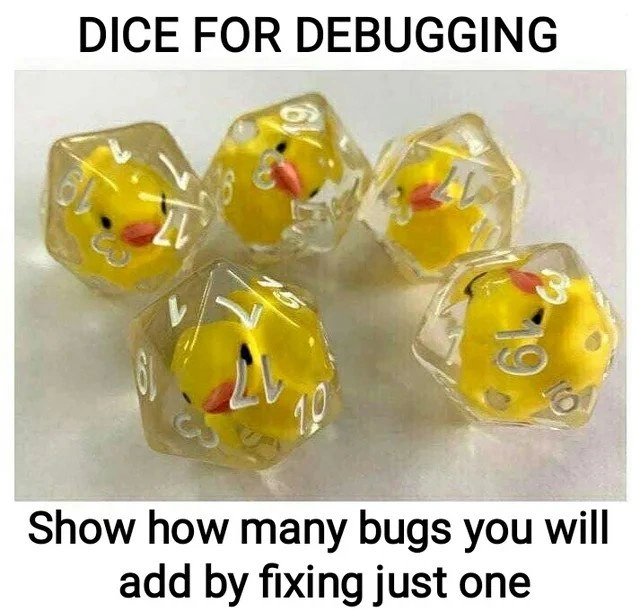
At first glance, this meme’s humor comes from combining two things a lot of developers are very familiar with: rubber duck debugging and the unpredictable outcomes of bug fixes. The image shows five clear resin d20 dice (the twenty-sided dice beloved in tabletop gaming) each with a tiny yellow rubber duck embedded in the center. The bold caption on top shouts “DICE FOR DEBUGGING,” and the text underneath says, “Show how many bugs you will add by fixing just one.” It’s a comical mashup of a programming inside-joke with a nerdy gaming reference. Essentially, it’s saying: Even when you’re debugging carefully (talking to your rubber duck), fixing a bug in code is so uncertain you might as well roll a 20-sided die to predict how many new bugs you’ll create in the process.

For a seasoned engineer, this lands as painfully funny because it’s a scenario we know too well. The phrase “fix one bug, add three” is practically an age-old adage in development teams. We’ve all had that bug (maybe a minor one) that we set out to fix, thinking it’s a straightforward change – only to find later that our “fix” caused something else to break. That “something else” could be a feature in a different module that we didn’t realize was connected, or a subtle side-effect that didn’t show up immediately. In developer lingo, that new breakage is called a regression: a bug that emerges in a previously working area due to a recent change. The meme basically illustrates a regression lotto: roll the dice to see how bad of a regression you created while trying to do the right thing! 🎲

Why dice? Dice introduce the idea of chance, and debugging outcomes often feel like chance. No matter how much experience you have, there’s always a bit of suspense: Is this fix actually going to work without any collateral damage? When deploying a bug fix, veteran developers sometimes half-joke, “Let’s roll the dice and push this to production,” acknowledging that there’s always risk. The Dungeons & Dragons reference is the cherry on top. In D&D, when you attempt something risky, you roll a d20 to see if you succeed (high rolls are good) or fail (low rolls are bad). Rolling a 1 is a critical failure – your action backfires horribly. Rolling a 20 is a critical success – you achieve something exceptional. The meme parallels this to debugging: except here, a high number on the die is bad (it means you unintentionally created a lot of new bugs). In other words, a “critical fail” in coding would be fixing one bug but injecting, say, 10 new ones 🤦‍♂️. The rubber duck inside the die adds an extra layer of nerd humor since rubber ducks are normally a programmer’s tool for reasoning and preventing mistakes. It’s as if even the duck is now a captive audience to the whims of fate – the poor duck can only watch as you roll and pray.

We laugh at this because it’s a release valve for the frustration. Imagine spending hours in Debugging Hell trying to fix a particularly tricky issue. You finally squash that bug at 2 AM, only to wake up to an angry message: your fix broke something else critical. It’s the software equivalent of cutting off one head of the Hydra and two more heads pop up. 🐍 (In Greek mythology, the Hydra grew two heads for each one cut off – a perfect metaphor for bug fixing gone wrong.) Seasoned devs have a bunch of war stories like this. For instance, you patch a memory leak in one component, but now another component mysteriously crashes because it was expecting that leak (believe it or not, stuff like this happens!). Or you adjust a timing issue in a multi-threaded system, and suddenly you’ve unlocked a race condition in another thread that never surfaced before. One fix unmasked another lurking bug. Troubleshooting software often feels like a game of whack-a-mole, and the meme acknowledges that with a knowing grin.

Let’s talk about rubber duck debugging for a moment: it’s a technique where you explain your code line-by-line to a rubber duck (or any inanimate object) as if it were a fellow programmer. The act of articulating the logic often helps you catch mistakes. It’s a beloved, almost silly, but effective debugging method. Now, in this image, the rubber duck is literally inside a die. The symbolism here is gold: instead of the duck helping you debug, it’s now just observing the randomness. It’s like saying, “Even with careful rubber-ducking, after you roll out your fix, fate might decide the outcome.” For a senior developer, there’s irony here: we use tools and methods to minimize mistakes (duck debugging, unit tests, code reviews), but ultimately, there’s still a non-zero chance our fix will have unintended effects. The duck in the die might also imply that sometimes we rely on luck as much as logic.

A seasoned dev will also recognize the “fixing just one” part of the caption as a tongue-in-cheek jab. There’s almost never “just one bug fix” in a complex system. Any fix can be the start of a chain reaction. We’ve internalized this so much that many teams practice regression testing religiously: when you fix something, you re-run the whole suite of tests to see what else might have broken. If you don’t have thorough tests, you might deploy a fix and then discover the new bugs in production (every developer’s nightmare scenario 😱). That’s why robust projects invest in automated test suites, staging environments, and beta releases – essentially to simulate a dice roll many times and catch issues early. But even with a battery of tests, reality has a way of surprising you. There’s that dark joke: “Our code has 0 bugs – we just haven’t found the remaining ones yet.”

The meme resonates especially with legacy systems or large interconnected codebases. In a small, clean codebase, fixing one thing usually doesn’t break something unrelated. But as software grows, weird dependencies and side-effects creep in. Perhaps function A() in one module was also indirectly used by function B() in another module. You modify A() to handle a special case for a bug fix, but now B() gets different behavior and starts malfunctioning. Oops – that’s a regression. This is common in legacy code that has been patched and extended over years by different people. A senior dev reading this meme might shudder remembering that one time they touched a 20-year-old piece of code (“just a small change, what could go wrong?”) and subsequently spent the next week firefighting five new bug reports. The rubber duck D20 would have been a perfect predictor for that fiasco!

There’s also an implicit commentary on how debugging can sometimes feel like a game of chance despite our best efforts. In a role-playing game, you prepare your strategy but ultimately a dice roll might decide your fate. Similarly, you do everything right when fixing a bug – you think through the logic, you test the immediate fix – yet when the code meets the real world (real users, real data, complex usage patterns), unexpected things can happen. That library update you relied on introduces a subtle change, or the environment differs slightly, and bam – new bug. It’s almost like the universe rolls a die to decide if today’s deploy goes smoothly or not. This meme takes that notion and makes it literal (and literal rubber ducks are always funny).

For those deeply steeped in developer culture, there’s another layer of entertainment: cross-nerd references. Many programmers are also into fantasy, sci-fi, and gaming. Spotting a D20 dice in a programming meme immediately screams a Dungeons & Dragons reference. It’s a bit of a wink to the audience: “Yes, we’re talking about code, but we also know our audience might enjoy a D&D joke.” The rubber duck is a classic programmer symbol, and the D20 is a classic gamer symbol. Together, they make a perfect storm of DeveloperHumor. It’s the kind of joke that if you showed someone who isn’t into programming, they’d probably scratch their head – “Why is there a duck inside a dice? I don’t get it.” But show it to a programmer who’s spent a few late nights debugging, and you’ll likely get a knowing laugh (or at least a wry smirk). It humorously validates a shared experience: Debugging often doesn’t go as planned, and sometimes it truly feels like the number of bugs is out of our hands.

In summary, “Dice for Debugging” with a rubber duck d20 encapsulates that bittersweet reality of software development: fixes don’t always fix just one thing. It’s funny because it’s true – every engineer has rolled their own imaginary debugging dice at some point. After all, when you push a bug fix and suddenly your bug tracker lights up with new issues, sometimes the only sane reaction is to chuckle, grab your rubber duck, and say, “Alright buddy, let’s figure out what I broke this time.”

// Pseudo-code representation of the meme's scenario:
fixBug(currentBug);              // You fix one bug...
int newBugs = rollDice(20);      // ...roll a 20-sided die to see how many new bugs appear
totalBugs = totalBugs - 1 + newBugs;  // Net bugs = one removed, plus whatever the dice says you added

(In the above tongue-in-cheek code, rollDice(20) returns a random number between 1 and 20. We subtract 1 from total bugs for the bug we fixed, then add the new bugs. The joke is that newBugs could be as high as 20 — meaning a truly unlucky fix made things twenty times worse!)

Level 4: Conservation of Bugs

At a deep theoretical level, this meme hints at what one could jokingly call a “Conservation of Bugs” principle in software engineering. It feels like a fundamental law: you cannot destroy a bug without accidentally creating one (or more) new bugs elsewhere. In more formal terms, each code change increases the overall entropy of a complex software system unless significant effort is made to maintain or reduce complexity. This is analogous to the Second Law of Thermodynamics: the entropy (disorder) of a closed system tends to increase. Here, the “disorder” is software complexity and unintended side-effects. Every time we touch the code, we risk adding a bit of chaos. Unless we actively refactor and simplify, bugs (as manifestations of chaos) will multiply over time. Some veteran engineers half-joke that in any non-trivial codebase, bugs aren’t fixed – they just move around.

From a computer science perspective, predicting the exact outcome of a bug fix in a large program is undecidable in the general case. This relates to the theory of computation – it’s a cousin of the Halting Problem. Alan Turing proved you can’t have a perfect algorithm that examines an arbitrary program and a change, and then infallibly tells you, “This change will introduce no new problems.” We can’t foresee every ripple a code modification will cause because the interactions in software can be as complex as mathematical chaos. A tiny fix can have non-linear effects, much like a butterfly flapping its wings on one side of the world causing a storm on the other. In software terms, changing one part of a program might unexpectedly affect a seemingly unrelated part due to hidden couplings or shared state – a true butterfly effect in code.

This is why formal verification and rigorous proofs of correctness exist: in safety-critical software (like avionics or medical devices), engineers sometimes use mathematical proofs to guarantee that a change doesn’t violate any important properties. They leverage type theory, model checking, and theorem provers to ensure no new bugs sneak in. But let’s be real – most of us aren’t working with formally verified code on a day-to-day basis (you’re probably not proving the correctness of your JavaScript web app with TLA+ or Coq). For the vast majority of software, we rely on imperfect methods: code reviews, testing, static analysis, and good architecture. These methods greatly reduce the chance of introducing bugs, but they can’t eliminate it entirely. Modern static analyzers and linters can catch a lot of mistakes, and strong typing or runtime assertions can enforce certain invariants. Yet, even with those safety nets, complex bugs still slip through. Why? Because any non-trivial program has practically infinite pathways and states; testing or analyzing all of them is computationally infeasible. If we imagine all possible interactions in a program as a huge space, a change might open a path through that space that was never explored before – revealing a bug that was “latent” until that fix enabled it. In short, the problem of exhaustively understanding a program’s behavior, especially after a change, is NP-hard at best (and often worse). No wonder debugging can feel like a roll of the dice – mathematically, it kind of is.

There’s also a historical, empirical insight here: Lehman’s Laws of Software Evolution. One of these laws observes that as software is continuously changed (to fix bugs or add features), its complexity tends to increase unless proactive measures are taken. Over decades of large projects, people noticed that every patch or improvement can introduce a bit of structural complication. Without periodic refactoring and cleanup, the codebase’s complexity – and by extension, its bug count – will trend upward. It’s like an ever-expanding Jenga tower; each move (change) makes the whole structure a little more wobbly. This law complements the “conservation of bugs” joke: in a poorly managed codebase, you might remove one bug only to plant the seed of two more because the overall complexity went up a notch.

In a more abstract sense, the meme’s dice symbolize probability and uncertainty in debugging. We can view debugging outcomes in probabilistic terms. For each fix, there’s a distribution of possible side-effects based on how entangled that piece of code is. If the code is simple and isolated, the probability of a negative side-effect is low. But if the code is part of a big, tangled system (imagine lots of global state or tightly-coupled modules), the probability of causing unintended consequences climbs dramatically. It’s almost like each bug fix has a probability P of spawning N new bugs, where N could range from 0 to some upper bound depending on the complexity – hence a twenty-sided die in the meme playfully caps N at 20 for comedic effect. Seasoned developers know this tongue-in-cheek “roll of the die” feeling all too well. We often mitigate it through best practices (like writing comprehensive tests) so that we catch issues early, before users ever see them in production the wild. But the fundamental truth remains: we can never be 100% certain a fix is without side effects, unless we’ve perused and proven the entire program’s correctness which is usually impractical.

So at this highest level, the meme reflects a kind of cosmic irony of programming: code is a complex system, and complex systems inherently resist our attempts to control them completely. Even as we try to debug (bring order), there’s an opposing force introducing new disorder – as if debugging obeys an uncertainty principle of its own. It’s a humorous acknowledgment of the reality that in software, troubleshooting one issue may fundamentally alter the system’s state in unpredictable ways. The Rubber Duck d20 encapsulates that duality: the duck represents rational Debugging logic, the die represents chaotic chance. No matter how logically you approach a bug, once you make that change and roll it out, the outcome might be subject to unpredictable variables beyond your immediate insight. In the battle between our desire for a perfectly bug-free system and the explosive complexity of real-world code, entropy often wins – and all we can do is test, monitor, and yes, sometimes pray to the Debugging Gods (or roll a lucky number).

Description

A photograph displays five transparent, 20-sided dice, commonly known as d20s. Inside each die, a small, cute yellow rubber duck is embedded. The image is captioned with bold, black text at the top, reading, 'DICE FOR DEBUGGING,' and at the bottom, 'Show how many bugs you will add by fixing just one.' This meme humorously merges the concept of 'rubber duck debugging' - a method where developers explain their code line-by-line to an inanimate object to find solutions - with the chaotic, unpredictable nature of software development. The use of a d20, a staple in tabletop role-playing games like Dungeons & Dragons, implies that fixing a single bug has a high chance of creating a large, random number of new problems, a frustratingly common experience for seasoned engineers working in complex systems

Comments

17
Anonymous ★ Top Pick In our legacy system, we don't use D20s; we use a D100. We call it the 'sprint commitment die'
  1. Anonymous ★ Top Pick

    In our legacy system, we don't use D20s; we use a D100. We call it the 'sprint commitment die'

  2. Anonymous

    When the PM requests a confidence interval for the hotfix, I roll the rubber-duck d20 three times - instant Monte Carlo regression forecast

  3. Anonymous

    Finally, a way to quantify the exact multiplier for the hydra effect in production - though experienced architects know the real number is always n+1 where n is whatever the dice show, plus an additional critical bug that only appears during the CEO's demo

  4. Anonymous

    The dice perfectly capture the Monte Carlo method of debugging: you never quite know the outcome, but you're statistically guaranteed that fixing one edge case will spawn N+1 new ones across different modules. Senior engineers know the real skill isn't preventing this - it's accurately estimating which number the dice will land on during sprint planning

  5. Anonymous

    Architecture review replaced by a rubber-duck d20 - the roll equals the regression fan-out; a natural 20 toggles a forgotten feature flag and pages SRE

  6. Anonymous

    Rubber-duck d20: roll to size the blast radius of a “one-line fix.” 1 = green build; 20 = transitive dependency bump, three Jira epics, a feature flag, and an outage someone insists is unrelated

  7. Anonymous

    The second law of debugging: every fix increases codebase bug entropy, now with authentic D&D randomness

  8. @DerBico 4y

    I experienced a similar one: how many new features could be implemented after the first one

  9. @okutaner 4y

    You need to roll em all

  10. @nuntikov 4y

    Each side is a power of ten

    1. Deleted Account 4y

      2

  11. @nuntikov 4y

    Nice

  12. @ZgGPuo8dZef58K6hxxGVj3Z2 4y

    Well now look at this in a paradox way... you cant roll 0

  13. @azizhakberdiev 4y

    Ah shit

    1. @sylfn 4y

      you have used d6, not d20

      1. @azizhakberdiev 4y

        Has anybody?

  14. Deleted Account 4y

    never experienced something like this, really. always broke things just adding new features to my legacy-code project, but they are fixed too after some time

Use J and K for navigation