Skip to content
DevMeme
7264 of 7435
Robot Eats 10 Baby Giraffes a Day, Still Answers Questions Wrong
AI ML Post #7964, on May 3, 2026 in TG

Robot Eats 10 Baby Giraffes a Day, Still Answers Questions Wrong

Why is this AI ML meme funny?

Level 1: The Magic Box That's Wrong

Imagine a friend proudly shows you a magic answer box. It's amazing! It talks! There's just one catch — you have to feed it ten baby giraffes every single day. You're horrified, but you ask the only question that matters: "Okay... but at least it gets the answers right?" And your friend gasps, genuinely scandalized, and says "Oh my goodness, NO. No no no no no." The joke is that the box costs something enormous and precious, and in return gives you... confident nonsense. It's funny because we all kind of own that box now, and we keep feeding it anyway.

Level 2: What's Actually Being Fed to the Robot

For those newer to the field, the comic maps onto real concepts almost one-to-one:

  • The robot is an LLM (large language model) — a system trained on huge text corpora to predict the next token. It produces statistically plausible text, which often looks like an answer.
  • The baby giraffes are the inference and training costs: electricity for GPU clusters, water for datacenter cooling, and the hardware itself. Training a frontier model consumes energy on the scale of thousands of households; every query afterward keeps the meter running.
  • "Answers questions... incorrectly" is what practitioners call hallucination — the model confidently generates false statements because it has no internal notion of truth, only of likelihood. Your first encounter with this is usually an LLM inventing a library function that doesn't exist, complete with convincing documentation.

The early-career lesson hiding in the punchline: when evaluating a tool, ask the Panel 3 question first. "But does it do the thing correctly?" is the cheapest test you'll ever run, and it's astonishing how often the honest answer is the inventor's.

Level 3: The Inference Bill Comes Due

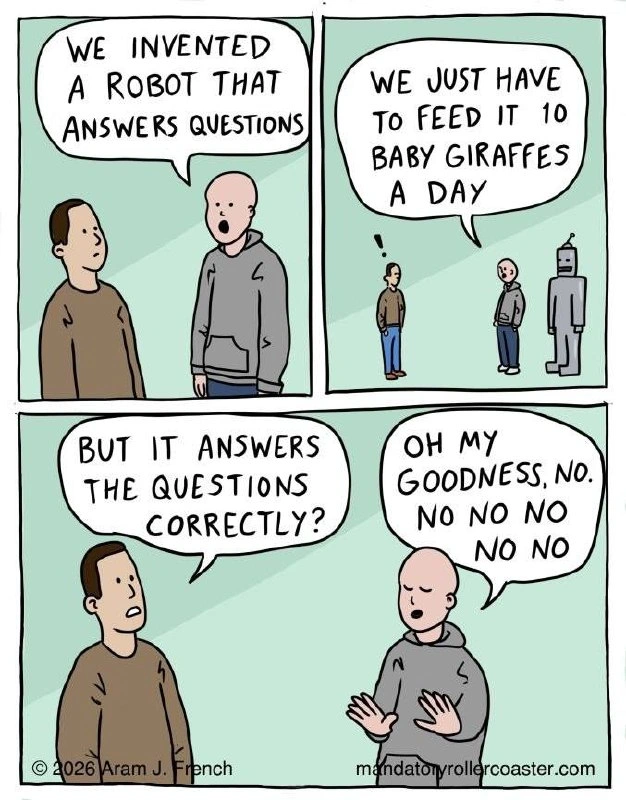
The genius of this four-panel comic is the order of operations. The inventor leads with capability — "WE INVENTED A ROBOT THAT ANSWERS QUESTIONS" — then discloses the cost ("WE JUST HAVE TO FEED IT 10 BABY GIRAFFES A DAY"), and only when directly cross-examined admits the product doesn't actually work: "OH MY GOODNESS, NO. NO NO NO NO NO." That's not a random gag structure. It's the AI hype cycle pitch deck, panel by panel: demo first, opex buried in the appendix, accuracy a question nobody on stage wants asked.

The baby giraffes are doing heavy satirical lifting as a stand-in for the very real and very opaque resource consumption of large language models: megawatt-scale datacenter draw, evaporative cooling water budgets, and GPU fleets whose embodied carbon nobody amortizes in the keynote. The choice of baby giraffes specifically — adorable, conspicuous, obviously monstrous to consume — is the point. Real LLM externalities are abstract (kilowatt-hours, acre-feet of water, H100-years), so they're easy to wave away. Nobody can wave away a giraffe. The comic re-renders an invisible cost as a visceral one, which is exactly what every sustainability report about AI infrastructure fails to do.

Then there's the second blade: hallucination. The industry has spent years building systems that are fluent rather than correct, because fluency is what the training objective optimizes and correctness is what the marketing department asserts. The inventor's emphatic, almost offended denial — five "NO"s, hands clutched to chest — captures something painfully familiar: the practitioner who knows perfectly well the model confabulates, has known since the first eval run, and finds the question almost naive. Of course it doesn't answer correctly. Correctness was never the deliverable. Plausibility was. The cost-versus-accuracy trade-off here isn't a trade-off at all; it's all cost, with accuracy as an aspirational roadmap item, somewhere after the Series C.

What makes it land for anyone who's sat through a procurement meeting: the listener's startled "!" comes at the price, not the product. We've collectively normalized buying the robot first and asking about answer quality later — usually after it's already wired into customer support.

Description

A four-panel webcomic (copyright 2026 Aram J. French, mandatoryrollercoaster.com) with simply drawn figures on a mint-green background. Panel 1: an excited bald man in a hoodie tells another man, 'WE INVENTED A ROBOT THAT ANSWERS QUESTIONS'. Panel 2: standing beside a grey retro robot, he adds 'WE JUST HAVE TO FEED IT 10 BABY GIRAFFES A DAY' while the listener reacts with a startled '!'. Panel 3: the listener asks, 'BUT IT ANSWERS THE QUESTIONS CORRECTLY?'. Panel 4: the inventor, hands on chest, replies 'OH MY GOODNESS, NO. NO NO NO NO NO'. A sharp satire of large language models: grotesque resource consumption (energy, water, GPUs - here, baby giraffes) in exchange for confidently incorrect answers, skewering the cost-versus-accuracy trade-off of the AI hype cycle


Comments

3
Anonymous ★ Top Pick Ten baby giraffes a day is still cheaper than our inference bill, and at least the giraffe count is observable
  1. Anonymous ★ Top Pick

    Ten baby giraffes a day is still cheaper than our inference bill, and at least the giraffe count is observable

  2. @Ihor3056 2mo

    AI in nutshell

  3. @blue_bonsai 2mo

    Start the feeding chain.

Use J and K for navigation