Richard Dawkins Presents: The Claude Delusion, Afterword by Daniel Dennett
Why is this AI ML meme funny?
Level 1: The Imaginary Friend Who Does Your Homework
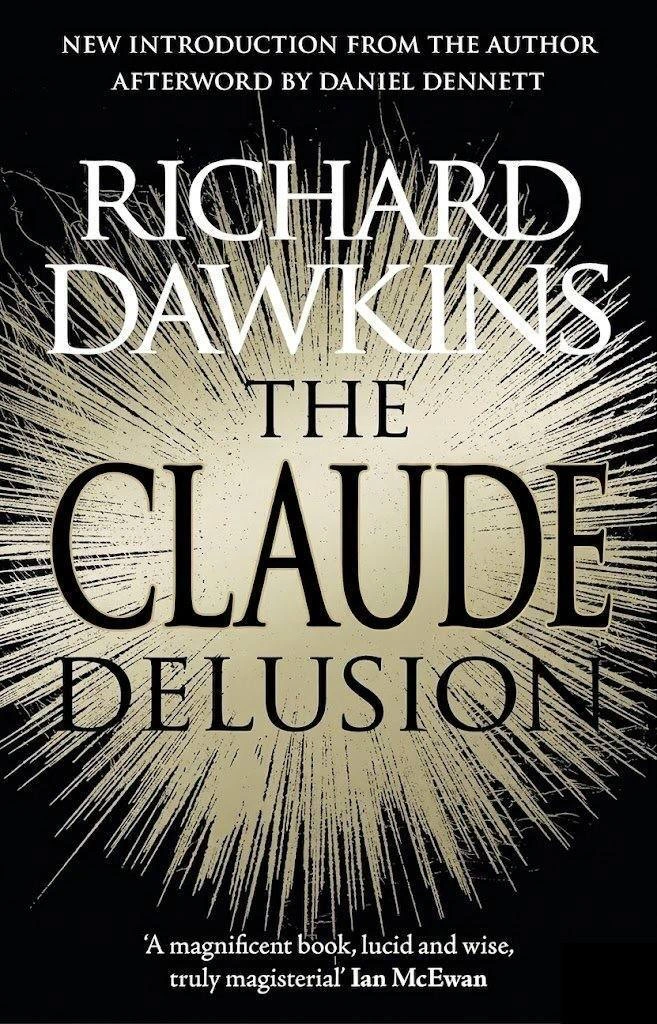
Imagine a famous book that asks, "Are people sure about the invisible friend they trust with all their big questions?" Now imagine someone redrew that exact book cover, but the invisible friend is the talking computer helper that programmers ask for answers all day long. The joke is gentle but pointed: lots of grown-ups now ask the computer friend everything, believe whatever it says, and even get a little defensive if you question it — which looks suspiciously like the thing the original book was warning about. Same shiny cover, same dramatic explosion of light, one new name to worship.
Level 2: The Cast of Characters
If some of the names on this cover are unfamiliar, here's the map:
- Claude — Anthropic's family of large language models, widely used as a coding assistant. Like all LLMs, it generates plausible text by predicting tokens; it can be brilliantly helpful and confidently wrong in the same paragraph.
- The God Delusion — Richard Dawkins' 2006 bestseller arguing that religious belief persists without evidence. The parody borrows its authority to ask whether AI belief works the same way.
- Daniel Dennett — philosopher of mind, famous for asking what consciousness actually is and for the "intentional stance": treating a thing as if it has a mind because that predicts its behavior well. Sound familiar? It's why you say your AI assistant "thinks" or "wants."
- Anthropomorphizing — attributing human traits to non-humans. Early-career engineers do this within a week of using an LLM ("it got confused," "it's lying to me") — partly because it's genuinely the most efficient vocabulary available.
The practical takeaway hiding in the joke: treat LLM output like a Stack Overflow answer from a confident stranger — often useful, never gospel, always verify with a test before you commit.
Level 3: Faith-Based Engineering
The craft here is in the fidelity. This isn't a lazy template meme — it's a pixel-faithful recreation of the actual paperback cover of The God Delusion: the black field, the silver starburst exploding behind the type, RICHARD DAWKINS in stately white serif, the red banner promising "NEW INTRODUCTION FROM THE AUTHOR, AFTERWORD BY DANIEL DENNETT," and even the genuine Ian McEwan blurb at the bottom — "A magnificent book, lucid and wise, truly magisterial." Exactly one word has been changed:
THE CLAUDE DELUSION
That single substitution does an enormous amount of work, because it cuts in at least three directions simultaneously.
First cut: developer culture's drift from skepticism to faith. The empirical loop — write code, run it, observe — is quietly being replaced by a testimonial one: Claude said it's fine. When an engineer pastes an LLM's confident explanation into a code review as if citing scripture, they've stopped doing science and started doing exegesis. Dawkins' book argued against accepting claims without evidence; the parody suggests an entire profession now does daily devotionals with an autocomplete engine, complete with monthly tithes to Anthropic.
Second cut: the consciousness debate itself. The afterword credit is the deepest joke on the cover, because Daniel Dennett — who really did write the afterword for editions of the original — spent his career on the intentional stance: our irresistible habit of attributing beliefs, desires, and minds to systems whose behavior is easier to predict that way. Anthropomorphizing an LLM is the intentional stance running at full throttle. Whether "belief in Claude's mind" is a useful predictive shortcut or a category error is a live academic fight, and the cover smuggles the entire syllabus into a fake byline.
Third cut, the recursive one: which delusion is being named? That Claude is intelligent? That it isn't? Or that the people warning about AI religion are themselves founding one? The parody works precisely because every faction in the AI discourse — boosters, doomers, and deflationists — can read the title as aimed at the other camp. That ambiguity is what separates a good shitpost from satire.
Description
A parody book cover mimicking Richard Dawkins' 'The God Delusion'. On a black background with a dramatic silver starburst/explosion graphic, the cover reads: 'NEW INTRODUCTION FROM THE AUTHOR, AFTERWORD BY DANIEL DENNETT' in red at top, then 'RICHARD DAWKINS' in large white serif type, and the title 'THE CLAUDE DELUSION' in massive black-embossed and white letters. At the bottom, a blurb: ''A magnificent book, lucid and wise, truly magisterial' - Ian McEwan'. The joke swaps 'God' for 'Claude', satirizing the quasi-religious faith developers place in Anthropic's AI assistant - treating its outputs as gospel, anthropomorphizing it, and the broader debate about whether belief in LLM intelligence (or consciousness) is itself a delusion. Dennett's afterword nods to his actual work on consciousness and intentional-stance attribution
Comments
6Comment deleted
Devs replaced 'it works on my machine' with 'Claude said it's fine' - same epistemology, higher monthly tithe
Chat, is this real? Comment deleted
Written entirely by Claude? Comment deleted
a bit of context: https://garymarcus.substack.com/p/richard-dawkins-and-the-claude-delusion Comment deleted
ty for the context Comment deleted
*religion Comment deleted