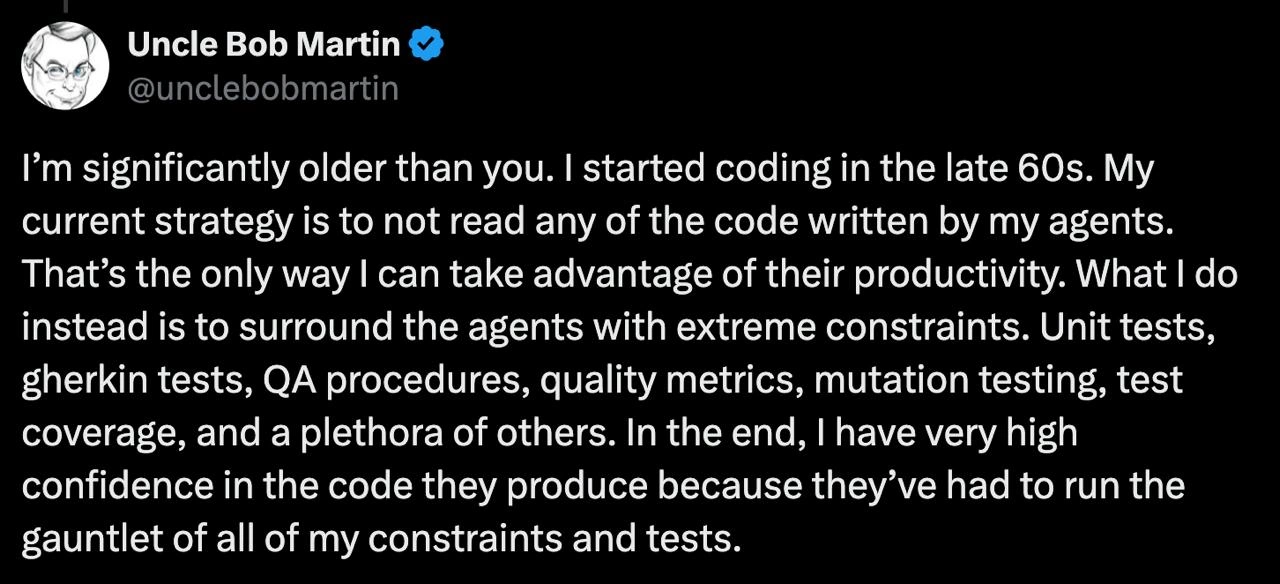
Forgetting Your Own Code After Two Months
Why is this CodeQuality meme funny?
Level 1: When You Confuse Yourself
Imagine you wrote a secret message to yourself, using a special code language that you just made up on the spot. At the time you write it, you know exactly what every symbol and squiggle means, and you’re confident you’ll remember it forever. Now, fast forward two months. You find that secret message again, and… you have absolutely no idea what it says. You’re staring at your own writing, completely puzzled, thinking, “What did I even mean here?!”
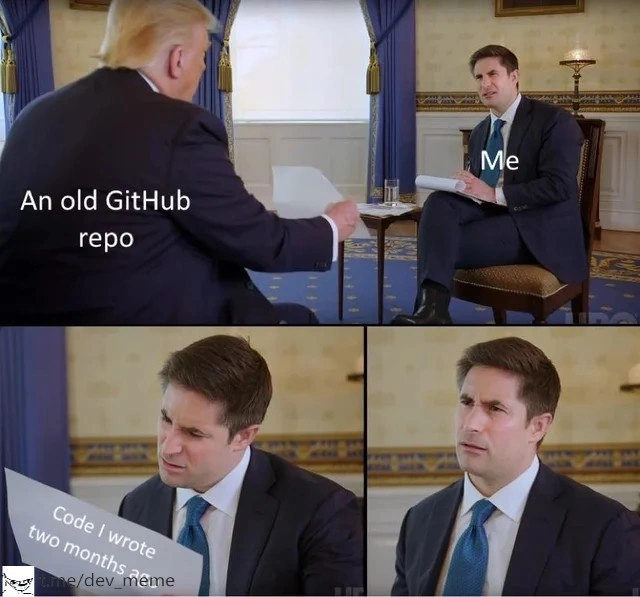
That’s exactly what’s happening in this meme, but with computer code. It’s like a kid building a complicated LEGO castle without instructions, assuming they’ll remember how every piece fits. Later on, even the same kid looks at the castle and is confused about how it was built. In the picture, the man holding the paper is the developer reading his own code from two months ago, and the shocked look on his face is like saying, “Did I do this? This is so hard to understand!” It’s funny because you’d think you would understand something you made yourself, but sometimes things get so messy or complicated that even you can’t figure them out later. It’s a silly reminder: whether it’s a secret message, a LEGO creation, or a computer program, if you don’t make it clear and leave yourself some hints, you might end up scratching your head at your own work, just like this guy in the meme.
Level 2: Who Wrote This?
At this level, let’s break down the scenario more simply. The meme shows a familiar interview scene (yes, that’s former US President Donald Trump on the left, and interviewer Jonathan Swan on the right) repurposed into a coding joke. The labels turn it into a story about code readability and maintainability. The interviewer, labeled “Me”, represents a developer (specifically the person reading code). The interviewee, labeled “An old GitHub repo”, represents some old open-source code repository you might find on GitHub. In the first frame, “Me” (the developer) is confidently engaging with the old repo, implying “I can handle this old code.” But then in the next part, the interviewer (the developer) looks down at a sheet of paper labeled “Code I wrote two months ago.” His expression changes to confusion and overwhelm. In the final frame, he’s staring ahead blankly, totally lost. The contrast is the joke: code I wrote just 2 months ago is causing me more bafflement than an ancient codebase written by someone else years ago.
Why would your own recent code be harder to understand than somebody else’s old code? This gets into basic ideas of code quality and technical debt. Let’s define a couple of terms:
Code Readability: How easy is it to read and understand a piece of code? Code with good readability has clear naming (for variables, functions, etc.), a clean structure, and often some comments or documentation. If code is readable, a developer (including you, the original author) can quickly grasp what it’s doing.
Maintainability: This is closely related to readability. Maintainable code is written in a way that it’s easy to fix bugs in or add new features to. It’s organized, well-documented, and not overly complex. If something is maintainable, future developers (or future you!) can modify it without feeling like they’re defusing a bomb.
Technical Debt: This is a metaphor – think of it like taking a shortcut in your code “on credit.” You get something working quickly (that’s the benefit, like taking a loan), but you haven’t done it in the cleanest or best way. Later, you “pay back” that debt with interest – meaning it will cost you extra time and effort to fix or understand the code. For example, skipping writing documentation or tests saves time now but creates technical debt because later on, someone (maybe you) will struggle and spend more time dealing with the consequences. In our meme, the code written two months ago probably has some technical debt: maybe rushed design, no comments, or tricky logic that wasn’t cleaned up.
Legacy Code: This usually means old code that’s still in use but no one really wants to touch because it’s complex or outdated. It could be written in an old language or just be very confusing. Here, it’s funny because we’re calling “code from 2 months ago” legacy code. Normally two months is not old at all, but if the code is poorly written or if you’ve forgotten everything about it, it feels like legacy code from ages past.
So what’s happening is self-code amnesia – the developer has kind of forgotten the details of their own code after a short time. This is more common than you might think, especially if that code wasn’t written clearly. When you look at someone else’s open-source project (the “old GitHub repo”), you often find that the project has a structure: there might be a nice README file explaining how things work, maybe the code has been cleaned up by multiple contributors, and there’s a certain pride in making it understandable for others. You, as a reader, also approach it carefully: you read the documentation, you try to follow the code step by step. In short, you expect it to be unfamiliar, so you’re prepared to take your time and decode it.
On the other hand, when you wrote code yourself a couple of months ago, you might not have been so meticulous. Perhaps you left no comments because you assumed “I’ll remember what this does.” Maybe you chose quick and dirty solutions due to a tight deadline (that’s an injection of technical debt right there). And crucially, you didn’t document your thought process – why you chose this approach, what the tricky parts are, etc. Now, two months later, you come back to that code without that context in your head. It’s as if someone else wrote it! You find yourself reading the code line by line, trying to reverse-engineer your own logic. The shock on the interviewer’s face in the meme is exactly that realization: “Oh no, I have no idea what’s going on in this code... and I’m the one who wrote it!” It’s a mix of embarrassment and frustration that many developers (even new ones) quickly recognize.
Let’s imagine a simple scenario: Suppose in June you wrote a function calculateMonthlyReport() in a rush because your boss needed a quick result. You didn’t have time to make the code tidy. Now it’s August and there’s a bug or a new requirement. You open your own file and see a bunch of convoluted loops or cryptic variable names like temp2 and flag. There are no comments explaining the weird formula you used. You spend 15 minutes just figuring out what you were trying to do back then. You might even use version control tools like git blame to see who last modified that code, and it points right back at you! That’s the “Who wrote this? … Oh, it was me.” moment. It’s both funny and a bit humbling.
The reason this meme is so relatable (especially tagged as CodingHumor and RelatableDevExperience) is that almost every developer has been in this situation. It usually happens early in your career, the first time you revisit a project you haven’t touched in a while. You open it expecting to immediately get back into the groove, and instead you feel like you’re reading someone else’s work. It’s a surprise because we think “It’s my code, I should understand it.” But code can be like a puzzle, and if you didn’t leave yourself clues or if you’ve forgotten the original problem context, it’s genuinely challenging to solve that puzzle again.
So, in simpler terms: your own code can become “mystery code” if you don’t write it clearly. The meme exaggerates by comparing “two-month-old” to “ancient” code, but that drives home the point. It’s poking fun at the idea that even recent code can feel archaic if we neglect the principles of good design and documentation. For a junior developer or anyone new to these concepts, the lesson hidden in the humor is: try to write code that your future self (or any future developer) can read like a book, not like a secret code. Because otherwise, you’ll end up like the guy in the meme, bewildered by something you yourself created not long ago.
To avoid that baffled look in real life, developers learn practices to improve understandability:
- Clear Naming: Give variables and functions meaningful names (
total_salesinstead oftemp, for example) so that even if you forget details, the name hints at purpose. - Comments and Documentation: Write a brief comment for anything not obvious. Even a one-line note like “# convert average to annual scale (multiplying by 12)” can save future-you a headache.
- Refactoring: After writing a quick solution, go back when you have time and clean it up. This is like paying off the technical debt early, so it doesn’t trip you up later.
- Tests: Writing tests for your code can indirectly document what the code is supposed to do. If a test says
assert calculate_magic([1,2,3]) == 42, then you know why 42 was expected as output for that input, giving you a clue what the code is meant to achieve.
The meme strikes a chord because it’s funny and true. It reminds new developers: don’t be too sure that just because you wrote something, you’ll always remember it. Code can surprise you, even your own. In short, good code is like a good joke – if you have to explain it later (even to yourself), it might not have been that good. Here, the developer is essentially having to “explain” his code to himself after two months, and judging by his face, it’s not going well!
Level 3: The Half-Life of Code
Even code quality can decay faster than you’d expect. In this meme, the developer (the interviewer labeled “Me”) looks confident confronting “An old GitHub repo” – an ancient open-source project – yet is utterly shell-shocked when facing a printout labeled “Code I wrote two months ago.” This captures a phenomenon every experienced programmer knows too well: your own code can turn into legacy code in a matter of weeks. It’s as if there’s a radioactive half-life for clarity – after about 60 days, half of the original context and reasoning has decayed away. The humor comes from that extreme contrast in confidence: we brazenly dive into some stranger’s decade-old repository, but two-month-old code we authored ourselves leaves us stunned and confused. Why does this happen? Let’s dig into the technical and human factors at play.
At a high level, this is about maintainability and emergent technical debt. Technical debt isn’t just a distant concept afflicting legacy systems from the 2000s – it can accumulate shockingly fast. Perhaps two months ago you wrote a clever fix at 2 AM to meet a deadline. It worked, so you moved on, telling yourself “I’ll refactor this later.” Two months is later. Now you’re effectively staring at uncommented, unreadable code written by a past version of you under duress. In software, shortcuts and “temporary” hacks have a way of fossilizing into the codebase. Without continuous refactoring and documentation, even recent code can calcify into a confusing mess. Seasoned developers joke that “any code of your own that you haven’t looked at for six months might as well have been written by someone else.” Here it’s only eight weeks, and already you’re playing detective to understand your own logic. Software entropy (sometimes called code rot) sets in quickly when code isn’t kept clean – variable names drift from their meaning, implicit assumptions go undocumented, and once-clear logic becomes opaque. That innocent-looking snippet with result = something * 42 made perfect sense during the late-night coding spree – now you’re wondering, “Why 42? Was I just being quirky, or is there a real formula?” When we compromise on code readability, we are effectively writing code to be read only by our immediate self, not our future self (or anyone else). And future-you is now as mystified as if some random GitHub user wrote it.
There’s an ironic twist: reading someone else’s well-established open-source repo often feels easier than reading your own recent work. Why? Established projects (the “old GitHub repo”) usually have helpful documentation like a README.md, consistent coding styles, and many contributors refining the code over time. As an outsider, you approach it systematically: you check the docs, maybe skim an architecture overview, and you’re mentally prepared to study it. In contrast, when approaching code you wrote, you assume familiarity – “I wrote it, so I must know it.” This false confidence means we don’t write ourselves instructions. No README, no comments, maybe not even descriptive names – after all, we knew what processData2() did at the time. But memory is volatile (in fact, more volatile than RAM!). After a couple months, without cues, our own code might as well be written in a foreign dialect. The developer experience (DX) here turns sour: you feel like an archaeologist digging through cryptic commit messages and mysterious functions you left behind.
Let’s consider a quick example. Imagine two months ago you slapped together a function to calculate a “magic number” for a feature, and it’s full of kludges:
# Quick fix from 2 months ago (technical debt incubating):
def calculate_magic(seq):
total = sum(seq)
avg = total / len(seq)
magic = int(avg * 42) # 42 was some "adjustment factor" I chose arbitrarily
return magic # No comments explaining why this works
Now present-you has a bug report tied to this function. You open it and immediately squint at that 42. Why 42?! It’s not obvious if 42 is a meaningful constant (the answer to life, universe, and everything? 😉) or just a placeholder. There’s no comment or documentation – past-you assumed future-you would remember. This is self-inflicted technical debt: a maintenance burden created by code lacking clarity or rationale. In an open-source project, a change like this might be caught in code review (“Please explain this constant or make it a named variable”). But in your own rushed work, there was no such feedback loop. So now even you, the original author, experience code confusion akin to stumbling through someone else’s spaghetti code.
Another factor is how our brains handle context switching. In the span of two months, you’ve probably worked on other tasks, if not entirely different projects. The mental model you had for that code has faded. When you revisit your code, you have to reload all that context from scratch – just as you would when first exploring an unknown GitHub repo. But at least with someone else’s repo, you expect to do that rebuilding of context; with your own code, it’s an unpleasant surprise. The meme’s bottom frames – the interviewer’s perplexed, blank stare – perfectly depict that “hold on, what did I do here?” moment. It’s a relatable mix of shock and self-doubt. You start questioning your past self: Why did I structure it this way? What was I thinking? It’s both funny and a little humbling to realize that “past-me” is now effectively an “other developer” who left you this puzzling inheritance.
From an engineering perspective, this highlights why maintainability best practices are so important. We typically write code once but read it dozens of times (especially during debugging or adding new features). Clean code principles emphasize clear naming, simple design, and comments for a reason: not just for teammates, but for your own future sanity. Failing to do so leads to what we see in the meme: the Me of today is basically treating the old code as an inscrutable artifact. The meme exaggerates by comparing a two-month gap to an “ancient” repository, but that exaggeration lands because it contains truth – code doesn’t take centuries to become legacy; sometimes eight weeks and a foggy memory are enough. Senior developers have learned (often the hard way) that writing self-documenting code and leaving breadcrumbs (like concise comments or thorough commit messages) is an investment. Otherwise, you get that overwhelmed interviewer look when you face your own creation later. It’s a rite of passage in the developer experience: the day you struggle with code and then discover via git blame that you wrote it. In fact, many of us have run git blame on a confusing file, hunting for the “culprit,” only to see our own name and a date from last quarter. There’s a split-second of horror followed by either laughter or groaning – I have only myself to blame (literally)!.
Ultimately, the humor works on multiple levels. At face value, it’s the absurdity of finding your recent code harder than somebody else’s ancient code. But underneath, it’s poking fun at our human fallibility and the transient nature of programmer memory. It subtly mocks the idea that “old code” is always the scary monster – sometimes the call is coming from inside the house, so to speak. 😅 Even the best of us have stared at our own past commits in utter confusion. The meme resonates because it’s a lighthearted reminder: code maintainability matters, and if you neglect it, you might be treating your own work as a bizarre legacy project in no time. No developer is immune – whether you’ve been coding for one year or twenty, you’ll have moments where you react just like that interviewer: wide-eyed, speechless, holding the evidence of your own sloppy genius. It’s equal parts humbling and hilarious, and it’s why this meme hits home across the developer community.
Description
A three-panel meme using the Donald Trump and Jonathan Swan interview format. In the top panel, Donald Trump, labeled 'An old GitHub repo,' hands a paper to interviewer Jonathan Swan, who is labeled 'Me.' In the bottom-left panel, Swan looks down at the paper, which is labeled 'Code I wrote two months ago,' with a scrunched, bewildered expression. In the bottom-right panel, he looks up and away, his face a mixture of confusion and disbelief. The meme captures the universal developer experience of revisiting one's own code after a relatively short time and finding it completely alien or nonsensical. This highlights how quickly context is lost in software development and reflects the rapid pace of learning, which can make past work seem primitive or poorly constructed. For senior developers, it's a wry acknowledgment that the 'stranger who wrote this terrible code' was, in fact, themselves just a few weeks ago
Comments
7Comment deleted
My git blame history is just a list of my past selves I want to have a serious talk with about their life choices
Strange how I can parse a 2008 Perl CGI monolith from a stranger, but when Git blame says “you, 60 days ago” I need a hex-dump and an archaeologist - self-inflicted legacy scales faster than Moore’s Law
The half-life of code comprehension is inversely proportional to the number of microservices you've deployed since writing it - which explains why that 'temporary workaround' from Q2 now looks like it was written by a different species entirely
Every senior engineer knows that feeling when you git blame your own code from two months ago and realize you've either learned a lot since then, or you were having a *really* bad sprint. The real horror isn't the legacy COBOL system from 1987 - it's the JavaScript you wrote last quarter that now looks like it was generated by a caffeinated intern with a Stack Overflow addiction and no concept of separation of concerns
When your past self commits in ancient runes, leaving present-you without a git bisect lifeline
Opening an old GitHub repo: git blame points at me, but my brain’s LRU cache evicted the ADR and the commit message reads “temp hack.”
Context has a two‑sprint TTL; open an old repo and git blame turns into a mirror while you reverse‑engineer your own architecture