Returning From Vacation to Face Mountain of Open Jira Tickets
Why is this ProjectManagement meme funny?
Level 1: The Chore Monster
Imagine you went on a nice long vacation and didn’t do any of your chores during that time. You come back home, and all the chores are still there waiting for you – plus a bunch of new ones that piled up! The trash is overflowing, laundry is in a huge heap, and dirty dishes are stacked high. It’s like leaving a big mess in your room and coming back to find it turned into a giant monster of a mess. You feel a little scared and overwhelmed looking at it, right? But you know you have to roll up your sleeves and start cleaning. The meme is comparing that feeling to a developer returning to work and seeing a huge list of tasks waiting. It’s funny because it uses a make-believe monster to show how our chores or work can seem super scary and enormous when we ignore them for a while. Just like a brave hero in a story facing a dragon (or a samurai facing a mythical beast), the person coming back from vacation has to face the big pile of work. It’s a silly way to say: “Uh-oh, I took a break and now I have a lot to catch up on!” But we smile because we’ve all been there – whether it’s homework, chores, or office tasks – and we know that feeling of coming back to a mountain of stuff to do, even though the break was totally worth it.
Level 2: Back to Backlog
Let’s break down this scenario in simpler terms. Jira is a popular software tool that teams use to track their work – think of it as a big digital to-do list for projects. Each task, bug, or feature request is logged as a ticket in Jira. The backlog is essentially the collection of all these open tickets that still need to be done. In an Agile development environment (a style of working where teams build software in small, frequent increments), the backlog is constantly reviewed and prioritized. This review process is called backlog grooming (or backlog refinement): the team regularly goes through the list, clarifies what each task means, decides what’s important, and weeds out things that aren’t relevant anymore. Ideally, the backlog stays orderly and manageable through this ritual. However, when someone crucial is away, even a well-groomed backlog can grow wild.
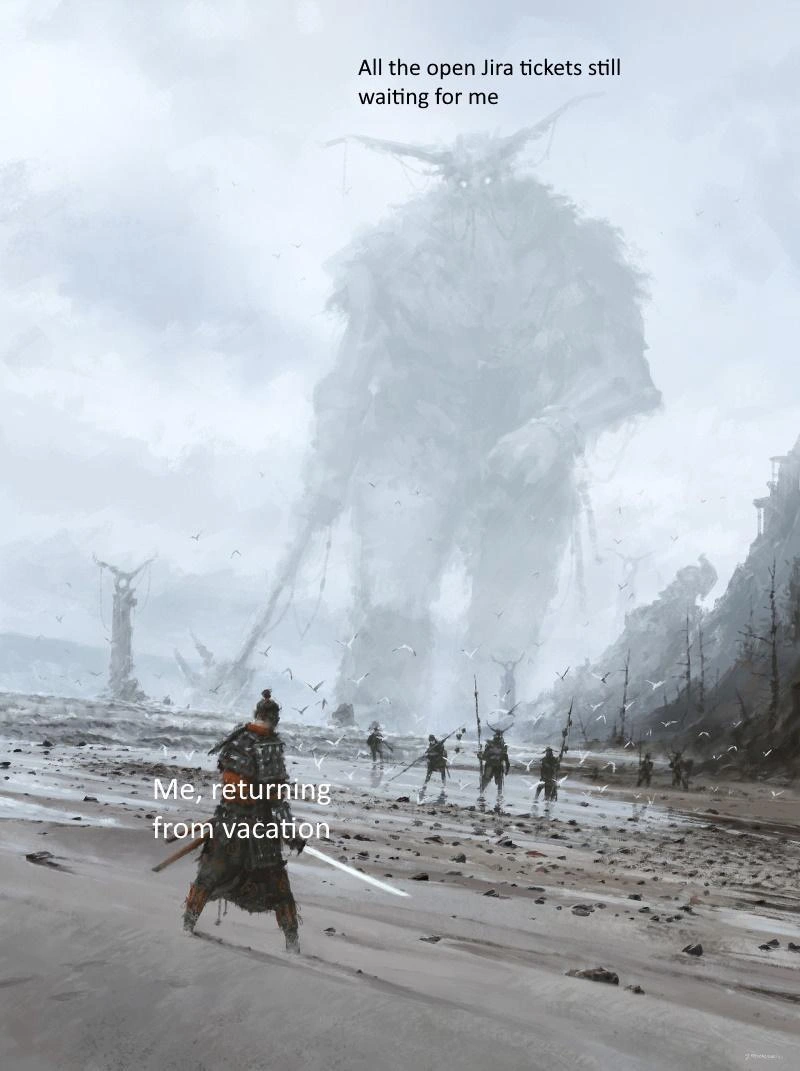
Now, picture a developer who took some time off – say a vacation or parental leave. While they’re away (PTO is short for Paid Time Off, i.e. vacation or leave days), work doesn’t stop. New issues are discovered, new features are requested, and some tasks that were in progress might be put on hold waiting for that person to return. The meme shows this with the giant misty monster labeled “All the open Jira tickets still waiting for me”. That monster represents the huge queue of tickets (tasks) that have accumulated. The small warrior standing on the beach (“Me, returning from vacation”) is the developer coming back to the office and realizing just how many things are pending. It humorously compares the first day back at work to an epic showdown, like a single hero facing a gigantic foe. This is exaggeration, of course, but it captures the feeling perfectly. A backlog that doubled in size can feel as scary as a monster looming over you, especially if you’re the one expected to address most of those issues.
Let’s connect this to everyday Agile team practices:
- Sprint Planning: In Scrum (a common Agile framework), work is planned in short cycles called sprints (often 2 weeks long). Before each sprint, the team decides which backlog items (tickets) to tackle. If a key developer is away on vacation, the team should plan fewer tasks for that sprint or distribute their tasks to others. Sometimes this happens; other times, the team might underestimate how much the person was handling. If multiple sprints went by during the absence, some tasks might have been postponed or carried over because the specialist wasn’t there. This means those tasks stack up in the backlog.
- Daily Stand-up: This is a quick daily meeting (usually each morning) where team members share what they’re working on and if they’re blocked. The meme hints at “the first stand-up back” anxiety. Why? Imagine coming to that first stand-up after your vacation and having to say, “I’ve got 25 open issues assigned to me, and I’m not sure where to start.” It’s a daunting update! The stand-up is meant to surface problems like this so the team can help, but it can still be nerve-wracking to reveal such a large pile of work waiting.
- Backlog Grooming/Refinement: While you were out, the team might have held grooming sessions. They possibly re-prioritized things – maybe some of your tasks were deemed less urgent and moved down the list, or some were marked to wait for your input. But grooming doesn’t eliminate tasks; it just organizes them. So upon return, you might find your tasks neatly labeled and prioritized… yet still all there, staring at you.
- Project Management & Deadlines: Some of those tickets might have due dates or are part of a deadline-driven project. For example, if a feature was supposed to be done by end of the month, and you were away mid-month, that deadline is now looming closer. You might feel pressure to rush and complete those tasks to meet the timeline. This is where deadline pressure kicks in. The meme’s atmosphere of scale and doom humorously reflects that pressure: it can feel like a huge weight when multiple deadlines stack up immediately after a break.
For a junior developer or someone new to this environment, a few key definitions:
- Agile is a way of managing work that values flexibility, customer feedback, and frequent delivery. Teams break work into small pieces and continuously adapt. It includes practices like sprint planning, stand-ups, and backlog grooming.
- Jira is a tool many Agile teams use to keep track of these pieces of work. Each item (often called a user story, task, or bug) gets a ticket in Jira with details and status.
- Backlog refers to all the work items that have been noted down but not yet completed. Think of it as the team’s to-do list. It can contain everything from big features to tiny bug fixes, usually ranked by priority.
- Ticket is just another word for an item or issue in that tracking system. If a user reports a bug, a developer or manager creates a ticket in Jira describing the problem. If the business wants a new feature, that’s another ticket.
- Burnout is extreme work-related stress or exhaustion. Developers mention burnout when they’ve been overwhelmed by work for too long without enough rest. Ironically, taking a vacation is supposed to help avoid burnout, but coming back to chaos can momentarily increase stress again. That’s why balancing work and rest (Work-Life Balance) is tricky: you need breaks to stay healthy, yet the work waits for you, which can be discouraging.
So why is this meme funny to developers, including those not very senior? Because it’s relatable exaggeration. Even if you’re relatively new, you might have experienced a smaller-scale version: say you were off sick for a couple of days or you took a long weekend. When you return, you find a bunch of emails, maybe a few Jira tickets assigned to you, and a feeling of being behind. It’s not literally a giant mythical monster, but it feels overwhelming for a bit. Now imagine that feeling amplified for someone who was away for a longer time, like two weeks, and who usually handles a lot of tasks. The pile-up can be huge. The meme takes that feeling and turns it into a dramatic fantasy scene to poke fun at it. The samurai imagery implies the developer needs courage and focus (like a warrior) to get through the first days back. The monster implies the backlog has grown into something intimidating. It’s humorous because it’s true enough to recognize, but portrayed in a way that we can laugh at our own anxiety. It reminds even junior devs that this happens to everyone and that they’re not alone in feeling a bit lost after time off.
There’s also a subtle nod to the idea that in Agile teams, no one should be a lone warrior. The fact that the picture shows the lone samurai and a few other soldiers in the distance hints at team dynamics. Ideally, the team would have swarmed and tackled those issues together so no one comes back to a nightmare. Sometimes teams do manage that – someone covers your on-call rotation, another handles urgent bugs in your area – but more often than not, everyone has their own workload, and a lot of your stuff will simply be waiting when you get back. This meme playfully acknowledges that gap between how we say we work (collaboratively, share the load) and how it feels in practice (each dev ends up fighting their own battles).
In summary, “Me, returning from vacation” versus “All the open Jira tickets still waiting for me” is a comical way to describe the post-vacation catch-up many developers go through. The tags like #DeveloperFrustration and #DeadlinePressure are about the stress and annoyance of that situation. And tags like #WorkLifeBalanceTips and #DeveloperBurnout are a reminder: yes, it’s frustrating, but taking time off is still important for your well-being. The meme acknowledges the problem (coming back is tough) while also implicitly encouraging a chuckle and perhaps a conversation about how to make it better (maybe teams seeing this will think “let’s not let John’s tasks pile up like that when he goes on leave”). For a newcomer, the key takeaway is: in software teams, plan for absences if you can, but don’t be surprised if things stack up – it happens to the best of us, and that’s why this image strikes a chord.
Level 3: Backlog Boss Battle
Imagine returning to work after a blissful break, opening Jira, and being greeted by a colossal backlog monster. The meme’s dramatic fantasy art exaggerates a very real Agile nightmare: all the open Jira tickets still waiting for me. The lone samurai warrior in the image — labeled “Me, returning from vacation” — symbolizes a senior developer steeling themselves to face an overwhelming queue of unresolved issues. It’s a project management horror show that any battle-scarred engineer recognizes. This combination of elements is darkly funny because it transforms a mundane office scenario into an epic showdown. We’ve all felt like heroes returning to a battlefield of tasks after some much-needed PTO (Paid Time Off), only to find the enemy grew stronger in our absence. The humor comes from shared painful truth: in software teams, work doesn’t pause just because you did.
In theory, Agile teams practice backlog grooming and load-balancing to prevent such scenarios. A well-oiled Scrum team would redistribute tasks before someone goes on leave, adjusting sprint commitments. Ideally, the Sprint Planning before you left should have accounted for your absence, and any new issues would be triaged and handled by others. But reality rarely lives up to Agile’s ideals. Instead, what often happens is a perfect storm of accumulated tickets. Critical bug fixes, feature requests, code reviews, and miscellaneous “quick questions” all quietly pile up like driftwood on that bleak shoreline. The product owner might continuously add stories to the backlog (“It’ll get prioritized later”), and colleagues may defer non-urgent tasks (“Let’s wait for them to return, they know this part best”). By the time you’re back, the backlog has swelled into a tsunami of work. It’s a systemic issue: despite WorkLifeBalance slogans, many organizations still rely on individual heroes for specific domains. Knowledge silos and last-minute deadline pressure mean tasks often wait instead of reassigning. The result? One developer facing a mountain of JIRA tickets that feels as tall and forbidding as a mythical titan.
Monster: "All the open Jira tickets still waiting for me..."
Samurai Dev: gulp "I’m back. Let’s do this."
This meme resonates because it nails that dreaded first day back. The text hovering over the mist-shrouded giant epitomizes developer frustration: it’s the sum of all those unresolved problems you blissfully forgot on vacation. The warrior’s stance (sword drawn, alone on the sand) captures the vibe of a senior engineer mustering the courage to dive into ticket triage at the morning stand-up. It’s equal parts heroic and tragicomic. Why tragicomic? Because every experienced dev has lived this: you come back recharged, but the moment you log in, you feel nearly burnout again seeing what piled up. It’s a classic trade-off: take time off to preserve sanity, only to return to combat-level stress. Sprint planning anxiety is the next chapter of this story – now you have to explain or estimate this bloated backlog in front of the team. Even if no one blames you, you personally feel responsible to slay the beast. The meme expertly exaggerates that sense of solitary duty. In reality, you’re not literally alone (your team’s there, represented by those smaller soldiers in the artwork), but it feels like your fight – especially if many tickets are related to your domain expertise or personal tasks deferred until your return. Those smaller figures could be teammates who tried to hold the line, but the giant “ticket monster” still looms, waiting for its true owner.
Let’s decode some of the satire in technical terms. Jira is the industry-standard tool for tracking issues, tasks, and bug reports – essentially a giant to-do list for the team. The backlog in Jira is where all pending work items live, especially those not yet started. Over a vacation, that backlog can mutate into a ticket hoard. New bug reports from QA, feature ideas from stakeholders, and pending code reviews all contribute to the bloat. It’s common for a developer to return and find dozens of notifications: issues assigned to them, or comments tagging them with questions. Each of those is like a mini-soldier prodding the giant backlog creature, but not quite slaying it. Meanwhile, any tasks you left unfinished before PTO are likely still there unless someone heroically finished them. If multiple sprints passed while you were out, some tasks may have been rolled over repeatedly (ever seen stories move to the next sprint board 3 times? That backlog monster grows new heads like a Hydra). Backlog refinement meetings might have occurred, but without your input, teammates might just mark those items as “blocked” or “to discuss when back” – effectively feeding the beast rather than shrinking it.
To seasoned engineers, the absurdity is painfully familiar. This meme pokes fun at Agile ceremony versus real-life chaos. Agile frameworks preach sustainable pace and team ownership of work, but here we see the opposite: a single warrior vs. a massive foe. The reasons this keeps happening are worth a veteran eye-roll:
- Knowledge Silos: Often one developer is the go-to expert for certain components. If they’re away, tasks in that area stagnate. The backlog monster grows because nobody else slays those specific tickets.
- Partial Coverage: In theory someone else steps in, but teammates already have their own workload. They might chip away at a few minor issues (the smaller soldiers in front), yet leave the gnarliest problems untouched for your return.
- Management Pressure: Product managers might keep stuffing the backlog with new requests even while you’re OOO (Out Of Office). They assume it’ll get prioritized eventually — and “eventually” arrives the day you’re back.
- Sprint Deadlines: If you left mid-sprint or multiple sprints elapsed, some work got postponed. The team might have met the sprint goals by dropping your tasks to backlog (to not tank the velocity). Now those dropped tasks are all staring at you, plus any new ones.
- Support Issues: Production bugs and customer support tickets don’t care that you were on parental leave. They still accumulated each day. It’s like the codebase saying, “Oh, you relaxed? Here, fix these 50 things as penance.”
- False Security: Sometimes teams think “we’ll handle it while you’re gone,” but then reality hits – maybe an urgent incident stole everyone’s time, and your planned coverage never happened. So your JIRA queue saw zero burn-down in your absence. Surprise!
To a veteran, this pattern has happened again and again – it’s practically folklore in tech. Going on holiday (or parental leave) is ironically a risk factor for a ticket avalanche. There’s even a tongue-in-cheek Murphy’s Law variant: the longer your PTO, the nastier the bug awaiting you on return. Ever hear someone quip “don’t take vacation right before a release”? They’re half-joking, half-traumatized. The meme’s samurai imagery perfectly captures that silent dread looming on the last day of vacation: you know something giant is waiting in the fog of your inbox. It’s almost ritualistic – like sharpening your blade (updating your dev environment, caffeinating heavily) before charging into battle with the Jira backlog monster.
From an organizational perspective, tackling this backlog beast is harder than it looks. Sure, one might say “just distribute the work” or “pause new projects until they return,” but business timelines rarely pause. If you’re a critical resource (as much as Agile tries to avoid single points of failure, they exist), your absence creates a void. Backlog grooming can flag things as low priority or delegate some tasks, but many tickets effectively get a “waiting for assignee’s return” status. There’s also psychological truth: after a refreshing break, even a normal workload can feel overwhelming. Here, the meme exaggerates it to a gigantic scale, which is humorous and validating. It acknowledges the almost PTSD-like flashbacks seniors have: recalling times they came back relaxed only to be hit by a wall of Jira notifications. The phrasing “All the open Jira tickets” suggests nothing was resolved – a total accumulation. It’s funny because it’s true enough to sting: you chuckle, then maybe sigh remembering your own backlog battles.
The fantasy battle imagery also adds a layer of ironic empowerment. A lone samurai is badass – skilled, disciplined, and fearless. The dev coming back from break might need to channel that warrior spirit to slice through the tangle of issues. In one hand the samurai has a sword; in reality, the developer wields a keyboard and IDE. The birds circling the sky, the wreckage on the sand – it all paints a dire scene. That’s how a frazzled engineer can perceive their task list at 9 AM on Monday: a devastated landscape to triage. Yet, like the warrior, you step forward because what else can you do? There’s a sort of gallows humor pride in it: “Yep, it’s all waiting for me, and I’ll handle it.” And you will slice through them, one ticket at a time, hopefully with some backup from your squad once they stop gawking at how huge the beast is. The meme underscores both the absurdity and the heroics of senior dev life: nobody wants to face the colossal ticket queue, but when duty calls, you suit up and get to work (perhaps after a big cup of coffee or two).
To sum up the senior perspective: this meme is too real. It humorously encapsulates post_vacation_overwhelm in software development. The tags like #DeveloperFrustration and #Burnout ring true – the scenario is a breeding ground for stress. But it also touches on #WorkLifeBalanceTips in an implicit way: Yes, taking time off is vital (our samurai probably needed that rest to fight anew), but companies and teams must improve how they manage workloads during absences. Otherwise, every return from PTO feels like facing Jira-zilla with a sword made of good intentions. It’s a collective chuckle and a caution: your backlog won’t conquer itself, but at least this meme lets us laugh about the absurd drama of it all before we charge in and start closing tickets.
# Pseudo-code dramatizing backlog growth while the developer is away
days_off = 14 # two-week vacation
backlog_tickets = current_backlog_count # tickets before PTO
for day in range(days_off):
new_tasks = random.randint(1, 5) # each day, 1-5 new tickets arrive
backlog_tickets += new_tasks
# (No tickets resolved because the assignee is out)
print("Backlog tickets waiting for me after vacation:", backlog_tickets)
# Output: Backlog tickets waiting for me after vacation: [a big scary number]
Description
A dramatic fantasy artwork showing a lone samurai warrior on a beach labeled 'Me, returning from vacation' facing an enormous, towering colossus monster in the misty distance labeled 'All the open Jira tickets still waiting for me'. Several smaller warriors are scattered between them on the desolate beach, creating a Shadow of the Colossus-inspired scene. The scale difference between the tiny samurai and the massive creature perfectly captures the overwhelming dread of returning to work after time off and discovering that nobody touched your ticket backlog, which has only grown more menacing in your absence
Comments
16Comment deleted
The real boss fight isn't the Jira tickets -- it's the 47 'quick question' Slack messages from people who apparently forgot how to function without you for two weeks
The only thing worse than facing the giant backlog is discovering half the tickets are just follow-ups from the one meeting you missed
If only story points translated to hit points - I’d have spec-d a smaller boss fight before filing that time-off request
The only thing that scales better than microservices is the exponential growth rate of Jira tickets during your PTO - and unlike distributed systems, there's no eventual consistency, just immediate existential dread
That moment when your two-week vacation spawns a raid boss made entirely of P1 tickets, unread Slack threads, and merge conflicts that have achieved sentience
Two weeks of PTO and the Jira queue implemented eventual consistency - every ticket replicated across three boards, gained a dependency, and one got promoted to an Epic
JIRA backlogs: the only system achieving infinite horizontal scale without a single Kubernetes pod
Based and 2x father pilled 😍 Comment deleted
Based part is highly debatable regarding the giveaway shitshow lol Comment deleted
Found the non-father. wagmi 🥰 Comment deleted
Username checks out. Comment deleted
I am never going to reproduce… Comment deleted
did I told tell Comment deleted
Dude that's cool af Comment deleted
Here, funny pic: Comment deleted
James Bond approves: the second time is easier, considerably. Comment deleted