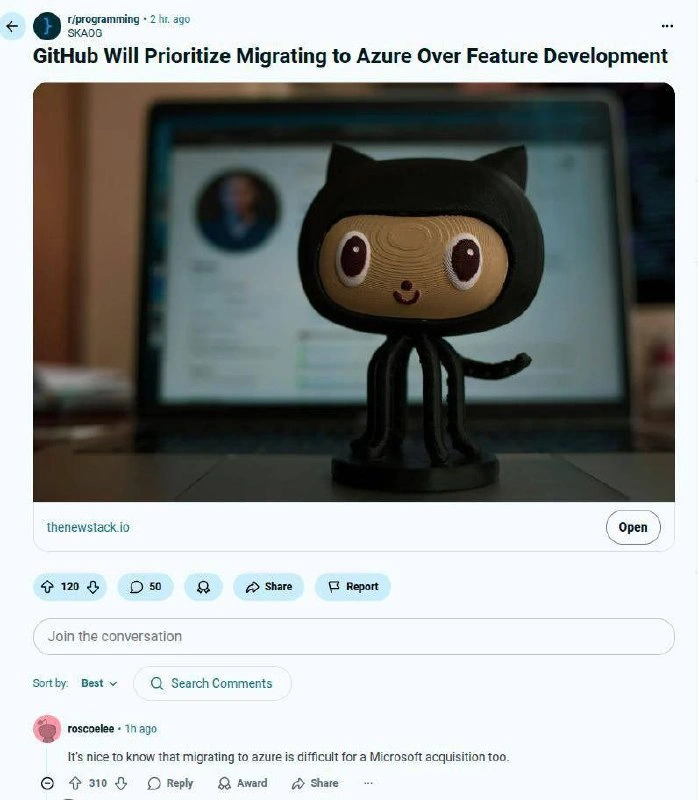
GitHub Prioritizes Azure Migration Over Feature Development: Reddit Reacts
Why is this Cloud meme funny?
Level 1: Moving Day, No New Toys
Imagine you and your friends have a big clubhouse (like a cool playroom) where you always hang out and invent new games. One day, a rich uncle buys the clubhouse and says, “You know what, instead of playing and making new games, I want you to move everything to a new clubhouse I own across town.” So now, instead of getting new toys or playing new games, you all have to pack up all your old toys and move them to this new place.
It takes a loooong time to move — boxes and boxes of toys, carefully carrying your game console, all your furniture, everything. During this whole moving time, you’re not playing or coming up with new fun ideas, you’re just doing the move because your uncle thinks it’s super important to have everything in his clubhouse. In the end, all your toys and games are now in the new location (which maybe has a fresh coat of paint, but the toys are the same). None of your games got better or new during this time, right? You just spent a bunch of effort to set up the old stuff somewhere else.
Now, while you’re doing this, one of your friends quips, “Ha, even with your rich uncle’s help, moving is really hard, huh?” Everyone laughs a bit, because it’s true — even though the new clubhouse is fancy, moving all your things was still a huge chore.
That’s essentially what the meme is saying about GitHub and Microsoft. GitHub is like the clubhouse full of toys (features for coders). Microsoft is the rich uncle who bought it and said “move to my place (Azure cloud).” All the kids (engineers) had to pause the fun stuff (making new features) to do the boring moving work. The Octocat (a cute cat mascot) in the picture is like a kid standing there with a tired, blank face, thinking “Really? We have to do all this now?” It’s funny in a “this is silly but we can relate” kind of way. The joke is highlighting that sometimes big bosses make you do big chores that don’t immediately make your toys or games any more fun — and even they know it’s a tough job.
Level 2: Azure Migration 101 (What’s Going On?)
Let’s break down the humor in simpler terms. GitHub is a hugely popular platform where developers store and share code (think of it like a library for code, with version control so you can track changes). A while back, GitHub was bought by Microsoft, the big tech company that also owns the Azure cloud. Azure is Microsoft’s giant network of data centers and services — basically, their version of Amazon’s AWS or Google Cloud. When companies use Azure, they’re running their software on Microsoft’s servers over the internet (that’s what “the Cloud” means in practice).
Now, when Microsoft acquires a company (like they did with GitHub), they often want that company’s services to run on Microsoft’s cloud (Azure) rather than on a competitor’s cloud or on independent infrastructure. It’s as if Microsoft said, “Hey GitHub, now that we own you, you should live in our house (Azure) instead of your old one.” This is where the term vendor lock-in pops up: it means being dependent on a specific provider’s technology. GitHub moving onto Azure will make it pretty tightly tied to Microsoft’s platform in the future.
The meme title says: “GitHub Will Prioritize Migrating to Azure Over Feature Development.” In plain speak: GitHub’s team is being told to spend their time moving all of GitHub’s systems onto Azure first, and put adding new features for users second (for now). If you’re a GitHub user, you might be waiting for new goodies or improvements. This headline humorously suggests you shouldn’t hold your breath — the engineers are busy with a behind-the-scenes relocation project.
The image shows a cute 3D-printed Octocat figurine (that little black cat with octopus legs is GitHub’s mascot) staring blankly in front of a laptop. It’s a visual metaphor: Octocat (standing in for GitHub) looks kind of stunned or unamused. Why? Because instead of hacking on cool new features or fixing bugs, Octocat has been told to pack up and migrate everything to Azure’s cloud. It’s like its eyes say, “Seriously? We’re doing this now?”
On Reddit (the programming subreddit), people are joking about this scenario. The top comment by user roscoelee says: “It’s nice to know that migrating to Azure is difficult for a Microsoft acquisition too.” This comment is pointing out irony: even though GitHub is now backed by mighty Microsoft itself, moving to Azure is still a hard, complex job. In other words, Azure isn’t simple, even for Microsoft’s own team. Devs find that funny because it confirms their own struggles with Azure or big migrations — kind of an “hah, it’s not just us!” moment.
To appreciate the humor, you should know:
- Feature development means working on new tools, improvements, or functionality that users will directly see or use. For example, a new VersionControl feature like an improved code search on GitHub, or a new way to manage pull requests.
- Migrating to Azure is an internal project. It means moving all of GitHub’s data (all those repos, issues, etc.) and services (the website, the APIs, the background jobs) to run on Azure’s infrastructure. Ideally, if done right, users wouldn’t notice a difference — the site should work the same. But it’s a ton of work for the engineers and doesn’t immediately give users something new.
- DevOps/SRE teams are the folks who handle deployment, servers, uptime, and reliability. They’re the ones who plan and execute such migrations, ensuring the site stays running. This kind of project is definitely giving GitHub’s DevOps/SRE team some long days and nights. (They have to ensure everything is copied correctly, everything is configured in Azure properly, and nothing breaks. It’s like moving a whole city’s worth of stuff to a new country and making sure the lights stay on.)
- Cloud Migration Strategy is basically the game plan a company makes for how to move from one cloud or data center to another. It involves figuring out what to move, in what order, how to test it, how to roll it back if something fails, etc. It’s a big, careful planning exercise.
So, the meme is funny to developers because it shines light on a common scenario: A company gets bought by a big corporation, and suddenly there’s a mandate: “Use the new parent company’s tech stack!” All other work becomes secondary. If you’re an engineer excited about building new stuff, this can be frustrating. Imagine you were about to launch some neat GitHub feature that users have wanted for ages, but now your bosses say, “Hold on, spend the next 6 months moving our servers to Azure first.” It’s not very satisfying, and users don’t immediately benefit, but the company’s executives care a lot because it aligns with corporate goals (Microsoft wants GitHub on Azure, for cost savings and showcasing Azure’s capabilities).
The Octocat mascot staring blankly is basically an avatar for GitHub’s developers feeling a bit deadpan or disheartened. It’s like, “Well, I guess this is our life now.” We often use humor to cope with these situations in tech.
Also, that personal note from the admin about Azure’s AI API being a mess with scattered docs: that’s a relatable gripe for developers. Azure has a lot of services and sometimes the documentation isn’t all in one place or easy to search. If even Microsoft’s own search engine can’t find their Azure docs easily, you can imagine the headaches. So, the admin is commiserating that Azure can be confusing – implying even GitHub’s team likely has to slog through confusing docs and poorly searchable info to do this migration. It’s like an inside-joke complaining: “Azure, get your act together on docs!” For the meme’s context, it underscores that migrating to Azure has its pain points.
In short, at this level: GitHub (owned by Microsoft) is pausing new features to move their whole platform to Microsoft’s cloud (Azure). Devs find it funny/ironic because:
- It’s a super familiar corporate move that we’ve seen before.
- It highlights cloud vendor lock-in priorities (company politics) winning out over cool new tech improvements.
- Even with all of Microsoft’s might, Azure migrations are tough, confirming what many of us have experienced.
- The Octocat’s blank look = our collective “meh, figures…” reaction.
If you’re a junior dev or just outside this situation, just imagine being told to refactor an entire huge project to use a different library or service just because your company wants to use their in-house tools — not because it’ll make the product better for users right away. You’d be a bit bummed, right? That’s what’s going on here, and that’s why it’s both funny and painfully true for those in the industry.
Level 3: Cloud Over Code (Migration Mandate)
The meme hits experienced devs right in the DevOps/SRE feels with its dark humor. GitHub, famously represented by the Octocat mascot, is pictured staring blankly at us — a perfect thousand-yard stare of an engineer told to drop everything and migrate to Azure. Why is this funny? Because it’s a classic case of infrastructure_over_features: big corporate boss (here, Microsoft after acquiring GitHub) decrees a massive cloud migration and suddenly all those cool user-facing features on the roadmap get put on ice.
This situation screams vendor lock-in and corporate Cloud mandate. Microsoft paid $7.5B for GitHub, so of course they want GitHub’s services on their cloud (Azure) rather than paying a rival or running a separate datacenter. It’s synergy, they say. The rest of us call it “migration hell.” The humor is that even for a Microsoft-owned platform, moving to Azure is a herculean task — validating every grumble we’ve had about Azure’s quirks. The top Reddit comment nails it:
roscoelee: “It’s nice to know that migrating to Azure is difficult for a Microsoft acquisition too.”
Translation: Even with all of Microsoft’s resources, GitHub’s journey to Azure is no cakewalk. The r/programming crowd upvoted this because they’ve been there, done that, got the “cloud outage at 3 AM” T-shirt. It’s a form of schadenfreude and commiseration rolled into one. We laugh (perhaps bitterly) because we picture the GitHub ops team slogging through the same CloudMigrationStrategy headaches everyone faces.
Consider what “migrating GitHub to Azure” likely entails:
- Massive data transfer – moving millions of Git repositories, issue trackers, CI artifacts, etc., into Azure’s storage. You can bet an SRE is praying the bandwidth holds and no data corruption hits.
- Re-architecting services – mapping what ran on the old infrastructure to Azure equivalents. That means replacing, say, AWS S3 with Azure Blob Storage, or on-prem hardware with Azure VMs. Nothing fits perfectly; there’s always that one service that doesn’t have an exact Azure analog.
- Downtime risks – GitHub is mission-critical for developers worldwide. Doing a live migration without impacting users is like swapping a jet’s engine mid-flight. No pressure.
- Documentation scavenger hunt – Azure’s docs can be, to put it mildly, challenging. (As an aside, even the admin quips how Azure’s AI API docs are scattered in the “deepest holes” and barely searchable with Azure’s own search. If you’ve tried Azure, you’re probably nodding… or sobbing.) So imagine GitHub’s engineers combing through poorly indexed Microsoft docs and internal knowledge bases just to figure out how to recreate their setup on Azure. Fun times.
- Feature freeze – While all hands are on deck for the migration sprint, new features and improvements fall by the wayside. Users waiting on that shiny new pull request UI or VersionControl enhancement? Sorry, come back after we finish appeasing the Azure gods.
In essence, the meme lampoons how an corporate_acquisition can derail product momentum. The Octocat’s blank stare = every developer’s deadpan look when upper management announces, “Big rewrite time! Stop feature work, we need to integrate with our new platform.” It’s a mix of irony and resignation. 😑
This dynamic is all too familiar in tech history: a big company buys a successful product, then platform_porting becomes Priority #1. It happened when Yahoo bought Tumblr (servers got moved), when Oracle bought Sun (hello, Oracle cloud attempts), and now Microsoft with GitHub. The enforced Azure migration hints that even if GitHub was running just fine on its old setup (rumors said parts of GitHub ran on AWS), that doesn’t matter—now it must prove loyalty to the Azure cloud. Cue the CloudHumor and head shaking from seasoned devs: “We’ve finally found something slower than Git’s garbage collection – a cloud migration mandated by corporate.”
The cruel punchline? For all this effort, the average GitHub user won’t notice any new features or improvements. Ideally, done right, they won’t notice anything at all (zero downtime fingers crossed). So from a user perspective, months of engineering work result in… status quo. As a cynical veteran might say: Great, we moved everything to Azure so the CFO can sleep better. Meanwhile, my bug fix backlog is growing cobwebs.
In the big picture, this meme highlights the eternal battle between feature velocity and infrastructural projects. Devs get it: sometimes you have to pay off tech debt or overhaul systems (we do those grudgingly). But this feels like a business-imposed detour. It’s not fixing a scaling issue or adding capability for users - it’s primarily to satisfy corporate strategy (get off rival clouds, unify our stack). The Octocat staring blankly is basically every engineer’s soul leaving their body on hearing the new directive: “Drop everything, we gotta move to Azure ASAP.” You can almost hear the project manager announcing it with a forced smile as all developers in the room silently scream inside.
And because we’re in Cynical Veteran mode here, let’s be real: big migrations rarely go perfectly. Expect some hiccups, maybe a surprise outage or two blamed on “complex refactoring”. The silver lining for the rest of us? We gain a spicy meme and the comfort that even Microsoft’s own products struggle with the same cloud pains. DevOpsHumor at its finest.
To sum up this level: the meme is richly humorous for those with industry experience because it encapsulates corporate mandate absurdity. It’s poking at Microsoft for prioritizing “Azure-ification” of GitHub over giving us developers new goodies. It validates our skepticism whenever higher-ups say “this will be quick and easy” — we know migrations are neither quick nor easy. As the saying in SRE circles goes, “No downtime? No way.” Here’s a pseudo-sprint plan diff that GitHub’s roadmap might as well have:
# Company directive: "Migration first, features later"
- task: "Migrate to Azure Cloud"
owner: DevOps/SRE Team
priority: P0 # drop EVERYTHING, top priority
- task: "New Feature Development"
owner: Product Team
priority: P3 # on hold until migration is done
The priorities tell the story: Azure or bust. In short, the meme lands because it’s a truth wrapped in humor — even mighty GitHub is not immune to the cloud vendor strategy over user feature trade-off. We laugh, perhaps a bit ruefully, recognizing that blank Octocat stare in ourselves the last time we got such an assignment.
Description
A screenshot of a Reddit post on r/programming titled 'GitHub Will Prioritize Migrating to Azure Over Feature Development' with a link to thenewstack.io. The post features a cute Octocat (GitHub mascot) figurine in front of a computer screen. It has 120 upvotes and 50 comments. The top comment by user roscoelee (310 upvotes, 1h ago) reads 'It's nice to know that migrating to azure is difficult for a Microsoft acquisition too.' The humor is in the irony that even Microsoft's own subsidiary struggles with Azure migration, validating every developer's experience that cloud migrations are painful regardless of corporate backing
Comments
20Comment deleted
When even Microsoft can't make Azure migration easy for their own acquisition, you know your team's '6-month migration estimate' is actually measured in geological epochs
The GitHub-to-Azure migration is the enterprise version of refactoring a legacy system: the budget is infinite, the timeline is 'when it's done,' and the only user-facing feature is a longer list of known issues
Apparently the new roadmap is `git remote add origin azure && git push --force`, because nothing says enterprise synergy like blocking pull requests until the cloud bill is under the same parent company
Even Microsoft's own acquisitions need a three-year roadmap, two architecture reviews, and a sacrificial goat to successfully migrate to Azure - turns out 'lift and shift' is more like 'lift, shift, pray, and hire consultants'
When your new parent company's cloud migration becomes more important than shipping features, you know the honeymoon phase is over. Even Microsoft finds migrating to Microsoft hard
Acquisition math: convert epics to landing zones, implement in Bicep, and call the vendor lock‑in “modernization.”
Post-acquisition glow-up: features forked to 'later', Azure migration merged to master
Say no to "the cloud" - put your servers in your own basement, use excess heat as a heat source during winter :) Comment deleted
i have my little server in my room and pc which i got free heat and in summer i put them outside Comment deleted
And you can watercool them with standard house radiators so pumps would be the only noise generators. Comment deleted
For now, my shittiest expirience ever is with Apple Podcasts Connect API doc: it's hidden behind login (you can get credentials only directly from Apple), it has close to nothing explained and it has links to types that don't lead anywhere. I'm struggling to do the simplest things🙄 Comment deleted
I see people reverse engineering to get the api endpoint for azure to workaround some automation😂 Comment deleted
There's four az APIs IIRC, and resource naming is quite so inconsistent which makes it hell for devops Comment deleted
Azure's AI api (all services are a mess) Comment deleted
AI api was especially cursed as to me taste Comment deleted
Eg it would give non-working code examples with deprecated API versions after model "deploy" 🌚 Comment deleted
I still remember when microsoft was set to buy github. Most sane people noped tf out of it to gitlab and other alternatives. They will keep on taking corporate driven retarded decisions like they did for xbox and their many studios. Never go mainstream lads Comment deleted
Github only sold because it wasn't profitable Comment deleted
GitLab is completely different from GitHub Comment deleted
They want users to use copilot trained on documentation to get money from them. Comment deleted