The Zen of Clean Infrastructure
Why is this DesignPatterns Architecture meme funny?
Level 1: Every Pipe in its Place
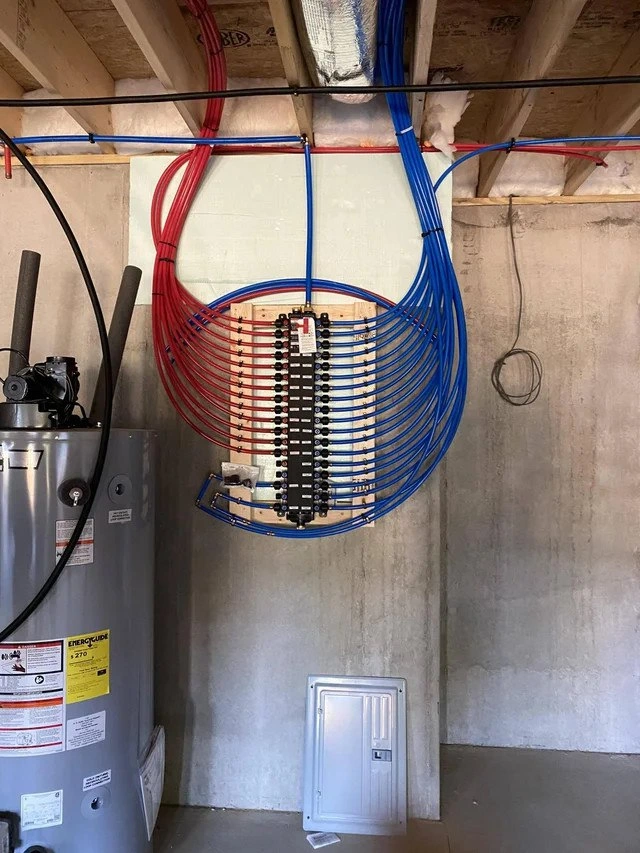
Imagine you go into a basement and see two sets of colored pipes – one bunch red, one bunch blue – all looped and lined up perfectly like an organized rainbow. It almost looks like someone took a bunch of giant hula hoops and cut them in half, then hung them on the wall in two neat rows. That’s what’s happening in this picture. Usually, pipes in a house just run in whatever way gets the water where it needs to go, kind of like how your headphones’ wires get all tangled if you don’t straighten them. But here, the plumber made the pipes super tidy and easy to follow. The red pipes carry hot water, the blue pipes carry cold water, and they all meet in the middle at that black box (which is sending the water off to different rooms, like a big junction). It’s funny because we don’t expect something like plumbing – which is normally hidden and a bit messy – to look so organized and color-coordinated. It’s like if you sorted all your Legos by color and size in separate bins, or if a bunch of garden hoses were hung up in perfect coils instead of being a tangled heap. The feeling you get from seeing it is a mix of surprise and satisfaction: wow, everything is in its place and it just looks so neat! Even if you don’t know anything about servers or data centers, you can appreciate that someone took the time to make those pipes look nice and straightforward. It means if there’s ever a problem, anyone can trace a red or blue pipe from start to end without confusion. In simple terms, this meme is funny and pleasing because it shows a plumbing job done with an almost obsessive level of order – the kind of order that tech folks love to see in their computer cables, applied in a totally unexpected setting like a home basement. It’s proof that being organized isn’t just for computers – it can make anything better, even the pipes that bring water to your shower!
Level 2: PEX Meets Patch Panel
In this meme, a home plumbing setup is arranged to look just like the neat wiring in a professional server room. Let’s unpack that: The image shows a bunch of water pipes (the red and blue tubes) all coming together in one place with immaculate order. The plumber used PEX tubing, which is a type of flexible plastic pipe widely used in modern plumbing. PEX is often colored red for hot water and blue for cold water, making it easy to tell them apart. Here, all the red PEX tubes are on the left side and all the blue tubes on the right side, creating a clear separation between hot and cold lines. They curve down in nearly perfect, identical arcs – it’s so orderly that it almost looks like a piece of art or an intentional design pattern on the wall. These pipes plug into a black manifold in the center, which basically works like a hub distributing water to different destinations (sinks, showers, etc.). If you’ve ever seen the back of a Wi-Fi router or a network switch with many cables plugged in, that manifold with pipes coming out of it is serving a very similar purpose. In fact, it looks just like a network patch panel where lots of Ethernet cables all neatly come together and snap into one board. That’s why the caption jokes that the plumber “secretly trained in data-center cable management” – because this is exactly how IT professionals strive to arrange cables in a data center: grouped, color-coded, and easy to trace.
Cable management is a big deal in IT Infrastructure and DevOps circles. It refers to organizing cables (power cables, network cables, etc.) so that they are not tangled, are grouped logically, and often labeled. In a data center or server rack, good cable management means running cables along the sides in bundled channels, using cable ties or Velcro straps, and keeping everything tidy. Why go through that trouble? Because when something needs fixing, you can quickly find the right cable without yanking on the wrong one. It also helps with cooling (tangled cables can block airflow) and just overall sanity – nobody likes a spaghetti mess where you can’t tell what’s what. Here the joke is that our plumber applied those same “tidy up” principles to household plumbing pipes, which is uncommon but brilliant. Typically, plumbers might not worry about making pipes look symmetrical – after all, pipes usually get hidden behind walls. But over-engineering in a fun way has led to this incredibly neat display. Every pipe has its own slot on that central distribution block (manifold), exactly like every server cable has a port on a patch panel. If one needs to repair the line to, say, the kitchen sink, they can see exactly which red (hot) and blue (cold) pipes feed it and turn off just those, similar to how an engineer might unplug a single network cable or flip one circuit breaker without disturbing the whole system.
For someone newer to these concepts, think of DevOps/SRE folks as the kind of people who manage large systems and keep services running reliably. Part of that job, when it involves hardware, is making sure the physical setup is robust – and messy cables can literally cause outages (if a stray foot snags an unlabelled cable) or at least big headaches. So, there are “best practices” for organizing those cables, often called “data-center cable management best practices.” They include things like: use proper lengths of cable (no 50-foot cable when 5 feet will do, because the excess becomes spaghetti), separate cables by type or purpose (maybe blue cables for management network, yellow for main network, etc., just as this plumber separated cold vs hot water lines by color), label each end of a cable (so you know, for example, this cable goes from Server A to Switch B, or in plumbing, from water heater to bathroom sink), and keep cables accessible (don’t bury the important connection at the bottom of a knotted pile).
In the picture, the satisfying symmetry and organization is what makes techies smile. It’s essentially real-world engineering humor: we’re looking at simple home plumbing, but it’s arranged with the kind of care that we usually only see in high-tech environments. It drives home a point even a junior developer or newcomer can appreciate: organization and attention to detail matter, no matter the field. Just like well-structured code is easier to debug, well-structured pipes or cables are easier to service. If you’ve ever had to untangle a bunch of wires behind your TV or under your computer desk, you know how annoying messy connections can be. Now imagine that times a hundred for servers – or in plumbing, imagine trying to trace a leak when pipes are a confusing maze. This plumber basically said “Nope, not on my watch!” and made sure anyone can see the entire system layout in one glance.
Also, let’s touch on over-engineering in this context. Over-engineering means doing more than what’s required to meet the immediate need, often to make something extra robust or just because one is being perfectionist. Sometimes people use the term negatively (like adding unnecessary complexity), but other times – like here – it’s almost endearing. The plumber didn’t need to form perfect loops and a symmetric design; water will flow through a random-looking pipe just as well. But by going the extra mile, they made something special that balances form and function. It’s comparable to a coder spending a bit of extra time to refactor and comment their code very clearly, even if the program would run without that effort. Not everyone will see that work once the drywall (or the deployment) is in place, but it sure makes maintenance easier and shows pride in workmanship.
In summary, this meme resonates with tech folks because it’s a real-world analogy linking plumbing to computer network cabling. The plumber built a plumbing system that looks like a scaled-down version of a tidy server room. The red and blue PEX pipes stand in for neatly run network cables, and the manifold is the plumbing equivalent of a network patch panel. Everything is organized, efficient, and easy to understand at a glance. For a junior developer or someone just getting into IT, it’s a perfect illustration that good design principles (like clear organization and labeling) are universal – and that even something as ordinary as water pipes can teach a lesson about infrastructure best practices. Plus, it’s just fun to look at – a nice break from seeing the usual tangle of cords or code!
Level 3: Patch Panel Plumbing
At first glance, this image looks like a network rack disguised as a plumbing job. The plumber has routed the red (hot water) and blue (cold water) PEX tubing with the kind of precision and symmetry usually seen only in high-end data center cable management. Each tube swoops down in a perfect arc into a central black distribution manifold that strongly resembles a network patch panel. For seasoned infrastructure engineers, this is both hilarious and deeply satisfying – it's as if a routine home plumbing setup got the full tier-4 data center treatment. The humor comes from the role reversal: we expect messy pipes behind drywall, but here we have cable-grade neatness. It’s a classic case of RealWorldAnalogies where principles from IT Infrastructure are applied to household plumbing. And admit it, the result scratches the same itch as seeing a beautifully organized server rack. 😃
In a typical server room, good cable management means you can open a cabinet and instantly understand what's connected where. That’s exactly what's happening here with water lines. The satisfying symmetry of those red and blue loops isn’t just for show; it reflects best practices like keeping paths orderly and avoiding spaghetti wiring. We’ve all seen the nightmare of tangled, unlabeled server cables – a mess that turns simple tasks into hours of tracing. By contrast, this plumber’s work is a shrine to order: every pipe is clearly separated, likely labeled (or at least intuitively color-coded), and routed without crossing or tangling. They even used gentle curves, just like an engineer would use proper cable bend radiuses to protect fiber optics or avoid kinking Cat6. The water lines as network cables parallel is spot-on: red pipes on the left, blue on the right, mirroring how one might segregate, say, separate network types or purposes with color-coded cables. The black manifold acts as a central hub, analogous to a network switch or patch panel distributing connections to each room, faucet, or appliance (like ports to servers). It’s a one-to-one “home-run” layout, similar to running individual Ethernet drops from each office desk straight back to a central switch for clarity and independence. This level of meticulous planning in plumbing is almost over-engineering – the kind of extra-mile effort an obsessive DevOps/SRE type would put in because they know future maintenance will be a breeze.
Let’s break down the data-center-grade techniques we see in this plumber’s magnum opus:
- Color Coding: Hot and cold water lines are distinguished by red and blue tubing, just as network engineers color-code cables (for instance, red for critical links, blue for standard connections). This reduces confusion and helps anyone servicing the system instantly know which line is which. No more guessing which pipe feeds the shower – it’s literally red hot and true blue!
- Centralized Distribution: The black plumbing manifold is essentially a patch panel for water. All the supply lines terminate there in an organized row. This is analogous to a structured cabling approach where each device or room has its own dedicated cable run back to a central panel or switch. In plumbing, this means each faucet or appliance has a direct line to the manifold (often called a “home run” system in modern PEX plumbing). It avoids the complexity of daisy-chained lines and makes it easy to shut off or service one line without affecting others – much like being able to unplug one server’s network cable without disturbing the rest.
- Symmetrical Routing: Notice how the pipes form matching arcs on left and right. This isn’t strictly necessary for function, but it reflects an aesthetic and practical discipline. In network racks, you’ll see bundled cables trimmed to equal length and routed in parallel paths, often with satisfying symmetry, to keep things tidy and evenly stressed. Here the plumber likely cut each PEX line to matching lengths and used identical routing on both sides, creating a mirror image. It’s pleasing to the eye and avoids crossings. Symmetry for its own sake might be a tad over-engineered, but it certainly sparks joy and makes any abnormalities (like a pipe out of place or a new addition) immediately noticeable.
- Cable (Pipe) Support and Slack Management: Those graceful curves mean the PEX tubes aren’t stretched tight; there’s a bit of slack and a gentle bend radius, preventing strain on connections – similar to how cable management in racks includes service loops or slack for moving equipment and avoiding sharp bends that could damage fibers or copper. The pipes are probably clipped or strapped at regular intervals (though out of frame) to maintain this shape, akin to how cables are velcro-tied to cable ladders or rack rails. The extra care ensures nothing is accidentally tugged loose and everything stays put over time.
- Labeling & Documentation: While we can’t see labels in the photo, one can assume a plumber this detail-oriented has labeled each line on the manifold (e.g., “Kitchen Sink Hot”, “Bathroom Cold”). In IT, labeling each cable end and documenting the patch panel mapping is standard best practice, so you don’t have to play “which cable goes where” during an incident. If a leak happens or an appliance needs replacement, being able to identify and shut off the correct line in seconds is invaluable – just as a sysadmin values knowing exactly which cable to pull when replacing a server.
For the grizzled operations veterans, this picture is practically OpsHumor nirvana. It pokes fun at how our obsession with clean design can extend beyond computers into water pipes. We’ve learned the hard way that chaotic wiring (or unstructured anything) leads to technical debt – or in plumbing terms, a future cascade of leaks and curses when something goes wrong. Here, the plumber has preemptively paid off that debt with upfront organization. It’s funny because you can imagine the plumber thinking, “I’m not just installing pipes; I’m building a reliable system.” This mirrors how a good SRE approaches even small tasks with an eye toward longevity and maintainability. In the real world, many plumbing jobs hide behind drywall, and as long as water flows, nobody cares how it looks. But when you over-engineer a solution like this, you end up with a basement wall that could be in a museum of modern engineering art (or at least on the front page of r/cablemanagement). It’s both absurd and admirable.
Historically, networking and plumbing have more in common than people think – after all, the early metaphor for the internet was “a series of tubes.” 😂 Here we see that idea flipped delightfully on its head: a series of tubes (literally PEX pipes) arranged like a high-end network. It’s a cheeky reminder that whether it’s packets or water, moving stuff from point A to B benefits from orderly pathways and good design. Senior developers and IT pros are chuckling because they’ve chased down one too many rogue cables or mystery dependencies in their time, and the thought of a plumbing system this well-organized feels like discovering a unicorn. It’s the ultimate crossover episode between a home contractor and a network engineer – and the result truly sparks joy for anyone who’s ever had to untangle a mess, be it code, cables, or copper pipes.
Description
A wide shot of a utility room with exposed ceiling joists and concrete walls. The central focus is a remarkably clean and organized PEX plumbing manifold mounted on a wooden board. Numerous red (hot) and blue (cold) pipes sweep in elegant, perfectly parallel curves from the ceiling down to the black distribution manifold. The symmetry and order of the pipes are visually satisfying. To the left is a grey water heater with its warning labels and an EnergyGuide sticker. Below the manifold is a small, grey electrical panel on the floor, leaning against the wall. The image evokes a sense of satisfaction from well-organized infrastructure, analogous to perfect cable management in a server rack or a well-architected software system. It's a non-digital example of the engineering desire for order and clarity
Comments
7Comment deleted
This is what happens when you let a backend developer plumb their own house. The water flows with 99.999% uptime and every pipe is idempotent
My plumber just shipped a hydration microservice mesh: red PEX for write paths, blue for read replicas - now my bathroom has stronger consistency guarantees than our prod database
When your spouse asks why the home network needs 48 ports and you explain it's for redundancy, but really it's because you refuse to let a single Docker container share a VLAN with your smart toaster
This plumber clearly understands dependency injection better than most Spring developers - every hot and cold water dependency is explicitly wired, properly isolated, color-coded for immediate identification, and routed through a central manifold that would make any microservices architect weep with joy. The separation of concerns is so clean you could probably pass a SOC2 audit on this plumbing system. Meanwhile, I've seen production Kubernetes clusters with worse cable management than this basement
Big Ball of Mud pattern: scalable until a hot path leak floods the monolith
Plumber accidentally built a production-ready service mesh: color-coded routes, per-endpoint circuit breakers, zero cross-talk - and better cable management than our Kubernetes cluster
Plumber’s service mesh: red = hot path, blue = cold path; circuit breakers on every service, one water‑heater monolith as the SPOF, and those coils are just retries with exponential backoff