Skip to content
DevMeme
1948 of 7435
The Zen Art of Server Rack Cable Management
Infrastructure Post #2159, on Oct 18, 2020 in TG

The Zen Art of Server Rack Cable Management

Why is this Infrastructure meme funny?

Level 1: No Tangles Here

Have you ever pulled your earbuds out of your pocket and found them not all knotted up? That almost never happens – but if it did, you’d feel a little moment of happiness, right? That’s the kind of feeling this picture gives. Usually, a bunch of cables ends up like a bowl of spaghetti – tangled and confusing. But here, every cable is laid out nicely, side by side, like perfectly lined-up toys on a shelf. Everything is tidy and easy to follow from one end to the other. It makes the people working there feel calm and happy because they don’t have to struggle with any knots or mess. It’s amusing and satisfying because things in real life are rarely this perfectly organized. Seeing it is like finding a little moment of peace in an otherwise messy world.

Level 2: No Spaghetti Allowed

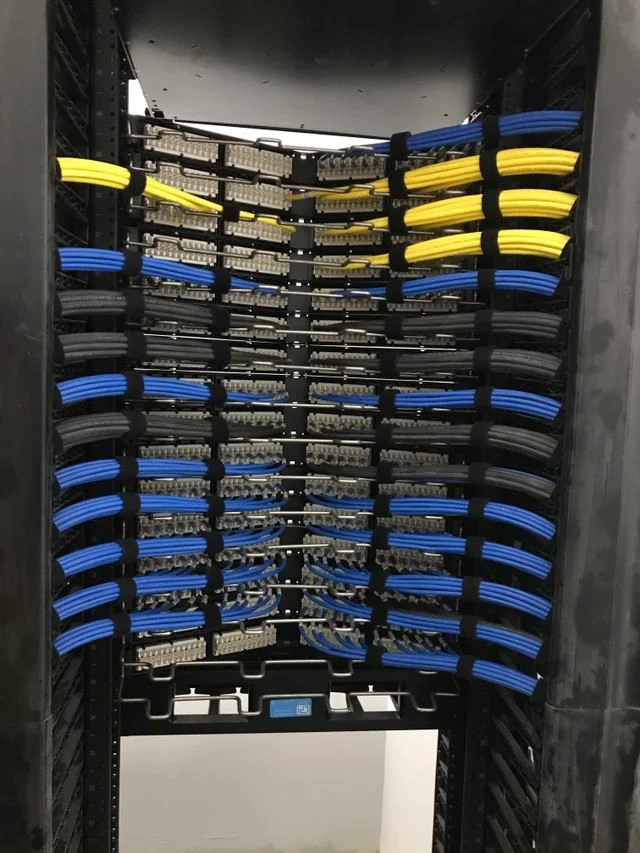
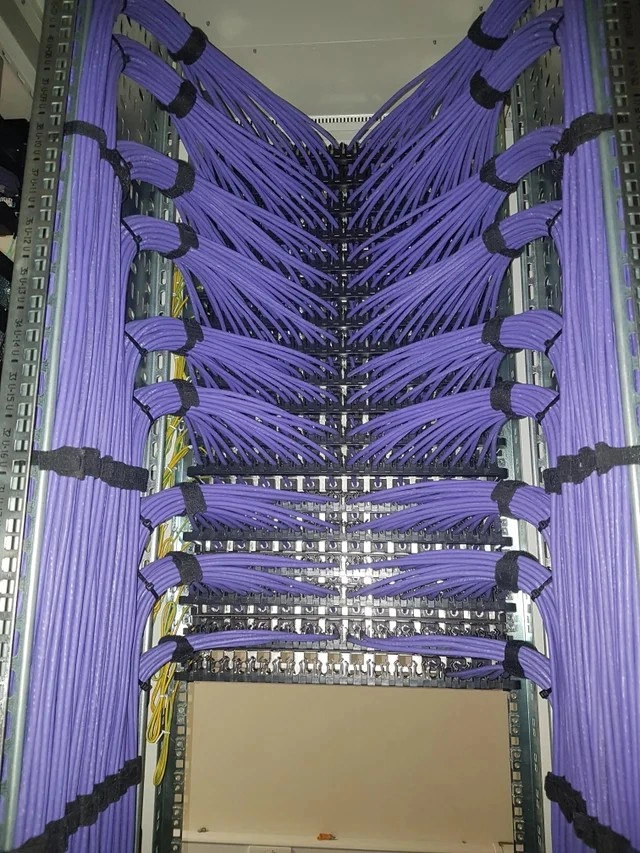
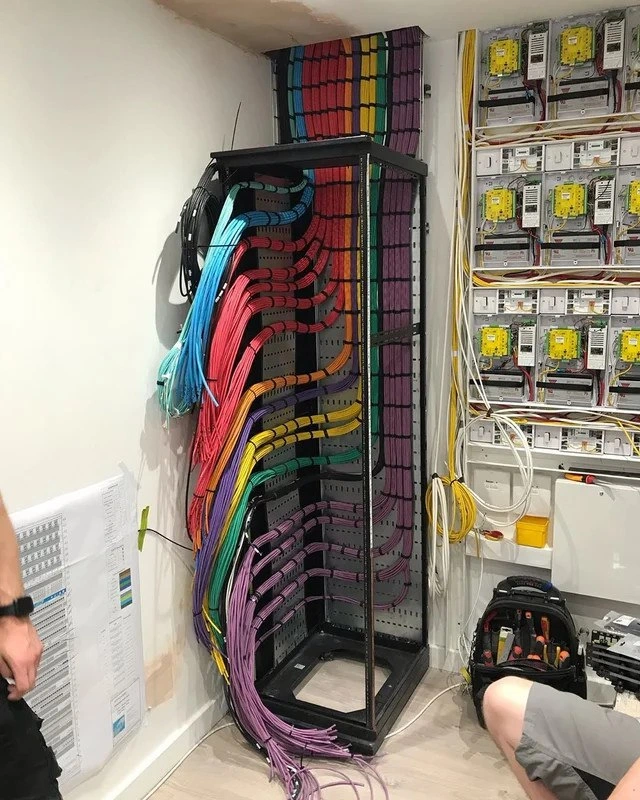
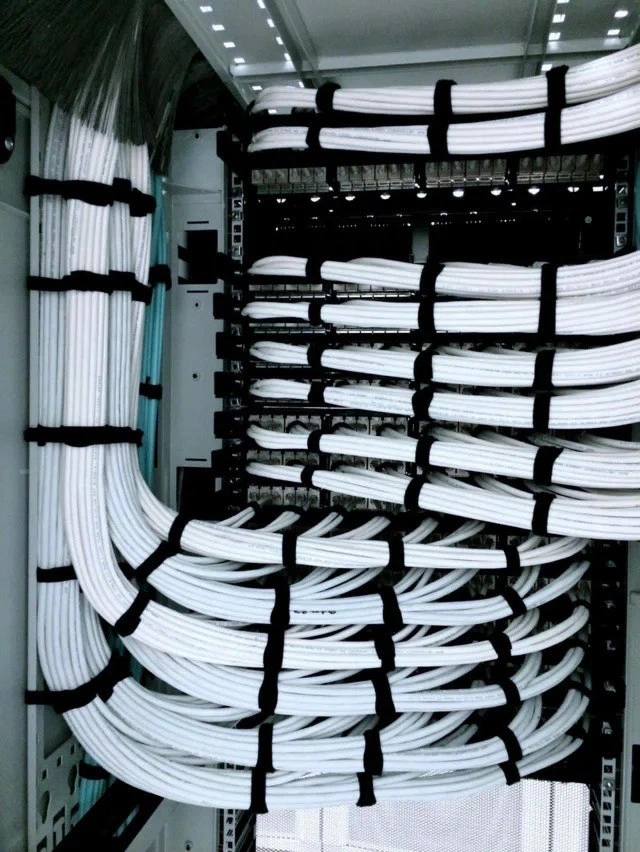
This meme shows a beautifully organized server rack full of network cables, and it’s basically every junior admin’s cabling dream. In the picture, all those thick white wires are Ethernet cables – the cords that connect servers, switches, and other devices so they can talk to each other. They’re all routed in gentle curves and held together by black Velcro straps at neat intervals. The cables plug into a panel with lots of ports (holes) at the front; that’s a patch panel. A patch panel is like a hub or interface for cables: instead of running one very long cable from a server directly to a network switch across the rack, each cable runs from the server to the patch panel. Then, short patch cords connect the panel to the switch. This way, everything stays organized: the back of the patch panel can be wired permanently and neatly, and the front side lets you easily plug and unplug connections as needed.

So why is this impressive? Because real-life cables often turn into a tangled mess if you’re not careful – people jokingly call that “spaghetti wiring”. Imagine a bowl of spaghetti noodles: that’s what random messy cables hanging everywhere look like. It becomes really hard to figure out which cable goes where. But here, cable management is done perfectly. Each bundle of cables is arranged like a tidy highway curve, not a pile of noodles. If you needed to replace one cable or trace a connection, you could do it without pulling on a bunch of other cords. Everything is likely labeled (even if you can’t see the tags) and routed along a clear, intentional path. In short, this setup checks all the boxes of good cabling practice – the physical layer best practices you learn in networking 101: cables are cut to the proper lengths, run in organized bundles with gentle bends, secured but not strangled, and easy to identify end-to-end.

Newcomers to IT might not realize how important these details are. For example, the bend radius of a cable – that’s how sharply you can bend it – matters for performance. Network cables (like Cat5e or Cat6 Ethernet) have twisted pairs of wires inside that carry data signals. If you bend a cable into a tight corner or crease it, those internal twists can get disturbed or even break, which can slow down the network or cause errors. That’s why in this rack, the cables all sweep in nice, smooth curves (big loops rather than tight corners). It keeps the data flowing fast and prevents damage.

Also, notice the use of Velcro straps instead of plastic zip ties. Velcro (hook-and-loop) straps are soft and reusable. They hold groups of cables together firmly but gently. If you need to add or remove a cable later, you can peel the Velcro open, adjust things, and press it back – easy! Zip ties, on the other hand, are single-use plastic ties that you have to cut off once tightened. They can pinch cables too hard if over-tightened (flattening the cable a bit, which isn’t good for those twisted pairs inside), and when you cut them, you risk nicking the cable insulation. That’s why good NetworkInfrastructureDesign avoids zip ties for network cabling in favor of Velcro. The black straps in the photo are Velcro, meaning whoever did this expected future changes and wanted to do things the right way.

Another detail that experienced folks will appreciate is how this neat cabling helps with cooling and maintenance. Servers and network gear in a DataCenter generate a lot of heat and rely on fans and airflow to stay cool. If you have a curtain of messy cables dangling in front of air vents, it can block airflow and make equipment run hotter (and possibly throttle or fail sooner). Here, the cables are routed along the sides in bundles, leaving room for air to move freely. And when it’s time to troubleshoot or replace hardware, a tidy layout means you can find the correct cable quickly. For example, if server #12’s network link is down, you can just follow the one cable from port 12 on the patch panel through the bundle to the server, without rummaging through a rat’s nest.

People sometimes call images like this “cable porn” because it’s so satisfying to look at if you work with cables. It’s a bit of tech slang – obviously nothing to do with actual adult content, but it means this picture of cables is extremely pleasing to the eye of IT professionals. The joke in the meme’s title about “achieving zen” is half-serious: when you see such perfectly routed cables, it really does give you a calm, happy feeling. It’s like everything is in order in the universe (at least in that rack!). As a junior network admin or sysadmin, you aspire to reach this level of neatness because it makes the job easier and honestly makes you look like a pro. This meme glorifies that ultimate goal: no spaghetti mess, just pure organized connectivity bliss.

Level 3: Structured Serenity

For seasoned NetworkEngineering professionals and SystemsAdministration gurus, this image is nothing short of breathtaking. We’re looking at a server rack interior where dozens of white Ethernet cables trace flawless horizontal arcs into a patch panel – it’s basically a data center Zen garden. The meme’s caption about “achieving zen in the data center” isn’t just hyperbole: this level of CableManagement is so pristine and orderly that it genuinely evokes a sense of calm. Everything is meticulously bundled with uniform black Velcro straps, forming a satisfying ladder-like pattern. Each bundle maintains an ideal bend radius (no cable is kinked past its comfort zone), which is pure textbook physical-layer best practice. In the world of infrastructure, this is Layer-1 Nirvana – all the fundamentals of wiring done exactly right.

What makes this funny (and deeply satisfying) is how unusually perfect the setup is. It's a triumphant display of what we jokingly call “cable_porn”. In real life, most server rooms are far from this tidy. Many of us have opened a network closet only to find a rat’s nest of tangled cords – the infamous "spaghetti wiring" that every SystemAdministrator dreads. Here, however, not a single cable is out of place. The humor lies in the contrast: we all know how chaotic racks can get, so seeing one this immaculate is almost mythical. It’s like spotting a unicorn eating four-leaf clovers – an ultra-rare sight that both amazes and amuses those of us jaded by messy cable chaos.

Technically, there’s solid engineering behind the beauty. Those black straps are hook-and-loop ties (Velcro) instead of plastic zip ties. Seasoned techs prefer Velcro because it’s gentle and reusable – it holds cables snugly without choking them, and you can easily undo it to reroute things. Using zip ties is a common rookie mistake; over-tighten one and you risk pinching the cable insulation or damaging the twisted pairs inside, causing mysterious network glitches. This meme-worthy rack shows none of those rookie errors: every connection has proper strain relief (so the cable plugs aren’t bearing any tension), and the bundles are secured at careful intervals. The result? Improved airflow through the rack (no big clumps of cable blocking fans or vents) and easier troubleshooting. If a server goes down, an admin can trace its cable in seconds along one of those neat arcs, instead of wading through a jungle of identical wires.

On a deeper level, this image speaks to NetworkInfrastructureDesign ideals. Standard DataCenter best practices like labeling each cable, using precise cable lengths, and routing along designated paths are all implied here. You can bet that if we zoomed in, each cable might even have a tiny code or label printed on it for identification. This kind of discipline pays off: moves/adds/changes are smoother, and there's less chance of accidentally yanking the wrong cable (an all-too-familiar disaster in messy racks). The zen joke hints that the person who wired this must have had monk-like patience and focus. Perhaps they spent hours gently grooming each bundle into shape. For fellow infrastructure geeks, the sheer dedication to order is both funny and admirable – funny because we know how easily entropy sneaks back in, and admirable because we’ve all aspired to this perfection at some point.

To highlight just how special this scenario is, consider a comparison between this Zen rack and the typical spaghetti rack many of us encounter:

Aspect Zen Rack (Meme Ideal) “Spaghetti” Rack (Real World)
Cable Tracing Each cable follows a clear path. Finding the other end is quick and painless. Cables zigzag and tangle. Tracing one feels like untangling a box of Christmas lights.
Airflow & Cooling Neatly routed cables don’t block servers’ fans. Equipment “breathes” easy, staying cooler. Messy coils everywhere act like a blanket over vents. Some servers run hotter (and louder!).
Maintenance Unplugging or replacing one cable is a surgical, single-cord operation. No disturbance to neighbors. Touch one cord and a whole spaghetti blob might move. High chance of accidentally pulling the wrong connection at 2 AM.
Aesthetics & Morale Visually satisfying and DataCenter tour-ready. Techs feel proud and zen-like calm seeing it. Eyesore of tangles. Techs feel stressed looking at it, and new hires mutter “where do I even start?”.

The meme gets a knowing chuckle because every experienced admin recognizes the aspiration-versus-reality gap. Achieving this level of order often requires planning, time, and a borderline obsessive level of attention to detail that daily firefighting doesn’t always allow. It’s a gentle ribbing of our industry’s tendency to preach cleanliness while often living in chaos. And yet, seeing it done right is undeniably uplifting. Some even joke that neat cables “make the network run faster”. While that’s not literally true (data doesn’t actually move faster through pretty wires), the confidence and peace of mind that come with a tidy rack can feel just as good as a performance boost. In short, this meme nails a core infrastructure truth: a well-organized physical layer brings a special kind of joy – a zen-like satisfaction amidst the usual data center disorder.

Description

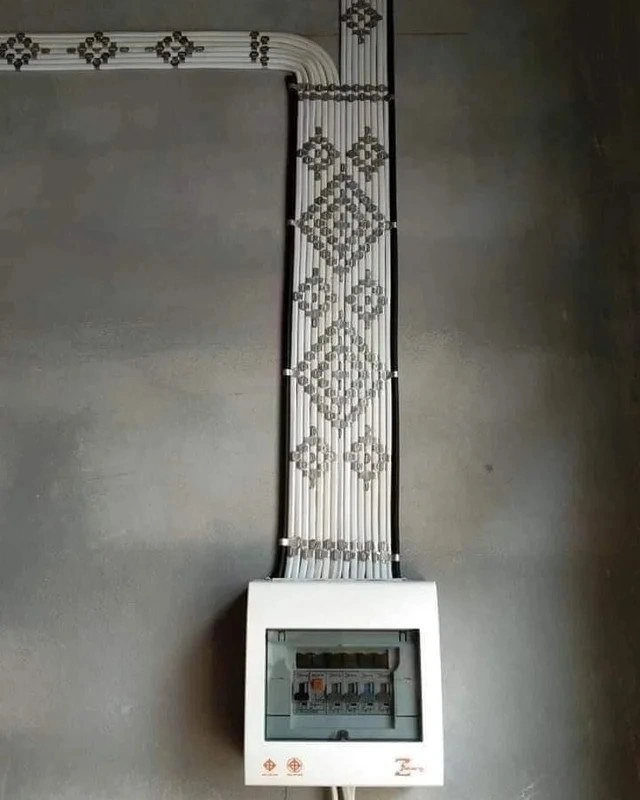
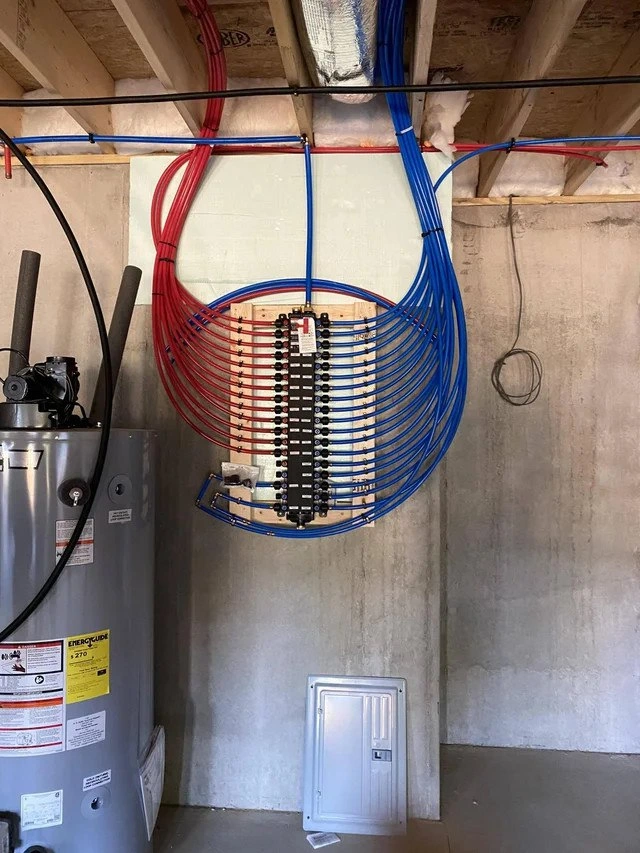
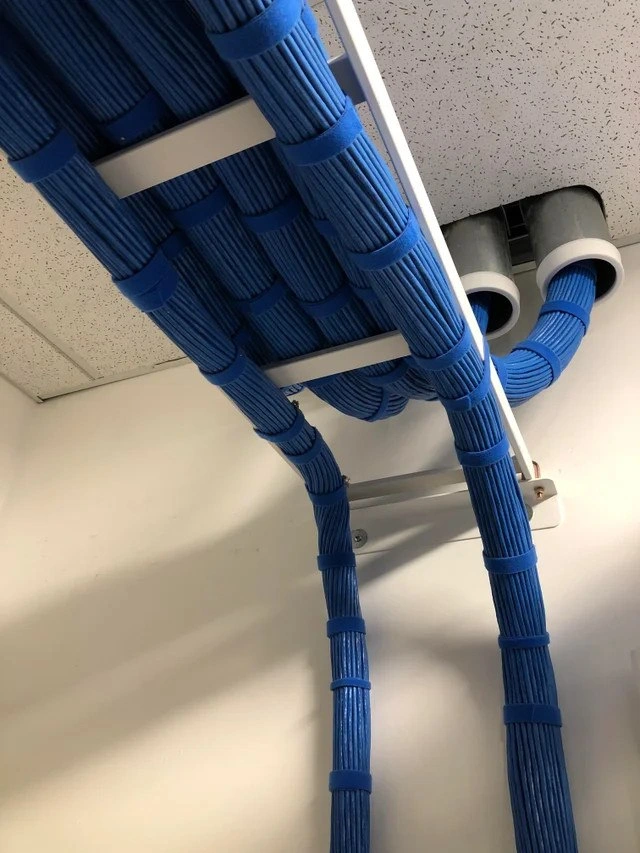
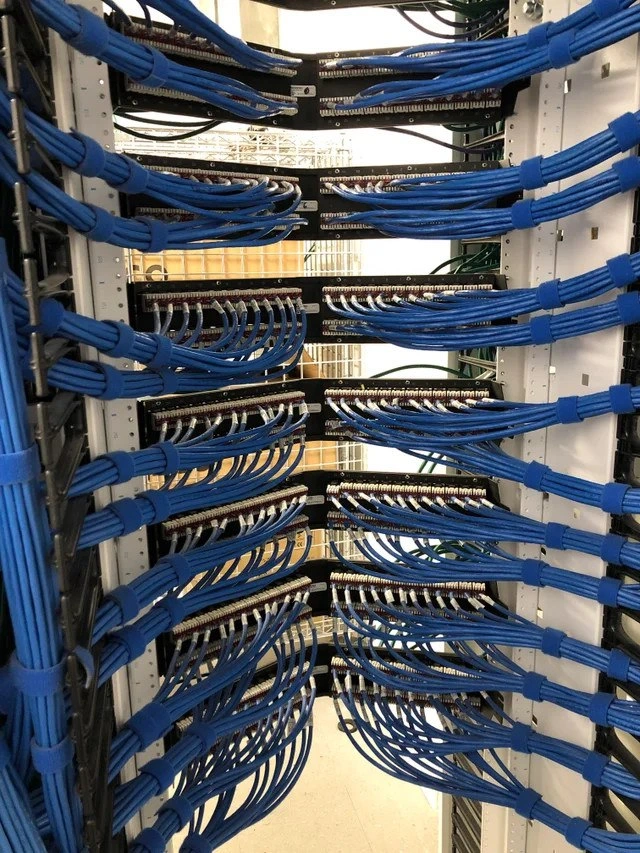
A photograph showcasing exemplary cable management within a server rack, a sight often referred to as 'cable porn' by IT professionals. The image displays dozens of thick, white networking cables meticulously organized into clean, uniform bundles. These bundles are secured with black velcro straps and sweep in graceful, parallel arcs from the side of the rack into patch panels or network switches. The background shows the dark metal frame of the server rack and the dense ports of the networking equipment. The lighting is even, highlighting the pristine condition of the cables and the overall orderliness of the setup. This image is deeply satisfying to engineers and system administrators because it represents an ideal state of infrastructure - organized, maintainable, and aesthetically pleasing - which is a stark contrast to the chaotic 'cable spaghetti' often found in real-world data centers
Comments

7
Anonymous ★ Top Pick This is a picture of a server rack taken 5 minutes before the 'urgent' request to add 'just one more cable' was submitted
  1. Anonymous ★ Top Pick

    This is a picture of a server rack taken 5 minutes before the 'urgent' request to add 'just one more cable' was submitted

  2. Anonymous

    Behold: the only production environment where deterministic routing, zero tech debt, and perfectly decoupled layers are enforced with a 10-cent Velcro strap

  3. Anonymous

    This is what happens when you hire the contractor who charges by the meter instead of by the hour

  4. Anonymous

    This is what happens when your network engineer has both OCD and a performance review coming up. Meanwhile, somewhere in a startup's 'server closet' (read: broom closet), cables are achieving sentience through spontaneous spaghetti-based neural networks. The real question: did this take longer to install than migrating the entire infrastructure to Kubernetes? Probably. Was it worth it? Ask the on-call engineer who can actually trace a cable at 3 AM without having an existential crisis

  5. Anonymous

    The only bundle in tech without version conflicts or transitive dependency nightmares

  6. Anonymous

    Terraform apply IRL: state locked with zip ties; drift detected at 2 a.m.; rollback strategy - scissors

  7. Anonymous

    Velcro instead of zip ties: loose coupling, high cohesion, and perfect bend radius - if only our microservices looked like this patch panel

Use J and K for navigation