Skip to content
DevMeme
1946 of 7435
Artisanal Electrical Wiring as Code Craftsmanship
Infrastructure Post #2162, on Oct 18, 2020 in TG

Artisanal Electrical Wiring as Code Craftsmanship

Why is this Infrastructure meme funny?

Level 1: Everything in its Place

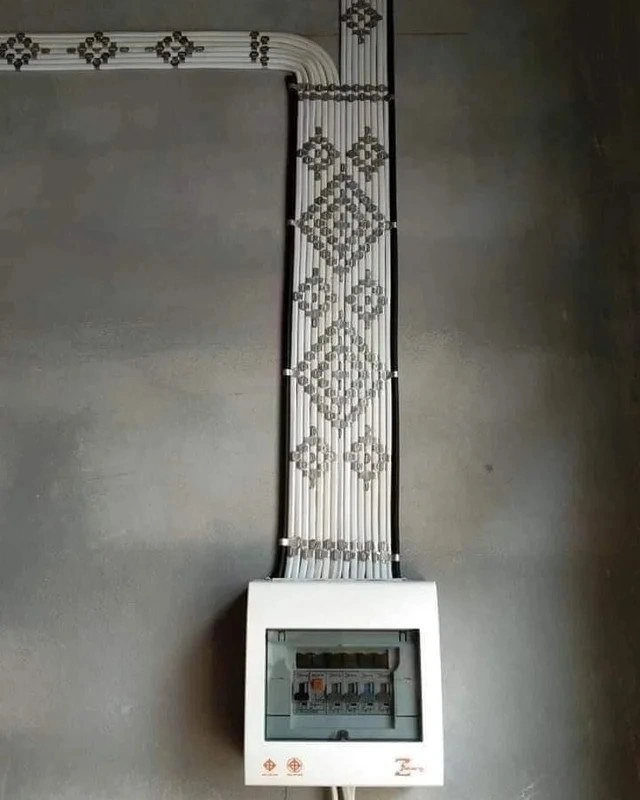
Imagine you walk into your room and see all your toys or tools lined up perfectly straight, sorted by type and color, with no mess at all. For example, think of dumping all your LEGO pieces on the floor (which is usually a big jumbled pile), but instead someone has sorted them into neat rows by shape and color, maybe even making a cool pattern with them. Wouldn’t that feel nice to look at? This picture is funny to us because it shows a bunch of wires (the kind that usually get all tangled like a heap of spaghetti) arranged as neatly as if someone was making artwork out of them. It’s like when you take a chaotic thing and organize it so perfectly that it almost doesn’t look real. Everything is in order: all the wires go straight up together, then all turn left together at the exact same spot, making a satisfying L-shape. The black straps around them make diamond shapes, kind of like a Minecraft or pixel-art design, which turns a boring wall of cables into something creative.

Why is this amusing? Because normally, behind the scenes in buildings or computers, cables are a messy tangle that people hide away. Seeing them treated with this much care and creativity is unexpected – it’s both useful (since it’s super tidy) and playful (it makes a pretty pattern). The feeling it gives is similar to finally untangling a really knotted ball of string and winding it into a perfect coil – ahh, so orderly! In simple terms, it’s really satisfying to see something messy made incredibly neat. It makes people happy to look at, just like a perfectly cleaned up room or a row of crayons arranged by rainbow colors. The joke is that someone who really, really likes keeping things neat (especially a programmer who likes very clean code) would feel as delighted seeing this wiring as a kid might feel seeing all their favorite candies sorted and lined up without any mess at all.

Level 2: Zip Tie Pixel Art

What we’re looking at here is a wall-mounted distribution box (the white panel at the bottom) with an array of electrical circuit breakers inside. This is the kind of panel you’d find in a building to control power to different areas or appliances (similar to the fuse box in a house). The gray concrete wall and the printed warning icons (in red) with Chinese text suggest this is possibly in an industrial or commercial building in Asia. The orange logo might be the manufacturer of the electrical box or the company that installed it. But the real eye-catcher is how the conduit pipes (the white tubes carrying electrical wires) leave the top of the box and go upward in a perfectly organized fashion.

Normally, you’d expect these cables to run messily or just in a simple bunch. Here, roughly twenty white conduits exit the box in a tight, ruler-straight column. They then make a sharp 90-degree left turn near the ceiling. The person who installed these didn’t stop at mere functionality; they used zip ties (those black straps) not only to bundle the cables but to create a decorative pattern. The black zip ties are spaced out at regular intervals, clamping the white pipes together. Because of the deliberate spacing, the ties form a repeating sequence of squares and diamond shapes — it truly looks like pixel art from an old video game, where each black zip tie is like a “pixel” against the grid of white cables. This is why we dub it "zip_tie_pixel_art" in the tags. It’s as if the electrician hid an 8-bit Mario or Zelda pattern in the wiring (okay, not a specific game character, but the geometric patterns definitely give off an 8-bit vibe).

For a junior developer or someone new to engineering, the analogy here is about aesthetics in organization. Think of writing code: you can write a program that works but is all jumbled and hard to read, or you can write it cleanly with consistent indentation, clear naming, and comments. The term “clean code” means code that is formatted and structured so well that it’s easy to read and maintain. That’s the software equivalent of what we see in this panel. Every cable here is like a line of code that’s been formatted to align perfectly with the others. In code, we might use a linter or formatter (like running npm run format with Prettier, or using an IDE’s auto-format feature) to instantly turn messy code into something neatly arranged. In the hardware world, cable management is the counterpart: using cable ties, cable trays, or conduits to organize wires so that they’re not a tangled mess.

Why does this matter? In practical terms, neat wiring makes it easier to maintain and safer. If one circuit is having an issue, a technician can open that panel, immediately see the labels on the breakers, follow the corresponding white conduit up, and know exactly which route that circuit’s wires take. If everything were tangled, that task would be a nightmare of tracing lines and possibly pulling on the wrong cable (imagine debugging a program where all the variables have random names versus one with clear naming conventions). The fact that the conduits go up in a straight column and only turn when they need to (90 degrees at the top) is akin to keeping your code flow structured and not spaghettifying it with random jumps or goto statements. It’s literally spaghetti code vs. well-structured code, but in physical form. In fact, messy wiring is often nicknamed “spaghetti wiring,” and here we have the opposite: a visually satisfying lattice of cables that any engineer would admire.

The meme’s caption jokes about a “clean-code zealot.” A zealot is someone who is extremely passionate, almost to an obsessive degree, about something. In software teams, a clean-code zealot might be the person always insisting on best practices: they enforce strict coding standards, they refactor mercilessly, they love design patterns and may even get fussy about a single misaligned space or a missing doc comment. The joke suggests that such a person, normally obsessed with code quality, would “swoon” (nearly faint with joy) at the sight of this panel. Why? Because it’s basically clean code, but in an electrical wiring context. It’s like their abstract ideals made real in the physical world: perfectly formatted infrastructure. Even the concept of Clean Architecture (a software design principle for organizing code into layers with clear boundaries) is hinted at: this installation is like a “clean architecture” for power distribution – each circuit (like a software module) is clearly separated into its own conduit path, all the paths are organized (like layers), and they converge neatly into the panel (which we can liken to an interface or a central module).

Let’s break down a few terms from the tags and context to make sure everything’s clear:

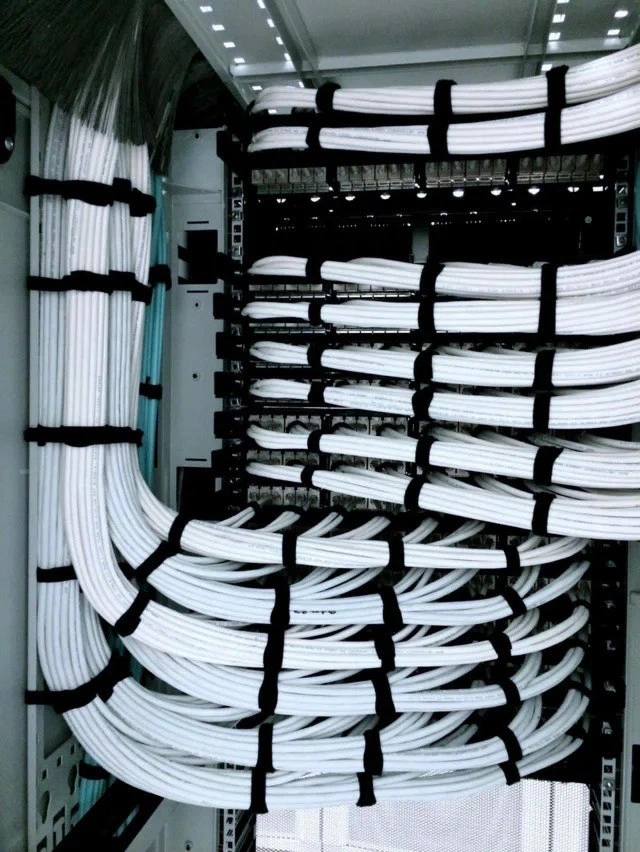
  • CableManagement: This refers to how you organize cables to keep them tidy. In a server rack, for example, good cable management means bundling network cables so they’re not hanging all over, labeling them, and routing them through side panels. It’s both an art and science in IT and engineering fields. Bad cable management leads to confusion, overheating (if airflow is blocked), or even tripping hazards; good cable management, like we see here, leads to efficiency and sometimes internet fame! (People really do share photos of neat cables for fun, hence HardwareHumor and SysadminHumor categories love this stuff.)

  • Zip ties: These are the little black (or sometimes colored) plastic strips used to cinch things together. They have a locking mechanism: you put the tail through the head and it tightens but doesn’t loosen. They’re cheap, come in various lengths, and are ubiquitous for bundling cables. Here, they used black zip ties on white cables to create contrast, so the pattern really pops out visually. Using zip ties at precise intervals is what made the aesthetic_wiring possible. This also shows a bit of restraint: all zip ties line up to form those diamonds and squares, meaning the installer planned the spacing carefully.

  • Panelboard / Distribution box: The white box is where multiple electrical circuits connect to different breakers. Each breaker is a safety switch that will flip off (or “trip”) if too much current flows, preventing electrical fires. In the image, you can see a row of toggle switches (the breakers) behind the glass window. They’re clearly labeled, likely with the names of the areas or devices they control (though the text might be in Chinese). The front has those red icons: typically, one icon might indicate high voltage, another might be a warning to only let authorized personnel open it, etc. These are standard safety labels. The distribution box serving as a canvas for this cable art is typically something utilitarian – usually hidden in a closet or against a wall, rarely paid much attention. Seeing one turned into a artistic display is part of the humor/appeal.

  • Pixel art: This is a style of art where images are made up of small square “pixels,” just like old video game graphics or Minecraft blocks. The patterns made by the black zip ties against the white cables look like pixel art because you can imagine each segment between zip ties as a pixel or a tile in a grid. It’s like someone placed Tetris blocks in a symmetrical pattern. For context, "8-bit" refers to the era of older computing and games (like the original NES or old Mario) where graphics were blocky and pixelated due to low resolution. So calling this cable arrangement “8-bit pixel art” is a fun way to describe the chunky, symmetric patterns.

  • Satisfying_cable_routing and aesthetic_wiring: These tags are highlighting that this isn’t just functional wiring; it’s done in a way that is visually satisfying. There’s a whole corner of the tech world that loves these “satisfying” pictures (like those videos where someone power-washes a dirty sidewalk and it comes out perfectly clean, or when someone cuts a cake into equal pieces flawlessly). For developers and system admins, seeing cables routed so perfectly scratches that same itch. It’s just pleasant to look at, the same way perfectly formatted JSON or an impeccably organized class hierarchy is pleasant to read.

For a junior developer, the key take-away is how universals like organization and clarity apply across domains. Just like you maintain clean and modular code for a software project (so that it’s easy to hand off or update later), an electrician or sysadmin maintains clean and well-organized wiring so that anyone working on it later (including future-you) can trace what’s going on. And when someone goes above and beyond – adding extra flair like symmetric patterns or super tidy alignment – it stands out. It’s both useful and artful. That’s why this meme is both funny and inspiring to tech folks: it’s as if an everyday technical task (wiring up a panel) was approached with the precision of writing an enterprise-grade, beautifully refactored program. The result is so over-the-top satisfying that we can’t help but share it and joke that it would make even the most fanatical clean-code developer weak at the knees!

Level 3: Ruler-Exact Routing

On a deep technical level, this image strikes a chord with seasoned engineers because it embodies clean architecture principles in a literal, physical form. Each white conduit pipe emerges from the distribution panel with ruler-straight precision, then makes a perfect 90° turn — an orthogonal elegance any circuit designer or software architect can appreciate. The black zip ties aren’t just holding cables; they’re carefully placed to form repeating diamond patterns, turning mundane wiring into an 8-bit pixel art tapestry. This is more than just CableManagement – it’s cable craftsmanship.

In the Infrastructure and SystemsAdministration world, we jokingly call such perfection “cable porn,” because pictures of impeccably routed wires give Hardware enthusiasts the same satisfaction that beautifully refactored code gives developers. It’s humorously extreme: somewhere a clean code zealot (the kind who insists on purging every lint warning and aligning every variable assignment) is swooning over this panel as if it were a flawless codebase. The meme makes us grin because we all know how rare this level of order is in practice. We’ve opened server racks or network closets expecting tidy structured cabling, only to find spaghetti instead. Here, by contrast, every conduit is a single-responsibility pathway, no overlaps or crossing lines – like functions in a well-designed program that never step on each other’s toes.

This combination of hardware humor and software analogy lands so well because it highlights a shared ideal across disciplines: clarity and order. We often preach the DRY principle (Don’t Repeat Yourself) and separation of concerns in code; in this panel each cable run is separated and neatly parallel, with zip-tie latticework perhaps ensuring no two lines interfere or repeat paths unnecessarily. The breaker box’s internal circuits are clearly labeled (visible through the glass window), which is the physical equivalent of well-documented code or commits. It’s as if the installer applied a prettier auto-formatter to the electrical wiring – every route standardized, every bend consistent. They even achieved decorative symmetry, a flourish that serves no functional purpose except pride and joy, much like a developer who not only solves a problem but makes the solution elegant.

There’s an undercurrent of shared engineering ethos here: attention to detail. Historically, high-reliability wiring (like in early telephone switchboards or NASA spacecraft) required meticulous bundling and lacing of cables. Old-school engineers used waxed lacing cords in lieu of zip ties to bind wiring harnesses into tidy looms, partly for safety and maintainability, but also as a point of pride. This meme channels that same tradition into a modern setting. Seasoned sysadmins know that neat cabling isn’t just aesthetic – it reduces errors and makes troubleshooting at 3 AM far easier (no guessing which cable #42 among a tangle is the culprit). The humor, then, comes with a nod and a wink: we’re half-amazed and half-amused that someone actually had the time (or OCD tendencies) to make it this perfect. It’s a techno-zen garden on a concrete wall, mixing functionality with art. And deep down, every senior dev or engineer chuckles because we wish our legacy systems, crammed Jira boards, or God-class objects could be whipped into this kind of shape. This picture is the physical manifestation of “No Technical Debt” – an object lesson that sometimes, by investing extra care upfront, you get a system so organized that maintenance becomes a joy rather than a nightmare.

To really highlight the contrast, consider the difference between the usual state of cables and this masterpiece:

Typical Spaghetti Wiring 😱 Pixel-Perfect Wiring 😀
Cables of random lengths tangled chaotically All conduits cut to exact length and run in parallel lines
Messy overlaps and diagonal runs everywhere Strict 90° bends and orthogonal paths, no crossing lines
Unlabeled breakers & mystery circuits 🙈 Clearly labeled breakers, easy-to-trace circuits 🔎
Hard to troubleshoot or modify without pulling on a mess of wires Easy to maintain – you can follow each cable from panel to ceiling like a well-commented function
Functional, barely – prone to human error Functional and beautiful – a showcase of engineering pride

Seeing the right column gives a senior engineer the same kind of serene satisfaction as stumbling upon a legacy codebase that’s actually well-documented and logically structured. It almost never happens, which is why it’s funny: this photo is basically a nerd fantasy. And like any good fantasy, it inspires us – maybe at work we’ll spend an extra hour routing those server cables just so, or refactoring that gnarly code module for clarity, remembering this absurdly satisfying image. In short, the meme humorously celebrates an extreme ideal: whether it’s cables or code, when every element is in its place and purposefully aligned, it’s pure bliss for the detail-obsessed among us.

Description

This image displays an electrical installation that elevates cable management to an art form. Against a plain concrete wall, a bundle of numerous white electrical wires runs vertically and horizontally into a white fuse box. The wires are meticulously organized, and black cable ties are used to create a stunning, repeating diamond-shaped pattern along the entire length of the wire run. This isn't just neat; it's decorative and demonstrates an incredible level of precision and craftsmanship. For developers, this is a powerful metaphor for clean code and well-architected systems. The visible order and aesthetic appeal resonate with the satisfaction of creating logical, maintainable, and elegant software solutions
Comments

7
Anonymous ★ Top Pick This is the physical manifestation of a codebase with zero linting errors, 100% test coverage, and no technical debt. The rest of us are just untangling spaghetti
  1. Anonymous ★ Top Pick

    This is the physical manifestation of a codebase with zero linting errors, 100% test coverage, and no technical debt. The rest of us are just untangling spaghetti

  2. Anonymous

    Proof that Clean Architecture scales to hardware: each conduit is its own bounded context, the zip-ties enforce dependency inversion, and you can hot-swap a domain with nothing but a screwdriver

  3. Anonymous

    When the infrastructure team has more artistic vision than your frontend developers, but still can't explain why the network is down

  4. Anonymous

    When your electrician implements a full mesh topology for redundancy but forgets that electrical current doesn't need consensus protocols. This is what happens when you apply CAP theorem to AC power distribution - technically impressive, operationally questionable, and definitely not following the KISS principle. At least if one conduit fails, you've got N-1 redundancy... though I'm not sure the building inspector will appreciate your interpretation of 'high availability infrastructure.'

  5. Anonymous

    Electrician who gets SOLID: each conduit has a single responsibility, no tangled dependencies

  6. Anonymous

    Goodhart’s law at layer 1: make “cable neatness” an OKR and you get zip‑tie cross‑stitch that nails the metric while doubling MTTR

  7. Anonymous

    Ops implemented the Decorator pattern at OSI Layer 1 - gorgeous diamonds, tight coupling; the next “just add one more circuit” requires a rewrite

Use J and K for navigation