When L1 Cache Outsmarts Quantum Grover Search in Meme Form
Why is this Hardware meme funny?
Level 1: Hide-and-Seek Heroes
Imagine you’re playing hide-and-seek with two friends. One friend is like a superhero – as soon as you finish counting, he already knows exactly where the hider is. He marches straight to the correct hiding spot without checking anywhere else and shouts, “Found you!” every single time, with total confidence. This super friend is like the buff Doge in the meme: he can find what he’s looking for instantly and never misses.
Your other friend is really smart and has a cool trick up his sleeve to find people faster than normal, but it’s not absolute magic. Maybe he has a special pair of goggles that give him a blurry hint of where the person might be hiding. Using these, he doesn’t have to search every single room one by one; instead, he jumps to a few likely hiding spots and usually, pretty quickly, he discovers the person. However, the hint from the goggles isn’t perfect – once in a while he might guess wrong and have to try another spot. So this friend might call out, “I think I found them... oh wait, maybe not. Let me check over here!” He usually locates the hider faster than someone searching completely blindly, but he’s not as ridiculously fast and sure as the first friend.
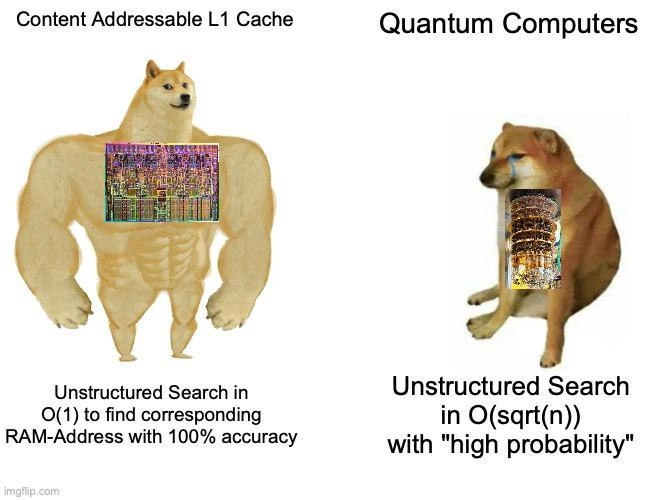
The joke in the meme is funny because you’d expect the friend with the high-tech goggles (like the fancy quantum computer) to be the champion, but here the naturally gifted friend with the almost magical instinct (like the trusty cache in a normal computer) outperforms him. In the picture, the big strong dog represents that instantly-finding friend, and the smaller dog represents the friend with the fancy method that’s almost as good but not quite. It’s a playful way of saying sometimes a simple, reliable trick can beat a complex, futuristic method when it comes to finding something quickly.
Level 2: Cache vs Quantum 101
If you’re a newer developer or just starting to learn about these terms, let’s break down what’s happening in this meme. It’s comparing two very different ways of searching for data: one is using a typical CPU’s fastest memory (an L1 cache) and the other is using a quantum computing trick for search. The joke centers on how fast each one can find something in an unstructured search scenario. “Unstructured search” means the data isn’t sorted or organized in any helpful order – you just have to hunt through everything to find what you want. The left side of the meme is the CPU’s L1 cache (Level 1 cache), which is the smallest and quickest memory located right on the processor chip. When your program needs some data, it first checks the L1 cache because that cache can deliver data much faster than going out to main memory (RAM). Now, “content-addressable L1 cache” refers to the cache using a special hardware feature: content-addressable memory. In a normal memory, you supply an address (like a numbered slot) and get whatever data is stored at that address. But with content-addressable memory (often shortened to CAM), you give a piece of data (or a tag identifying the data), and the memory hardware itself searches all its entries simultaneously to see if that data is stored anywhere. Think of it like asking a room full of 100 people, “Who has the number 7 card?” and everyone in the room checks their own card at the same time – if someone has it, they immediately raise their hand. Because this checking happens in parallel, finding something in a small CAM-based cache takes the same tiny amount of time no matter how many entries are in it. We denote that as O(1) time complexity, meaning constant time. So, if the cache has the data you’re looking for, you get an answer in essentially one step (with 100% certainty that it’s either there or not). That’s why the meme’s left side (buff Doge) is bragging about finding the right RAM address (location of the data in memory) in O(1) time. It’s a guaranteed quick hit, as long as the data is indeed in that cache.
The right side of the meme is about quantum computing, which is a totally different, still-experimental kind of computing. Quantum computers use qubits (quantum bits) that can represent 0 and 1 at the same time (this is called superposition), allowing them to explore many possibilities in parallel in a certain sense. The meme text “unstructured search in $O(\sqrt{n})$ with high probability” refers to a famous quantum algorithm called Grover’s algorithm. Here $n$ is the number of items to search through, and $O(\sqrt{n})$ (pronounced “order of square root of n”) means the time it takes grows about like the square root of the number of items. For example, if you have 1,000 possible places where something could be, $\sqrt{1000}$ is about 31.6, so on the order of ~32 steps are needed with this quantum method. A normal linear search might need up to 1000 steps in the worst case (checking each item one by one), while a quantum search algorithm like Grover’s can find the item in roughly 32 steps. That’s a big improvement when $n$ is large! However, it’s not as instantaneous or surefire as the cache’s one-step lookup. The phrase “with high probability” means the quantum algorithm doesn’t guarantee a 100% correct answer in one run – instead, it gives a very high chance of finding the right answer quickly. In practice, you might run the quantum search a couple of times or use additional techniques to boost the confidence. It’s a bit like saying, “I can probably find what you’re looking for a lot faster than looking everywhere, but I might need a second try just in case.” So the quantum computer’s approach, while much faster than naive search, still scales with the size of the problem (needing more steps as $n$ grows, just a lot fewer than $n$) and has that slight uncertainty factor.
In simple terms: the CPU’s L1 cache uses a hardware trick to find data almost instantly if it’s there – that’s why it’s depicted as the super-strong Doge boasting about constant $O(1)$ time. The quantum computer uses a clever quantum trick to find data much faster than a normal search would – that’s the Cheems dog saying $O(\sqrt{n)}$ time, which for large datasets is dramatically faster than $O(n)$. But Cheems has to add “with high probability” because he isn’t absolutely certain on the first go. The meme is poking fun at how the old-school solution (the cache in your everyday computer) is in this case both faster in complexity and completely reliable, while the cutting-edge solution (the quantum algorithm) is faster than classic search but still slower than the cache and a bit uncertain. It’s a lighthearted way to show the contrast between a sure, instantaneous method and a fancy but probabilistic method for finding a needle in a haystack.
Level 3: Constant-Time Flex
Seasoned developers and computer engineers get a kick out of this buff Doge vs. Cheems scenario because it flips the script on the usual hype. On the left, we’ve got the ultra-muscular Doge labeled “Content Addressable L1 Cache” with a colorful microprocessor die adorning his chest. His caption boasts: “Unstructured Search in O(1) to find corresponding RAM-Address with 100% accuracy.” In plain terms, he’s bragging that he can look up a piece of data in constant time, and never get it wrong. On the right, the whimpering Cheems dog represents “Quantum Computers” – he’s also pasted with a shiny chip image, but his caption admits: “Unstructured Search in O(√n) with ‘high probability’.” That’s a lot less confidence! The poor guy basically says, “I can search faster than normal, but not that fast, and I’m not even always 100% sure I’ve got the answer.” The meme format exaggerates this contrast: buff Doge (the Chad of computing) is doing a victory pose for the old-school cache, while Cheems (the struggling newbie) meekly represents cutting-edge quantum tech with caveats.
For anyone who’s dealt with real-world performance, this meme hits a sweet spot of HardwareHumor and AlgorithmHumor. It’s highlighting a classic PerformanceTradeoffs situation. On one side, the L1 cache is a known hero in everyday computing – experienced folks know that a huge part of speeding up programs comes down to cache hits. A CPU L1 cache is a tiny chunk of super-fast memory right next to the CPU cores. When it’s content-addressable, it means the cache can instantly tell if the data you need (identified by its address tag or content key) is present among its entries. This is implemented by something like a fully-associative lookup: the cache compares your request against all stored tags at once. So from a coder’s perspective, checking the cache is a constant-time operation (O(1)), and if the data is there, you get it immediately with absolute certainty. That’s the buff Doge flexing: the CPU’s memory hierarchy is so well-optimized that finding recently used data is almost like a dictionary lookup that always takes the same tiny amount of time. Senior engineers have spent careers optimizing for cache locality and associativity – it’s a mundane, reliable speedup technique that pays off massively in practice.
On the other side, QuantumComputing is often portrayed as this revolutionary giant – promising to crack RSA encryption, simulate physics, and yes, speed up search problems. Grover’s algorithm is the poster child for that search speedup: instead of $O(n)$ linear time to scan an unstructured list, it can do it in $O(\sqrt{n})$ steps, which is a big theoretical win for very large n. However, those of us in the industry know there’s always a catch. Quantum algorithms are probabilistic; “with high probability” is their version of a fine-print disclaimer. It means you might have to run the quantum search a few times or double-check the result to be sure. Plus, current quantum computers are noisy and have only a small number of qubits – nowhere near the scale to beat classical hardware on something as straightforward as looking up a value in memory. So the Cheems side of the meme elicits a knowing chuckle: the quantum computer sounds a bit underwhelming here, basically saying “I can maybe find it faster than a normal search, but I need special conditions and I’m not always sure.” Meanwhile, the content-addressable L1 cache is like, “Kid, I do this billions of times per second, guaranteed.” It’s the ultimate classical_vs_quantum smackdown in miniature.
The humor also touches on the difference between theoretical Big O bragging rights and practical performance. We often equate lower Big O with better, but here the absolute champ is an $O(1)$ method that relies on throwing hardware at the problem, whereas the vaunted quantum $O(\sqrt{n})$ method still has a non-trivial cost and a bit of randomness. It reminds senior devs of a broader theme: sometimes the hard-earned optimizations in classical computing (like caches, branch predictors, or specialized circuits) can outperform exotic new paradigms for a lot of real tasks. In other words, Performance in practice is a mix of clever algorithms and clever hardware. This meme playfully celebrates that by showing our trusty old silicon muscles overshadowing qubits in a specific contest. It’s saying, in effect, “Don’t underestimate the power of well-engineered classical tech” – a comforting thought for those of us maintaining systems in plain old C or Python while the hype train for quantum (or any new tech) barrels on. When you’ve been around long enough, you learn to appreciate these brilliant low-level feats like content-addressable caches that quietly make everything faster. So seeing a buff Doge personifying that, outshining the timid quantum Cheems, is both informative and hilariously relatable for the tech crowd.
Level 4: Silicon vs Superposition
At the bleeding edge of CS_Fundamentals, this meme pits a specialized piece of classical hardware directly against a quantum algorithm – a showdown between silicon and superposition. The left side’s buff Doge isn’t just for show: it represents a content-addressable memory (CAM) used in a CPU’s L1 cache, which performs an associative lookup in hardware. In a CAM-based search, the query (like a memory tag or content key) is broadcast to all entries in parallel, and dedicated comparison circuits light up for a match. This is why the meme brags about “Unstructured Search in $O(1)$” – in one clock cycle, the cache can tell if the data you want is already loaded and exactly where it is. It’s deterministic and 100% accurate because the hardware literally checks all possible way entries simultaneously. Essentially, a CAM trades silicon real estate to achieve constant-time lookups: if you have $n$ entries, you’ve built $n$ tiny comparators side by side. Complexity theorists would note that the time complexity is $O(1)$, even though the hardware complexity is $O(n)$. In practice, for a small L1 cache (maybe 32 or 64 lines), this parallelism is a worthwhile Performance hack – the CPUCache flexes its muscle by doing what amounts to $n$ comparisons in one go and still calling it constant time.
On the right side, we have Cheems representing quantum computers tackling the same problem of an unstructured search. The meme specifically alludes to Grover’s algorithm – one of the famous QuantumComputingConcepts – which offers a proven quantum speedup for searching an unsorted database. Grover’s algorithm operates in $O(\sqrt{n})$ time, which is a quadratic improvement over the classical $O(n)$ linear search, but notably not as lightning-fast as the cache’s $O(1)$. How does Grover achieve $O(\sqrt{n})$? It leverages quantum superposition to examine multiple possibilities simultaneously and amplitude amplification to boost the probability of the correct answer. In simplified terms, a quantum computer can put all $n$ possible indices into a blended state at once. It uses an oracle (a special quantum subroutine that knows the correct answer) to mark the right state by flipping its phase, and then a diffusion operation (inversion about the mean) to amplify that marked state’s amplitude. Repeating this dance about $\frac{\pi}{4}\sqrt{n}$ times will rotate the system’s state vector to where the target solution has a high amplitude. Finally, when you measure the quantum state, you get the target’s index with high probability. That cheeky phrase “‘high probability’” in the meme underlines how quantum answers are inherently probabilistic – you might need a few tries to be virtually certain of success. Grover’s algorithm is actually optimal for unstructured search in the quantum realm; theory (via the BBBV theorem) tells us you can’t do better than quadratically faster than brute force, so $O(\sqrt{n})$ is the best we know how to do with quantum magic.
The humor emerges from this stark classical_vs_quantum contrast. On paper, the content-addressable L1 cache looks like it’s humiliating the fancy quantum method – a brute-force silicon solution achieving in one step what quantum computing needs on the order of $\sqrt{n}$ steps to do. It’s a bit tongue-in-cheek, of course. The cache’s O(1) is made possible by highly specialized hardware and is practical only for small $n$ (a cache has a limited number of entries, all wired for parallel compare). If you naively tried to scale a CAM to billions of items, you’d need absurd amounts of circuitry – that’s why we don’t have gigantic CAMs replacing all of RAM for searching. Quantum, on the other hand, tackles the general mathematical problem where $n$ could be astronomically large, and still offers a significant speedup over classical sequential search. But in the here and now, for the kind of small, latency-critical lookups that a CPU’s L1 cache handles, the good old silicon brute-force-in-hardware approach can actually beat the pants off a quantum algorithm’s theoretical advantage. The meme captures that ironic twist: the Hardware solution (buff Doge) is confidently flexing deterministic constant-time lookup, while the QuantumComputing solution (Cheems) – despite all its futuristic allure – ends up sounding a bit timid with a mere probabilistic speedup. It’s a delightful nod to the idea that sometimes yesterday’s tech (cleverly optimized in silicon) can outpace tomorrow’s exotic algorithms, at least in certain niches. To visualize the contrast, here's a conceptual code-style sketch of each search approach:
# Classical linear search (O(n) time)
for i, item in enumerate(data):
if item == target:
index = i
break
# Content-addressable memory lookup (O(1) time, hardware parallelism does the work)
index = CAM_lookup(target) # returns index if target is found, in a single step
# Grover's quantum search (O(√n) time, pseudocode for concept)
state = prepare_superposition(n) # put all n possibilities into superposition
for _ in range(round(0.785 * (n ** 0.5))): # ~π/4 * sqrt(n) iterations of Grover's loop
apply_oracle_mark(target, state) # mark the target state by flipping its phase
apply_diffusion(state) # amplify marked state's amplitude (inversion step)
result_index = measure(state) # get the result index (correct with high probability)
Description
The image uses the classic “buff Doge vs. Cheems” split-panel meme. On the left, a hyper-muscular Doge is labeled in bold black text at the top: “Content Addressable L1 Cache.” Across his chest sits a brightly-colored microprocessor die photo. Beneath him, black caption text reads: “Unstructured Search in O(1) to find corresponding RAM-Address with 100% accuracy.” On the right, a small, timid Cheems dog is titled at the top: “Quantum Computers.” A similar die photo is pasted on his torso, and a caption underneath says: “Unstructured Search in O(sqrt(n)) with ‘high probability’.” The meme playfully contrasts the deterministic O(1) associative lookup of a CPU’s content-addressable cache with Grover’s O(√n) quantum search, poking fun at how good old silicon sometimes beats bleeding-edge qubits in practical latency-sensitive workloads

Comments
22Comment deleted
Sure, Grover gives you √n speed-up, but my L1 CAM calls that ‘naptime between two clock edges.’
After 20 years of quantum computing promises, we're still waiting for that killer app while my L1 cache continues to humble Grover's algorithm every nanosecond - turns out the real quantum superposition was the friends we made along the way to room-temperature operation
Ah yes, quantum computing: where we trade the silicon certainty of 'I know exactly where that byte is' for the quantum equivalent of 'I'm pretty sure it's in one of these superpositions, give me sqrt(n) tries and I'll probably find it.' Meanwhile, your L1 cache is sitting there like 'I've been doing O(1) lookups since before you knew what a qubit was, and I don't need a dilution refrigerator to do it.' It's the ultimate hardware flex: deterministic nanosecond lookups at room temperature versus probabilistic microsecond searches at near absolute zero. But hey, at least quantum gets the VC funding
L1 cache: Grover's algorithm in silicon since the '90s, zero superposition, full determinism - no decoherence excuses needed
Grover buys you sqrt(n) queries; CAM buys O(1) by burning n comparators and your entire power budget - choose your asymptotic poison
Grover gives you O(√n) with amplitudes; CAM gives you O(1) with watts - architects know which constant hurts in production
basically accuracy vs speed trade-off Comment deleted
Don't say that, it sounds like it will turn into three-body problem when memory gets introduced Comment deleted
Do I need to remind people about Meltdown and Rowhammer every month instead of every year? :) Comment deleted
Big O notation there clearly says it's at a disadvantage for both Comment deleted
100 years in development vs 20 years in development Comment deleted
OK but when traditional caches were a probabilistic structure? Comment deleted
made one yesterday but i dont wanna share.... 💯 Comment deleted
There are for different types of tasks Comment deleted
Sir, this is Wendy’s meme For a serious discussion though we have posts like https://t.me/dev_meme/6392 I do actually hope that 50%+ of followers do get the difference between tasks that each of them is expected to solve the best. But let’s get some laugh at those Q while they didn’t broke all our crypto guards based upon dozens of years of research Comment deleted
Wait a minute… so you’re telling me I shouldn’t have printed the meme and included it in my presentation to the manager? Comment deleted
Better put it on the first page of your CV so those HRs know in advance you’re fluent with algorithms 👋 Comment deleted
Yall better learn how to anneal Comment deleted
Get right with QUBOs Comment deleted
Constrain your quadratics Comment deleted
cam is only o(1) for the same class of search problems if you fill up o(n) memory first with the entire search space Comment deleted
but n is huge Comment deleted