Skip to content
DevMeme
7098 of 7435
qrpff: DVD DeCSS Descrambler in 472 Bytes of Perl
Cryptography Post #7782, on Mar 3, 2026 in TG

qrpff: DVD DeCSS Descrambler in 472 Bytes of Perl

Why is this Cryptography meme funny?

Level 1: The Secret Recipe on a Napkin

A big company locks its movies in a special box and says, "Only our official can-openers may open this, and telling anyone how it works is forbidden!" Then two students discover the lock is so flimsy that the instructions for picking it fit on a single napkin — and people start printing the napkin on T-shirts and wearing it everywhere. The funny part is the size mismatch: an entire industry's scary, lawyer-guarded lock, defeated by a recipe shorter than a grocery list. Once a secret fits on a shirt, it's not really a secret anymore.

Level 2: Reading the Unreadable

  • CSS scrambled commercial DVDs so only licensed players could read them; DeCSS is the umbrella name for code that unscrambles it.
  • A VOB file is the container on a DVD holding the MPEG-2 video stream — the input both scripts consume.
  • Perl golf is the sport of writing working programs in as few characters as possible, exploiting Perl's default variables ($_), map, pack, and regex substitutions — all visible in the colored body text.
  • The DMCA (Digital Millennium Copyright Act, 1998) made it illegal to circumvent copy protection or distribute tools that do — which is why a 472-byte script became a federal courtroom topic.
  • stdout/stdin are just a program's standard output and input pipes: feed scrambled movie in, get watchable movie out.

For someone early in their career, the takeaway is that code can carry meaning beyond its function. You'll meet obfuscated code as an accident (legacy spaghetti) and as an art form (golf, the IOCCC) — qrpff is the rare case where it was a protest banner.

Level 3: The Cipher That Fit on a T-Shirt

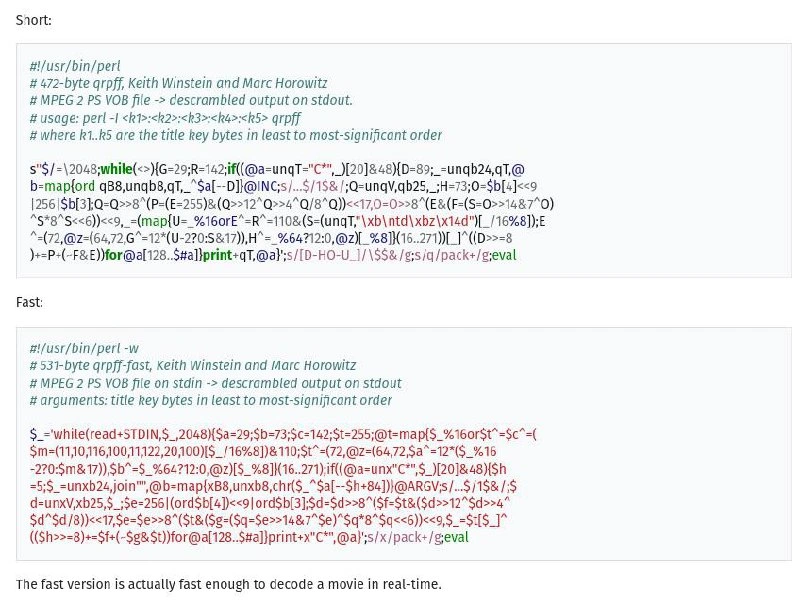
The screenshot shows two golfed Perl programs, labeled Short: and Fast:, with header comments that are almost defiantly polite given what follows:

# 472-byte qrpff, Keith Winstein and Marc Horowitz # MPEG 2 PS VOB file -> descrambled output on stdout.

…and then bodies like s"$/=\2048;while(<>){G=29;R=142;if((@a=unqT="C*",_)[20]&48){D=89... — sigil soup ending, naturally, in eval. The closing caption deadpans: "The fast version is actually fast enough to decode a movie in real-time."

This is qrpff, written by two MIT students in 2001, and it's less a program than a legal argument. Context: in 1999, DeCSS broke DVD encryption, and the movie industry responded with DMCA anti-circumvention lawsuits, arguing that distributing the code was trafficking in a "circumvention device." The hacker community's counter-thesis was that code is speech — and qrpff was the reductio ad absurdum. If 472 bytes of Perl can be banned as a "device," can it be banned when printed on a T-shirt? Recited as a haiku? Sung? (All of these happened — DeCSS was distributed as poetry, images, and a dramatic reading.) The golfing wasn't vanity; the smallness was the point. Every byte shaved made the "this is a dangerous machine, not expression" argument more absurd.

The Fast: variant (531 bytes, reading a VOB from stdin) lands a second blow: the claim wasn't just that descrambling could be expressed compactly, but that the forbidden act was practically trivial — real-time movie decoding in a one-liner. Meanwhile, Perl's reputation as a write-only language does load-bearing comedic work here: the same community that mocked unreadable Perl celebrated this particular unreadability as civil disobedience with syntax highlighting. Twenty-five years on, the meme endures because the industry lesson stuck: DRM that ships the key with the lock always falls, and legal force is a poor patch for broken math.

Level 4: Forty Bits of Hubris

What those 472 bytes actually implement is the Content Scramble System (CSS), the DVD industry's late-1990s encryption scheme — and the reason it fits in a tweet-sized Perl program is that CSS was cryptographically doomed from the drawing board. CSS is built on two linear feedback shift registers (LFSRs) — 17-bit and 25-bit — whose outputs are combined through 8-bit adders with carry to produce a keystream XORed against the MPEG-2 payload. LFSRs are wonderful for cheap hardware (a DVD player in 1997 had to descramble in real time on pennies of silicon) and terrible as a security primitive: their linear state evolution means knowing a short stretch of output lets you wind the registers backward.

Worse, export regulations of the era effectively capped the key at 40 bits, and the cipher's structure leaks so badly that the effective strength is far lower — Frank Stevenson's 1999 cryptanalysis showed attacks on the order of $2^{25}$, brute-forceable in seconds on a Pentium. The visible code mirrors this honestly: the header asks for <k1>:<k2>:<k3>:<k4>:<k5>five title key bytes — and the body is essentially those two shift registers ($Q>>8, <<17, masks like &48 and 255) plus table lookups, expressed in Perl's most compressed dialect. The deep irony is mathematical: a system whose security depended on the secrecy of a weak algorithm met Kerckhoffs's principle head-on and lost in 472 bytes. The constraint that made CSS cheap to implement in hardware is exactly what made it small enough to wear.

Description

A screenshot showing two blocks of syntax-highlighted Perl source code labeled 'Short:' and 'Fast:'. The short version's header comments read: '#!/usr/bin/perl', '# 472-byte qrpff, Keith Winstein and Marc Horowitz', '# MPEG 2 PS VOB file -> descrambled output on stdout.', '# usage: perl -I <k1>:<k2>:<k3>:<k4>:<k5> qrpff', '# where k1..k5 are the title key bytes in least to most-significant order'. The fast version is '# 531-byte qrpff-fast' reading a VOB from stdin. Both bodies are nearly unreadable golfed Perl one-liners full of sigils, bit-shifts, map/pack and an eval. Caption below: 'The fast version is actually fast enough to decode a movie in real-time.' This is the legendary qrpff DeCSS implementation - CSS DVD decryption compressed into a few hundred bytes, famous from the DMCA era when the code was printed on T-shirts as free speech protest
Comments

8
Anonymous ★ Top Pick 472 bytes that broke DVD encryption, yet still more readable than our prod regex for email validation
  1. Anonymous ★ Top Pick

    472 bytes that broke DVD encryption, yet still more readable than our prod regex for email validation

  2. @sukhrob_ikromov 4mo

    It’s 6-7 lines of code

  3. @SamsonovAnton 4mo

    Perl's best coding practice, circa year 2000 — the exact reason I quit learning Perl right from the start.

  4. @Nocturn_le_chat 4mo

    Wth this even is

  5. @FunnyGuyU 4mo

    This is obfuscated or deliberately written like gibberish. If you split this into lines and give some meaningful names to the variables, it wouldn't appear so intimidating.

  6. @palaueb 4mo

    In year 2001 I was used to code javascript like this to optimize size😂😂, other developers hated me hard

    1. @pnlt_s 4mo

      now there's a tool to do this automatically

  7. @palaueb 4mo

    Yeah! Progress!!

Use J and K for navigation