Developer’s first salty, then sheepish reaction when QA exposes a bug
Why is this Bugs meme funny?
Level 1: Cookie Jar Confession
Imagine a little kid who did something naughty, like sneaking a cookie from the cookie jar when they weren’t supposed to. 🍪 Now, the mom comes in and says, “Hey, did you take a cookie from the jar?” The kid, not wanting to get in trouble, crosses his arms and shouts, “No! I didn’t take any cookie! How could you accuse me?!” – basically getting upset and denying it even though there are cookie crumbs on his face. That’s the first reaction: anger and denial because the kid’s pride is hurt and he really doesn’t want to be caught. But the mom gives him that look and maybe points out the obvious crumbs or the lid left open. Realizing he’s been found out, the kid’s tone completely changes and he mumbles, “...Okay, yes, I did take a cookie. You’re right.” 😇 Now he feels a bit embarrassed and admits the truth.
This meme is just like that, but with a software bug. The developer is like the kid who made a mistake (wrote some bad code), and the QA person is like the mom who discovered the mistake. At first, the developer gets mad and defensive – kind of like saying “No, you’re wrong! There’s nothing wrong with my code!” (that’s the “Well first of all, screw you” part, which is him being angry at having his mistake pointed out). It’s funny because it’s such a human reaction – sometimes when we’re accused of messing up, even if we did mess up, we get angry instead of admitting it right away. But then, just like the kid with the cookie, the developer realizes the tester is correct. In the end he’s like, “Yeah… you’re right.” It’s that sheepish feeling when you know you’ve been caught. We laugh at the meme because we recognize this pattern in ourselves or people we know: first getting all huffy and saying “No, not me!”, then shortly after going, “Alright, my bad. You were right.” The contrast between the big temper tantrum and the quiet admission makes it humorous and very relatable, whether it’s about cookies or coding errors.
Level 2: Debugging Denial
Let’s break down what’s happening in simpler terms. The meme shows a software developer at his desk (you can see his dual monitors with a dark-themed code editor open) reacting to a tester (QA) who found a mistake in his program. QA stands for Quality Assurance – that’s the part of the team whose job is to test the software and find any bugs (errors or flaws in the code) before it goes out to users. Think of QA engineers as professional software testers: they click all the buttons, enter crazy inputs, and try all sorts of scenarios to make sure everything works correctly. A bug, in software terms, is when the program doesn’t behave as intended. It could be a crash, a wrong calculation, a button that doesn’t do anything – any kind of defect. Here, QA has found a bug “in my code”, meaning the developer wrote something that isn’t working right, and the tester caught it. This is part of the normal QA process: developers create features, and QA tests those features thoroughly to ensure quality.
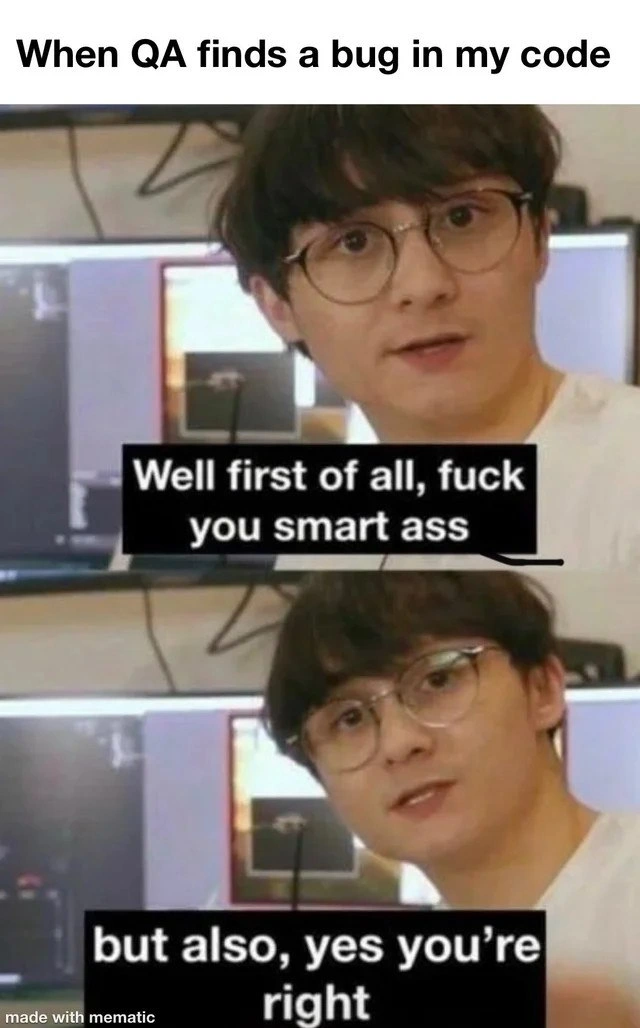
Now, how does the developer react? The top text of the meme already sets the mood: “When QA finds a bug in my code.” Immediately we know the developer’s pride might be hurt. In the first image panel, the caption on the black bar is “Well first of all, f* you smart ass,”** which is a very blunt and rude way of saying “I’m not happy you pointed that out!” 😅 This is an obviously exaggerated, salty reaction – in real life, a professional wouldn’t (or shouldn’t!) curse out the tester for finding a bug. But it humorously reflects the developer frustration that can happen internally. The developer is basically having a tantrum: he’s in denial, possibly thinking “No way, there’s no bug – you must be mistaken or using it wrong.” Often, when someone first tells a programmer there’s something wrong with their code, the programmer’s instinct is to push back a little. A super common phrase developers use is “It works on my machine!”. This phrase has become a running joke in development circles. What it means is: “When I ran this code on my own computer, everything seemed fine. So if you see a problem, maybe the problem is on your side (like your computer or how you ran it), not my code.” It’s basically a defensive excuse. Here, the meme’s first caption is like the rude version of “It works on my machine, you must be doing something wrong,” delivered with a whole lot more anger and spice. The developer is calling the QA a “smart ass” – implying the tester is being too clever or nitpicky – because he’s upset that there’s a flaw being pointed out. This is the dev vs QA banter we talk about: developers sometimes jokingly get mad at QA for breaking their stuff, but really it’s all part of the job.
In the second panel, the subtitle text switches to “but also, yes you’re right.” 😂 This is the punchline: after that flare of anger, the developer has checked and realizes the QA is actually correct. There is a bug. His code isn’t as perfect as he thought. So now he looks a bit sheepish (you can see in the image, the developer’s face is kind of like “well, you got me there”). He basically goes, “Yeah... okay, fair enough.” This two-stage reaction – from denial to acceptance – is something many new programmers experience as they start working with testers or even in code reviews with senior developers. At first, it’s a blow to your ego when someone finds a mistake you made. You might react defensively or think “that can’t be true.” But after you reproduce the issue yourself, you have to admit they were right. In a way, this is a tiny version of the debugging process: step 1, you doubt there’s an issue; step 2, you investigate and confirm the issue; step 3, you accept it and then fix it. The meme just focuses on the emotional twist between step 1 and 2.
Let’s explain a few terms and concepts from this scenario:
- Developer vs QA roles: A developer writes the code for an application. QA (Quality Assurance) tests that application to ensure it works correctly. Sometimes QA is a separate team, sometimes they’re engineers in the same team dedicated to testing. They report problems (bugs) back to the developers so they can fix them. In practice, they work together, but this can lead to a kind of friendly rivalry. Developers might feel “Ugh, QA is always trying to break what I build,” and testers might tease, “If I don’t find any bugs, are you sure you actually built anything useful?” It’s all about ensuring the final software is solid.
- Bug report and defect triage: When QA finds a bug, they usually file a bug report (often in a tracking system like Jira or GitHub issues). This report describes the problem and how to reproduce it (the steps to make the bug happen). There might be a meeting called defect triage where the team (devs, QA, managers) reviews new bug reports to prioritize them – deciding which bugs need to be fixed now and which can wait. In those discussions, a developer might initially downplay a bug (“Is it really a bug? Maybe the user won’t do that.”) and QA will insist (“It is a bug, and we should care because X, Y, Z”). The meme’s first reaction is basically a super-sarcastic, unprofessional version of a developer saying “This bug report is bogus!” followed by the second reaction, which is like “Actually, never mind, the bug report is valid.”
- Pride in code vs product quality: Developers often take pride in their work – they’ve spent hours or days writing this code, so they feel attached to it. When someone finds an issue, it can feel like personal criticism. That’s why the dev in the meme gets defensive. But QA’s job is to ensure quality, meaning they want the product to be the best it can be, and that means finding problems. The phrase ego vs quality (hinted at in the meme context) boils down to: sometimes a coder’s ego (not wanting to be wrong) conflicts with the need for good quality (admitting something’s wrong so it can be fixed). In professional environments, good teams encourage open communication so that it doesn’t become a blame game. Instead of “Who messed up?”, the mindset shifts to “Okay, there’s a bug – how do we fix it?”.
- Developer frustration & debugging: The feelings shown are forms of frustration. First, developer frustration at someone pointing out a mistake (nobody likes being told they goofed, especially if they were confident). Second, there’s the implicit debugging frustration that follows: once he admits the bug is real, the developer knows he has to dive back into his code to diagnose and fix it. Debugging can sometimes be challenging and time-consuming. Imagine having to comb through hundreds of lines of code or retrace a complex problem – it can be tedious. That’s why a dev might groan when a QA finds a bug, not just out of wounded pride, but also because they know it means unexpected extra work ahead, possibly under time pressure.
- “Works on my machine” (classic phrase): It’s worth noting again because this is practically the PG version of what the meme said. If you spend any time around developers, you’ll hear this phrase joked about a lot. It basically means the developer didn’t notice the bug in their own environment, implying the tester must have some weird setup or did something odd. It often leads to the discovery that the developer’s environment was different (maybe they had a certain setting on, or their data was clean), whereas the tester tried something else. In any case, it’s a famous tongue-in-cheek excuse. Here, the meme just cuts to the chase with a much more blunt “f*** you, smart ass,” which is obviously not a professional excuse, but comically amplifies the sentiment behind “It works on my machine.”
If you look at the image itself, it’s a two-panel screenshot of the same person (the developer) at his desk. It’s likely from a video or just staged for the meme. He looks young, wearing glasses, and in both panels he’s turned towards the camera. In the first panel, even though his face is a bit blurred, you can imagine he has an annoyed or sassy expression as he delivers that first line. In the second panel, his expression is more subdued, like “yeah, I can’t really argue now.” The dual monitors in the background with code are a nice touch – it immediately signals “this is a programmer.” Many devs use multiple screens to code, and the dark theme on the editor is a common preference (it’s easier on the eyes during long coding sessions, plus it looks cool 😎). The little watermark “made with mematic” in the corner tells us this meme was created using the Mematic app, which is a popular meme generator. That watermark is pretty common to see on memes; it means the image and text format likely came from a meme template the creator chose in the app. So this whole setup is a known meme template style: big white text at top for context, bold caption bars for dialogue or reactions, etc. The presence of that watermark is a small meta-joke to meme enthusiasts – it’s like seeing the branding of the tool used, but it doesn’t affect the joke itself.
The context tags like qa_vs_dev_banter and bug_report_reactions basically describe what we see: a playful exaggeration of the banter between QA and dev, and how developers react to bug reports. In real workplace interactions, things are (usually) more cordial. Often the developer will investigate the bug report and either say “Ah, you’re right, my bad,” or occasionally “I can’t reproduce it, can you give more details?” if they truly can’t see the issue initially. But the funny part is that emotionally, many devs admit to going through this exact two-phase reaction internally. First, a flare of “No, it can’t be!” (maybe with an eye roll or a grumble), then a realization of “Ok, it is.” It’s almost like a mini version of the five stages of grief – denial then acceptance (skipping bargaining, etc., unless you count “maybe it’s not a big deal?” as bargaining 😅).
For a junior developer or someone new to working with QA, the takeaway from this meme (besides the laugh) is: don’t take bug reports personally. Even though the meme shows the dev being defensive and then conceding, it’s showing it in a comical light. In reality, the quicker you can move past the “No way!” phase and into “Alright, let’s see what’s wrong and fix it,” the better it is for everyone. QA and developers are on the same team, even if they playfully rib each other. The reluctant acceptance in the second panel is actually a positive thing — it’s the moment the developer can start solving the problem. And every bug solved makes the software better for users. In the end, both the dev and QA want the product to succeed. So while the dev might start out saying “Ugh, you got me, you jerk,” the unspoken next line is, “Thanks for catching that, let’s make it right.” This meme just boils that whole dance into two captions, making us laugh at how ridiculous we can be about our own mistakes.
Level 3: Ego vs Quality
At the highest level, this meme pokes fun at a developer’s ego clashing with software quality demands. It captures the exact moment a coder’s pride takes a hit: QA (Quality Assurance) has identified a bug in the developer’s code. For seasoned engineers, this scenario is both painfully familiar and darkly funny. We’ve all been there – that sinking feeling when a tester breaks the feature we were so sure was bulletproof. The top caption sets the stage: “When QA finds a bug in my code.” Immediately, every experienced dev recalls countless bug reports arriving from QA, often right when you thought the code was perfect “done”.
The humor comes from the two-part reaction shown in the meme. In the first panel, the developer’s defensive reflex kicks in, and he basically says: “Well first of all, f* you smart ass.”** This is an exaggerated, unfiltered version of the knee-jerk developer frustration many feel when someone points out their mistake. Of course, in a professional setting you (hopefully) don’t actually say something that rude to QA – you might think it, or mutter it under your breath when a new bug report pops up in JIRA at 4 PM on Friday. The phrasing "smart ass" is telling: the dev is acknowledging (grudgingly) that the QA was clever to find what he missed, even as he’s annoyed. It’s classic QA vs Dev banter. The developer’s pride is stung – “How dare you find a fault in my beautiful code!” – so the first impulse is to shoot the messenger with a snarky remark. It’s an ego defense mechanism. In real life, this might be phrased more diplomatically as “Are you sure you’re using it right?” or the infamous “Works on my machine!” excuse. That’s developer-speak for “I didn’t see this bug when I ran it, so maybe it’s not my fault.” It’s a deflection, sometimes accompanied by blaming the test environment or troubleshooting everything except the code itself. This is where the seasoned cynic in us chuckles: we know that denial is often the first stage of bug grief.
In the second panel, reality sinks in. The developer’s expression softens and the subtitle reads: “...but also, yes you’re right.” Cue the reluctant acceptance. This is the sheepish, face-saving way of saying “Okay, you got me. The bug is real.” The humor intensifies here because of the whiplash in tone: going from an F-bomb to a meek concurrence in a split second. It’s a comedic exaggeration of how a developer inwardly transitions from indignant denial to resigned agreement once they actually investigate the issue. Any senior developer reading this meme can practically hear their inner voice going, “Ugh, fine – QA was right (again).” You might not use those exact words, but you eventually tell the tester, “Thanks, I’ll fix it.” It’s an ego vs quality battle: your ego puts up a fight, but quality assurance wins because facts are facts – the code is broken in some way. The bug report from QA proved valid. Experienced devs know that feeling all too well, and they’ve learned that bugs in software are inevitable no matter how smart you are. It’s why we have a whole QA process in the first place! The meme perfectly encapsulates that inner conflict: part of you wants to insist “Impossible, my code is fine,” but the wiser part knows “If QA says it’s broken, it probably is.”
This meme also hints at the broader dynamic between development and testing teams. Historically, there’s been a playful rivalry – sometimes tense, sometimes jovial – between devs and QAs. Testers are tasked with defect triage and trying to “break” the application to ensure all bugs are caught. Developers, on the other hand, strive to build and maintain the software. When a tester finds an issue, it can feel like they’re attacking your baby, the code you crafted. It’s not truly personal, but in the moment it feels personal. That’s why the dev’s first reaction in the meme is so salty, as if someone insulted his work or intelligence. In reality, a good QA engineer isn’t trying to make the developer look bad; they’re trying to make the product better. But in the trenches of tight deadlines and late-night builds, a new bug report can feel like an accusation: “You messed up.” The developer frustration is real – especially if it’s a bug in a part of the code you were confident about, or a weird edge case you never considered. There’s an almost fight-or-flight instinct: fight (deny, argue it’s not a bug or not your fault) or flight (blame something else, avoid the discussion). Seasoned devs have sat through enough bug report reactions to know that arguing with QA is usually a losing battle (and a waste of time). The code either works or it doesn’t. You can delay the truth, but eventually you’ll have to face it.
Let’s talk about debugging for a moment. Once the developer accepts “Yes, you’re right,” that’s when the real work begins: figuring out why the bug happened and how to fix it. Sometimes that reluctant acceptance is accompanied by an inward groan because you know you’re about to dive into a tedious troubleshooting session. Maybe it’s a nasty null pointer exception that only occurs under certain conditions, or an off-by-one error that QA spotted because they tried an input of 0 when you only tested positive numbers. A senior dev reading this meme might laugh remembering the countless times they said, “No way, that crash can’t happen”, only to find a bizarre combination of inputs or a race condition proving them wrong. It’s funny in hindsight (and in memes) because it’s so universal. The meme’s text could almost be the transcript of a defect triage meeting in mini form:
- QA: “There’s a bug in the new feature.”
- Dev (initially): “I highly doubt that. It worked fine for me. Are you sure? What did you do, exactly?” (subtext: user error or environment issue, maybe?).
- QA: “I did XYZ and it reliably crashes.”
- Dev: sigh “Okay... you’re right. I’ll look into it.”
The first panel’s caption, albeit crude, is just the unfiltered version of that defensive pushback. The second panel is the capitulation. It’s testing humor at its core – exaggerating the dev’s internal monologue for comedic effect. And notice, the dev calls QA “smart ass” – implying the tester is a bit too clever. It’s a backhanded compliment; he’s basically saying “yeah, you’re smart enough to find the bug I missed, and that annoys me.” This tongue-in-cheek animosity is something many development teams channel into friendly competition: some teams even joke about how many bugs QA can find versus how few bugs devs allow to escape. There’s ego vs quality but also team camaraderie beneath it if done right. After all, everyone’s goal is a high-quality product; they just approach it from opposite sides. Good QAs often take pride in breaking things, and good devs (after cooling off) appreciate that someone made their work more robust by catching mistakes early.
From a senior perspective, this meme also subtly nods at best practices versus reality. In an ideal world, a developer writes comprehensive unit tests and does thorough debugging/troubleshooting so that QA barely finds anything. But in reality, tight deadlines, complex systems, and human error mean QA will find something you overlooked. The initial defensive reaction is basically the dev’s brain saying “No, it’s not my fault – it must be something else!” We joke that a developer’s first law of denial is “there’s no way that bug is due to my code.” Yet, nine times out of ten, yes it is. 🙃 Over time, a battle-hardened programmer becomes almost grateful when QA finds a bug, because it’s far better than having that bug slip into production. As a cynical veteran might say: Better to swallow your pride now than swallow a production outage at 3 AM. The meme’s humor is amplified by that truth. The dev’s salty face in panel one is every engineer internally screaming “Noooo!” when a bug stops their code from being perfect. Panel two is the same engineer five minutes (or an hour) later, after reproducing the issue, quietly muttering “Dang it, they were right. Time to fix my screw-up.” It’s a little victory for QA and a little humbling for the dev. And in software, those moments never really stop, no matter how senior you get – you just learn to move faster from panel one to panel two (ideally skipping the profanity 😅). In short, the meme resonates because it’s a comically truthful snapshot of the dev vs QA dynamic: initial defensive banter, followed by begrudging cooperation to squash the bug. It’s developer humor drawn from real experience, reminding us not to let pride get in the way of improving our code.
Description
The meme shows two vertically stacked screenshots of a young developer (face blurred) sitting at a desk with dual monitors that display a dark-themed code editor and other windows. A bold black headline on a white background at the top reads, "When QA finds a bug in my code." In the first panel, a black subtitle bar says, "Well first of all, fuck you smart ass," capturing the developer’s knee-jerk defensiveness. The second panel repeats the scene but the subtitle now reads, "but also, yes you’re right," illustrating reluctant acceptance. A small "made with mematic" watermark sits in the bottom-left corner. Technically, the joke highlights the classic dev-versus-QA dynamic during defect triage: initial ego-driven denial followed by acknowledgement that the tester’s bug report is valid
Comments
12Comment deleted
Bug triage is just my emotional eventual-consistency model: first I serve QA some stale outrage, a few retries later I converge and admit my “thread-safe” code was purely eventual fiction
After 20 years in the industry, you learn that QA finding bugs in prod is actually a feature - it means your monitoring didn't catch it first and you still have a QA team that hasn't been 'optimized' away by management who read about shift-left testing in a Medium article
The five stages of grief when QA files a ticket: denial ('works on my machine'), anger ('well first of all...'), bargaining ('can we call it a feature?'), depression (staring at the stack trace), and acceptance ('but also, yes you're right'). Senior engineers skip straight to acceptance - they've seen enough production incidents to know QA just saved them from a 3 AM page
QA's gift: exposing that 'impossible' path you optimized into oblivion, right before it tanks prod
QA drops a cURL repro, DB seed, and HAR; my initial 500 (denial) turns into a 200 (ACK) once I notice the p99 race condition
QA opens a ticket; my ego runs a two-phase commit: PREPARE “can’t reproduce,” COMMIT “adding the regression test.”
Почему Comment deleted
https://t.me/dev_meme/3667 Please use English as main language -- translate message or explain its meaning Fast trabslation (may be inaccurate): Why Comment deleted
Непонятно Comment deleted
https://t.me/dev_meme/3667 > Please use English in this chat. Comment deleted
Thats me😂😂😂 Comment deleted
My favorite reaction 🤣 Comment deleted