A 'Mature' Python String Concatenation Joke
Why is this Languages meme funny?
Level 1: Hidden Word Prank
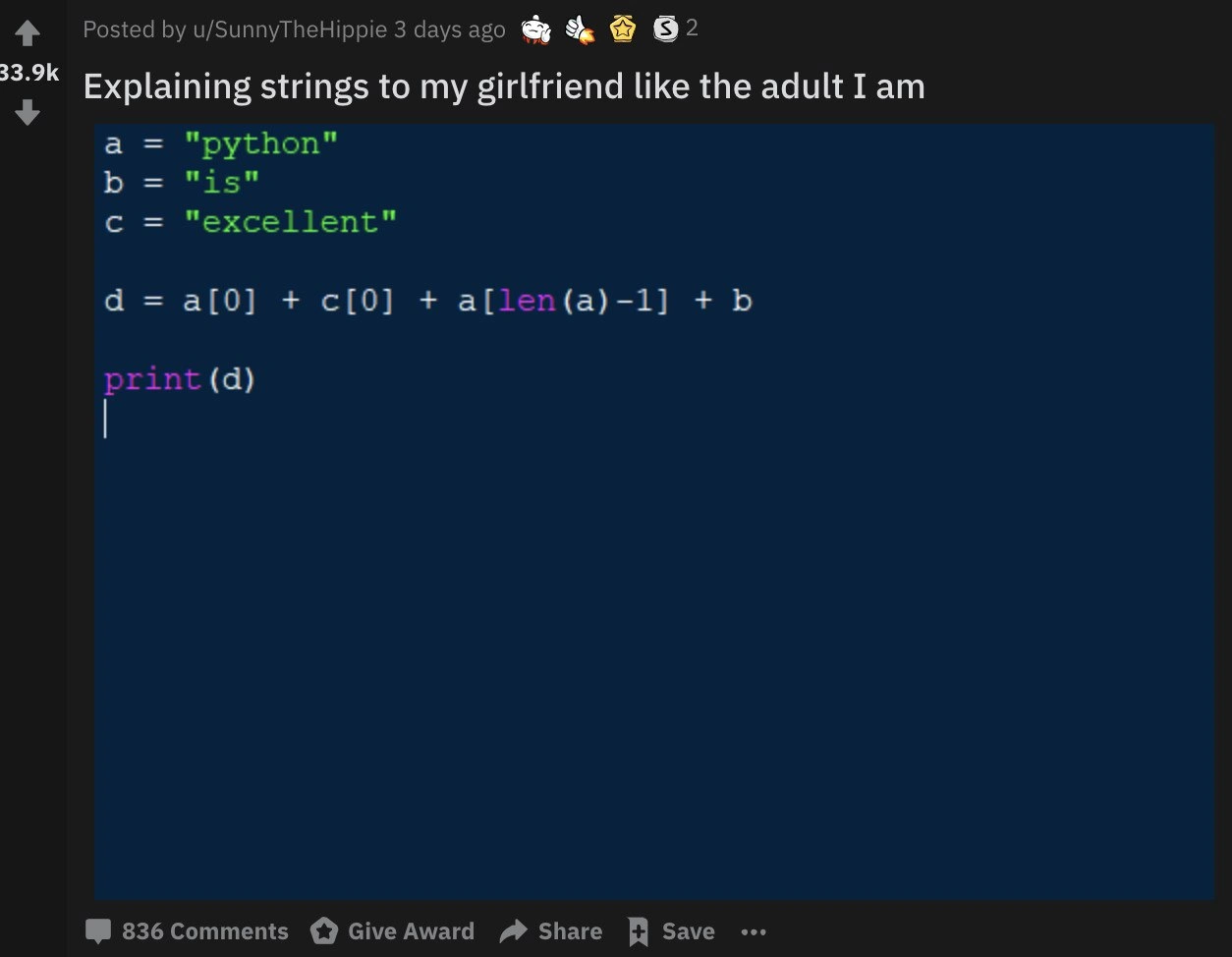
Imagine you’re learning how to make words using letters, kind of like playing with those alphabet magnets on a fridge. Now suppose your friend is showing you a neat little trick: they take the first letter from one word, then the first letter from another word, and then the last letter from a third word, and glue all those letters together with a short word in between. They’re doing this very seriously, as if they’re teaching you spelling or showing you how to build new words. You’re watching thinking, “Oh, cool, we’re learning how to pick letters from words!” But when you finally see the letters put together, they form a very silly word — the kind of naughty, giggle-worthy word that kids might secretly write on a calculator or whisper to each other for a laugh. 😄 It’s totally unexpected because your friend acted like it was going to be an ordinary lesson. The funny part is that your friend was being sneaky. They hid a little joke in what looked like a normal explanation. It’s like if a teacher, while pretending to give a normal spelling lesson, suddenly revealed the word “penis” on the board using letters from innocent words. You’d probably burst out laughing because it’s both surprising and playfully immature. In simple terms, it’s amusing because someone took something as straight-laced as a spelling lesson and turned it into a prank. They used basic letter-picking tricks to spell a silly secret message. The contrast between the serious way they explained it and the sneaky joke outcome makes it hilarious. Even though we’re “adults,” sometimes we just can’t resist a good childish laugh!
Level 2: Spelling with Indices
Let’s break down what’s happening in this code example in simpler terms. In Python, a string is essentially a sequence of characters, kind of like a list of letters. Each character in the string has a position, called an index, which Python uses to let you access that character. Important detail: Python (like many programming languages) uses zero-based indexing. That means the first character is at index 0, the second character is at index 1, and so on. So if we have a = "python", the character a[0] is 'p' (the first letter of "python"), a[1] would be 'y' (the second letter), and so forth up to a[5] which would be 'n' (the sixth and last letter, since "python" has 6 letters total). The function len(a) gives the length of string a. Here len("python") is 6. So len(a) - 1 equals 5, which is the index of the last character. Thus, a[len(a)-1] effectively means “the character at position 5 of 'python'”, which is 'n'. In Python you could also simply use a[-1] to grab the last character directly (negative indices count backwards from the end), but using len(a)-1 is a more explicit way to demonstrate the concept of finding the last index. Now, Python allows you to concatenate (join together) strings using the + operator. So when you see an expression like a[0] + c[0] + a[len(a)-1] + b, it’s taking four pieces (each piece is a string, even if it’s just one letter) and gluing them together into one bigger string. Let’s illustrate the steps clearly:
a = "python"
b = "is"
c = "excellent"
# Indexing: get the first letters and last letter from the strings
first_letter_of_a = a[0] # 'p' from "python"
first_letter_of_c = c[0] # 'e' from "excellent"
last_letter_of_a = a[len(a) - 1] # 'n' from "python" (len(a)=6, so index 5 is 'n')
# Now concatenate (join) these parts with the string in b
d = first_letter_of_a + first_letter_of_c + last_letter_of_a + b
print(d) # This will output: penis
Looking at the code above, we can follow how d is formed step by step. We take 'p', then 'e', then 'n', and then add "is" at the end. Piece those together and you get the string "penis". The print(d) line simply tells Python to display the value of d on the screen. So if you ran this program, you’d see the word penis appear as the output. In essence, the programmer is pulling out particular letters from the words "python" and "excellent" and combining them with the small word "is" to form a completely new word. This is a classic little exercise in string manipulation: you learn how to take substrings (individual characters here) and join them to make new strings. It’s the same basic concept behind, say, taking a word and abbreviating it using its first letter, or forming acronyms from phrases – except here the goal was to form a secret joke.
Now let’s think about the scenario and why it’s funny. The Reddit post is titled “Explaining strings to my girlfriend like the adult I am.” Imagine you’re a new coder who’s excited about learning something cool in Python, like how to pick letters out of words and mix them around. You might want to show this trick to someone (a friend, a partner, or a classmate) to demonstrate what you’ve learned. In the post, the developer is doing exactly that with his girlfriend as the audience. He’s acting like a teacher, explaining the fundamentals of strings: “Look, you can store words in variables like a, b, c. You can get the first letter of a string by using [0], or the last letter using len()-1, and you can glue (concatenate) strings together with +. Isn’t that neat?” For a while, it sounds like a perfectly wholesome, nerdy mini-lesson in basic CS fundamentals.
But here’s the twist: while demonstrating this, he deliberately chose specific words ("python", "is", "excellent") that appear innocent (in fact, together they form the phrase "python is excellent", which is something you might genuinely say when praising the Python language). Under the hood, though, he’s using those words to hide a prank. The letters he extracts and the way he concatenates them spell out a very silly word. It’s a bit like doing a magic trick: on the surface you see a proper explanation, but the "reveal" is a punchline that makes you go, "Oh my gosh, did it really just say that?" For someone new to coding, it’s a memorable demonstration – you learn how string indexing works and you get a laugh out of it. Terms like concatenate simply mean joining strings end-to-end, and that’s exactly what happened to produce the final output. And terms like index just refer to the position number of characters in the string, starting from 0. By understanding those, you can see how each part of the word was taken from a specific spot in the original words.
If you’re an early-career developer or a student, you might find this meme extra funny because it reminds you of the little playful experiments you probably did when learning to code. Maybe you wrote a program to print your name, and then as a joke changed it to print something goofy. Or you discovered you could take the first letters of words to form acronyms, and perhaps you secretly tried to make them spell out something cheeky. There’s a universal experience when you first get the hang of coding: the realization “Hey, I can make the computer say anything I want!” – which inevitably leads to a few developer humor moments. This meme captures that exact feeling. The coder here is essentially doing an intro_to_strings tutorial, but he’s also having a laugh by sneaking in a juvenile punchline. It’s both educational and a little mischievous. For someone just learning, it shows that programming isn’t only about serious calculations and enterprise applications – sometimes it’s about having fun and expressing your sense of humor, even if that humor is a bit childish. And honestly, seeing a basic concept like string indexing being used to spell out a forbidden classroom word can make the lesson more memorable! You’re likely to never forget how to get the first character of a string once you’ve seen it used to conjure a hidden joke.
Level 3: Mature Code, Immature Output
At first glance, this snippet looks like a straightforward Python lesson on string indexing and concatenation. The code defines three variables a, b, c as words ("python", "is", "excellent") and then constructs a new string d by picking specific characters from those words. A seasoned developer immediately recognizes these operations: a[0] grabs the first letter of "python" (which is 'p'), c[0] takes the first letter of "excellent" ('e'), and a[len(a)-1] accesses the last letter of "python" ('n', since len(a) is 6 and the last index is 5). Finally, it appends the entire string stored in b (which is "is"). The result? When you print(d), you get the string "penis". Yes, this very serious demonstration on how to index strings ends up spelling out a juvenile punchline. The meme sets us up with what sounds like an educational phrase ("python is excellent") only to reveal a hidden output joke that would make any 12-year-old chuckle. It’s the contrast between the mature coding context and the immature result that elicits a laugh.
For experienced developers, the humor hits on multiple levels. On one hand, there’s a sense of déjà vu: most of us remember writing our first intro to strings code, extracting characters with string[index] and feeling clever about it. On the other hand, we also remember being young and sneaking silly words into assignments or playing pranks with code. This meme’s author is clearly indulging that inner child. The title “Explaining strings to my girlfriend like the adult I am” drips with irony—he’s pretending to be an oh-so-mature teacher walking through CS fundamentals, but the end product shows he couldn’t resist a cheeky gag. It’s a classic case of a developer using their powers (in this case, knowledge of string indexing) for a bit of CodingHumor. The fact that he’s supposedly teaching his girlfriend adds another layer: you can imagine the coder keeping a straight face while this innocent-looking code snippet runs, only for the output to pop up as a not-so-innocent surprise. It’s humor through subversion: the seriousness of a coding lesson setup is subverted by a juvenile punchline.
From a senior perspective, there’s also an appreciation for how deliberately the code is written to appear like a legit teaching example. Note how it uses a[len(a)-1] to get the last character of "python". A more idiomatic Python approach might be a[-1] (since Python allows negative indices to count from the end) or even slicing like a[0] and a[-1] directly. But the author explicitly wrote out len(a)-1, probably to imitate the step-by-step logic a teacher would use when explaining how indices work. This is exactly how you’d explain it to someone new: “the last index is length minus one.” That little detail makes the code feel pedagogical and conceals the prank better. It’s a crafty move: the snippet reads like an introductory string indexing demo (with nicely colored syntax highlighting in the screenshot to boot), and nothing about a = "python"; b = "is"; c = "excellent" raises suspicion because “python is excellent” is a perfectly benign statement. In fact, it sounds like a positive endorsement of the language, which is something an enthusiastic educator would say while teaching. All the while, letter by letter, the code is assembling a completely unrelated, risqué word. This bait-and-switch is what causes developers in the know to burst out laughing once they mentally parse through the code. We’ve all seen or done similar things — whether it was sneaking an Easter egg into code or using variable names that form acronyms or messages.
Speaking of Easter eggs, this kind of hidden output joke has a long tradition in geek culture. Many seasoned devs can recall typing 5318008 into a calculator and turning it upside down to spell “BOOBIES”. 😆 In that same spirit, here we have a Pythonic version: taking pieces of words and flipping the meaning into something mischievous. It’s the same playful “I can’t believe I got away with that!” energy. The meme resonates because it bridges the experience of learning fundamental concepts with the timeless reality that programmers (and honestly, all of us) never truly outgrow a good juvenile punchline. In a profession that often demands intense focus and seriousness, these little moments of silliness – like a hidden "penis" string in your demo – are a refreshing reminder that coding can be fun and irreverent. The senior dev inside all of us appreciates both the clever use of basic tools and the goofy humanity behind it. After all, if you can’t occasionally have a laugh with code, you’re missing out on one of the joys of the craft!
Description
A screenshot of a Reddit post, titled 'Explaining strings to my girlfriend like the adult I am'. The image displays a code snippet in what appears to be a dark-themed IDE. The code is written in Python. It initializes three string variables: `a = "python"`, `b = "is"`, and `c = "excellent"`. It then proceeds to construct a fourth string `d` by concatenating specific characters from the other strings: the first character of `a`, the first character of `c`, the last character of `a`, and then the entire string `b`. Finally, it prints the value of `d`. The humor lies in the juvenile wordplay hidden within the seemingly educational code. The code will output 'penis'. The joke contrasts the mature and educational framing ('Explaining strings to my girlfriend') with the immature, Beavis and Butt-head level joke actually being told. For developers, it's a silly, relatable example of finding childish humor in the otherwise serious and logical world of programming

Comments
7Comment deleted
Ah, the classic off-by-one error in judgment. He thinks he's teaching string indexing, but he's really just creating a buffer overflow of cringe
Twenty years of code reviews have taught me this constant: with zero-based indexing, someone will inevitably derive “penis” from “python is excellent,” and the PR still gets an “LGTM” because the unit tests pass
This is the same code complexity we use to explain our microservices architecture to the board, except their output is usually "why is this costing us millions?"
This is the programming equivalent of using a Rube Goldberg machine to accomplish what a single string literal could do - technically impressive string manipulation demonstrating zero-indexing, len() function usage, and negative array indexing, all deployed with the maturity level of a production hotfix at 3 AM. The real engineering challenge here isn't the algorithm complexity; it's explaining to your partner why you spent 20 minutes crafting an O(1) solution to generate a word that would make HR schedule a meeting
Great demo of 0-based indexing and why PRs exist: use a[-1] and f-strings - more importantly, don’t concatenate yourself into an HR incident in the logs
Great indexing demo: a[0] + c[0] + a[len(a)-1] + b - string immutability 101 and a reminder that CI checks syntax, HR checks output; put the profanity filter in the pipeline
Senior dev pedagogy: Skip defining 'b' to simulate production debugging from minute one - zero to NameError in record time