Python Developer Discovers Semicolons
Why is this Languages meme funny?
Level 1: Little Symbol, Big Problem
Imagine you grew up writing sentences without ever needing to put a period at the end. You might text your friends "hello how are you" and just hit send – no full stop, and everyone still understands you. But then you go to school, and your teacher insists that every sentence must end with a period. One day you hand in your homework without those periods, and the teacher marks it wrong, saying "You forgot the period at the end of this sentence." You'd probably be confused for a moment – why does that tiny dot matter so much?
This meme is showing a similar situation, but with computer languages. In one “world” of coding, the programmer never had to use a little semicolon symbol ; at the end of lines. Then they step into another “world” where that symbol is required everywhere. The computer is like that strict teacher pointing out the missing punctuation, and the programmer is the confused student thinking, "Huh? We need to add that now?" It's funny (and relatable) because such a small detail – a tiny missing symbol – can cause so much confusion when you switch from one set of rules to another.
Level 2: Semicolon 101
This meme highlights a basic compiler error about a missing semicolon ;. In a language like C, the semicolon is absolutely required at the end of most lines (think of it like the period . at the end of an English sentence). It tells the computer, "This is the end of one instruction; now get ready for the next." If you forget to put a semicolon at the end of a statement, the C compiler gets confused and throws a syntax error. Syntax just means the set of rules for how you must write code, so a syntax error is the computer saying, "Oops, this line doesn't follow the rules I expected." In the error message, it even points to the exact location (line 57) and says the ; is missing there. The program won't compile (convert to an executable program) until you fix that tiny mistake. It’s a bit like writing a sentence without a period – the reader (in this case, the computer) keeps looking for an ending that isn’t there.
For a Python programmer, this kind of message can be puzzling at first. Python doesn’t require semicolons at the end of each line. When you write Python code, you typically just do something like:
x = 5
print(x)
No semicolons needed – each new line is understood to be the end of a command. Python uses indentation (spaces or tabs at the start of a line) to group code instead of curly braces { } or special end-of-line markers. So if you’ve been working in Python for a long time, you don’t even think about adding a ; at line ends. It’s simply not part of the Python coding habit. Now, when that Python-savvy person switches to C and the compiler suddenly says “missing ';'”, their first reaction is confusion: "Missing what? Why do I need that here?" It’s a little culture shock between the two programming languages. The rules of one language (Python) are different from the rules of another (C), and our poor developer just hit that difference head-on. They have to remember that in C every statement must end with that semicolon character, even though they never needed it in Python.
The good news is that this type of error is easy to fix once you spot it. The compiler literally told us what to do: add the missing ; at the end of line 57. In general, when debugging or troubleshooting compile errors, it helps to read the error message closely because it often pinpoints the problem. Missing semicolons are one of the most common mistakes for newcomers in C (and even for experienced coders who jump between languages). It might be a bit frustrating – you might chuckle and facepalm when you realize the only thing wrong was a missing ; – but it's also a quick fix. The meme is funny because it shows a developer who is totally at home in one environment suddenly getting tripped up by a tiny piece of punctuation in another. It’s a relatable little moment of coding frustration that almost every programmer encounters when they venture into a new language and have to adjust to its unique syntax rules.
Level 3: Brace Yourself
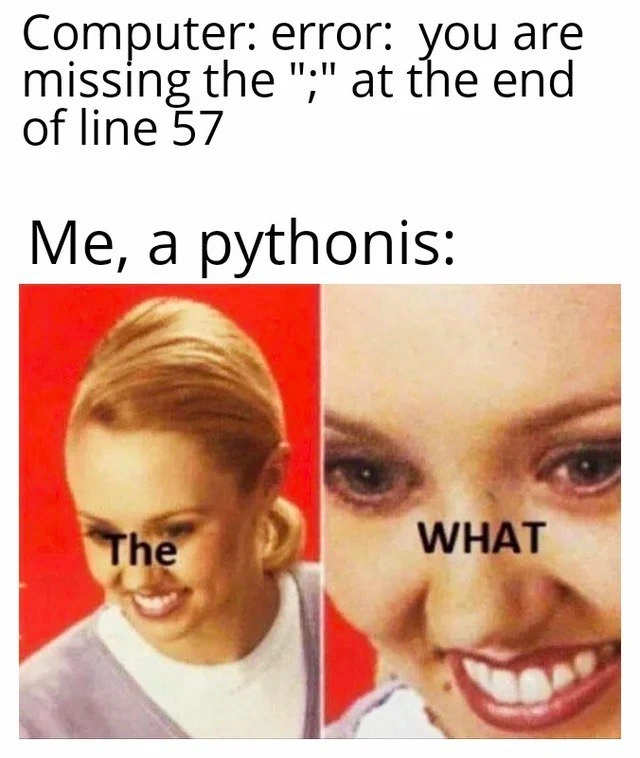
For an experienced developer, the humor here lands immediately. Picture a Python engineer suddenly coding in C and seeing a message like, "error: missing ';' at the end of line 57." In the meme, the top text shows exactly that compiler complaint, and below it the Pythonista’s confused reaction (the blonde child with the "The WHAT?" expression) says it all. It's a classic case of context-switch confusion. You can almost hear the Python dev thinking: "Semicolon? We haven't done that dance since... ever!" The culture shock is real – going from Python’s world of clean, punctuation-free line breaks to C’s world where forgetting one tiny ; can break everything.
This scenario is painfully familiar to anyone who’s worked with multiple programming languages. Each language has its own little quirks and muscle-memory habits. In Python, you just hit Enter to end a line; your mind is trained to worry about alignment and indentation, not semicolons. But the moment you hop into C (or Java, or C++), that muscle memory betrays you. You might write a few lines and blissfully run gcc or another compiler, only to be greeted with a wall of red text. The compiler is essentially acting like a strict grammar teacher, pointing at your code and shouting that you did something wrong. It’s complaining about a missing punctuation mark that you haven't needed in ages. The result? A brief "WTF?" moment as you stare at the error message, then a facepalm when you realize, "Oh right... this language needs that silly semicolon."
We've all been there. Even seasoned polyglot developers chuckle (or groan) at this phenomenon. For example, consider a quick snippet where a Python-trained mind slips up in C:
// Writing C with a Python mindset
#include <stdio.h>
int main() {
int count = 10 // Oops: no semicolon here
printf("Count is %d\n", count);
return 0;
}
Attempting to compile that will instantly yield something like:
error: expected
';'beforeprintf
The compiler stops right at the int count = 10 line and refuses to go further. The fix is trivially easy (just add the missing ;), but in that moment the Python programmer is flabbergasted, basically saying "The what is missing?!"
This meme is poking fun at those language-switch headspin moments. It's not that the Python dev is incompetent; it's that their brain has been running on Python syntax autopilot. Switching to C feels like moving to a country where all the street signs are in a different alphabet overnight. The missing semicolon error is a tiny mistake that causes a disproportionate amount of frustration – and afterwards, some laughter. Seasoned engineers will recall debugging sessions where the culprit turned out to be a single missing character like this. It's almost a rite of passage in C programming to see “expected ';'” and immediately know what you forgot. Likewise, brace placement and other syntax differences have tripped up many a coder switching between languages (cue the playful language wars over whether indentation or braces+semicolons make for better code).
In the big picture, this highlights how different programming communities have different norms, and how those norms can catch you off guard. Python’s philosophy emphasizes minimal punctuation and relies on whitespace for structure. C comes from a tradition where you manually punctuate every line to make the code crystal clear to the compiler. Neither approach is wrong, but your brain gets wired to one set of rules at a time. So when a Python programmer stumbles into C’s rules, it feels like forgetting to carry the 1 in basic math – an obvious mistake you normally wouldn't make. The meme nails that feeling: the Python developer suddenly feels like a confused kid in C's classroom, all because of one missing semicolon. And every developer who’s juggled different languages can relate to that bewildered face, then laugh knowing they’ll remember to double-check their line endings next time they switch coding “languages.”
Level 4: Parsers & Punctuation
Under the hood, this meme's humor is rooted in language grammar and compiler design. In formal terms, languages like C have an explicit syntax rule that every statement must end with a specific terminal symbol: the semicolon ;. The C compiler's parser expects that token at the end of each statement as it builds the program's parse tree (the structured representation of code). If the parser doesn't find the ; where the grammar rules demand one, it hits a wall: it cannot reduce the code into a valid Abstract Syntax Tree (AST) node for that statement. In compiler error form, it essentially says "Syntax Error: expected ';' before end of line" – meaning the formal grammar was violated. This design comes from C's ancestry in the ALGOL family, where punctuation like semicolons clearly delineate the end of instructions. In a Backus–Naur Form (BNF) description of C, you might literally see a production rule like <statement> ::= <expression> ';' indicating that a semicolon is mandatory. Missing it is not just a style slip; it's a grammatically invalid sentence in the language of C, so the compiler refuses to compile the code and throws an error.
Now compare that to Python's world: Python's syntax was built on a different philosophy. Instead of braces and semicolons, Python uses newlines and indentation as the way to structure code. In effect, Python treats the end-of-line itself as an implicit terminator of a statement. The Python interpreter’s lexer actually generates special INDENT and DEDENT tokens to mark the start and end of indented blocks (like loops or functions), and newline characters signal the end of a statement unless a line break is explicitly escaped. In formal grammar terms, Python doesn't require a ; at all (though it allows one if you want to put multiple statements on one line). Significant whitespace (indentation that matters to the code’s meaning) is a core feature of Python’s grammar. This means the Python parser knows that when it sees a newline at a certain indentation level, the statement is complete and the block might be ending. Where a C compiler relies on a symbol to end a statement, Python relies on the layout (the structure of the code text itself). It's a fundamentally different grammar rule system: Python’s design embraces the idea that code readability improves when we remove unnecessary punctuation.
These contrasting parser behaviors reflect deeper language design choices. C’s explicit semicolon requirement gives the compiler unambiguous instruction boundaries and was historically common in compiled languages to simplify parsing. Python’s approach, inspired by the ABC language and influenced by language design discussions of the late 1980s, boldly removes those end-of-line markers in favor of a cleaner look. Each approach has theoretical implications: for instance, certain parser generators or compiler tools handle free-form languages (like C, where whitespace is largely irrelevant to the compiler) differently than indentation-sensitive ones (like Python, which must track indent levels explicitly). The humor of the meme arises from this very real theoretical divide: a Python expert encountering a C compile error is effectively experiencing a clash of grammatical paradigms. It's a bit like a linguist suddenly faced with a new dialect's punctuation rules – a small formal difference causing a big cognitive dissonance. The missing semicolon is a trivial character, but it represents the gulf between two compiler mindsets and the subtle syntax nuances that can trip up even seasoned programmers.
Description
A three-part meme about programming language syntax. The top section displays black text on a white background: 'Computer: error: you are missing the ";" at the end of line 57'. Below this, it says, 'Me, a pythonis:'. The main part of the image is a two-panel format against a red background. The left panel shows a smiling blonde woman with the word 'The' overlaid. The right panel is an extreme, distorted close-up of her face, showing a wide, toothy, and unsettling grin with the word 'WHAT' overlaid. The humor arises from the fundamental difference in syntax between Python and many other languages like C++, Java, or JavaScript. Python uses newlines to terminate statements, making semicolons unnecessary. For a developer accustomed only to Python (a 'pythonist,' despite the typo), encountering a mandatory semicolon is a baffling and alien concept, hence the confused and horrified reaction
Comments
7Comment deleted
My linter is so aggressive, it's starting to add semicolons to my grocery list. My code is clean, but now my milk is a syntax error
Nothing like a compiler reminding you that your brain’s garbage collector forgot to re-enable semicolons after the last ‘import this’ context switch
After 15 years of Python, switching to Java feels like being asked to end every sentence in a meeting with "over" like we're on walkie-talkies. "The service is deployed, over. The tests are passing, over. Please review my PR, over."
This perfectly captures that moment when you've been writing Python for so long that semicolons feel like a distant memory from a more verbose era - until your IDE autocomplete betrays you by suggesting one, or worse, you accidentally leave one in and Python just... ignores it. The real horror isn't the error message; it's realizing you've been context-switching between languages so much that your muscle memory is now a polyglot mess, and you're one keystroke away from writing `def function() {` or `import sys;`
Python errors: precise enough to blame you, vague enough to make you doubt reality
After years in Python, my mental lexer treats NEWLINE as a terminator; the C compiler reminds me it parses tokens, not vibes
Polyglot monorepo tip: configure clangd to ignore the Python directory - otherwise the only thing getting terminated is your flow, not the statements