Skip to content
DevMeme
6073 of 7435
A Proud, Protective Family of Sun Microsystems Servers
TechHistory Post #6651, on Apr 16, 2025 in TG

A Proud, Protective Family of Sun Microsystems Servers

Why is this TechHistory meme funny?

Level 1: Stay Away from My Kids

Imagine a big mommy or daddy being very protective of its children in a family photo. The big parent stands behind, with all the little kids lined up in front. Now, someone else (maybe a stranger) comes by and tries to approach the kids. The parent steps in and says, “Don’t talk to me or my kids ever again!” in a very serious, over-protective way. It’s a funny overreaction you might see in a cartoon or a silly movie.

In this meme, the parent and children are not people at all, but old computers! The giant purple computer at the back is like the parent, and the smaller purple computers in front are like its kids. Of course, computers don’t really have families, but we’re pretending they do just for the joke. The big computer is basically telling everyone, “Hey you – yeah, you! Leave me and my little ones alone!” It’s acting like a grumpy mom or dad trying to protect its babies.

The reason it says “my Suns” (S-U-N-S) instead of “my sons” is because the company that made these computers is named Sun Microsystems. So it’s a play on words: Sun sounds just like son (like son and daughter), but here it refers to the brand of these machines. It’s a simple pun – like if you had a candy bar called “Dad’s” and you show a big bar and a mini bar with the caption “Don’t talk to me or my Dad’s ever again.” It’s just mixing a normal phrase with a brand name that happens to sound the same as a common word.

So, why is this funny emotionally? Because we’re giving feelings to machines. We’re imagining that big server has a personality – a very serious parent personality – and it’s humorously telling off anyone who comes near its “family.” It’s the same kind of chuckle you get from imagining a guard dog fiercely protecting a bunch of cute puppies. The big server might look imposing and stern (it’s tall, dark, and has a serious grill on the front like a frown), and the little servers are its adorable mini-me’s. The phrase is like something you’d see in a meme with a big action hero and a tiny version of him, or a big cat and a kitten. Here it’s tech gear, which makes it even sillier because machines aren’t alive – but for a second, we pretend they are.

At the simplest level: big old computer says, “Don’t mess with me or my little computers ever again.” It’s absurd and playful. You don’t need to know anything about Unix or servers to giggle at the protective parent vibe coming from a bunch of purple computer boxes. It’s funny because it mixes something totally non-human (servers) with a very human attitude (protecting one’s children and shooing outsiders away). Essentially, it’s a nerdy way of saying “This is my family, back off!” – and picturing a computer feeling that way just makes us smile.

Level 2: From Workstation to Enterprise

To understand this meme, let’s break down the basics. Sun Microsystems was a famous technology company (especially in the 1980s and 1990s) that built computer workstations and servers. The word “Sun” in their name actually came from an acronym (Stanford University Network), but it’s fitting because their logo looked like a diamond made of the word “sun” repeated, and their machines were shining stars in the Unix world. They ran an operating system called Solaris, which is a flavor of Unix (similar to how Linux is a Unix-like OS). So if you hear Solaris Unix, that’s the software these machines typically used to run programs.

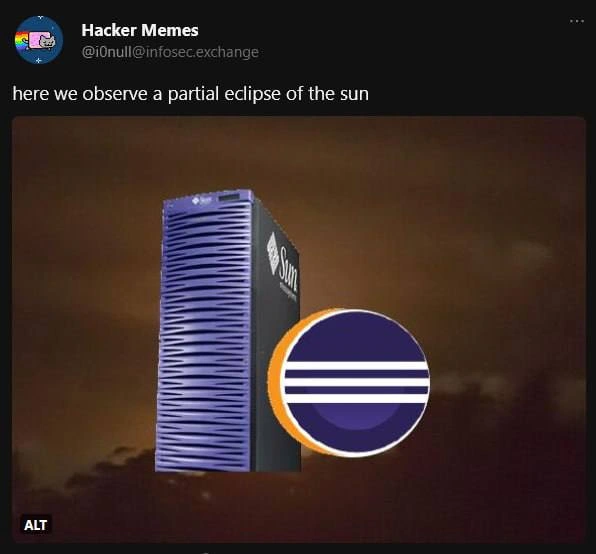
Now, in the image, we see five machines of different sizes, all wearing Sun’s trademark color scheme – a sort of royal purple with black or grey. They’re arranged like a family photo: the largest server is standing tall at the back (the “parent”), and in front of it are progressively smaller servers (the “children”). Sun’s product line indeed spanned from small to huge:

  • Workstations (Pizza-box servers) – The smallest ones, often just a few inches tall and wide like a flat box (about the size of a large pizza box). They were usually used by individual engineers or for smaller tasks. Don’t let their size fool you; back then a Sun pizza-box workstation on your desk was a status symbol for doing serious programming or CAD design.
  • Mid-range Servers (Rack-mount units) – The medium-sized boxes in the lineup could be slid into server racks (standard metal frames in server rooms). They might be a couple of “U” high (a rack unit “U” is 1.75 inches tall), containing more processing power and disk storage, used for departmental servers or specialized functions.
  • Enterprise Servers (Tower or cabinet) – The big guy at the back. These were often free-standing towers or full rack cabinets loaded with processors, memory, and disks. A machine like that could serve an entire company’s database or website. It likely has multiple CPUs (processors) and redundant power supplies. These were the heavy hitters – literally heavy, often requiring two people (or a small crane!) to move. They earned the nickname "big iron" because they were physically massive and critically important.

All these machines in the photo are part of Sun’s hardware family – they share a common design and technology. For example, they all use Sun’s SPARC processors. SPARC is a type of CPU architecture (specifically RISC, which stands for Reduced Instruction Set Computer). Without getting too technical, RISC processors like SPARC were designed to execute simpler instructions at high speed. This made Sun’s systems very powerful for things like databases and multitasking in that era. And since they all use SPARC and run Solaris, you could run the same application on any of these machines – just scale up to a bigger box if you needed more performance. In a way, it’s like having a line of cars from a compact to a truck, all made by the same company: they might share the same engine type and fuel, just with different sizes and horsepower.

Now, the text on the image – “DON’T TALK TO ME OR MY SUNS EVER AGAIN” – is a play on a popular meme phrase. The original phrase is “Don’t talk to me or my son ever again,” and people on the internet use it humorously by pairing a big thing with a little similar thing (like a big dog and a little puppy that looks like it, or a large cartoon character and a mini version). It’s like the big one is a parent, and it’s telling some outsider to leave its child alone. It usually comes off as comically overprotective.

In this meme, the phrase was tweaked to say “my Suns” instead of “my son.” Why? Because all these computers are made by Sun Microsystems, and tech folks love puns. 😄 The big server is basically saying: “Don’t talk to me or any of my Sun machines ever again!” as if it’s a grumpy parent protecting its kids. It’s extra funny to us because “Sun” sounds exactly like “son.” So it’s a perfect pun – one of those jokes where if you know the context, you get a little dopamine hit from how the words cleverly match the picture.

Let’s unpack the Unix-y restraining order idea: In Unix (and Unix-like systems), there’s a concept of user permissions and access control – basically the OS saying “this user can access this, but not that.” The meme jokingly imagines the Sun server telling someone “Don’t even attempt to access me or my related servers.” It’s not a literal feature, just a humorous exaggeration. But it resonates because sometimes legacy systems feel closed off. For example, an old Sun server might use outdated network protocols or have firewall rules that make it hard for new systems to communicate with it. Trying to “talk” to it (like connecting from a modern computer) can indeed be difficult without special steps. So, in a funny way, the meme caption captures that isolation you get with old LegacySystems: they’re in their own world, and if you don’t speak their language (old software, old connectors), they effectively say “go away.”

For someone new to this, imagine these Sun servers as an older generation of technology. Legacy hardware refers to equipment that’s from an earlier era – it might still work, but it’s not the current standard. People keep legacy systems running for various reasons (maybe a critical application depends on it, or they haven’t gotten around to replacing it). However, working with them can be challenging. Think of it like trying to use an old phone from 20 years ago with today’s apps – it’s tough to get them to work together. That’s why modernization (the tag LegacySystemsAndModernization) is a big theme in IT: companies often have to migrate from these sturdy old Sun machines to modern servers or cloud solutions.

In summary, at this level, just know: the meme is showing a Sun Microsystems server family (big server and its smaller relatives), and the text is a playful twist on an internet catchphrase. It’s highlighting the idea of an old proud tech saying “leave my brood alone.” The humor comes from the pun (Sun/son), the visual of a tech “family portrait,” and the truth that older systems often do seem to be fiercely self-contained. Even if you haven’t personally managed a rack of Sun servers, you can think of it like seeing a parent with grown kids in matching outfits scowling at a stranger – it’s both adorable and a little ridiculous, which is exactly the vibe the meme is going for.

Level 3: Purple Reign in the Rack

For the experienced engineer, this image hits like a wave of TechNostalgia. Here we have a family portrait of classic Sun Microsystems servers – the big purple tower flanked by its smaller kin – proudly displaying their signature slatted bezels. This hardware dynasty ruled the backrooms of enterprises through the 90s and early 2000s. They were legendary in their time: if you walked into a server room, the imposing Sun Enterprise server (the tallest in the back) was often the crown jewel, humming with a half-dozen fans and the warmth of enough power draw to heat a small apartment. The smaller units – think of mid-range servers or even Sun workstations – are its brood, the junior members of the datacenter clan. Seasoned sysadmins see this and can practically smell the ozone and feel the cricked back from racking those 50-pound beasts.

The meme text itself, “DONT TALK TO ME OR MY SUNS EVER AGAIN,” riffs on a popular meme format where a protective parent figure (here the giant server) tells off someone to leave their kid alone. The brilliant geeky twist is using “Suns” instead of “sons,” directly referencing Sun Microsystems and making a homophone pun. It’s a classic example of HardwareHumor colliding with Internet culture. You have to know the “don’t talk to me or my son” meme and know Sun’s hardware to fully appreciate it – that overlap is basically an inside joke for infrastructure veterans. When that bold white Impact font shouts this absurd command, it’s hard not to chuckle if you’ve ever racked a Sun server or typed along in a Solaris shell. It’s stupid, it’s meaningless, and that’s why it’s hilarious – that’s how server room stories are born.

Why is this so funny to the initiated? Because it anthropomorphizes legacy infrastructure with a grain of truth. In the enterprise heyday, Sun servers were almost treated like members of the team (or family). They were expensive investments, each with a role: the big one might have been the production database server, the smaller ones for dev, QA, or specific apps. A senior engineer or admin often felt protective of these machines, much like a parent. You didn’t just casually “talk to” (i.e., interact or mess with) the production Sun box – you followed proper procedure, lest you incur the wrath of a lead sysadmin. It’s easy to imagine a grizzled Unix admin saying half-jokingly, “Don’t you dare SSH into the main Sun server or its clones without my permission.” This meme basically gives that sentiment a humorous image.

There’s also a subtext about legacy systems isolation. These old Solaris Unix servers often ran critical apps for decades, walled off from modern systems. They might not integrate well with today’s cloud or x86 services – in a sense, they don’t “talk” nicely with new tech. Many companies have a modernization tale: some youthful engineer suggests replacing the ancient Sun box with a modern solution, only to meet resistance: It’s been running fine since 1999, don’t touch it! The meme’s restraining order vibe (“ever again!”) echoes that territorial stance. It’s the Sun clan closing ranks against the outside world. LegacyHardware can inspire that mix of reverence and stubbornness. Sure, we joke about it, but there’s reality: migrating off these systems is hard. They harbor decades of tweaks, and the original Sun Microsystems clan (now Oracle) would gladly charge a fortune for extended support. So sometimes, they remain in that back corner of the data center, whirring away behind figurative Do Not Disturb signs.

This “family lineup” also lampoons the grand hardware lineages tech companies used to have. Sun named many of its servers with familial branding – Ultra, Enterprise, SPARCstation – creating a sense of pedigree. The largest server in the back might be an Ultra Enterprise 6000 or 10000 (a multi-rack monster nicknamed Starfire), while the front could include an Ultra 2 or a cute little SPARCstation IPX. Seeing them together in one image is itself a bit absurd, like gathering every generation of a family for a single portrait – something you’d rarely see outside of a Sun product catalog. That’s part of the joke: in reality, no one had all five of these exact units lined up like posed relatives, but in meme-land, we pretend the whole extended Sun family hangs out together. And naturally, Big Papa Sun is very protective of his mini-Suns.

For those of us who lived through it, there’s an affectionate eye-roll here. We remember when these servers were the silicon nobility. Tech presentations bragged about SPECint benchmarks on the latest UltraSPARC, and ads touted “The network is the computer” – Sun’s famous motto. Now they’re datacenter relics. But seeing them staged with that meme text triggers shared memories: the loud whoosh of a Sun E450’s fans, the Solaris OK prompt (ok> from the OpenBoot PROM) blinking on a serial console, the smell of dust and electronics on a Friday 3 AM emergency swap-out. It’s a flood of ServerRoomStories condensed into one silly visual. We laugh because we remember, and because these war stories of coaxing along old Suns (and occasionally cursing at them) are common in our community. The meme format might be “stupid and meaningless” as the poster quips, but to legacy system veterans it’s perfect. It’s a quirky salute to those Unix-y beasts and the people who kept them running – a recognition that, hey, we kinda treated those servers like family back then (and sometimes still do for that one last Solaris box in the corner).

Level 4: RISC Royalty Reunion

At the deepest technical level, this meme evokes the SPARC lineage and the era of high-performance RISC architecture servers. Sun Microsystems was a founding member of the RISC royalty – their SPARC (Scalable Processor ARChitecture) chips were designed with reduced instruction sets aiming for efficient pipelines and high throughput. The purple-and-black towers in the image aren’t just random boxes; they’re part of a family tree of Sun’s hardware, all sharing the same SPARC DNA. In practice, that meant a single Solaris Unix binary could run on the smallest “pizza-box” Sun workstation or the largest Ultra Enterprise server – a uniform architecture family spanning from baby to behemoth. This architectural consistency was a hallmark of Sun’s approach: one Unix OS (Solaris) to rule them all, one instruction set to bind them.

Under the hood, these servers boasted serious engineering. The largest tower (“parent” Sun) likely contained multiple CPU modules with a high-speed interconnect (Sun’s Ultra Enterprise line was famous for its crossbar switch and symmetric multiprocessing). These big iron machines could have dozens of UltraSPARC processors cooperating with cache coherency protocols and massive shared memory – essentially a mini-supercomputer in a box. Meanwhile, the smaller “offspring” units in front might house single or dual SPARC CPUs. They all spoke the same binary language (SPARC instructions), but the big one could carry out many more conversations in parallel.

The meme’s absurd restraining order – “Don’t talk to me or my Suns ever again” – hints at a technical reality: these systems often ran in isolated, closely-knit clusters. In high-security setups, you couldn’t just talk to a Sun server without permission; they might be on a private network segment, guarded by thick firewalls (or cranky sysadmins). It’s a tongue-in-cheek nod to how proprietary these setups can be: outsiders (newer systems or unapproved users) keep out. In a deeper sense, it also nods to the protective stance of Unix traditions – like a process in user space being firmly told by the kernel, “access denied.” If one were to formalize this “Unix-y restraining order” in technical terms, it might be thought of as a chmod on communication or an LDAP rule preventing non-Sun machines from interfacing. Of course, that’s not literally how it works, but the joke tickles the part of an engineer’s brain that remembers the insular world of proprietary hardware.

On a historical note, this regal lineup of SPARC servers represents a bygone era when multiple CPU architectures thrived in data centers. Sun’s SPARC, IBM’s POWER, DEC’s Alpha – each was a proud clan of silicon royalty, with unique instruction sets and hardware designs. In those days, scaling up meant getting a bigger box from your vendor’s family (as humorously illustrated by Papa Sun and his mini-Suns). Over time, commodity x86 processors (originally CISC-based but adopting many RISC-like features) caught up in performance. The economics of scale and Moore’s Law favored x86, leading to the Sunset of SPARC’s dominance. By the late 2000s, x86 servers (and later ARM servers in the cloud) took over the throne, and Sun’s kingdom faded (Sun Microsystems was acquired by Oracle in 2010, marking an end of an era). This meme, in its silliness, is a nostalgic cryptogram of that history: it reminds seasoned techies of a time when on-prem iron giants roamed the server rooms, fiercely independent and incompatible with the outside world – a true RISC reunion now mostly found in museums and retro computing labs. The humor runs deep for those who can read it: it’s the ancient dialect of Unix hardware aristocracy, playfully packaged as an Internet meme.

Description

This is a meme using the 'Don't talk to me or my son ever again' format, which typically shows a larger and smaller version of a person or object in a protective stance. The image displays a collection of vintage, purple-colored Sun Microsystems servers and workstations of various sizes, from large tower servers to smaller desktop units. The distinctive purple chassis and Sun logo identify them as hardware from the late 1990s and early 2000s, likely from the UltraSPARC era. Superimposed over the image in bold, white text is the phrase 'DONT TALK TO ME OR MY SUNS EVER AGAIN'. The humor is a multi-layered pun that works on two levels: first, it substitutes 'Suns' for 'sons' to fit the meme format, and second, 'Suns' is the colloquial name for machines built by Sun Microsystems. The joke personifies this obsolete but once-dominant hardware as a defiant, proud family, which is deeply nostalgic and humorous for veteran system administrators and engineers who worked with these powerful, and notoriously hot and loud, machines
Comments

12
Anonymous ★ Top Pick That's the server family that raised Java. Now Oracle has custody and only lets them see it on weekends
  1. Anonymous ★ Top Pick

    That's the server family that raised Java. Now Oracle has custody and only lets them see it on weekends

  2. Anonymous

    Remember when scaling meant rolling in another SPARC that needed its own circuit breaker instead of running ‘terraform apply’?

  3. Anonymous

    The real tragedy isn't the protective parent act - it's that Oracle acquired them in 2010 and now you need a license agreement just to look at this meme, plus annual support fees for each pixel rendered

  4. Anonymous

    When your legacy Sun infrastructure has been running the same mission-critical COBOL batch jobs since Y2K and management still won't approve the cloud migration budget because 'if it ain't broke, don't fix it' - even though finding replacement parts now requires archaeological expeditions through eBay and the last person who understood the Solaris kernel configuration retired in 2009. The servers have outlived three generations of sysadmins, two company acquisitions, and somehow still have better uptime than your Kubernetes cluster

  5. Anonymous

    Those purple Sun boxes don’t do Kubernetes; they do Solaris Zones, NFS, and an OpenBoot PROM at 3am - vendor lock‑in so strong it shipped with its own CPU ISA

  6. Anonymous

    Cloud sales rep walks in: 'Time to migrate?' Sysadmin: 'Don't talk to me or my redundant PowerEdges ever again.'

  7. Anonymous

    Every cloud-migration deck has a "quick wins" slide; the SPARC box replies with nine years of uptime and a license daemon - don’t talk to me or my Suns ever again

  8. @MixaKonan 1y

    Indeed they are

  9. @ZgGPuo8dZef58K6hxxGVj3Z2 1y

    This is just AI human slop

    1. @patsany_horosh_mne_v_dm_pisat 1y

      Lol why is that so funny

  10. @patsany_horosh_mne_v_dm_pisat 1y

    cap

  11. @SamsonovAnton 1y

    SPARC not dead! 🤘

Use J and K for navigation