Skip to content
DevMeme
4551 of 7435
The Duality of a Developer's Day
DeveloperProductivity Post #4993, on Nov 9, 2022 in TG

The Duality of a Developer's Day

Why is this DeveloperProductivity meme funny?

Level 1: Not in the Instructions

Imagine your parent asks you to vacuum the living room, but they don’t mention anything about moving toys or furniture. You start vacuuming and come across a big toy box right in the middle of the floor. Instead of pushing it aside, you vacuum around the box, making an awkward detour. You manage to clean the floor, except there’s a big dusty patch under the box (since you didn’t move it). Now your parent comes in and sees this strange clean ring around the toy box and dust still underneath.

Parent: "Why didn’t you move the box and clean under it?"
You: "Well, moving the box wasn’t in the instructions you gave me!"

Sounds silly, right? You did exactly what you were told (clean the floor) but ignored the obvious step of moving the obstacle, because technically no one told you to. The result: the floor is kind of clean, but it looks odd and isn’t really clean under the box. This is funny in a facepalm kind of way because it shows what happens when someone follows rules or instructions too literally. Instead of solving the real problem (a clean floor), they can end up doing extra work that avoids the problem (dancing around the toy box).

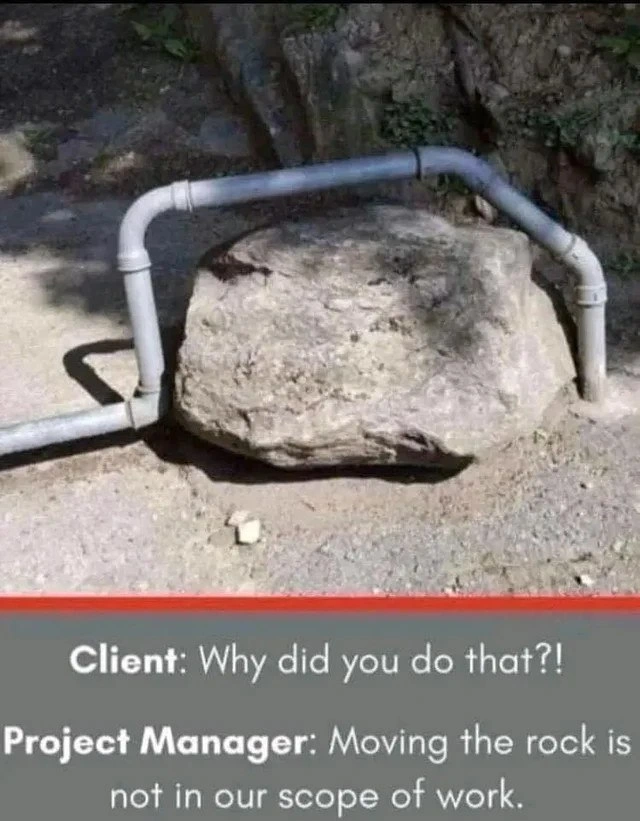
The meme with the pipe and the rock is just like that. The pipe going over the rock is like vacuuming around the toy box. It’s a goofy solution that happened because “move the rock” wasn’t in the instructions. It makes us laugh because we all know it would’ve been so much simpler to just pick up the box – or in the meme, move the rock – but sometimes people stick to the exact words of a plan even when it doesn’t make sense. The feeling you get is a mix of frustration (why didn’t they just fix the real issue?) and amusement (it’s such an ridiculous way to solve the problem). It teaches, in a lighthearted way, that doing something just because that’s what the rules say, without thinking, can lead to solutions that are technically correct but practically absurd.

Level 2: Scope Over Sense

Picture the meme: a gray PVC pipe is supposed to run straight along the ground, but instead it takes a sudden upward loop over a big boulder and then goes back down. It looks so goofy that even someone with no engineering background would ask, "Why on earth is the pipe doing a rainbow over a rock?" Below the image, the dialogue reads:

Client: Why did you do that?!
Project Manager: Moving the rock is not in our scope of work.

This little exchange sets the stage. The Client expected a clean, sensible pipeline. The Project Manager (PM) basically replies, "We didn't move that huge rock because our plan/contract didn’t say we should." In project terms, moving the rock was out of scope – meaning it wasn’t included in the agreed-upon tasks (Scope of Work). The PM is following the rules to the letter. This is a classic case of misaligned expectations: the client assumed the team would handle obvious obstacles, while the team (under the PM’s direction) stuck only to what was formally requested. The humor here is a kind of head-shaking ProjectManagementHumor: the team did exactly what they were told, and yet delivered something obviously suboptimal.

Let's break down some terms and concepts for clarity:

  • Scope of Work (Scope): In any project, the scope defines what is to be done. If something is "not in scope," it means it’s not officially included in the plan or contract. Here, removing the rock wasn’t in the list of tasks, so the team avoided it. Think of scope as the rules or instructions the project team is following. The PM in the meme is very literal about these rules.
  • Scope Creep: This is when the project’s scope keeps expanding – new tasks or features get added beyond what was originally agreed. Managers usually try to prevent scope creep because it can lead to delays and extra costs. In the meme, interestingly, the PM is so afraid of adding scope (even a reasonable task like moving a rock) that they prefer a wacky workaround.
  • Workaround: A workaround is a solution that doesn’t solve a problem directly, but finds a way around it. Bending the pipe over the boulder is a physical workaround. In software, a workaround might be writing extra code to handle a bug in an external system instead of fixing that bug. Workarounds often are quicker in the moment but can be inefficient or fragile.
  • Technical Debt: This is a key concept in software engineering. Technical debt refers to the future cost (in time, effort, money) of choosing an easy but limited solution now instead of a better solution that might take longer. The term comes from analogy: it's like taking on debt – you get something now (quick solution) but you owe a fix later with interest (extra trouble). In the meme, the weird pipe loop is basically physical technical debt. The team delivered the pipeline fast without moving the rock, but later on someone will have to deal with that rock (like if the pipe starts leaking at the bend, or if they eventually need to remove the rock anyway). So they "saved" effort now by not moving the rock, but likely created more work down the line.

Now, why is this funny to developers and engineers? Because this exact scenario happens in software projects, just not with literal rocks and pipes. It’s an analogy. Here’s a comparison between the physical scenario in the photo and a software project scenario:

Physical Project (Meme) Software Project Equivalent
A big boulder is blocking where the pipe should go. A legacy system or major bug is blocking a feature implementation.
Removing the boulder isn’t in the scope of work (wasn’t planned or budgeted). Fixing the legacy system or bug isn’t in the project’s approved tasks (not scheduled or too risky for now).
Solution: Bend the pipe in a crazy way over the rock to avoid moving it. Solution: Write convoluted code or add an extra module to work around the legacy system/bug, instead of fixing it.
Result: Water flows from point A to B, but the pipe looks odd and is less efficient. Result: The feature technically works, but the code is messier, slower, or harder to maintain.
Long-term issue: That bent section may weaken or break, and the rock still sits there – someone else will have to deal with it eventually. Long-term issue: The workaround code can cause bugs or slowdowns, and the original problem (legacy system/bug) still remains – the team will likely face it again in the future (with interest).

In other words, the meme is pointing out a scope_vs_solution dilemma. The Project Manager prioritized sticking to the scope (no rock removal) over finding the best solution (which obviously would be remove the rock). This is where the comedic StakeholderExpectations clash happens: the client expected the team to use common sense to meet the project’s real goal (a proper pipeline), but the team followed the project rules so rigidly that they delivered a silly-looking outcome.

For a junior developer or someone new to tech, it might be surprising that this kind of thing happens. You might think, "Surely no one would do something that obviously dumb in a real project?" But it does happen, albeit usually in code or planning, not with actual pipes. For example, imagine you’re building a web app and there’s a flaw in an authentication library. A sensible fix is to patch or replace the library, but that might be considered out of scope for the current sprint (maybe because it’s a third-party component or it could delay release). Instead, your team might implement a quick patch in your own code to handle the flaw – essentially coding around the problem. The app works (users can log in), but now your code has extra complexity that wouldn’t be needed if the library were fixed. That’s analogous to bending the pipe around the rock: you got the job done as defined, but introduced a maintenance headache.

This meme is a form of DeveloperHumor and Sarcasm directed at rigid project management. It’s gently poking fun at PMs who boast about finishing “on time and on scope” while oblivious to the kludges used to get there. As a new developer, you'll likely encounter situations where you have to decide (or your manager decides for you) between doing something the proper way versus the quick way that adheres to current scope. The lesson (wrapped in humor) is that blindly following the plan without re-evaluating it when reality throws a boulder in your path can lead to laughable (and painful) results. Good project management should involve saying, “Hey, we found a giant rock – let’s talk about adjusting the plan,” rather than “Not our problem, carry on as written.”

Level 3: Boulder-Driven Development

In the saga of project management folly, this meme nails a scenario every seasoned dev has witnessed: when an immovable constraint meets an inflexible scope. The result? Boulder-driven development. (Yes, that's a tongue-in-cheek twist on BDD – normally Behavior-Driven Development, but here the boulder dictates our design decisions.) Instead of addressing the root problem (the giant rock in the way), the team is forced to engineer a convoluted solution around it. It's like designing software architecture around a legacy system nobody will replace – the obstacle_workaround becomes the core of your design. EngineeringIrony at its finest.

Let's decode the humor: The Project Manager proudly proclaims, "Moving the rock is not in our scope of work." In corporate-speak, scope is king – the predefined list of tasks your team agreed to do. If something isn't explicitly in that Scope of Work (SOW), then by bureaucratic logic, it might as well not exist. Here the StakeholderExpectations (the client’s obvious desire for a sensible pipeline) collide with the PM’s literal_scope_interpretation of the contract. The PM chooses ScopeCreep paranoia over common sense, instructing the team to just bend the pipe around the boulder rather than "waste" time moving it. Seasoned devs recognize this pattern instantly: delivering a feature exactly to spec, even if the spec ignores reality. The humor (tinged with pain) comes from how familiar this dysfunction is.

This bent-pipe solution is a physical monument to technical debt. It screams "quick hack now, pay for it later." In software terms, the rock is a legacy bug or system the team isn’t allowed to touch, so they implement a kludge around it. The pipe awkwardly arching over the boulder is equivalent to a maze of if-statements and kludgy adapters in code. Everyone in the room knows it's a bad idea long-term – it’s going to be brittle, inefficient, and ugly – but Management_PMs sometimes prioritize staying in scope over building it right. It's that classic ProjectManagementHumor where doing the "technically correct" thing results in an obviously wrong outcome. As a cynical veteran might quip, nothing says efficient engineering like building a rollercoaster pipeline just to avoid handling one pesky rock.

From a senior perspective, this meme also highlights the cost of MisalignedExpectations. The client’s shocked question (“Why did you do that?!”) is the aftermath of a communication failure. The client assumed “laying the pipe” included handling obstacles; the contract (and PM) treated obstacle removal as somebody else’s problem. This is a shared PTSD moment for developers: being asked by a client or QA “Why on earth does it work this way?” and having to answer, “Because changing the ‘rock’ wasn’t in the budget or requirements, so... we worked around it.” Cue the client’s facepalm.

Real-world war stories abound: maybe you weren't allowed to refactor a crusty module, so you wrote new code around it that doubles the complexity; or a third-party API had bugs but updating it was out of scope, so you handled all its edge cases with extra code. Those who’ve been on death-march projects or fixed-bid contracts know this tune by heart. The devs and architects are essentially coerced into a WONTFIX mindset for the core issue, and so the final deliverable includes a big, honking workaround visible to everyone. It's simultaneously hilarious and tragic — a perfect representation of TechDebt solidified in PVC pipe. You can almost hear future maintenance teams saying, "Who the heck thought this was a good idea?" as they trace that wonky pipeline.

To put it into pseudo-code for the coders in the back:

if has_rock_obstacle:
    # TODO: Remove rock properly in the next project phase (which may never happen)
    pipeline.route_around(rock_obstacle)   # Hacky detour 
else:
    pipeline.go_straight()

This snippet mirrors the meme’s logic: detect a major obstacle and, instead of eliminating it, explicitly code a detour. It's a physical_technical_debt pattern condensed into a few lines. We even drop a # TODO comment there – the hallmark of “yeah, we know this is bad, fix it later (maybe)”. Seasoned devs smirk at this because it's too real: how many times have we written // FIXME: temporary hack knowing full well "temporary" might turn into forever? The meme exaggerates it with a literal pipe skirting a rock, making the Sarcasm obvious even to non-coders, but the core message hits home for engineers: rigid scope management can lead to ridiculously inefficient systems.

In summary, at this senior level we’re laughing (and crying a little) at how ProjectManagement processes sometimes incentivize doing the wrong thing in the name of doing the project “by the book.” The stakeholders_clients end up baffled by the nonsensical result, engineers shake their heads at the accruing TechDebt, and the Management_PMs pat themselves on the back for sticking to scope and budget. It's a "between a rock and a hard place" scenario – literally the rock, and the hard place of a fixed scope. The meme resonates because it captures that absurdity perfectly, in one image: a solution that technically meets the requirements and simultaneously defies all practical sense.

Description

This meme presents a two-panel comic. The top panel shows a brain glowing with activity, labeled 'My brain when I'm trying to fall asleep with a great idea for my side project'. The bottom panel shows the same brain, but this time it's dim and inactive, labeled 'My brain the next day at work trying to solve a simple bug'. The meme hilariously captures the frustrating reality for many developers whose passion for coding often strikes at inconvenient times, leaving them drained and uninspired during their day job. It speaks to the mental separation between personal passion projects and the often less-exciting demands of corporate work
Comments

7
Anonymous ★ Top Pick My brain at 2 AM has the solution to P vs NP, but my brain at 2 PM can't remember how to exit vim
  1. Anonymous ★ Top Pick

    My brain at 2 AM has the solution to P vs NP, but my brain at 2 PM can't remember how to exit vim

  2. Anonymous

    That pipe is our Kafka stream, the rock is the 3-million-line COBOL core - PM said refactoring was out of scope, so we just routed events over the boulder and called it “cloud-first.”

  3. Anonymous

    This is exactly how we implemented OAuth2 around our legacy authentication system - technically compliant, completely misses the point, and now everyone has to navigate around both problems

  4. Anonymous

    This is the infrastructure equivalent of wrapping legacy code in try-catch blocks instead of refactoring - technically it works, meets the acceptance criteria, and the PM can mark the ticket as 'Done,' but every engineer who encounters it afterward will wonder what kind of Lovecraftian horror necessitated such a solution. The rock represents that 'temporary' database schema from 2003 that's now load-bearing across 47 microservices, and those pipes are every subsequent feature built around it because 'migration is out of scope for this sprint.'

  5. Anonymous

    Enterprise scope management: CAB won’t let us touch the monolith, so we ship a RockAdapter - two elbows rebranded as “Integration Layer” - and celebrate that the water is backward compatible

  6. Anonymous

    Enterprise SOW architecture: build an adapter around the boulder - just like wrapping a microservice around the COBOL core because schema changes are “out of scope.”

  7. Anonymous

    Enterprise architecture 101: pipe the services around the COBOL boulder - extraction's a separate RFP

Use J and K for navigation