Skip to content
DevMeme
4478 of 7435
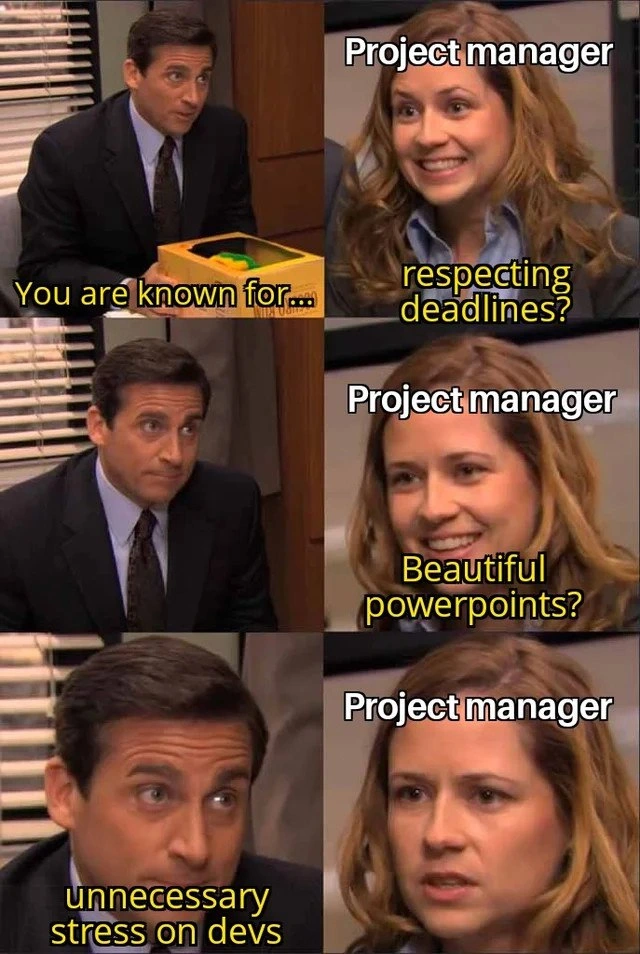
Project manager thinks deadlines and slide decks, devs remember the stress instead
Management PMs Post #4915, on Oct 8, 2022 in TG

Project manager thinks deadlines and slide decks, devs remember the stress instead

Why is this Management PMs meme funny?

Level 1: Homework Panic

Imagine you’re in school and your teacher gives you a big project to finish by tomorrow. The teacher is very strict about the due date – no matter what, you must hand it in tomorrow. They also want you to make a fancy poster to present your work to the class. Now, the teacher is all excited thinking, “Wow, I’m great at keeping my students on schedule, and I’ll get to see some beautiful posters!” But how do you and your classmates feel? Probably stressed out and nervous. You’re rushing to do the project all night, maybe even skipping sleep, and frantically coloring that poster to make it look nice. The teacher only thinks about the deadline and the pretty presentation, but the students only remember how overwhelmed they felt.

This meme is just like that. The “project manager” is the strict teacher, proud of setting tight deadlines and loving those slide presentations (like the poster). The developers are the students who had to do all the work in a hurry. In the end, the boss imagines they’re known for being on time and making nice slides, but the workers remember that they felt a ton of unnecessary stress. The joke is funny (and a bit sad) because it shows how the person in charge can sometimes forget what it’s like for the people doing the actual work – just like a teacher bragging about tough deadlines while the kids are completely frazzled.

Level 2: Unpacking Deadline Pressure

Let’s break down the scene and the jargon for those newer to the software world. The meme uses a familiar the_office_meme_format – images from the TV show The Office – to set up a joke about a project manager and their reputation. In a software team, a Project Manager (PM) is the person responsible for planning and managing the work. They set deadlines (due dates for when tasks or projects must be finished), keep track of progress, and report to higher-ups or clients about how things are going. Often, PMs organize status meetings and create PowerPoint slide decks (fancy presentations) to show timelines, milestones, and project updates. In corporate environments, being good at making these slide presentations (sometimes jokingly called slideware) and meeting deadlines is seen as a professional skill. It’s not uncommon to hear a manager praise someone for “always respecting deadlines,” meaning that person gets work done on time no matter what. And “beautiful PowerPoints” just refers to well-designed, clear slides – basically being great at communicating plans and results in meetings.

Now, on the other side we have the devs – the software developers who actually build the product. They care about writing good code, fixing bugs, and delivering a working application. From a developer’s perspective, what the PM demands (deadlines and constant presentations) can sometimes feel out of touch with the reality of software development. Why? Because building software isn’t perfectly predictable. Unexpected problems pop up: a library doesn’t work as expected, a feature is more complex than anticipated, or a bug takes days to diagnose. So a rigid deadline can start to feel unrealistic quickly. When a deadline is tight or unrealistic (one of our tags here is UnrealisticDeadlines), developers often have to rush. Rushing can mean working late nights or weekends (causing DeveloperFrustration and exhaustion), or cutting corners like skipping tests or code reviews. That might help finish in time, but it also creates stress and can lead to shaky results. This cumulative pressure on the team is what we call DeadlinePressure – the stress that builds up as the due date looms and there’s still a mountain of work to do.

The meme’s text “unnecessary stress on devs” is highlighting that the project manager’s actions (pushing hard on timelines and packing the schedule with meetings or presentations) often put extra stress on the developers that perhaps could be avoided. It’s “unnecessary” in the sense that maybe with a bit more flexibility or better planning, the team wouldn’t have to panic. For example, if a PM sets a deadline that’s too soon (maybe because they promised a client, or upper management insisted), the devs end up in crunch mode: doing frantic programming, often late into the night, to meet that date. That’s a very stressful experience. The developers remember those feelings of pressure and burnout much more than any nice slide deck or on-time delivery celebration.

We also see the phrase “respecting deadlines” in the meme. A junior developer might wonder, “Isn’t respecting deadlines a good thing?” Generally, yes – delivering on time is important. But the joke implies the PM is so focused on the deadline that they might ignore whether the deadline was reasonable to begin with. It’s as if the project manager’s pride is in never moving a due date, no matter what reality is – even if the requirements change or the task turned out way bigger than expected. That inflexible approach can be problematic in software, where some agility and adjusting is usually needed.

Then there’s “beautiful PowerPoints.” If you’re new to office life, you might be surprised how much time can go into making things look good for presentations. In many companies, there are weekly or bi-weekly meetings where the PM or team lead must update everyone on progress. They often use Microsoft PowerPoint to make slides with charts (like how much work is done, any risks, timelines, etc.). A “beautiful PowerPoint” means the slides are well-designed – perhaps using the company template, nice graphics, very clear points. It’s basically a polished report. Some project managers take this very seriously, treating it as a deliverable in its own right. However, developers sometimes joke about it, because from their perspective, the real work is the code being written, and a slide deck is just “talking about work” rather than doing work. If a PM spends a lot of time perfecting slides, devs might roll their eyes a bit, thinking, “We could’ve used that time to solve a real problem instead of tinkering with fonts and bullet points on slides.” The meme taps into that: the PM proudly guesses they’re known for great slides, which suggests maybe they put a lot of effort there – but the devs don’t exactly appreciate fancy slides when they’re stressed out.

The overall scenario is a common stereotype in Management_PMs versus engineering teams. The project_manager_stereotypes often show them as overly formal, schedule-driven, and sometimes oblivious to the human side of software development. The dev stereotype is being grumpy about meetings and wanting to focus on coding. In reality, good project managers try to balance timelines with the team’s well-being and are very aware of developer productivity. But this meme plays on the bad cases we’ve all heard about (or experienced) where the PM inadvertently becomes a source of stress rather than help. It’s ManagementHumor and CorporateHumor because it exaggerates traits many have seen in office culture: like the manager who’s in love with PowerPoint presentations, or who constantly brings up “the deadline” as if it’s sacred, even when things clearly need more time.

If you’ve ever been a junior dev on a team, you might recall your first crunch time or tight deadline. At the start, you hear something like, “We need to deliver Feature X by next Friday for the client demo.” It sounds doable until you hit a snag or two. Suddenly it’s Wednesday, the code isn’t working yet, and now there’s also a Thursday meeting where the PM wants you to help make slides about progress. That dual demand – finish the work AND make it look all tidy on slides – can feel overwhelming. The meme is basically pointing at that situation and laughing, saying: “Look, the PM might think they’re known for being timely and organized (deadlines and decks), but all the dev remembers is the stress they felt.” In the final panel of the meme, the PM’s face is stunned or speechless – that’s the realization moment: “Oh... that’s what you think of me?” It emphasizes the disconnect in perception.

So, in simpler terms: the project manager in the meme thinks they’re doing a great job by keeping projects on schedule and making impressive presentations. But the developers who have to do the actual work see that behavior as causing a lot of last-minute rush and anxiety. This meme is shining a light on that misalignment with a bit of sarcasm and a scene from a famous comedy show to keep it light. It’s a cautionary tale for any new developer or manager: focusing only on dates and slides might earn you a certain “reputation” – and not the one you want!

Level 3: Slideware vs Software

This meme nails a classic pm_vs_dev_dynamics conflict that every seasoned developer has witnessed. It repurposes a scene from The Office to highlight the stark contrast between what a Project Manager (PM) thinks they're admired for and what the dev team actually remembers. On the right, the smiling PM character eagerly guesses they're known for "respecting deadlines?" or maybe "beautiful PowerPoints?" – all the polished ProjectManagementHumor hallmarks of corporate success. Meanwhile, the left side (Michael Scott’s deadpan expression) delivers the brutal punchline: "unnecessary stress on devs." 😣 In other words, the PM imagines their legacy is timely delivery and slick slide decks, but engineers know them for inducing late-night panic and DeadlinePressure. The humor hits home because it’s too real in many workplaces: the boss proudly brandishes a Gantt chart or a fancy slide deck timeline, while the dev team is quietly drowning in crunch mode.

From a senior developer’s perspective, this joke cuts deep into corporate culture and project_manager_stereotypes. It’s lampooning that well-worn scenario where a manager obsesses over due dates and status reports (often via endless PowerPoint presentations) and in doing so creates a Deadline Death March. In software, a "death march" means a project with unrealistically tight deadlines that forces engineers to work ridiculous hours – a fast track to burnout. The meme’s PM seems blissfully unaware, thinking their value lies in enforcing schedules and crafting “beautiful slide decks.” But veterans know slideware isn’t software: you can’t compile a PowerPoint, and a project plan means nothing if the code is rushed and buggy. UnrealisticDeadlines lead to shortcuts, technical debt, and 3 AM production emergencies – things the Cynical Veteran in all of us has survived. We chuckle (or maybe groan) because we’ve lived this: the code gets rushed to “make the date,” then spends months being fixed afterwards. As the meme implies, the stakeholderPressure that PMs pass down the line often translates into devs furiously hacking away, fueled by caffeine and anxiety, to avoid being labeled “late.”

The technically insightful angle here is how management practices can clash with engineering reality. It’s a known anti-pattern: managing by PowerPoint. Instead of removing obstacles for the team, a bad PM adds more bureaucracy – like having developers waste an afternoon on slide prep for a status meeting, right when they’re in crunch time. The irony is palpable. Sure, that slide deck might look “on track” to higher-ups, but under the hood it’s held together by last-minute hacks and stressed developers. We even have a term for this style: PowerPoint-Driven Development (PDD) – when a project’s narrative in presentations starts to trump the actual state of the code. Beautiful powerpoints? More like polished fiction to appease upper management. Meanwhile, developers are muttering under their breath, “I guess that fancy timeline slide will fix the bugs, huh?” (Spoiler: it won’t).

This disconnect has been part of software engineering lore for decades. Fred Brooks in The Mythical Man-Month warned about it back in 1975. Brooks’s Law famously states: “Adding manpower to a late software project makes it later.” Yet every generation of managers learns the hard way that throwing more people or pressure at a project doesn’t magically compress schedules – it usually just creates chaos. Another gem, Hofstadter’s Law, wryly observes: “It always takes longer than you expect, even when you take into account Hofstadter’s Law.” Seasoned devs know that software estimates are inherently uncertain; unexpected bugs or complexities can blow any timeline. But in many companies, acknowledging that reality is taboo – instead, schedules are treated as immovable and teams are just expected to “sweat it out.” This meme is basically the dev team collectively rolling their eyes at that mindset.

Consider how these elements play out in real life: a project manager under StakeholderPressure commits to a tough deadline (“We need this feature by end of Q3 because sales promised it to the client”). To keep everyone “aligned,” they host weekly update meetings with slick PowerPoint slides showing progress bars inching forward. They might genuinely believe they’re motivating the team and demonstrating leadership by “respecting deadlines.” But from the DeveloperFrustration side, those slides are a reminder of how little time is left. Every hour spent tweaking slide #37 of the status report is an hour not spent writing or testing code. The developers end up context-switching between actual engineering and preparing reports to justify their progress. The result? Mistakes get made, quality drops, and stress spikes. It’s a vicious cycle: the closer the deadline, the more frantic the PowerPoints, and the more unnecessary stress on devs – which, cruelly enough, often delays the project further.

In short, the meme humorously exposes a management vs. engineering truth: what gets managers pats on the back (timely delivery, neat decks) often gives developers ulcers. The CorporateHumor lands because both PMs and devs reading it likely cringe a little in recognition. As a senior dev, you’ve probably sat in that meeting where a PM crows about “We hit the deadline!” while you think, “Yeah, by skimping on unit tests and sleeping 4 hours a night.” The workplace CorporateCulture that rewards keeping up appearances (on slides) instead of sustainable workloads is being called out here. It’s sarcasm with a purpose – pointing out that a project manager’s real legacy isn’t the color-coded timeline in their slides; it’s the trail of frazzled engineers sipping their seventh coffee, praying the production deploy doesn’t explode.

To sum up the dichotomy, consider this translation guide between management-speak and developer reality:

Project Manager Says/Does Developer Hears/Feels
“We must respect the deadline.” “Crunch harder, quality can wait.”
“Let’s review the PowerPoint deck.” “Another hour lost to meetings, sigh.”
“We delivered on time 🎉.” “We delivered a buggy release under duress.”
(No mention of dev overtime) “My burnout isn’t even on their radar.”

Every line of that table reflects the meme’s core satire: the PM proudly focusing on deadlines and presentations, oblivious to the human cost on the dev side. It’s biting humor, especially for those of us who have been on the receiving end of an “all-nighter to meet a slide’s promise.” The next time someone in a suit brags about “respecting deadlines,” don’t be surprised if a developer quips: “Yeah, and stressing out devs in the process.” This meme just puts that exchange in picture form, making us laugh and wince at the same time.

Description

Six - panel meme using a well-known office sitcom scene: the left column shows a suited man holding a yellow gift box, the right column shows a woman replying. Panel-by-panel text reads: 1) bottom left: "You are known for..." 2) top right: "Project manager" and bottom right: "respecting deadlines?" 3) (left, silent reaction) 4) top right again: "Project manager" and bottom right: "powerpoints?" 5) bottom left: "unnecessary stress on devs" 6) (right, silent reaction). The joke is that the project manager proudly guesses positive qualities while the observer reveals their real reputation - causing needless stress for developers. Technically, it lampoons common software-team pain points: unrealistic schedules, slide-heavy status meetings, and the tension between project management and engineering productivity
Comments

16
Anonymous ★ Top Pick Every time the PM squishes the Gantt chart to fit a slide, the team discovers a new O(stress²) algorithm for burning weekends
  1. Anonymous ★ Top Pick

    Every time the PM squishes the Gantt chart to fit a slide, the team discovers a new O(stress²) algorithm for burning weekends

  2. Anonymous

    After 20 years in tech, I've learned that the most accurate project timeline is the developer's estimate multiplied by pi, rounded up to the nearest sprint, then ignored entirely in favor of whatever date sales already promised the client

  3. Anonymous

    The PM's Maslow hierarchy of needs: at the base, beautiful PowerPoint slides with perfectly aligned shapes; in the middle, arbitrary deadlines that ignore technical complexity; at the peak, developers who somehow deliver despite both. The irony? The stress they create trying to 'manage' the project often becomes the project's biggest blocker - a self-fulfilling prophecy where the overhead of coordination exceeds the cost of the work itself

  4. Anonymous

    If it compiles in PowerPoint, the PM marks it committed - then wonders why the burndown and the team both keep burning

  5. Anonymous

    PMs rebase deadlines like git branches: endlessly, never merging to main

  6. Anonymous

    When management optimizes for 100% utilization and slide velocity, you’ve implemented the worst queue: infinite WIP, exploding cycle times, and the only thing going green is the PowerPoint theme

  7. @yoyatayo 3y

    True, or not true. Idk im still student

  8. @iovi_iovi 3y

    so true I'm feeling depressed now 🫠

  9. @affirvega 3y

    Who tf is this and source please and English please

    1. Deleted Account 3y

      There are a terrorist attack happend few ours ago. Krumsky (?) bridge was blown up with a truck. But we have a very old underground meme - in all Acts of terrorism there was an Abu. Nariman Namazov - admin of 2ch (Russian 4ch).

  10. @RiedleroD 3y

    translate or perish, tarnished one

    1. @mekosko 3y

      That's political spam

      1. @RiedleroD 3y

        oh alright

  11. Deleted Account 3y

    He was saving people or doing opposite things. No matter what - he was everywhere. I can count at least 10 iterations, and 4 times it get in officiall news on TV (lol)

  12. Deleted Account 3y

    So, this is a spam, yes. With hope that it will get misunderstood

  13. @slnt_opp 3y

    The Russian version of Sam Hyde memes

Use J and K for navigation