The Agile Pivot: From Useless Icing to a Pie in the Sky
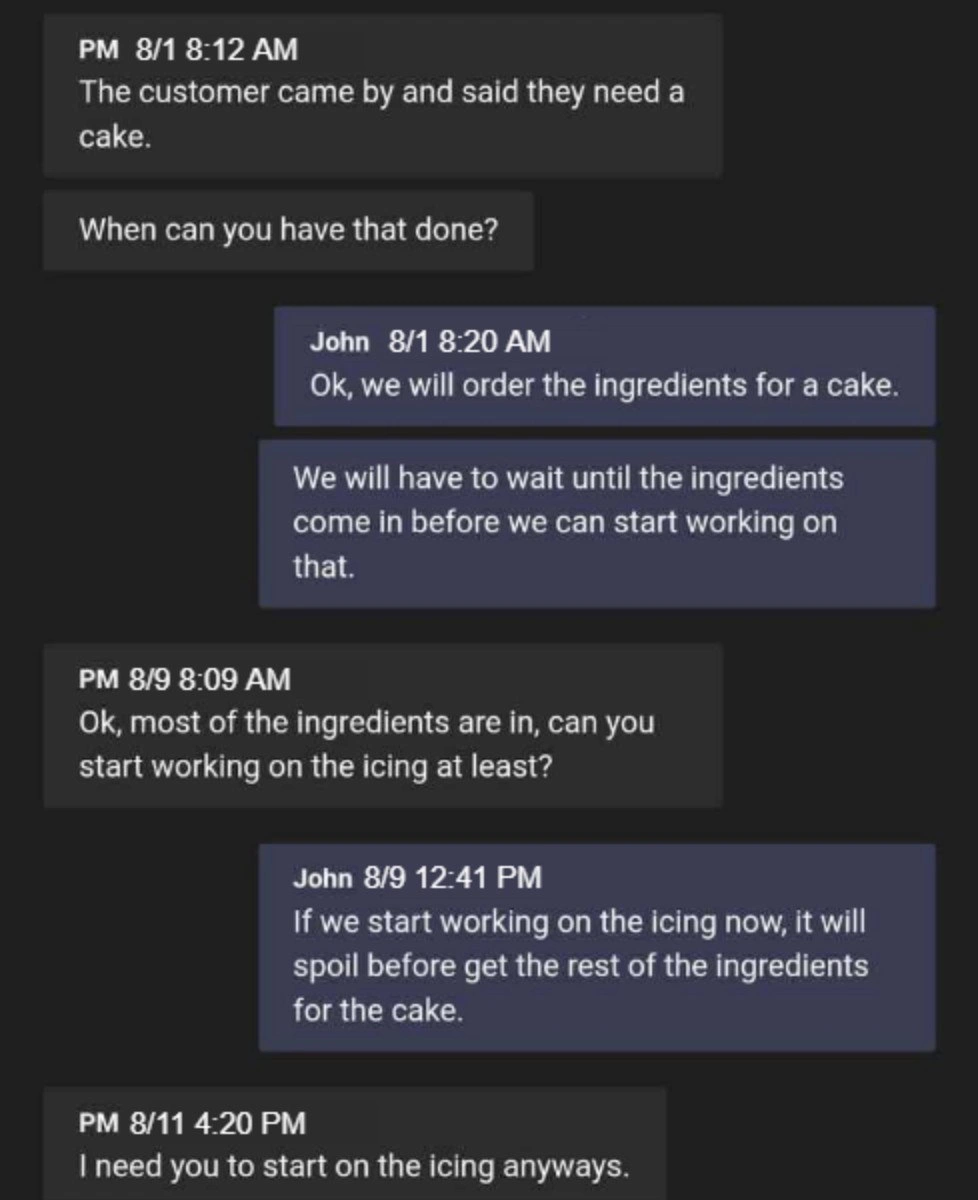
Why is this ProjectManagement meme funny?
Level 1: First Cake, Then Pie
Imagine your friend asks you to bake a cake for a party. You agree and start getting ready to bake. But uh-oh – you realize you have no eggs to make the cake batter, and the oven (stove) in your kitchen is busy because someone else is using it to cook dinner. You tell your friend, “I can’t bake the cake right now.” Your friend replies, “It’s okay, can you start by making the frosting for the cake anyway?”
So even though it feels weird to make icing with no cake to put it on, you decide to help and make a bowl of sweet frosting. It’s like doing things in a very strange order, right? You have a bowl of frosting sitting there, waiting for a cake that hasn’t been made.
Now, just when you finish the icing, your friend comes back and says, “Hey, change of plans – I know I asked for cake, but now I actually want a pie instead.” You’re left holding a bowl of cake frosting and no cake, and your friend now wants an entirely different dessert. All the work you did on the frosting is useless for a pie (a pie uses filling and crust, not cake icing).
You can probably sense why this situation would be funny and frustrating at the same time. It’s funny because it’s so silly: who in their right mind would tell you to make frosting when there’s no cake, and then not even use it in the end? It almost sounds like a goofy cartoon scenario. But it’s also frustrating — you did exactly what was asked, and you tried your best despite the odd request, and in the end it was all for nothing because the plan changed. You might laugh because it’s just so absurd, or you might feel annoyed that your time was wasted.
This little story is exactly what the meme is describing, but in real life it happens on software teams. The developer (like you, the baker in this story) is asked by a project manager or client (like the friend) to do things that don’t make sense (icing without cake), and then suddenly the client changes their mind (cake to pie). The reason people share a meme about it is to laugh at how ridiculous it is — sometimes humor helps us deal with the frustration of doing a lot of work that gets thrown away. It’s a reminder that plans can change quickly, and when they do, it can feel pretty unfair (and a bit comical in hindsight) for the person doing all the work.
Level 2: Icing Without Cake
This meme uses a simple baking analogy to describe a situation in software development where things go wrong due to changing plans and missing pieces. Let’s break down the scene and what each part means in a real project:
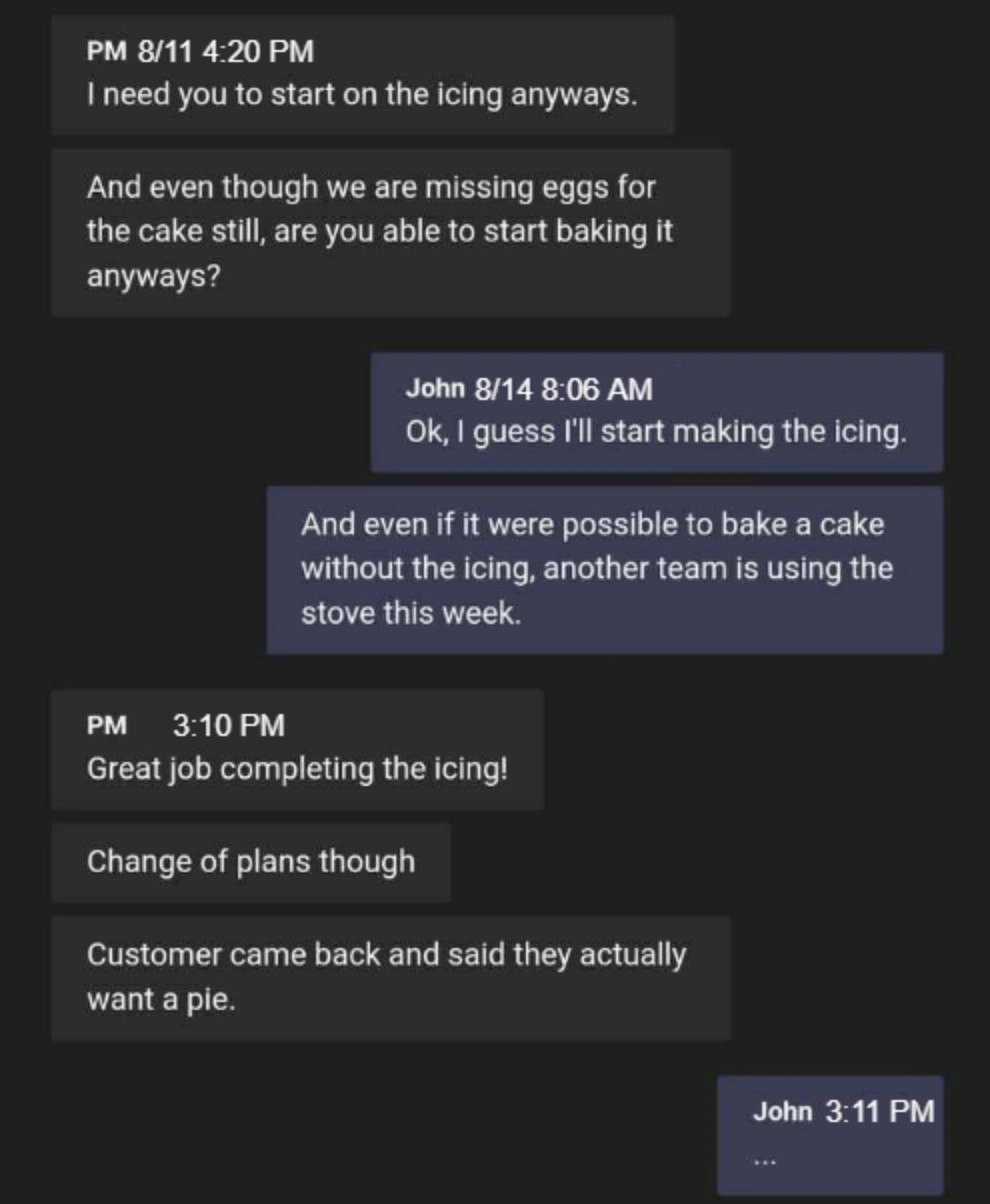
The PM (Project/Product Manager): This is the person in the gray chat bubbles giving instructions. In a real project, a PM is someone who coordinates the work, talks to the client (or customer), and decides what the team should do. Here the PM says things like “I need you to start on the icing anyways” and “even though we are missing eggs for the cake, are you able to start baking it?” This sounds odd in the baking context, and it is! It’s the PM asking the developer to start working despite missing a critical ingredient. In software, this would be like a boss saying, “I know we’re missing some data or a piece of the system, but can you start coding something now anyway?” It’s generally an unreasonable request because some tasks depend on others. PMs might push for this if they’re under pressure, but it puts the developer in a tough spot.
Missing Eggs = Missing Dependency: Eggs are essential for baking a cake, just like certain components are essential for building a software feature. In project terms, a dependency is something you need before you can proceed. If that thing is missing, we often call it a blocker because it blocks progress. In the meme, the missing eggs represent a blocker. For example, imagine you’re supposed to build a mobile app, but you’re still waiting for the server (backend) to be set up by another team. That backend is a dependency; without it, parts of your app can’t function. The PM in the meme is basically saying, “Pretend the blocker isn’t there, do what you can.” He’s asking John to bake without eggs, which every baker (and developer) knows is not going to end well.
Icing Before Cake = Working Out of Order: Normally, you bake the cake first, then put icing (frosting) on it as the final touch. Icing is like the finishing touch that makes the cake look and taste better, but on its own it’s not a cake. When the PM says “start on the icing anyways,” it means they want progress on something, even if it’s the wrong order. In software, this could be like designing a fancy user interface for an app feature that hasn’t been built yet. You can technically work on the icing (for example, you could design graphics or write code for the UI), but without the cake (the actual feature logic or the data), that work might have to be re-done or could be wasted. It feels backwards to the developer. John responds with, “Ok, I guess I'll start making the icing,” showing he’s reluctantly agreeing to do this out-of-order work. It’s a bit of a sarcasm in real terms, like saying “Alright, I’ll do this, but it’s not ideal.”
Stove is Busy = No Environment to Work In: John also says, “even if it were possible to bake a cake... another team is using the stove this week.” This translates to another real-world issue: limited resources. In many companies, teams share environments or tools. The “stove” stands for something like a server, a test environment, or a build machine that is currently occupied. It’s like if you wanted to deploy your code to a test server, but you can’t because another team is using that server for their project this week. John is pointing out that even aside from missing eggs, he literally cannot do the baking now because the tool/resource he needs (the oven) is unavailable. In project management, planning should account for these resource conflicts, but sometimes communication fails. Here, it seems the PM either didn’t know or didn’t care that the “stove” was booked by someone else. For a junior developer, this is a lesson: often you have to coordinate with other teams for shared resources. If that doesn’t happen, you get blocked through no fault of your own.
“Great job on the icing... actually they want a pie” = Last-Minute Change: After some time (notice in the chat, a few days pass), the PM says, “Great job completing the icing!” and immediately, “Change of plans though. Customer came back and said they actually want a pie.” This is the punchline of the meme. In real projects, this is akin to a stakeholder (usually the client or whoever is asking for the product) changing their mind about what they want, late in the game. Originally they wanted a cake; now they decided a pie would be better. It’s a huge change in requirements. In software terms, maybe you were building a website and the client suddenly says they need a mobile app instead, or you were making a reporting system and they say “actually, scrap that, we need a chatbot.” All the work done for the original request (the cake icing John made, and any other prep) is suddenly not useful for the new request (a pie). We call this kind of sudden shift a pivot or just requirement change. When smaller additions keep creeping in beyond the original plan, that’s called scope creep, but here it’s more like scope whiplash — a total redirection. The PM at least acknowledges John finished the icing (he says “Great job”), which is a bit comedic because that praise is immediately followed by news that renders the accomplishment moot. It’s like your boss saying “Good effort on that prototype, but the client doesn’t need it anymore.”
John’s “...” = Speechless (Not in a Good Way): John responds with just an ellipsis (“...”), which is a textual way of expressing silence or facepalm. It means John has nothing he can say that would be constructive. This is a very relatable moment for developers. It captures the developer frustration without using any words at all. When requirements change drastically or you’re asked to do something that makes no sense, you often just feel a bit stunned. Especially if you spent time and energy on that icing (work) only to find out it’s wasted, you might be thinking “Are you kidding me?!” but you might not say that out loud to your PM. So “...” is John biting his tongue, or him being at a loss for polite words. In many developer-team cultures, this exact scenario (do work despite blockers, then scope changes) has happened, and the “dot dot dot” reply is an inside joke for “I have no words for what just happened.”
Why is this meme funny? It highlights a real tension in project work in a very absurd, simplified way. Almost everyone can understand the silliness of trying to bake without eggs and then switching desserts mid-way. You don’t need to know coding to see why that’s a bad idea. For developers, it’s funny because we’ve been in John’s shoes and it usually feels just as ridiculous in hindsight. You laugh because otherwise you’d cry about the wasted effort. The meme is basically saying, “Hey, isn’t it crazy when your boss or client does this to you?” using a scenario with cakes and pies. It’s a form of ProjectManagement humor and Developer humor. The tags like ScopeCreep, ClientExpectations, and RequirementsVsReality all point to this common theme: the plan keeps changing or wasn’t thought out well, and the people doing the work are left frustrated. If you’re new to the workforce, the takeaway is that good planning and clear requirements are super important. And if you ever find yourself as John, know that it’s a shared experience — every developer has gone through a version of this and lived to meme about it.
Level 3: Half-Baked Requests
This meme is a near-perfect allegory for the frustration of software development under chaotic Project Management. We see a hapless developer, John, juggling impossible requests from a Product Manager (PM) who seems determined to ignore all dependencies and logic. It's written as a chat exchange about baking, but any senior engineer knows this is really about code and projects:
Missing Dependencies (Eggs): The PM asks John to “start on the icing anyways” even though the team lacks eggs to bake the cake. In software terms, this is like a manager asking you to implement a feature when a critical dependency (like a required library, an API from another team, or a piece of data) is unavailable. It's a classic management move: "Just work on something, anything, to show progress." The PM is essentially glossing over a blocker (no eggs) as if it’s a minor inconvenience. This often happens when deadlines are looming or status reports are due – managers feel they must demonstrate progress even if it means doing things out of order or with incomplete information. It's a recipe for wasted effort, pun intended.
Out-of-Order Execution: The PM then asks if John can start baking the cake despite missing ingredients. This is akin to beginning development or deployment before the prerequisites are ready. For example, "Can you start coding the module even though the backend service isn't finished?" It’s an absurd request because certain tasks have a natural order. Baking a cake without eggs is like deploying code without a database in place, or writing integration tests when the service you’re testing doesn’t exist yet. Any experienced dev knows you can't just pretend the missing pieces are there... unless you enjoy sunk cost surprises later. Managers who push for this are ignoring the very real sequence of steps in a project plan – it's doing things backwards and hoping it somehow works out.
Resource Contention (Stove in Use): John's response mentions another team using the stove this week. This translates to a real-world scenario where a vital environment or resource is occupied. Maybe the only testing server is being used by Team B, or the deployment pipeline is frozen because another project is going out. In this meme’s terms: even if John magically could bake a cake with no eggs, he physically can’t because he has nowhere to bake – the oven (compute resource, server, etc.) is unavailable. This highlights how team dependencies and shared resources can block progress. It's reminiscent of trying to share a single staging environment across multiple projects – a sure formula for scheduling conflicts. The PM either isn’t aware of this conflict or doesn’t care, which is another classic management oversight: planning as if you’re the only team in the kitchen.
Shifting Requirements (Cake vs Pie): The final gut-punch: after John complies with the nonsensical plan and finishes the icing, the PM cheerfully says, “Great job completing the icing! Change of plans though. Customer came back and said they actually want a pie.” This is the embodiment of scope creep and wild requirement changes. The project’s entire goal changed from a cake to a pie at the last minute. In real terms, the client or stakeholder completely changed the product direction (maybe they decided on a different feature set or market need). So all the work done on the “cake” (the icing, equivalent to code written under the old plan) is now potentially useless. This kind of pivot is painfully common: you build Feature A, then the client says, "Actually, let's do Feature B instead." All that effort on A becomes throwaway. Such misaligned expectations between the customer and the team lead to whiplash like this.
To visualize the absurdity, here's what the PM's plan vs Developer's reality looks like side by side:
| Plan (PM's Requests) | Reality (Dev's Perspective) |
|---|---|
| Start on the icing now (before cake). | Doing the finishing touches first – but there's no cake to put it on (likely wasted effort). |
| Bake the cake despite missing eggs. | Impossible to bake without essential ingredients (hard blocker, can't proceed). |
| Ignore that the stove is in use. | The only oven is busy with another team's work – no environment available to "bake" anything. |
| "Great, the icing is done!" (praise) | The icing is completed but has nothing to go on – the cake still isn't baked. |
| Switch to making a pie instead. | Complete change of direction – all cake-related work (including that icing) is now useless. |
John’s final reply is just “...”, a perfect ellipsis of despair. Every senior dev has had that speechless moment on Slack or in a meeting when faced with such nonsense. It’s the universal developer reaction to being jerked around by Stakeholder expectations: you have no words, only a quiet resignation (or a muffled scream into the void). The humor here is dark: it's funny because it's true. We’ve got the trifecta of project dysfunction all at once:
- Ignoring blockers – pushing forward despite missing building blocks.
- Resource collisions – planning as if you’re alone, when in reality multiple teams share the same oven.
- Last-second pivots – moving the goalposts after the work is done.
The meme’s Slack-like chat format makes it painfully realistic. Notice the PM’s request comes at 4:20 PM on 8/11 (very end of the work week) and John replies Monday morning. That timing detail is chef’s kiss: it implies the PM dropped this half-baked request right before the weekend, and John had to respond after stewing over the absurdity. Then, by Monday afternoon, the PM pivots dramatically. It’s the corporate equivalent of being told to paint a room that’s about to be demolished. Developer frustration doesn’t even begin to cover it.
In summary, this meme layers multiple common software project nightmares into one narrative. It lampoons the unrealistic optimism of some managers who treat development like an assembly line (thinking tasks can be done in any order), and the fickleness of clients who believe changing requirements is as simple as ordering a different dessert. Experienced developers chuckle (or groan) because we’ve all been John at some point – painstakingly completing the “icing” only to hear “Actually... we need a pie now.” It’s a humorous cautionary tale about how not to manage a project, reminding everyone that ignoring dependencies and constantly shifting goals is a recipe for disaster (and lots of facepalms).
Description
This is the second part of a chat conversation screenshot between 'PM' and 'John,' continuing the cake-baking analogy for a software project. The PM, having previously insisted John start on the icing without all ingredients, now asks him to bake the cake without eggs. John reluctantly agrees to start the icing but points out a new blocker: 'another team is using the stove this week,' a metaphor for a shared, contended resource like a testing environment. In a sudden pivot, the PM praises John for completing the icing, only to immediately announce, 'Change of plans though. Customer came back and said they actually want a pie.' The conversation ends with John's silent, frustrated response: '...'. This meme perfectly captures the pain of scope creep, where requirements change so drastically that completed work becomes entirely useless, leaving the developer speechless
Comments
7Comment deleted
Congratulations, you've just completed the icing for a feature that's now been deprecated. Your JIRA ticket has been moved to the 'Won't Do' column, but the story points will haunt the sprint velocity forever
Nothing like a PM pushing frosting-first development: ship the UI behind a “hasEggs” feature flag, borrow the oven from DevOps, then pivot Friday from Cake-as-a-Service to full-stack Pie-Ops
This is why we now have a dedicated "icing storage" microservice that costs $50k/month and nobody remembers why we built it
This is the software equivalent of being asked to implement the frontend before the API spec is finalized, then being congratulated for shipping it, only to be told the customer actually wants a mobile app instead of a web interface. The '...' response perfectly captures that moment when you realize you've just spent three days building something that will never see production because requirements changed after you solved the impossible problem they originally asked for
Classic enterprise agile: ship the frosting microservice while the oven platform is booked, then the roadmap pivots to pie and we relabel the frosting as a “decorator service” to hit OKRs
Enterprise Agile: ship the icing while DB creds (eggs) are missing and the oven (shared cluster) is booked by Platform; then the customer pivots to pie and asks if we can reuse the CSS
PMs perfecting the art of 'frost UI before MVP foundations solidify,' only to pivot the whole stack to pie