Project Management's Guide to Baking: Just Start on the Icing
Why is this ProjectManagement meme funny?
Level 1: Cake Before Icing
Imagine your friend tells you they need a cake for a party, but they haven’t even gone shopping for the ingredients yet. You offer to help bake it once the ingredients arrive. Now picture your friend saying, “Okay, we got some of the ingredients, can you start putting the icing on the cake?” You’d probably blink in confusion and reply, “But we haven’t baked a cake to put the icing on!” If they insist, “Do the icing anyway,” you know that’s a pretty silly request. The icing would just sit there with nothing to put it on and would go bad (or make a big sticky mess) by the time the actual cake is ready.
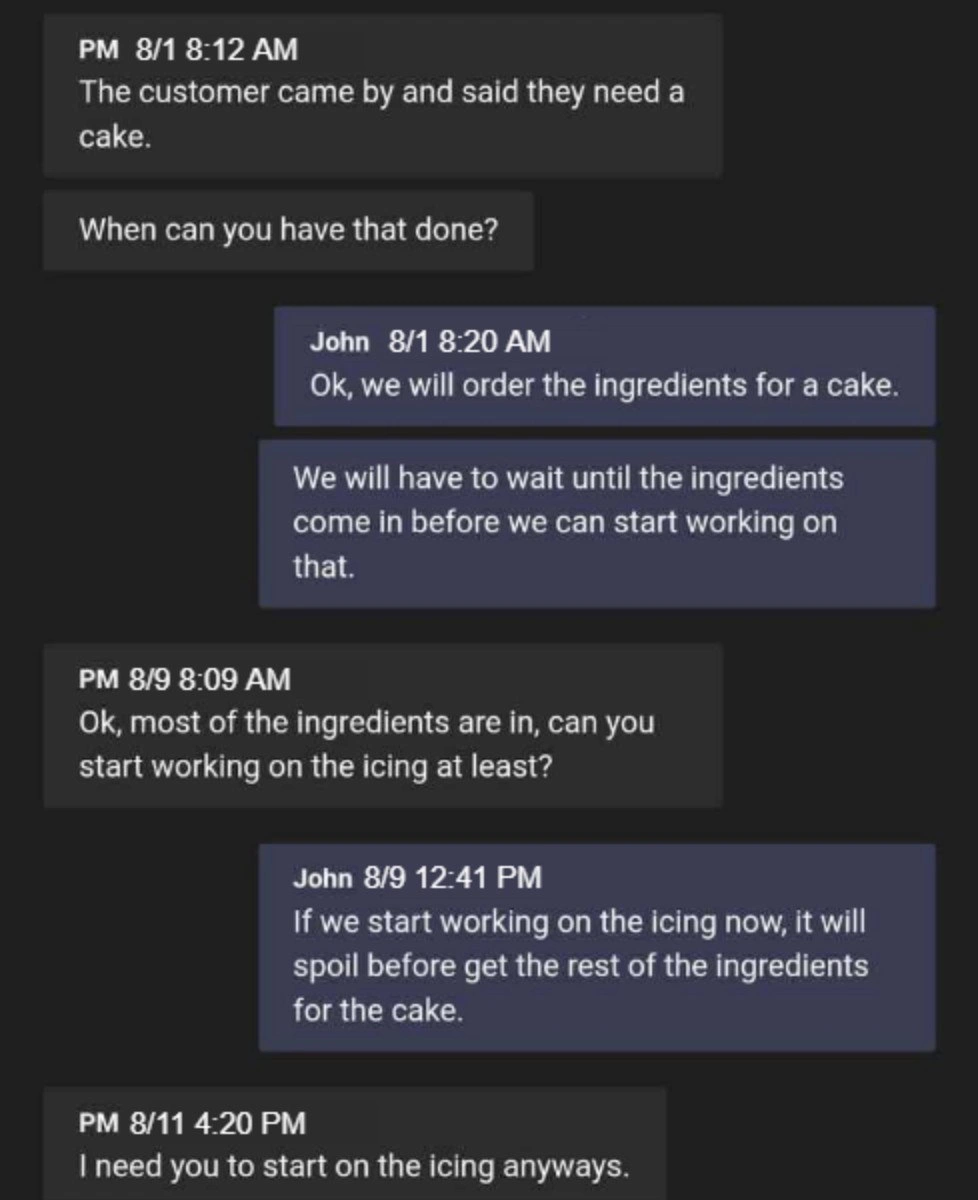
This meme is funny in the same way: a boss is basically asking an employee to frost an imaginary cake. It’s an everyday joke about doing things in the wrong order. Even a kid knows you have to make the cake first, then add the icing. The humor (and frustration) comes from how obvious it is — it makes us think, “What is that manager thinking?!” It’s like a teacher asking you to color in a picture that you haven’t drawn yet. Of course you can’t do that; you need the drawing first! In the story, John (the person making the cake) is feeling frustrated because he’s being told to do something that clearly doesn’t make sense. We find it funny because it’s so ridiculous and absurd, and we feel a bit of sympathy for the person being asked to do the impossible. Essentially, you need the cake before you can put on the icing — a simple truth that makes this situation so silly. That’s why this little chat is both humorous and relatable: it’s showing in a goofy way that sometimes people in charge ask for things that just aren’t realistic, like icing with no cake!
Level 2: Dependencies First
This meme uses a cake analogy to explain a common tech workplace problem: managers pushing for results out of order. Let’s break it down in straightforward terms. The Project Manager (PM) represents a manager or lead whose job is to coordinate the project and satisfy the stakeholder (in this case, the customer who requested the cake). When the PM says, “The customer needs a cake. When can you have that done?” they’re essentially asking the developer for a deadline on a new project that was just requested. John, presumably the developer, responds by saying they will order the ingredients for the cake, and importantly, he notes they have to wait for those ingredients to arrive before starting work. In software development, “ordering ingredients” is like gathering all the requirements, tools, or data you need. For example, if you’re asked to build a new app, you might need to get design mockups, API access, or approval on specs first. Those things are dependencies – tasks or items that must be in place before other work can begin. This waiting period is the dependency_wait_time, akin to waiting for our cake ingredients.
Now, the PM comes back on August 9th and says, “Most of the ingredients are in, can you start working on the icing at least?” Here the PM is pushing to begin a later step (making icing, which is like adding final touches or the user interface in a software project) before the earlier steps are completed. In real projects, this would be like a manager asking, “We have some of the back-end ready, can you start coding the final UI or polish the product now?” The developer (John) replies that starting the icing now would cause it to spoil before the rest of the ingredients arrive – meaning if you do work too early, it might become useless by the time it’s actually needed. In software terms, think of writing code based on assumptions or partial data: by the time the real data or remaining components arrive, your early code might no longer fit and would have to be thrown away or redone. That’s wasted effort, or spoiled_output.
This situation highlights a miscommunication and misaligned_timeline between the PM and the developer. The developer understands that tasks have to go in a logical order (you bake the cake, then put icing on it). The PM, however, is under pressure from the client (stakeholder) and is trying to speed things up in any way possible, even if it doesn’t make sense. This is a form of stakeholder_pressure driving a manager to set unrealistic deadlines or demands. The term scope creep usually refers to adding extra features beyond the original plan, which isn’t exactly what’s happening here (since “icing” is part of the cake project from the start, not an extra feature). But what we do see is similar project mismanagement: the timeline is getting bent into unnatural shapes because someone in charge keeps saying “do something now, even if it’s out of sequence.” This is a well-known frustration in project management for software: sometimes non-technical managers think that if part of a project can be started, it should be started immediately, regardless of dependencies or logical order. They might not realize that some tasks depend entirely on others being finished – just like you can’t frost a cake that hasn’t been baked.
For a newer developer (or anyone new to workplace dynamics), what’s funny here is also educational: ManagerExpectations can sometimes be unrealistic. A manager might insist on progress that looks good on paper or to the client, even if it’s just for show. Engineers often have to explain that doing things prematurely (here, premature_work like making icing too early) can lead to waste and rework. The “icing” in the conversation is a metaphor for final touches, pretty visuals, or the end product. The “ingredients” are the foundational pieces you need first. If you’ve ever followed a recipe or built something step by step, you know skipping to the last step doesn’t work. This meme basically translates a common software development glitch into a everyday scenario. ProjectManagementHumor like this uses something as simple as baking a cake to point out how absurd it is when stakeholder_expectations and management demands ignore the actual process. In summary, the PM in this meme is essentially saying “I don’t care if it’s not ready, start the finishing touches now,” and the developer is baffled because, well, that’s not how cakes or software projects are made!
Level 3: Premature Frosting
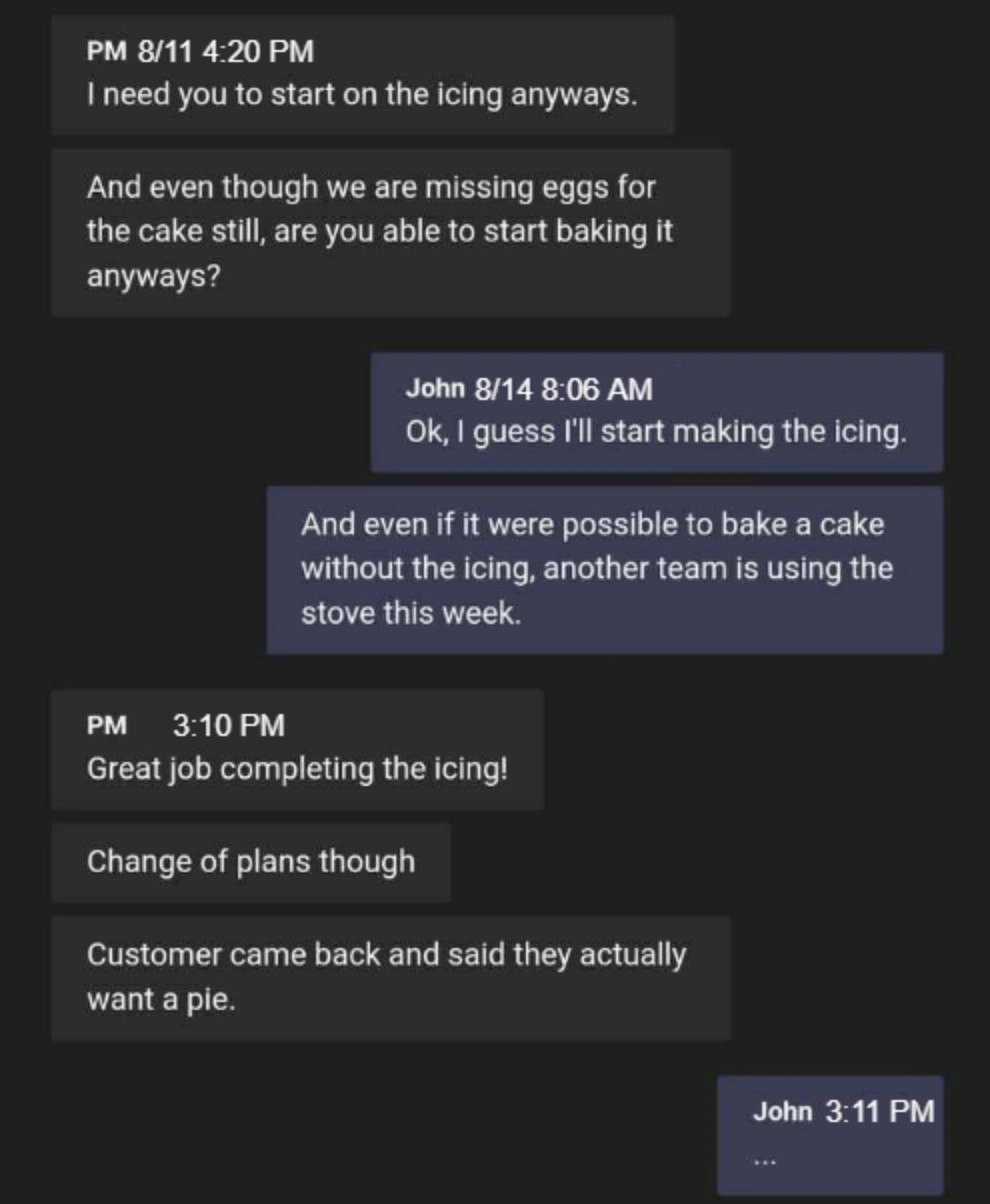
This cake analogy hits experienced developers right in the feels because we’ve all dealt with a project manager (PM) who puts the cart before the horse. The chat screenshot humorously shows a PM demanding icing on the cake before the cake even exists. In software terms, that’s like a manager insisting on polishing the user interface or deploying the final build when the backend code (the “cake base”) isn’t even written yet. It’s an absurd scenario that screams unrealistic deadlines and stakeholder pressure, and it’s funny precisely because it’s painfully familiar as a form of management humor. The PM is under the gun from an anxious client (the stakeholder who “needs a cake”), and in a panic to show progress, the PM leaves logic behind. They say, “Can you start working on the icing at least?” as if doing premature work will magically accelerate the project. Any senior engineer reading this meme can practically hear their own inner voice groaning, “Here we go again...”
On a technical project timeline, tasks have dependencies just like a recipe has ingredients. You can’t build the icing (finish the UI or final touches) until you’ve baked the cake (implemented core features or acquired all prerequisites). John, the developer, explains this very clearly: “We have to wait until the ingredients come in before we can start.” This is classic dependency_wait_time — those missing ingredients could represent waiting on a third-party API, a library, or another team to deliver something essential for the project. Starting on icing early would be like coding against an API that hasn’t been built or finalizing a frontend design when the requirements are still in flux. In veteran developer terms, that’s a recipe for rework and spoiled_output. The miscommunication here is almost comical: the dev’s rationale is rock solid (icing will spoil without a cake to put it on, i.e., any work done now will become useless), yet the PM either doesn’t understand or chooses to ignore it. Every seasoned engineer has seen this movie before – a manager’s expectations misaligned with reality, leading to “do it anyway” orders that create more chaos later.
Why would a PM act this way? Often it’s due to stakeholder_expectations and a desperate need to show progress. Perhaps the customer who “came by” demanding a cake also set a crazy deadline or is constantly checking in. The PM likely promised an optimistic delivery date without fully grasping the steps involved (sound familiar?). Now as days pass (notice the timestamps: August 1 to August 9 to August 11), the PM is feeling the heat. Instead of explaining to the client that certain things take time (like waiting for ingredients or dependencies), the PM tries to force progress by any means. This might be an example of a misguided Waterfall mentality where each stage is expected on a fixed date, or just plain misaligned timelines due to lack of technical understanding. It mirrors situations in software projects where a manager might say, “We have some of the data, can’t you start coding the final reports?” or, “The backend team is late, but can’t the frontend team at least start styling the app?” They see tasks in isolation, not realizing how tightly coupled certain things are. The humor (tinged with scope creep pain) comes from that cognitive dissonance: the PM imagines development is like an assembly line where you can work on any part independently, while the dev knows it’s more like baking – skip steps and you get a mess.
For those of us with battle scars from past projects, this meme also highlights the human factor and a bit of dark truth. There’s an element of sarcasm in John’s polite response “it will spoil”: you can almost sense him restraining a more cynical “this is a half-baked idea” retort. Seasoned devs have often had to explain obvious technical logic to non-technical managers, sometimes repeatedly. It’s a frustrating dance – the dev is trying to prevent disaster (or useless work), but the higher-up cares only about appearances or timeline optics. The final PM message, “I need you to start on the icing anyways,” is the punchline that makes engineers laugh and wince at the same time. It’s so misaligned with reality that laughter is the only safe response (short of banging one’s head on the desk). The meme perfectly captures that shared exasperation: we laugh because we’ve lived it. It’s project_management humor distilled – turning our daily headache of manager expectations and timeline absurdities into a scenario so obviously silly (icing with no cake!) that even a non-developer can see the flaw. In real life, pushing forward like this often leads to hastily written code that rots (spoils) or throwaway work that wastes time. The veteran perspective here might drop a famous adage: “Nine women can’t make a baby in one month – and icing a non-existent cake won’t deliver it any faster, either.” In short, the meme is a nod to every developer who’s been pressured to put shiny icing on a project that isn’t fully baked, and it wryly commiserates: we’ve all dealt with this kind of half-baked management directive, and yep, it’s as ridiculous as it sounds.
Description
A screenshot of a chat conversation between 'PM' and 'John' that uses a cake-baking analogy to illustrate a common software development problem. The PM asks for a cake, and John explains they need to wait for ingredients. The PM then insists John start on the icing even though most ingredients haven't arrived. John warns the icing will spoil, but the PM overrules him, demanding he 'start on the icing anyways.' The conversation is a metaphor for a project manager pressuring a developer to start on a feature (the 'icing,' often the UI) before the necessary backend infrastructure or dependencies (the 'ingredients') are in place. This highlights a classic conflict where non-technical managers, focused on visible progress, ignore technical constraints, leading to wasted work and developer frustration
Comments
7Comment deleted
You can't ice a promise. Well, you can, but then you just have a sticky mess assigned to you in a Jira ticket
PM keeps demanding we “work on the icing,” so I spun up an empty repo called frosting-service, set its health check to always return 200, and marked the project green - should buy us two sprints before anyone realizes there’s still no cake microservice
After 20 years in this industry, I've learned that "I need you to start on the icing anyway" is just PM-speak for "I already promised the customer they could lick the bowl at tomorrow's demo."
This is the software equivalent of a PM asking you to deploy the frontend before the API exists, then wondering why users see 404s everywhere. 'Just mock the responses!' they say, as if production users will be satisfied with Lorem Ipsum data. The real kicker? Eight days later, they're still demanding you start on the icing - because surely by now you've figured out how to make frosting defy the laws of thermodynamics and project dependencies
WaterScrumFall in one message: “Start on the icing” = build the UI while the API, schema, and contracts are TBD; mark it 80% done and 200% rework later
PO demanding the icing sprint before backend ingredients? That's deploying React polish on a 404 cake - shiny prod crashes incoming
Frosting-driven development: polish the demo while the dependency graph still has no cake node - looks great in sprint review, guaranteed rework in prod