The Bark of Truth in Developer Culture
Why is this DevCommunities meme funny?
Level 1: Not Just Jokes
Imagine you love soccer and know every funny joke and chant about the game, but you’ve never actually played soccer. Now suppose a real coach or player hears you joking and tells you, “Hey, knowing all the team jokes and chants doesn’t mean you can play on the field.” Ouch. You’d probably feel a bit hurt or embarrassed, right? Because deep down you know they’re right – being good at soccer takes practice and real play time, not just cheering from the sidelines. This meme is doing the same thing, but with programming. The dog’s comment is basically saying a truth that’s a little painful: enjoying the jokes about coding isn’t the same as being able to code for real. It reminds us that sometimes hearing the honest truth can sting more than an actual bite, especially when we realize we have more to learn.
Level 2: More Than Memes
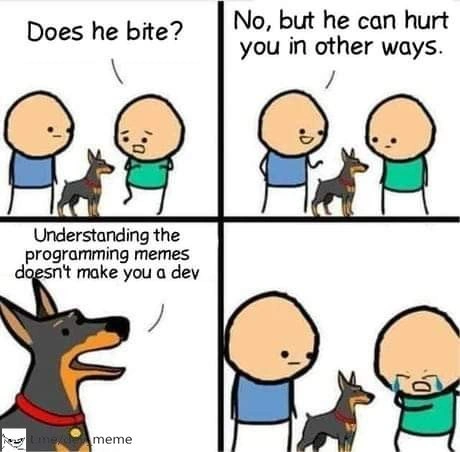
In simpler terms, this comic has the following exchange:
Person B: Does he bite?
Person A: No, but he can hurt you in other ways.
Dog: "Understanding the programming memes doesn’t make you a dev."
Now let's break that down. "Dev" is short for developer, meaning someone who writes computer programs (codes) to build software. Programming memes are those funny images or jokes about coding that you often see in developer circles online. For example, the subreddit r/ProgrammerHumor on Reddit is full of these inside jokes. They reference things like bugs, broken builds, or funny situations in coding (imagine jokes about a code not working because of a semicolon missing, or cartoon scenes of a developer crying over a crashed server). If you understand a programming meme, it usually means you’re familiar with the topic or have seen others talk about it in the dev world.
What the dog is saying is basically: “Hey, just because you get all those coding jokes, that doesn’t mean you actually know how to code or that you’re a programmer.” The owner’s line “he can hurt you in other ways” warns that instead of a bite, the dog will say something that might hurt emotionally. And indeed, the dog’s comment hits a nerve — you see Person B in the last panel with tears in his eyes. He’s hurt, not physically, but because the dog’s words made him feel bad. Why would it hurt? Because Person B probably thought being able to laugh at and understand programming jokes meant he was part of the programmer club. The dog basically said, “Nope, not really.”
This highlights a form of gatekeeping (setting unofficial rules about who counts as a "true" member) in the programming world. Gatekeeping is when people in a group say “you’re not a real member of us unless you meet these criteria.” Here, the dog is acting like a gatekeeper by implying Person B isn’t a real programmer (a "real dev") just because he only knows the jokes but hasn’t proven any coding ability. For someone new to coding (like a junior developer or a student), hearing “you’re not a dev” can sting. It taps into impostor syndrome – the self-doubt many newcomers (and even experienced folks) feel, worrying that they’re not actually good enough or that they’re a "fraud" in the community. Person B probably already feels a bit insecure about just lurking and laughing at memes without much coding practice. The dog’s remark hits that insecurity right on the head, which is why we see Person B look so crushed. It’s like the comic is visualizing those imposter_dev_feelings in a funny, exaggerated way.
The key point is that understanding jokes about programming and actually programming are two very different things. It’s one thing to laugh at a meme about a database crashing or a cartoon about messy code; it’s another thing to sit down and write code that avoids those crashes or cleans up the mess. As a new coder, you eventually learn that you can’t become a developer just by absorbing content or hanging around meme pages. You have to actually write code, make mistakes, and learn hands-on. That’s the learning curve everyone faces when picking up programming (or any skill, really). Memes might teach you a few buzzwords or give you a taste of the culture, but they won’t teach you how to debug an error or design a system. The dog’s message, though harsh in tone, is basically a reminder of this reality: to call yourself a developer, you need to put in the work, not just know the jokes.
It’s worth noting the meme format itself was pretty popular. The setup “Does he bite? / No, but he can hurt you in other ways” was a template people used for all sorts of topics around 2020. The pattern is always that the dog doesn’t physically bite, but instead he delivers a one-liner that hurts someone’s pride or feelings. In this case, the hurtful one-liner is aimed at beginners in programming culture. If you were browsing MemeCulture or dev joke pages at the time, you likely saw this comic format with different punchlines. So part of the humor comes from expecting the dog to drop a savage truth. Here that truth is specifically about the difference between feeling like you’re part of the programmer crowd and actually being a programmer. It’s a bit of a gentle roast. The community is basically telling its newcomers, “It’s cool that you’re here and laughing with us, but remember you’ve got to actually code to be one of us.” It might come off as a burn, but it’s more of a nudge for learners: enjoy the jokes, just don’t mistake them for actual coding knowledge.
So if you’re a junior dev or learning to code, the takeaway from this meme is: being a developer is about learning and doing, not just knowing the funny references. Don't be discouraged — everyone starts somewhere. It simply means that beyond enjoying those relatable jokes, you’ll want to dive into writing code, building projects, and truly developing skills. The meme uses humor to poke at that truth, hopefully motivating people to go from just meme-savvy to code-savvy.
Level 3: Truth Bites
In a twist on the classic does he bite? meme format, this comic delivers a dose of developer reality. A Doberman-like dog is asked if he bites, and the owner quips, “No, but he can hurt you in other ways.” The next panel reveals how: the dog smugly declares, “Understanding the programming memes doesn’t make you a dev.” For seasoned engineers, the humor lies in this unexpected truth bomb delivered by a cartoon canine. It’s not a physical bite, but a verbal one – a biting remark aimed squarely at those who might conflate being in on DeveloperHumor with actually being a developer.
For a senior developer, this scenario is darkly relatable. Many of us have seen enthusiastic newcomers in DevCommunities who know all the famous TechMemes and inside jokes – they can reference Stack Overflow one-liners or quip "It works on my machine!" at the drop of a hat. But being fluent in meme culture is not the same as being fluent in code. The meme pokes fun at this gap. The dog is essentially playing the role of the seasoned gatekeeper delivering a brutal reality check: being a software developer requires writing and understanding code, not just collecting witty programming one-liners.
This is a commentary on gatekeeping in DeveloperCulture – the attitude of “you’re not a real programmer unless you’ve done X.” Here the dog’s snarky line embodies programming_meme_gatekeeping: it implies Person B isn’t a “real dev” because they only have surface-level knowledge (memes) without the actual coding chops. It’s funny because it’s exaggerated – a talking dog as the gatekeeper – but there’s a grain of truth that makes devs smirk. We’ve all known folks (or maybe remember being those folks) who dive into the community’s MemeCulture and learn the lingo before they’ve written their first real program. It triggers a familiar twinge of impostor syndrome: that nagging worry of “Am I a real developer?” This meme gives that worry a voice, then cranks it up for comedic effect.
Another reason this lands for experienced devs is the reversal of expectations. In typical Developer Humor fashion, it uses a goofy everyday setup to highlight a serious learning curve. Newcomers might initially think knowing terminology or inside jokes confers expertise, but seasoned devs know there’s no shortcut to actual experience. In a way, the dog is like a brutally honest mentor or code reviewer who points out the one thing you didn’t want to hear. It’s the same energy as a code review comment that says, “Naming your variables after meme characters doesn’t make the function work.” It’s a playful rebuke that skill matters more than just witty banter.
Notably, this kind of gatekeeping humor has a long history in programmer culture. Think of the classic trope: “You’re not a real programmer until you’ve coded in C on a Linux terminal” or the perennial interview joke about inverting a binary tree. This meme distills that gatekeeper vibe into a single, bite-sized roast. It’s both a laugh and a cringe because, as seniors, we’ve learned that while community fun is great, coding is a craft defined by doing. In other words, you don’t earn your stripes from memes alone. As the meme-dog might put it in geek speak: HTTP 404 – Developer Status Not Found if all you’ve got are meme references. The painful punchline rings true, and that’s exactly why it tickles the developer funny bone.
Description
A four-panel comic strip in the 'Cyanide & Happiness' style. In the first panel, one character asks another, who is holding a dog's leash, 'Does he bite?'. In the second panel, the owner replies, 'No, but he can hurt you in other ways.' The third panel zooms in on the dog, a Doberman, which is barking out the words, 'Understanding the programming memes doesn't make you a dev'. In the final panel, the first character is shown crying, emotionally wounded by the dog's statement. This meme is a classic example of gatekeeping humor within the tech community. It highlights the difference between passively consuming and understanding developer culture (like memes) and having the actual hands-on skills and experience of a software developer. For senior engineers, it's a humorous take on the Dunning-Kruger effect they often observe in beginners or people in tech-adjacent roles
Comments
14Comment deleted
Understanding the memes means you know what a container is. Being a dev means you know why your container works on your machine but not in production
Knowing every ‘git push --force’ meme is cute; real developer status is earned when you actually do it, hot-patch the Flyway migration in prod, and convincingly label the whole episode “unscheduled chaos engineering” in the post-mortem
After 20 years in tech, I've learned that understanding programming memes is like understanding Kubernetes - it doesn't mean you can explain why production is down at 3 AM
This hits different when you realize half your team's Slack is just forwarding memes from r/ProgrammerHumor while the other half is actually shipping features. Understanding why 'it works on my machine' is funny doesn't mean you've ever had to debug a production incident at 3 AM because someone forgot to check their Docker volumes. The real test isn't whether you laugh at the joke about null pointer exceptions - it's whether you've ever spent six hours tracking one down through a distributed system only to find it was a race condition in a third-party library that's been deprecated for two years but your legacy monolith still depends on
Memes are the canary; merge conflicts in a monorepo are the coal mine collapse
You can hit 100% meme coverage and still fail the integration test called ‘customers’
Understanding programming memes isn’t dev; keeping P99 flat when Kafka backpressures, etcd loses quorum, and a feature flag flips - that’s the job
what then🤨 Comment deleted
Pohui🗿 Comment deleted
Does he byte? Comment deleted
it was painful Comment deleted
dont care + pohuy + didnt ask Comment deleted
My meme knowledge is down 🤣 Comment deleted
Jokes on you, I don't understand them Comment deleted