When Marketing Calls Your Complex System 'Magic'
Why is this DeveloperExperience DX meme funny?
Level 1: Not Actual Magic
Imagine you see a magician pull a rabbit out of a hat and someone says, “Wow, it appeared by magic!” But you know that behind the scenes, a whole team prepared that trick and the magician practiced it a hundred times. This meme is like that, but for Spotify’s music app. The app says the music from another device will appear “magically” on your device – as if your phone and laptop just found each other by a miracle. The funny part is, we know it’s not a real miracle; it’s people (the engineers) who made it happen by working really hard on the technology. It’s like your room getting cleaned “by magic.” In reality, your parents spent hours cleaning it while you weren’t looking. Here, the engineers spent months making sure your phone can talk to your speaker or computer to play music, but the app just calls it magic. The crying cat in the meme is a jokey way to show the engineers feeling a bit underappreciated (and also proud) — like they’re playfully saying, “It wasn’t magic, we worked super hard for that!” So the meme is funny because it points out that what seems simple and magical to us users actually took a lot of real work behind the scenes.
Level 2: Device Hide-and-Seek
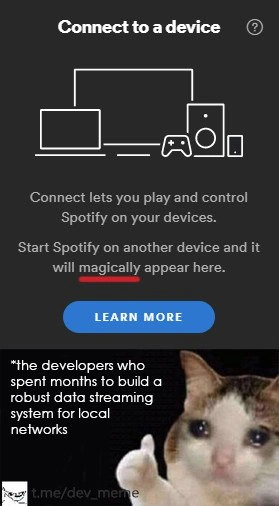
Let’s break down what’s happening in this meme in simpler terms. Spotify Connect is a feature that lets you play music on one device (like a smart speaker, TV, or laptop) and control it from another (like your phone). To an everyday user, it feels like the devices just “see” each other and music flows between them effortlessly. The meme’s top panel shows the actual Spotify app screen that says “Start Spotify on another device and it will magically appear here.” That’s the app telling you that if you open Spotify somewhere else, your current device will detect it and let you control it, almost like magic. The word “magically” is even underlined in red in the meme image to emphasize it – because that’s the key joke: the app calls it magic. But in reality, there’s very real technology making that happen. No actual magic spells, just clever programming!
So how do devices actually find each other? This is where local network service discovery comes in. Imagine all your gadgets (phone, laptop, speaker) are playing a friendly game of hide-and-seek on your Wi-Fi network. Zeroconf (Zero Configuration Networking) is like the rulebook that says, “Okay everyone, you can find each other without any manual setup.” One common Zeroconf method is something called mDNS (multicast DNS). Here’s a simpler analogy: usually, when you go to a website, your device asks a DNS server “what’s the address of this site?” But in your home network, devices can skip the central server and instead shout out “Hey, is anyone out there running Spotify?” (that’s the multicast). If a device (say your smart speaker) hears that and it is running Spotify, it responds “Yep, I’m here and I’m a Spotify player named LivingRoom!” Now your phone can list “LivingRoom speaker” as a connect option. All this shouting and responding happens in the background, automatically. No need for you to configure IP addresses or anything — that’s why it’s called zero-configuration. It’s the same kind of tech that makes printers show up in your computer’s dialog without you entering an address, or how your laptop finds a Chromecast or Apple TV to cast to. Spotify is using that idea for music playback devices. The “robust data streaming system” mentioned in the meme caption refers to all the tech that makes sure once the devices find each other, the music can stream continuously without lag or interruption over the local network.
Now, the bottom panel of the meme shows an image of a crying cat, pointing. This is a popular meme image (often captioned with things people cry or complain about in a funny way). Here, the caption next to the cat says: “the developers who spent months to build a robust data streaming system for local networks”. In plain terms, that caption is describing a group of software engineers who worked for months to make Spotify Connect work so well. They built the system that handles finding devices on the network, connecting them, and streaming the music reliably. The cat is “crying” because it’s jokingly upset or emotional – basically saying, “We worked so hard on this, and you’re just calling it magic?!” It’s a humorous way to show the developers’ perspective. They’re not literally mad at users or UI designers, but the meme exaggerates their reaction for comedic effect. It’s highlighting that what the user sees as “magic” is actually the product of a lot of coding, testing, and problem-solving by real people.
To give more context: cross-device playback (playing media on one device and controlling from another) might sound simple, but it involves a lot of moving parts. The developers had to ensure that when you hit “pause” on your phone, the other device (like your laptop or speaker) immediately knows to pause the music. They have to keep the song position in sync, show the correct song info on all devices, and maybe even transfer the stream of the song from one device to another if you switch outputs. All of this has to work even if your network connection is a bit shaky. When we say “robust”, we mean the system can handle real-world conditions: maybe your Wi-Fi has a momentary hiccup – the music shouldn’t stop completely; or your phone goes out of range – maybe the music keeps playing on the speaker anyway. The engineers planned for these cases so that the feature feels smooth.
So, essentially, the meme is pointing out two sides of the same coin: the user experience (which is simple and magical – just tap and your devices sync up and music plays) and the developer experience (which was complex and challenging – requiring a lot of work to make that simplicity possible). When you see that word “magically” in the app, remember it’s a friendly oversimplification. Underneath, Spotify Connect is using networking techniques like service discovery (e.g. mDNS), direct device communication or cloud messaging, and continuous streaming protocols to do its job. The developers are “in on the joke” because they know it’s not magic at all – it’s technology. And that’s what makes this meme funny: it’s a little tech inside-joke. The app pretending something is effortless, and the developers winking and saying, “If only you knew how much effort went into making it look effortless!” In summary, the top picture is the polished user interface saying “hey, it just works like a charm,” and the bottom picture is the developer reaction, playfully complaining (through the crying cat) about how they poured their effort into that project being labeled as a mere “magic trick.”
Level 3: Sweat, Not Spells
“Any sufficiently advanced technology is indistinguishable from magic.” – Arthur C. Clarke
This meme nails that famous adage on the head. The top panel’s friendly text — “it will magically appear here” — is the kind of marketing or UX copy that makes users smile and think, “Oh cool, it just works.” But experienced engineers and developers are chuckling (or maybe groaning) at that one word “magically”. They know there’s nothing supernatural about Spotify’s cross-device playback; it’s the result of months of hard engineering work. The humor (and pain) comes from the contrast between Marketing vs. Reality. The UI team, tech writers, or PMs choose delightful words like “magic” to keep things simple for users, while the dev team recalls the countless late nights debugging network issues and edge cases to make that “magic” happen. It’s a very relatable developer experience: your code is doing amazingly complex things, but the end user – by design – doesn’t see the complexity. In fact, if you’ve done your job well, they’ll never realize how much went into it. The crying cat meme at the bottom captures that mixed feeling perfectly: the cat (representing the developers) is teary-eyed and pointing, as if saying “Did you seriously just call it magic after all we went through?!” It’s both proud (because heck yeah, we made it work!) and a bit bitter (because calling it magic glosses over the blood, sweat, and tears). Every senior developer has a war story of an “overnight success” feature that actually took weeks or months of effort, only to have it described as if it were effortless. This meme is basically that war story in pictorial form.
The combination of those two panels is funny because it’s painfully accurate. On one side, the polished UI is treating a complex distributed streaming feature as a trivial toggle – connect and play, no big deal. On the other side, we have the developers who actually built the thing, essentially breaking the fourth wall through the meme to say, “Hey, not so fast with that ‘magical’ talk!” It’s a classic case of Marketing vs Reality in tech. The phrase “Start Spotify on another device and it will magically appear here” is the kind of optimistic, user-friendly language that product teams love. It implies effortlessness. But the developers know that under the hood this involved tackling local_network_service_discovery quirks, dealing with firewall or router issues, crafting a robust data streaming protocol that can hand off music streams between devices smoothly, and ensuring security (so that your neighbor can’t hijack your speaker and start blasting their music). None of those challenges are solved by magic, but by careful design, coding, and testing.
Why is this so relatable (and upvoted in developer humor communities)? Because so many of us have been there. Maybe you weren’t building Spotify Connect, but perhaps you integrated a payment system that people now say “just works seamlessly,” or you refactored a gnarly legacy codebase to make an app load “like magic” for users. The DeveloperHumor hits hard when the credit for all that toil is a single whimsical word in the release notes. Engineers often joke that when non-technical folks say “It’s like magic!”, the dev team is somewhere in the background either facepalming or raising a toast to surviving the project. It’s a double-edged sword: on one hand, calling it magic is a compliment – it means the feature works so well that the user doesn’t even think about what’s happening behind the scenes. (Indeed, making complex technology feel simple is the whole point of good engineering and design.) On the other hand, the meme is a wink-wink nudge-nudge from one developer to another: we know it’s not magic, and in fact, if you had seen the Git commit history, the design docs, the all-hands meetings, and the bug tickets, you’d know just how un-magical the process was! There were probably days where nothing felt like it would ever work: devices wouldn’t find each other because of a quirky router setting, or an iOS update broke the background service discovery, or two devices got out-of-sync in testing and blasted music out of both speakers (oops). The engineers might have had to dive into Wireshark to sniff packets, tweak timeouts, optimize reconnection logic – all the gritty stuff that never shows up in a slick UI demo.
The meme’s underlying wink is also about Developer Experience (DX) within a company. Think about the internal dynamic: the devs spend months perfecting this feature, and then marketing or the UI copywriter sums it up with “It’ll magically appear.” It’s kind of funny internally – the team might joke, “Yeah, magic… powered by our sweat and countless coffee cups!” If you’ve worked in a tech company, you might have witnessed similar moments. The PM or marketing team means well; they want users to feel it’s effortless. And truthfully, you wouldn’t put something like, “Start Spotify on another device and it will appear here after our app performs local network peer discovery via mDNS and cloud fallback” – that’s not exactly sexy copy for a tooltip! So “magically” is the chosen word. The developers might cringe a bit, but they also understand that if they’ve done their job right, it should feel like magic. It’s just that only they know the magic trick’s secret. This shared understanding is what makes the meme amusing: both the absurdity (magic? really?) and the humblebrag (our work is so good it looks like magic) come through.
In essence, the meme highlights the unsung heroes of tech – the engineers in the shadows (or in this case, the crying cat in the second panel) who conjure up these seamless experiences. It’s poking fun at the marketing vs. engineering divide in a light-hearted way. The cat’s teary pointing is like saying, “We see you calling it magic, and we’ll let it slide, but we remember the grind that made this happen.” Fellow developers find this hilarious because they’ve felt that exact emotion: a mix of pride and exhaustion when their intricate system finally works and someone testifies, “Wow, it’s like it was always this easy!” The meme is a little pat on the back to all those who have tamed complexity and got only a single sparkly adjective in return. After all, in the tech world, making something look simple is one of the hardest things – and we quietly love the craft even if the credit sometimes comes in the form of a tongue-in-cheek “magically.”
Level 4: Zeroconf Sorcery
Beneath the UI’s casual use of “magically”, there’s a complex distributed system performing precise engineering feats. Spotify Connect is not summoning devices by wizardry, but by carefully orchestrated network protocols. In fact, it leans on a classic local network discovery method: Zero Configuration Networking (Zeroconf). One key spell in that sorcery book is Multicast DNS (mDNS), which lets devices find each other with no manual setup. Essentially, each Spotify app on your phone, laptop, or smart TV broadcasts a little “here I am!” packet on the local network – like a digital beacon announcing “💡 A wild Spotify device has appeared!”. This happens through UDP multicast to a special address (224.0.0.251:5353) that all listening Spotify apps know to monitor. It’s as if every device is part of a group chat, and when a new device joins, it shouts its name and capabilities (e.g. “I’m a speaker named LivingRoom and I speak Spotify’s streaming protocol!”) to everyone in the room. Other devices hear that and update the list, making the new device magically show up in the UI. But behind that instant appearance is a finely tuned discovery protocol dealing with real networking challenges – packet loss, timing, and the awkward reality that Wi-Fi routers can be finicky gatekeepers for multicast traffic.
Now, discovering a device is just step one of this data streaming saga. To actually get music flowing seamlessly, the engineers had to build a robust streaming system on top of this discovery. That means establishing a communication channel between the controlling device (say, your phone) and the target playback device (say, your smart speaker or PC). In many cases, once devices find each other via mDNS, they negotiate a direct session or exchange info through Spotify’s servers to coordinate playback. They might set up a secure WebSockets connection or use a lightweight HTTP API to send control commands (“Pause”, “Play next song”, etc.) across the network. Crucially, all devices linked to your account need to agree on the current state of playback – this is essentially a distributed state synchronization problem. If you pause the music on your phone, the speaker across the room should pause almost immediately and every other Spotify app on your account should reflect that state. Achieving this requires careful design to maintain consistency. The system likely designates one source of truth (for example, one device or a cloud service acts as the authoritative leader for the playback state) and others follow, or it uses a consensus-lite approach where the last issued command wins. This coordination has to happen under constraints we recognize from distributed systems theory: balancing consistency and latency, handling network partitions (e.g. your phone goes offline but the music keeps playing on the speaker), and ensuring no single device’s hiccup corrupts the whole experience. There’s a dash of the CAP theorem in here – if your phone and speaker lose direct contact (Partition), the system might prefer availability (music keeps playing on the speaker) over strict global consistency (your phone might not know immediately that playback continued). Designing for these trade-offs means lots of subtle logic in the background, none of which feels magical when you’re the engineer implementing it with countless if/else statements and fail-safes.
Even the streaming of audio data itself is finely tuned under the hood. When you “connect” to a device, often that device doesn’t receive music from your phone; instead it independently streams the music from Spotify’s servers. This avoids double-hops and keeps audio quality high. But it means your devices and Spotify’s backend are in constant communication: authenticating the control session, handing off stream URLs or keys, negotiating codecs or bitrates – all quickly and invisibly. The word “robust” in the meme (“robust data streaming system”) hints that the dev team had to cover every edge case: What if the Wi-Fi signal weakens? What if two people on the same account issue conflicting commands? What about buffering and timing, so that when you hit “Skip” on your phone, the speaker is ready to start the next song without a crackle or pop? These are classic distributed-systems challenges (concurrency, state consistency, real-time constraints) dressed up in a rock-and-roll outfit. The local network aspect adds extra spice: on some networks, multicast might be blocked or slow, so the app might fall back to asking Spotify’s cloud “hey, do you see my other device online?” – effectively a backup plan using the central servers as a rendezvous point if peer-to-peer discovery fails. In other words, the engineers implemented multiple levels of redundancy and discovery to ensure that, whether you’re on the same Wi-Fi or controlling your home speaker from your office, the experience still feels instantaneous and, well, magical.
From an academic perspective, Spotify Connect’s cross-device feature is a textbook example of distributed systems principles applied to consumer tech. It cleverly blends local network protocols and cloud services to achieve a smooth experience. There’s no single “abracadabra” here, but rather a series of robust design decisions: decentralized discovery to avoid single points of failure, eventual consistency models to keep devices in sync without noticeable lag, and secure channels to prevent anyone else on the network from hijacking your tunes. No actual wands or incantations were used in the making of this feature – just a lot of packets, protocols, and engineering prowess. The only real sorcery here is the software kind, where sufficiently advanced technology indeed becomes “indistinguishable from magic” for the end user. And that’s exactly the point – the best tech, like Spotify’s seamless device connect, does such a good job that it feels effortless. But as we’re about to see, every developer who’s been in those trenches knows how much effort “effortless” really takes.
Description
A two-part meme that contrasts a simplified user interface with the complex engineering behind it. The top portion shows a screenshot of the Spotify application's 'Connect to a device' screen. The text reads, 'Connect lets you play and control Spotify on your devices. Start Spotify on another device and it will magically appear here.' The word 'magically' is underlined in red for emphasis. The bottom portion features the popular 'thumbs-up crying cat' meme, where a sad-looking cat gives a thumbs-up. Overlaid text reads, '*the developers who spent months to build a robust data streaming system for local networks'. The humor lies in the vast oversimplification of a highly complex technical achievement. For senior engineers, it's a relatable commentary on how their sophisticated work on distributed systems and network protocols is often presented to the end-user as 'magic,' glossing over months of effort
Comments
15Comment deleted
Product says it's 'magic.' Meanwhile, the on-call engineer is whispering mDNS incantations to a rubber duck at 3 AM to keep the 'magic' from turning into a pumpkin
“Magically appears on your other device” = mDNS broadcast, SSDP fallback, NAT hair-pinning, four OAuth handshakes, and me at 3 AM begging an IGMP-snooping router to stop discarding my packets - abracadabra, ship it
Nothing says 'senior engineer' quite like spending six months implementing mDNS, handling network topology changes, managing device handoffs, and debugging race conditions in distributed playback state... just so product can describe it as 'magically appears.'
Six months of distributed systems engineering, implementing service discovery protocols, handling NAT traversal, managing state synchronization across heterogeneous devices, optimizing for packet loss and jitter, building fault-tolerant streaming pipelines... and marketing calls it 'magically appear.' Sure, just like how TCP packets 'magically' arrive in order - through the sheer wizardry of sequence numbers, acknowledgments, and retransmission timers. The cat's expression perfectly captures that moment when you realize your carefully architected pub-sub system with MDNS discovery and custom RTP implementation will forever be described as 'magic' in the user-facing documentation
mDNS multicast finally propagates without flapping after six sprints of NAT roulette - now branded as ✨magic✨
We call it “magic” because “multicast discovery + NAT punch‑through + TLS pairing + session orchestration + jitter buffers + eventual consistency” didn’t fit on the button
Product copy says “magically appears”; reality is mDNS/SSDP discovery, TLS mutual‑auth, UDP hole punching, and eventual-consistency state sync - totally magic
magically и 50 сносок Comment deleted
magically и дока на 50 страниц Comment deleted
Только оно не только по локалке работает Comment deleted
Before it was only within local network (i.e. same wifi) 🤔 Comment deleted
Да, не только по локалке, просто все остальное уже точно magically Comment deleted
My favourite Spotify feature Comment deleted
haha, magic go brrrrrrr Comment deleted
Ну так, всё прекрасно, потому что очень развитые технологии становятся похожими на магию Comment deleted