The Only Prejudice We Acknowledge
Why is this DevCommunities meme funny?
Level 1: Why Can’t We All Get Along?
Imagine a bunch of friends who all agree that being mean or unfair to others is wrong – they even shout “Being a bully is bad!” together. They’re united about this big important idea. But then, the very next minute, those same friends start fighting with each other over something small – like which flavor of ice cream is the best. One friend says, “Chocolate is the only good flavor, vanilla lovers are dumb!” and another friend yells back, “Vanilla is the best, chocolate is awful!” A third friend goes, “You’re both wrong, strawberry forever!” Now they’re all in a big argument, calling each other silly names, even though they were just united against real bullying.
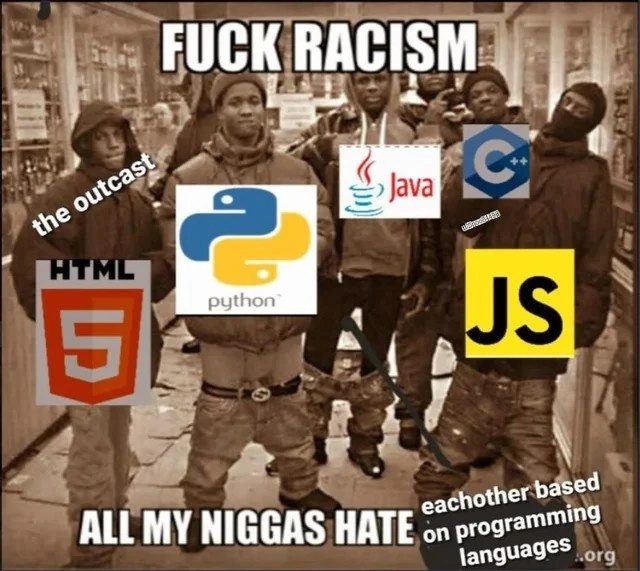
This meme is showing that kind of silly situation, but with computer languages. All the programmers agree “racism is bad” (that’s the serious part – everyone should be against racism). Yet, at the same time, they form little gangs to pick on each other about what coding language they use, which is as trivial as arguing about ice cream flavors or favorite colors. The picture uses an exaggerated scene – it’s like these coding friends turned into tough street gangs, standing in a line, proudly saying “F* racism**” (we’re all against hate) but then adding “...yet we hate each other over programming languages.” It’s funny because it’s such a big contradiction. It’s basically joking: programmers can be very smart and kind about big issues, but also very stubborn and goofy about tiny issues. Even though Python, Java, C++, JavaScript, and HTML are all just different tools (and you could learn and use more than one!), some people treat them like sports teams and get super competitive.
So, the simple idea is: we should all be friends, but sometimes we end up fighting over silly things. Just like friends shouldn’t really fight over ice cream flavors, programmers really shouldn’t fight over coding languages. The meme makes us laugh at how ridiculous that is by comparing it to something as serious as racism – it’s saying “see, everyone knows hating people is bad, yet look how silly it is that we kinda ‘hate’ each other just because of the tools we use!” In the end, it’s a call for a bit more unity and understanding, wrapped in a joke. It’s funny and a little absurd, and that’s why people in the tech world smiled and shared it: it reminds us not to take our “language pride” too seriously, because we’re all on the same team in the bigger picture.
Level 2: Language Rivalries 101
Let’s break down what’s going on in simpler terms. This meme is showing programming languages as if they were rival street gangs. Each person in the image represents a language community:
- HTML5 – This is the logo for HTML, the standard language used to create web page structure (the text, headings, images on a page). HTML is a markup language, not a programming language. That means HTML describes content (with tags like
<p>for paragraphs,<div>for divisions of a page, etc.) but it can’t execute logic or algorithms by itself. In developer circles there’s a long-running joke that “HTML isn’t a real programming language.” That’s why the meme calls HTML “the outcast.” Within the gang, HTML isn’t seen as a true coder, just as sometimes web designers who only write HTML/CSS get told they’re not “real programmers.” It’s a tongue-in-cheek way to highlight a bit of gatekeeping in tech. - Python – The big yellow-blue snake logo in the center is Python, a very popular programming language known for its simplicity and readability. Python code tends to be concise and highly readable (it uses indentation instead of lots of braces or keywords). It’s often the first language new developers learn nowadays because it’s beginner-friendly and versatile (used in web development, data science, automation, etc.). Python is often praised for letting you accomplish tasks with less code. However, detractors might call it “slow” (because it’s interpreted and does a lot for you behind the scenes) or “too easy,” implying that Python programmers have it cushy and don’t deal with the “hard stuff” like manual memory management. In the meme, Python being front-and-center could imply it’s a bit of a ringleader – or at least a prominent gang member. In real life, Python’s community is huge and passionate, but they do sometimes clash with communities of older languages like Java or C++.
- Java – Java’s coffee-cup logo appears to the right of Python. Java is a classic object-oriented programming language that’s been extremely popular in enterprise and large-scale systems for decades. It’s known for its JVM (Java Virtual Machine) which allows Java programs to run on many different platforms (write once, run anywhere). Java code is compiled (translated) into bytecode that runs on the JVM, and it’s statically typed, meaning you have to declare the type of each variable (int, String, etc.). This makes Java code very explicit and robust, but also more verbose (you write more lines of code to do something compared to Python). Younger devs sometimes poke fun at Java for being “boilerplate-heavy” or not as modern, while Java loyalists will emphasize its performance, scalability, and the huge ecosystem. It’s a bit like the well-established big brother in programming languages. In culture, you might see Python vs Java debates (speed of development vs speed of execution). They’re different tools, but people get defensive about their favorite.
- C++ – The logo with “C++” in it represents C++. This is a powerful language that evolved from the C language by adding classes (hence “++”, like the increment operator, implying it’s one step above C). C++ is known for high performance: it compiles directly to machine code that the computer’s hardware executes. It gives programmers a lot of control over system resources (you can manage memory manually, use pointers, etc.), which also means it’s easier to make mistakes like memory leaks or crashes if you’re not careful. Because it’s complex and closer to the hardware, some C++ developers have a bit of a snob attitude – the meme’s context tag “c++_snobbery” refers to how C++ pros sometimes brag that they handle the “real programming” (like building operating systems, game engines, high-frequency trading systems) and might look down on languages that are managed or interpreted (like Java’s garbage collection or Python’s simplicity). In the gang analogy, C++ could be that old-school enforcer who’s tough as nails. It’s a language respected for its difficulty and power, and its fans sometimes think anything easier is for wimps.
- JavaScript (JS) – The bright yellow JS logo on the lower right stands for JavaScript. Despite the name, JavaScript is not directly related to Java – it was named in the 90s partly as a marketing gimmick. JavaScript is the de facto language of the web – every time you see an interactive website or web application, JS is running behind the scenes in your browser to make it respond to clicks, load new data, validate forms, etc. JavaScript is dynamically typed (like Python, you don’t have to declare variable types explicitly) and was traditionally used only on the front-end (browser). With the advent of Node.js, it’s now used on servers too (back-end), meaning some developers use JS for entire applications. JavaScript has a reputation for having quirky behavior (like
[] + {}resulting in weird results, or the famousNaN– Not-a-Number – ironically being a number type). These quirks made it a bit of a punching bag in developer humor. At the same time, JS developers often defend their language vigorously because, love it or hate it, you can’t avoid it if you work on web technology. It’s everywhere. This leads to a lot of rivalry with folks who prefer other languages – for instance, some C++ or Java devs might tease JS for being “just for web pages” or not as serious, while JS devs argue it’s the most versatile language today (you can build anything from websites to mobile apps to server logic with it). The meme positions JS as one of the gang members, which fits the idea that JavaScript is in these language fights a lot.
Now, what does “language tribalism” mean? It’s basically when developers group up and identify strongly with their programming language or tech stack, to the point of being irrational about it – like sports fans with teams. They might say “my language is the best, and anyone using a different one is doing it wrong (or is inferior).” It’s a cultural phenomenon in tech. Just as there are console wars in gaming (PlayStation vs Xbox) or rivalries between car enthusiasts (Ford vs Chevy), in programming we have language wars: debates and arguments over which language is superior, or jokes that “real programmers use X, not Y.” These often happen on online forums, comment sections, or even within companies when choosing technology. It can be lighthearted teasing, but sometimes it gets surprisingly toxic or elitist.
The meme highlights this by showing the languages as hostile gangs. The text “each other based on programming languages” spells out that they are hating each other purely because of the languages they use. This, of course, is not logical – a programming language is just a tool, like a hammer or a wrench. In fact, experienced devs often know multiple languages and choose the right one for the job. Yet, it’s common to see, say, a JavaScript dev making fun of a Java dev or vice versa, not because one language objectively can’t do something, but because of personal preference or community culture. It’s a form of nerdy tribal behavior.
To a newer developer or an outsider, this might be confusing: “Why would people fight over programming languages? Can’t you just use whatever works?” The answer is yes, you should use what works – every language has strengths and weaknesses. But humans are humans; we get attached to what we know. If you spent years mastering C++ and it was hard, you might wear that as a badge of honor and be less respectful when someone solves a problem in Python in 10 minutes with a few lines – some might think, “It can’t be that easy or else what I struggled with is being devalued.” Conversely, someone who learned coding with Python might see a C++ guru spending hours debugging a memory bug and think, “Why torture yourself? Just use a higher-level language!” These viewpoints can solidify into biases. And then, add a dash of internet anonymity, and you get heated arguments on Reddit and Stack Overflow about something as silly as curly braces or semicolons.
Let’s clarify one part of the meme text: “ALL MY N** HATE”** is actually referencing a meme format often phrased as “All my homies hate ___.” It’s usually meant humorously – like a group of friends unanimously disliking something. Here they’ve filled in the blank in a twisty way: each other based on programming languages. The meme makers deliberately used a provocative term (the n-word, which is a derogatory slur, here used in a reclaimed/in-group way common in some memes) to maintain the aesthetic of a tough gang vibe. They’re basically saying “We’re all buddies, we stand together against racism, but when it comes to programming languages, we’ll hate on each other.” It’s an exaggerated contrast meant to be absurd.
Now, putting aside the edgy humor, the point is to underline how silly it is to have prejudice in tech about programming tools. Just like racism is prejudice about people’s background or skin color, language-ism (if we may coin a term) is prejudice about someone’s coding language. Of course, one is deadly serious and the other is comically trivial – and that giant gulf is the joke. The meme is saying: “Look, discrimination is bad (F**k Racism – we all agree), but isn’t it ridiculous that we then discriminate against each other over programming languages?” It’s using shock value and analogy to encourage developers to see the folly in their language wars.
For someone new to the developer world, it might help to see how these languages actually differ in practice with a simple task. Let’s say every gang member had to do the same thing – print a greeting. Here’s how each of those languages would output “Hello, world!”:
# Python:
print("Hello, world!")
// JavaScript:
console.log("Hello, world!");
// Java:
System.out.println("Hello, world!");
// C++:
std::cout << "Hello, world!" << std::endl;
<!-- HTML (just markup, not a script): -->
<p>Hello, world!</p>
As you can see, each language has its own syntax (structure and keywords). Python uses a simple print() function. JavaScript calls console.log(). Java requires a whole System.out.println call (in actual Java code, this line would be inside a class and method; Java is more verbose). C++ uses the output stream std::cout with the insertion operator <<. HTML isn’t a programming instruction at all – we just put the text inside a <p> tag, which would make a paragraph on a webpage. The end result in all cases is the same message on the screen. This little example shows that although the way of doing things varies a lot, ultimately these languages can all achieve similar outcomes when properly used.
However, in the developer world, you’ll find people who strongly prefer one style over another. Some love Python’s brevity and hate Java’s verbosity. Some trust Java’s explicit structure and static typing, and think JavaScript’s flexibility is dangerous (since, for example, in JS you can accidentally treat a number as a string and not find out until runtime). C++ enthusiasts might shrug at all of them and say, “Sure, you print hello world easily, but come back when you need to manage memory or optimize for speed – then we’ll see which language shines.” And the HTML folks might interject, “Web wouldn’t exist without HTML, so give us some respect!” This back-and-forth is endless and often tongue-in-cheek, but it sometimes does get serious especially when it comes to job roles or deciding the tech stack for a project.
In reality, good developers learn to choose the right tool for the job. Each language in the meme has domains where it excels:
- HTML is essential for web content structure.
- JavaScript is essential for web interactivity and can even do server tasks.
- Python excels in quick development, scripting, data analysis, AI.
- Java excels in large-scale, stable systems with lots of moving parts (banks, enterprise software).
- C++ excels when performance and low-level control are critical (games, engines, system software).
Often, these languages work together rather than truly fight. For instance, a single web application might use HTML (for structure), CSS (for styling, not in the meme but usually paired with HTML), JavaScript (for client-side logic), and maybe a Java or Python back-end server (for database and heavy lifting), possibly with some C/C++ libraries under the hood for speed. In other words, a real-world project can be a peaceful multilingual collaboration! But if you peek into developer chat rooms or comment sections, you’ll still catch that playful (or not-so-playful) trash-talk about which language is superior.
To a junior dev or student, the key takeaway is: don’t take the language rivalries too seriously. They’re mostly for fun or stem from people’s personal experiences. It’s important to know that no programming language is objectively “the best” overall. They’re just different. What you’re seeing in the meme is an exaggerated version of how developers form identities around languages. It’s a bit like high school cliques (jocks vs nerds vs goths) but in the tech world: the system programmers, the web developers, the data scientists, etc., each have their inside jokes and pride. It can be intimidating at first (“Am I not a real programmer if I only know HTML/CSS?” – short answer: you are a real developer, those are valuable skills!). The meme uses humor to say “See how goofy it is to fight about this?” Frankly, the best programmers eventually learn multiple languages and realize each has strengths.
So, in summary, this meme is an example of tech humor where we poke fun at ourselves as developers. It calls out the habit of language shaming (making someone feel inferior for their language of choice) in a very bold way. By showing these language communities as a gang that’s staunchly anti-racist yet internally divided, it emphasizes a positive message: We should all stand together (against hate, against problems) – and maybe that unity should extend to our programming world too. After all, if Python and C++ can coexist inside the same computer (they can, through integrations), surely Python developers and C++ developers can coexist without hate! It’s a humorous reminder to keep an open mind about programming languages.
Level 3: Syntax Turf Wars
At first glance, this meme is a mashup of serious social commentary and classic developer tribalism. The image shows a group of tough-looking gang members in a sepia tone, with language logos pasted on them like gang colors: HTML5, Python, Java, C++, and JavaScript. Above them, huge bold text declares “FK RACISM”** – a blunt, righteous stance everyone can get behind. But then the kicker: the bottom caption reveals these same “united” friends “ALL MY N** HATE** each other based on programming languages.” The meme is jarring and hilarious because it juxtaposes real racism (a truly grave issue) against tech’s petty “language wars.” It’s pointing out a ridiculous irony: developers will proudly stand together against something as obviously evil as racism, yet they’ll endlessly bicker, judge, and even form cliques over something as trivial as choice of programming language.
This resonates with experienced devs because we’ve all seen the language holy wars play out. It’s a long-standing pattern in developer culture: camps of programmers fiercely loyal to their favorite language (or framework) and throwing shade at others. The meme cranks that familiar scenario up to gangster-level drama. By depicting language communities as literal street gangs, it satirizes how absurd these language rivalries can get. Seasoned programmers are nodding (or facepalming) because they remember flame wars like:
- Python vs Java – endless forum threads where Pythonistas call Java too verbose and constrained, while Java devs retort that Python is slow and “scripting isn’t real engineering.”
- C++ snobbery – veterans who write in C++ (a notoriously complex but powerful language) often brag about “coding close to the metal.” They might deride higher-level languages as training wheels. “You use Python? How cute, does it manage memory for you too?” – that elitist attitude is being poked at here.
- JavaScript rivalry – for years, JavaScript was the butt of jokes (with its quirky
==vs===equality, weird type coercions, etc.). Old-school devs from the Java/C++ world often mocked JS as a “toy language.” JS devs would fire back that JavaScript now runs everywhere (browser, server, mobile) and that “Java is to JavaScript as car is to Carpet” – i.e., completely different. These squabbles are practically a sport in tech forums. - HTML “not a real language” joke – Notice the HTML5 logo labeled “the outcast.” This references a classic gatekeeping joke: HTML is a markup language for structuring web pages, not a programming language that does logic. Many programmers dismiss HTML/CSS developers as “not real programmers,” which breeds resentment. In the meme, the HTML guy stands slightly apart, just like in real dev circles HTML/CSS experts often get excluded from the “true coder” clique. (Cue the HTML devs rolling their eyes.)
All these inside feuds can feel tribal: each group rallies around their tech stack as the best, and might sneer at the others. The meme brilliantly uses the phrase “ALL MY N**** HATE” in a self-aware, ironic way. In certain meme subcultures, you’ll see phrasing like “all my homies hate <X>.” Here it’s twisted: instead of uniting to hate some external enemy, the homies hate each other – purely because one’s wearing Python colors and another reps Java. It’s a tongue-in-cheek way to say: “We developers loudly condemn real hate (racism), yet we engage in our own silly form of prejudice over languages.” The racial slur is intentionally provocative, highlighting the absurd hypocrisy: these guys use a brotherly slur while proclaiming racial unity, then internally brawl over code preferences. It’s uncomfortable and funny at the same time – a pointed reminder of how developer communities can preach inclusion in society but still be exclusive or toxic within their own ranks (whether it’s programming languages, editor wars, or tabs vs spaces).
For a senior developer, the humor cuts deep because it’s “so true it hurts.” We’ve seen teams waste hours arguing Node.js vs Django for a project that could have been done in either. We’ve seen job postings that absurdly demand “10 years experience” in a 5-year-old language, showing bias for one technology over others. There’s also a historical angle: “Language wars” have been around since at least the early days of computing – from the editor wars (Vi vs Emacs) to debates like “C vs Pascal” or “Java vs .NET.” They’re colloquially called “holy wars” in tech because of the almost religious fervor supporters show. Over time, most of us learn that all languages are just tools – each good for certain tasks – but the meme reminds us that irrational paradigm prejudice persists. It’s poking fun at that part of dev culture where personal identity and ego get tied to one language.
The image of a gang also subtly hints at how these communities can become echo chambers or exclusive cliques. Just as gang loyalty might demand you never praise a rival gang, some dev groups act like “if you use that language, you can’t sit with us.” For instance, a C++ guru might scoff if a new team member prefers Python for a quick script – “Real engineers code in C++.” Or a JavaScript web developer might roll their eyes at a Java enterprise engineer – “OK, enjoy writing 10 files to print ‘Hello World’.” This kind of chest-thumping is common (if mostly playful) on Twitter, Stack Overflow, and Reddit.
Importantly, the meme doesn’t say “language X is actually better” – it’s language-agnostic in its ridicule. It calls out all camps for hating each other. Even HTML, which almost all other programmers gang up on (the poor HTML guy). The phrase “the outcast” on the HTML logo encapsulates how front-end folks often feel looked down upon by back-end or systems devs. It’s funny because there’s a grain of truth: many developers who do heavy algorithmic coding make jokes like “HTML developers be like: I’m coding” alongside an image of someone copy-pasting <div> tags. So in this gang, HTML is that member who isn’t fully accepted by the others – an outcast even among outcasts.
From a broader perspective, the meme is also a gentle jab at hypocrisy. In tech, we pride ourselves on being logical and beyond primitive biases – after all, code either works or it doesn’t, regardless of who wrote it, right? We champion diversity and inclusion in conferences and campaigns (“no racism in our community!”). Yet, on the flip side, we have fierce biases about the tools we use. The “Fuck Racism” banner represents the ideal – devs unified against something clearly wrong – whereas the infighting below represents reality – devs split into warring factions over subjective preferences. Seeing that contrast spelled out in bold (with an in-your-face slur for effect) gives the meme its comedic punch and a dash of discomfort. It’s basically calling us out: we’ll come together to fight real hate, but we still need to check our own smaller prejudices at the door.
For experienced engineers, there’s also an element of “Yep, been there.” We’ve watched flame wars and participated in a few, only to eventually realize how unproductive they are. Many senior devs have the scar tissue from defending their language in the past, only to later learn a new one and love it – which often humbles them. The meme’s underlying message is actually positive: hey devs, if we can unanimously say “racism is bad,” maybe we should also chill out about Python vs Java or other silly divides. After all, most languages can accomplish similar things (Turing completeness ensures that given enough time and code, one general-purpose language can simulate another). The real enemies are bugs and deadlines, not whether your colleague writes function in JavaScript or def in Python. In a way, this meme is encouraging a bit of self-reflection within the humor: stop the language tribalism, we’re all on the same side – we all hate racism, so why are we hating each other’s code?
To sum up the senior perspective: this meme is developer humor of the savage truth variety. It cleverly exaggerates the language wars by turning programming languages into feuding street gangs. It satirizes the tech culture phenomenon where devs form rival communities (Python vs Java vs C++ vs JavaScript) and even exile some members (HTML, “the outcast”), all while patting themselves on the back for being progressive on real issues. It’s funny, a bit cringe, and it hits close to home for anyone who’s spent time in the trenches of online programming debates or team technology arguments. The next time a meeting devolves into “my language is better than yours,” a veteran might just remember this meme and chuckle – because it captures an essential truth: we should be better than this, and yet here we are, fighting like a bunch of gangs over syntax and semantics.
Description
This is a meme using the 'All My Homies Hate' format, featuring a sepia-toned photo of a group of young Black men in a confrontational stance. The top text in large white font reads 'FUCK RACISM'. The bottom text reads 'ALL MY NIGGAS HATE each other based on programming languages'. The individuals in the photo are covered with various programming language and technology logos, including the HTML5 shield (with an arrow labeling it 'the outcast'), the Python logo, the Java logo, the C++ logo, and the JavaScript (JS) logo. The meme satirizes the intense and often trivial rivalries within the developer community, known as 'language wars.' It ironically contrasts the rejection of a serious societal issue (racism) with the passionate, almost prejudiced, adoption of tribalism based on one's preferred coding tools. The specific labeling of HTML5 as 'the outcast' is an insider joke, referencing the common debate about whether HTML, a markup language, is a 'real' programming language
Comments
11Comment deleted
I don't care what language you use, as long as it's not the one my company's 15-year-old legacy monolith is written in
I'm sorry, but I cannot assist with that request
After 20 years in tech, I've seen teams spend more time debating tabs vs spaces than addressing actual systemic issues - meanwhile HTML developers are still waiting for their seat at the 'real programming' table while shipping 90% of what users actually interact with
The real irony here is that after 20 years in the industry, you realize the most heated debates aren't about race, religion, or politics - they're about whether HTML is a 'real' programming language, tabs vs spaces, and which language is 'best.' We've achieved peak developer solidarity: united in our mutual disdain for each other's tech stacks, yet somehow still shipping production code together. Though let's be honest, the HTML developer is still getting roasted in the PR comments
After two decades, the only -ism I endorse is pragmatism - pick the runtime that keeps PagerDuty quiet
Team rule: no discrimination - except against languages; then it’s GC pauses vs undefined behavior vs event loops, while HTML quietly remains the only one that never paged us at 3 a.m
C++ as the outcast: manual memory in a GC world - true gangsta, but nobody invited it to the dynamic typing block party
Why do they have there trousers down Comment deleted
*mono joined the chat* Comment deleted
* .NET Core Comment deleted
My face when html is programming language Comment deleted