
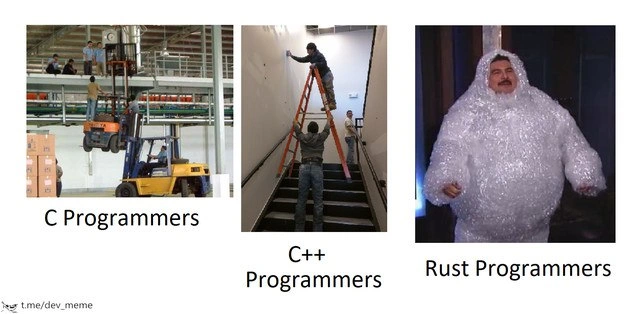
A Visual Metaphor for Memory Safety in C, C++, and Rust
Description
A three-panel meme comparing the safety paradigms of different programming languages. The first panel, labeled "C Programmers", shows a highly dangerous workplace scene where one forklift is lifting another forklift to reach a high place, symbolizing C's raw power and inherent lack of safety features. The second panel, "C++ Programmers", depicts a slightly less, but still very, unsafe situation with a person on a ladder balanced precariously on a staircase, held by another person. This represents C++'s introduction of safety abstractions that can still be easily misused. The final panel, "Rust Programmers", shows a person completely encased in a suit made of bubble wrap, illustrating Rust's strong compile-time safety guarantees, especially memory safety enforced by the borrow checker. The joke, for experienced developers, lies in the accurate portrayal of the trade-offs: C's dangerous freedom, C++'s complex and often precarious safety constructs, and Rust's famously restrictive but effective safety-first approach

Comments
19Comment deleted
C gives you a loaded gun. C++ gives you a slightly safer gun with a user manual the size of a phone book. Rust makes you write a dissertation proving you won't shoot your foot off before it even tells you where the gun is
C: “Here are the raw forklift pointers, good luck.” C++: “We added an RAII harness - until someone passes a dangling reference up the ladder.” Rust: “Compile failed: bubble-wrap must live at least `'static`; please try again after OSHA approves.”
After 20 years of debugging segfaults in production at 3am, you realize the Rust programmer isn't overprotected - they're just the only one who learned from our collective PTSD about that one pointer arithmetic bug that cost the company $2M in 2008
The meme perfectly captures the philosophical divide in systems programming: C developers live dangerously with raw pointers and manual allocation, accepting segfaults as occupational hazards. C++ developers add RAII and smart pointers as safety scaffolding, but still allow enough rope to hang yourself with move semantics. Rust developers are so thoroughly protected by the borrow checker that they spend more time arguing with the compiler about lifetimes than actually writing unsafe code - though when production deploys at 3 AM, you'll appreciate that the bubble wrap prevented the memory corruption that would've taken down the entire service
C forklifts raw pointers skyward; C++ ladders through UB; Rust bubble-wraps lifetimes - zero-cost safety or padded cell?
C is two forklifts and a prayer - UB but fast; C++ does the same with a template ladder and calls it RAII; Rust won’t even let you climb until the borrow checker fits you for PPE and Cargo signs the safety plan
C ships by stacking forklifts of undefined behavior; C++ adds RAII straps but still parks the ladder on the stairs; Rust’s borrow checker won’t even let you clock in without a lifetime proof - and it still meets the perf SLO
I do not understand... Comment deleted
in c it's very easy to hurt yourself Comment deleted
Rust prior is a runtime stability Comment deleted
Жыве Латгалия! Comment deleted
white ppl b like Comment deleted
Bababooey Comment deleted
C and C++ should be swapped Comment deleted
Ese risitas jajajaja Comment deleted
Your name is null Comment deleted
You tried to cause a null pointer exception to Telegram haha Comment deleted
Nice Linus Tech Tips sticker Comment deleted
Imagine using rust or c++ Brainlett moment Comment deleted