Skip to content
DevMeme
3824 of 7435
The One-Sided Relationship Between Developers and Users
DevCommunities Post #4166, on Feb 4, 2022 in TG

The One-Sided Relationship Between Developers and Users

Why is this DevCommunities meme funny?

Level 1: Invisible Helper

Think of a programmer like a chef in a restaurant kitchen who works really hard to cook your favorite meal. The chef is worrying the whole time: “I hope they like this dish! I’m adding extra love so it’s perfect.” Now, you as the diner just receive the plate and start eating. If it tastes good, you smile and enjoy it – you’re not really thinking about the chef who made it, right? You’re just happy the food is tasty. But if something’s wrong, like the soup is cold, you might frown or complain about the “restaurant” without imagining the tired chef. In this story, the programmer is the chef, and the user is the diner. The programmer cares a lot about making the user happy (just like the chef cares about the diner’s meal), but the user mostly just cares that the app or meal is good. The user isn’t trying to be mean – it just doesn’t occur to them to think about the people behind the scenes. So the funny idea here is: the helper (programmer) feels worried and sympathetic for the user, while the user is perfectly fine and not worrying about the helper at all. It’s a one-way street: the developer is like an invisible helper making everything nice, and the user enjoys the result without ever knowing who did it. That mismatch is what makes us chuckle, because it’s true in real life with so many things we use every day.

Level 2: Behind the Scenes

For a newer developer, let’s break down what’s going on here. The meme compares how programmers feel about users versus how “normie” users feel about programmers. A programmer is someone who writes code to create software – basically the person behind the apps or websites. A user (especially a “normie” user) is just an everyday person using that software, who likely doesn’t know much about how it’s built. Think of your non-tech friend who just taps an app and expects it to work. In internet slang, “normie” simply means an average person who isn’t part of a particular in-group – here, it means they’re not into the tech/developer world.

Now, the text “I feel bad for you” under Programmers reflects how developers often worry about users’ problems. We use the term “agonize over users” to describe how a dev might stress about the user experience being smooth. For example, if a feature in an app is confusing people, a conscientious programmer might literally feel guilty or lose sleep over it. They’ll say things like, “Oh no, if the checkout page is crashing, I feel terrible for the customer who couldn’t place their order. We need to fix that ASAP!” Developers are trained to be user-centric. In fact, there are roles like UX (User Experience) designers entirely focused on making things easy and pleasant for users. Early in your career, you learn that good communication with Stakeholders_Clients and focusing on UserExpectations are key. You might write user stories – simple descriptions of a feature from an end-user’s perspective – to guide your development. All of this is to ensure you’re empathizing with the end user’s needs. So, in short, programmers often put themselves in the users’ shoes and worry: Are the users happy? Did we accidentally frustrate them with that last update?

On the flip side, the text “I don’t think about you at all” under Normie Users means that regular users don’t usually think about the programmers at all. When a user opens up, say, a chat application on their phone, they’re thinking about messaging their friend, not about the team of engineers who spent months coding the app. If everything works, they barely notice the software – they’re focused on their own task or enjoyment. And if something doesn’t work, they might think “this app is buggy” or get annoyed, but still not specifically about the developers themselves (except maybe a fleeting “ugh, these developers are dumb” in frustration, but even that isn’t personal, they don’t know who built it). The phrase “I don’t think about you at all” comes from a TV show scene used in this meme, and it’s being repurposed to show that users simply don’t have developers on their mind. It’s not meant as an insult; it’s just reality. Most people using a piece of software have no reason to imagine the coding, testing, and deploying going on behind the scenes. The app or site is just a tool for them.

To put it simply, this meme is highlighting a funny communication gap. Programmers vs users can feel like two completely different worlds. Developers might overthink a tiny design change, like, “Will a slightly different shade of blue on the sign-up button confuse anyone or lower our conversion rate?” Meanwhile, a typical user might not even notice the button’s color at all – as long as it’s clickable, they’ll use it. The indifference_theme here (the theme of indifference) is showing that the care is mostly one-directional. Developers care a lot; users don’t notice.

This is a very relatable humor scenario for anyone who’s worked on a product and then watched real users interact with it. As a junior dev, the first time you ship a feature, you might be eagerly waiting for users to love it or at least acknowledge it. You might be checking feedback forums or app ratings nervously. Often, what happens? If you did a good job, users just use the feature quietly – no fanfare. If you messed up, you hear complaints, but usually like “This app sucks” rather than “Dear developer, I see you tried, but something is off.” Users aren’t thinking about the people coding; they only think about the product. It can be a humbling lesson in stakeholder expectations and reality. Clients and bosses expect you (the programmer) to anticipate users’ needs and problems – that’s your job. But the end-users themselves generally won’t give you direct praise or even direct blame in person, because you’re invisible to them.

In developer communities, memes like this are common because they capture that feeling perfectly. It’s almost a rite of passage to realize: “Wow, I spent two weeks obsessing over this algorithm to save users 2 seconds of load time, and no one even said thanks. In fact, no one even knows I did that.” It sounds a bit sad, but it’s also validating to see others joke about it – it means you’re not alone. This is how the tech world often works. The communication gap between technical folks and end users is huge. End users communicate by their actions (using or not using a feature, maybe leaving a star rating), whereas developers communicate through updates and patch notes that most users never read. The meme exaggerates it into a direct conversation: programmer says “I sympathize with you,” user replies “I wasn’t even aware of you.” As a junior dev, once you understand this dynamic, it actually helps. You learn not to take it personally when your hard work goes unnoticed. In fact, if users don’t think about you, it usually means you did a great job creating a seamless experience! And if they are thinking about you, it’s probably because something went wrong. That’s the ironic truth behind the humor: in software, no news is good news.

Level 3: Unrequited Devotion

In developer culture, this meme hits on an asymmetry of empathy that's all too real: programmers obsess over the user experience while the users remain blissfully oblivious to the programmers’ existence. The first panel’s text, “ProgrammersI feel bad for you,” captures how developers often internalize user pain. We pour over app reviews and support tickets at 3 AM, genuinely agonizing over users: Is the interface intuitive enough? Did that last release accidentally frustrate someone? We’ve been trained by agile processes and user-centric design to prioritize user expectations and happiness above all. In fact, in many dev teams, a successful feature is measured by users not encountering issues – a paradox where the better we do our job, the less anyone notices. It’s a one-sided relationship where the developer endlessly tweaks and tunes, feeling a responsibility for every hiccup the user might face.

The punchline hits in the second panel: “Normie UsersI don’t think about you at all.” The term “normie” is dev slang for non-technical everyday users – folks who just use the app without delving into code or GitHub repos. And indeed, regular users never think about programmers in their day-to-day. Why would they? When a website loads quickly and a button does exactly what they expect, they don’t pause to applaud the engineer who implemented the caching mechanism or fixed that off-by-one error. They simply carry on, assuming the service just works. This indifference isn’t malicious; it’s the default state of technology consumers. It’s even been said in design circles that “good UI is invisible.” If we do everything right, the user’s journey is so smooth they don’t even realize countless developers and designers sweated the details behind the scenes.

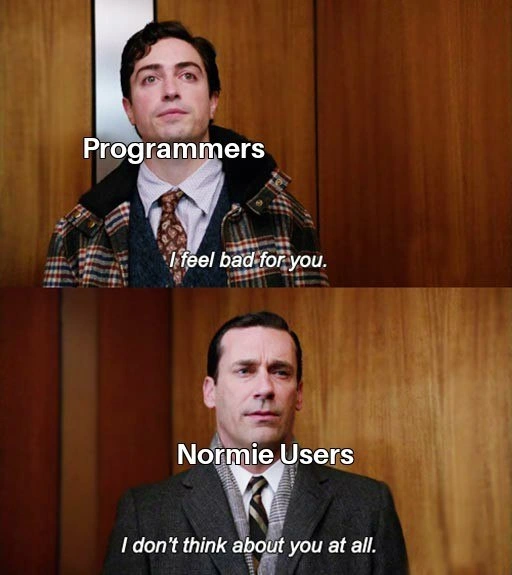
This meme cleverly uses a well-known elevator scene (a popular elevator_scene_meme template) to illustrate the indifference_theme. The Programmer character saying “I feel bad for you” mirrors developers feeling sorry for users when software isn’t perfect. The User character replying “I don’t think about you at all” is a direct, humorous slap of reality – the user’s worldview doesn’t include the developer at all. It’s funny because it’s true: much of DeveloperHumor comes from these little truths we all recognize. In countless DevCommunities discussions, you’ll find veteran engineers joking that users only notice them when something breaks. We’ve all been there: after a marathon debugging session to fix a nasty crash, you release a patch praying users will be happier. But do those users even know an update happened? Often not – they just stop complaining about the crash and move on. No news is good news.

From a senior dev perspective, this meme is also a commentary on stakeholder expectations versus reality. In many organizations, there’s an edict that “the customer is always right” or at least that “we must be customer-obsessed.” Engineers internalize this, bending over backwards to accommodate user feedback and anticipate needs. Yet, average users (or non-technical clients) rarely reciprocate with understanding. They might file a bug report saying “It’s broken. Fix it ASAP,” without a thought that a human on the other end will spend their evening firefighting that issue. This mismatch can be the source of burnout and dark humor among developers. We joke about it to cope – hence the relatable vibe of this meme in TechHumor circles. The indifference isn’t just between anonymous app users and dev teams; even Stakeholders_Clients in a project can exhibit it. How many times has a client asked for a “small change” that requires a massive refactor under the hood, and when you deliver overnight, their response is simply, “Great, here’s another feature request,” with no acknowledgement of the blood, sweat, and caffeine it took? Exactly. Normie Users and many stakeholders just see the end result. The thousands of commits, the midnight deploys, the heated stand-up meetings over that one pixel alignment – those are invisible.

This asymmetry is the core of the humor. It’s a reminder that as engineers we exist in a kind of behind-the-curtain role. We’re the invisible problem solvers. We constantly feel bad for the user whenever there’s an error or less-than-ideal experience. We write apologetic release notes: “Fixed an issue that may have caused the app to crash. Sorry for any inconvenience.” Meanwhile, the majority of users didn’t read that note and weren’t lying awake thinking, “I hope the developers are doing okay.” The second panel’s brutal line, “I don’t think about you at all,” encapsulates that truth with a cold, comedic precision. It’s essentially the user saying: “Look, as long as the app works, I’m not interested in what (or who) makes it work.” And paradoxically, that is how it’s supposed to be! We stake our pride on building systems so reliable and intuitive that users shouldn’t have to think about us. Yet it still stings a little, right? That’s why this meme resonates especially with experienced devs – it’s the programmers_vs_users dynamic boiled down to a darkly funny elevator one-liner. We laugh, maybe a bit nervously, because we’ve all felt like the guy in the plaid coat at some point: “I’m anguishing over your experience”, only to realize the user on the other side never even knew we were in that elevator with them.

Description

A two-panel meme using the 'I feel bad for you / I don't think about you at all' format from the TV show Mad Men. In the top panel, the character Michael Ginsberg looks on with a sympathetic but slightly condescending expression. He is labeled 'Programmers,' and the subtitle reads, 'I feel bad for you.' In the bottom panel, the character Don Draper appears coolly indifferent and is labeled 'Normie Users.' His subtitle reads, 'I don't think about you at all.' The meme humorously captures the profound disconnect between software creators and consumers. Developers often obsess over the complexities, trade-offs, and bugs that users will never see, sometimes feeling a misplaced sense of pity for their ignorance. In contrast, the average user is completely unaware of the engineering effort, viewing the software as a simple tool and giving no thought to the people who built it
Comments

12
Anonymous ★ Top Pick We write 10,000 lines of resilient, scalable, fault-tolerant code so the user can click a button and think, 'Huh, that was easy.'
  1. Anonymous ★ Top Pick

    We write 10,000 lines of resilient, scalable, fault-tolerant code so the user can click a button and think, 'Huh, that was easy.'

  2. Anonymous

    We spend weeks shaving 20 ms off a Raft quorum so their dashboard loads instantly; they install three coupon toolbars, throttle the CPU with 57 Chrome tabs, and declare, “Your app is slow.”

  3. Anonymous

    We spend months optimizing for edge cases that affect 0.01% of users, while they're out there using Excel as a database and Chrome with 200 tabs open, blissfully unaware we even exist

  4. Anonymous

    We spend sprints debating whether users will notice the 200ms regression; users haven't noticed the entire industry. The most honest telemetry metric is indifference

  5. Anonymous

    The brutal truth of software engineering: we obsess over edge cases, accessibility, performance budgets, and graceful degradation for users who will never know we prevented their browser from catching fire. Meanwhile, they're just annoyed the button is 2 pixels off-center. We're out here implementing exponential backoff with jitter while they're wondering why the internet is slow today. The asymmetry is real - we architect for their peace of mind, and they reward us by never thinking about us at all. It's like being a successful DevOps engineer: if you're doing your job right, nobody knows you exist

  6. Anonymous

    We spend weeks debating CAP and shaving P95s; users operate on a strict 0‑thoughts‑per‑month SLA unless the login breaks

  7. Anonymous

    The real SLO is users never thinking about us; the moment they do, it’s a SEV-1

  8. Anonymous

    We Kubernetes-orchestrated for your HA bliss; normies just Ctrl+F5 past our CAP trade-offs

  9. Deleted Account 4y

    @RiedleroD i swear no nsfw this time Kappa

    1. @sylfn 4y

      done

      1. Deleted Account 4y

        Thanks, russian hacker

        1. @ZgGPuo8dZef58K6hxxGVj3Z2 4y

          Lmao

Use J and K for navigation